Background Switcher (Hidden)

Showing posts with label bay-breasted warbler. Show all posts

28 Minutes of September

Tuesday, September 15, 2020

12 comments

 The morning started beautifully, at 8:17 AM with this spring's rose-breasted grosbeak, trying to sing. He'd gotten strawberry jam all down his front. Just kidding--he's coming into his first adult plumage, but it's gonna take a couple years. I love seeing them when they're just showing the first hints of their sex.


I went inside reluctantly, but I was due to be on a public radio fundraiser for WOSU with my dear friend Ann Fisher,  and I wasn't about to miss that! I am deeply honored to be asked to help with a fundraiser. Ann asks such wonderful, unexpected questions, and I adore her and hold her in highest regard. I feel like this narrow sort of nature savant, where she's a brilliant generalist who knows something about everything. I know I'm kind of a break from the news, and I like serving in that capacity.

Well, I'd no sooner hooked up the Zoom audio connection with the Columbus OH radio station than a little wave of fall migrants came sweeping into my yard. I'm inside sitting at my drawing table, all tethered by headphones plugged into my laptop, and all this is happening outside! 

11:09 am: A young female Blackburnian warbler peers quizzically through the birch twigs. 
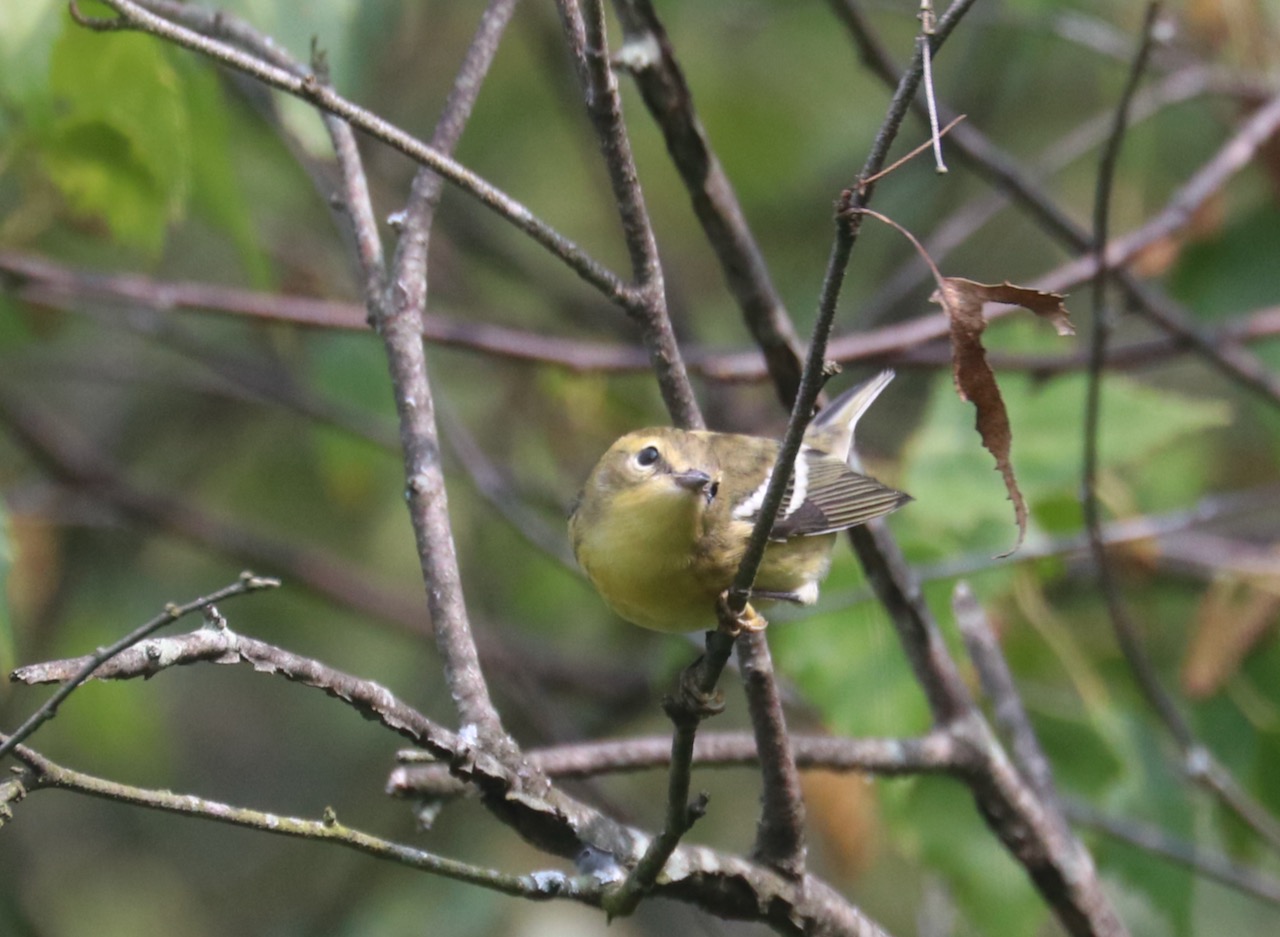

There's warbler action everywhere. I see a little magnolia go flitting through, but I don't get my lens on another bird until 11:14 when a young bay-breasted warbler lands on the feeder post.


You can see the traces of bay on his flanks, which tells us it's a male. How beautiful!


Bay-breast is sometimes hard to tell from blackpoll in fall, but you can almost always see a bit of bay on the flanks. The bay-breast has lead-gray feet and legs, while a blackpoll has yellow-orange feet. And baybreasts have sweeter, plainer faces and cleaner striping on the back than do blackpolls, which always look a tetch mean to me. Blackpolls have a stern line through the eye, bay-breasts less so.

At 11:19, the bay-breast fluttered over to a birch, where it made a lovely sight.


At 11:27, a beautiful young Blackburnian warbler appeared. I got a bunch of blurry photos, but this one was at least acceptable. It's a classic Audubon pose, showing every field mark--the very wide white wingbars, the pale backpack straps, and the strong, long eyeline. This is probably a young female, as it has no hint of orange in its yellow face. It's a girls' club today!


At 11:28, an eastern wood-peewee caught a little moth. How do I know it's a peewee and not an eastern phoebe? It's showing strong cinnamon wingbars, which a hatch-year phoebe would display as well. I know by the steepness of its forehead, and the slenderness of its body. Weird, but true. An eastern phoebe would look more flat-headed, with a larger head proportionate to its body.


Keep in mind that as I'm taking all these photos, I'm trying to sound cogent and informed about whatever Ann asks about. Ha ha! By now, Ann knows to ignore the sound of my shutter clicking as we talk. Science Chimp's gotta do what she's gotta do.
And it only got better! Here comes a  female black and white warbler, at 11:30! One of my very favorites!


Black and white warblers creep all over trunks and limbs, like a nuthatch does. They're looking for spiders, crickets, moths, larvae; anything that hides in bark crevices.
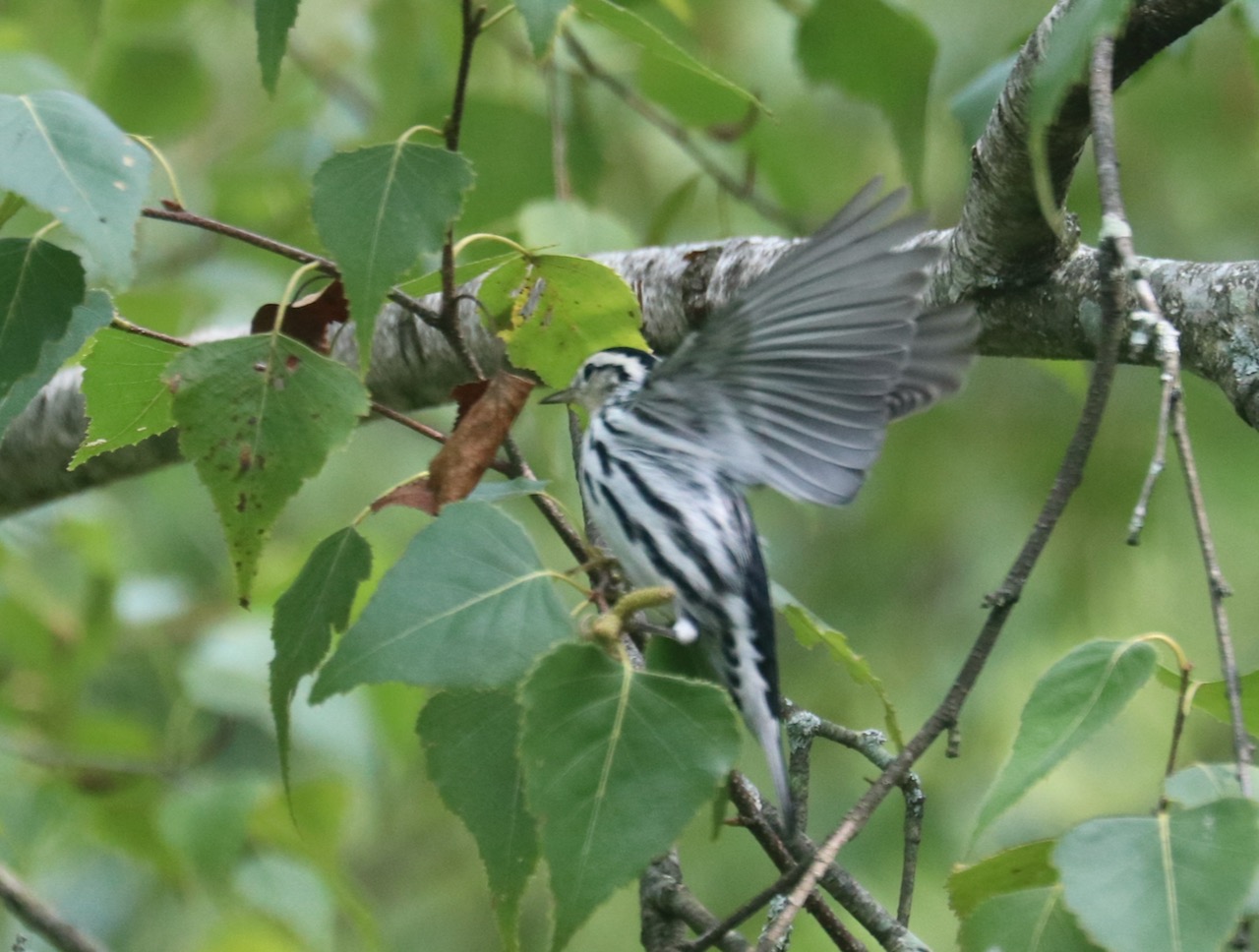

Here are the wings that will take her to a Costa Rican shade coffee plantation. And look, please, at the beautiful undertail and rump feathers, herringbone black and white. I always try to get a look at those perfect chevrons. 


We know this is a female by the clear white throat. A male would have black striping there. See that long, long bill, for probing in the bark? Black and whites also have a very long and strong hallux, or hind toe, for hanging head-down! Just like a nuthatch.


Only two minutes later, at 10:32, along comes a Cape May warbler. You're going to have to trust me on this ID. There are so many things that factor in here, but one of them is that we get floods of Cape Mays in the fall, and I just know them.   But how, you ask?


Well, there is no other fall warbler except perhaps a young female Pine, that has this precise shade of olive-drab. A young female Cape May and a young female Pine are the drabbest fall warblers there are. 

The strong but blurry streaking on the chest and flanks is another good field mark for Setophaga tigrina, the Cape May, the little striped tiger.


And finally it displays for the camera its best field mark in any plumage--the lime green rump.


This photo was taken at 10:32, and the warbler wave was over. 

Almost. A young bay-breasted warbler came right up to the studio window to say hello


and ask if I'd seen its most beautiful wings? Look at those long, tapered jobs--the wings of a long-distance migrant, who is headed to Central America. This bird is built to fly, and fly he will. 


Even I am agog at all that happened in my Ohio yard in those 28 minutes, and I'm grateful to be able to share it with you just a couple of hours after it happened.

It is a comfort, as America lies sick and burning, battered by discord as it is by hurricanes and thick smoke, to know that beautiful birds are still hatching, fledging, and now on the move, headed for the tropics, still living out their small but important lives. The smoke from California and Oregon has finally made its way to Ohio, to steal September's blue, and turn the sun into a smudgy thumbprint. Ann Fisher invited me on the show to give her listeners a nature break, and I'm here to tell you that the fall warbler migration is in full swing, today, right now. Get out there and take it in! It'll save you.

If you'd like to listen, the show is archived at https://tinyurl.com/zickonWOSU
If you'd like to give to WOSU, a $20 monthly sustaining donation will get you a subscription to Bird Watcher's Digest AND a fleece neck gaiter, too! 

Get out there and watch some warblers, will ya?

Birds of Passage

Thursday, May 21, 2009

7 comments
They are still coming, the migrants, though the peak has passed. This morning, a blackpoll warbler gave its sibilant coded song, herald of the end of migration. They have the farthest north to go of almost any warbler; I'm sure it's still snowing on their breeding grounds in far northern Canada right now.

Rainy weather prevents many from singing, and we have to get out and search for them visually, or we'd never know they were there. I've seen five magnolia warblers for each one I've heard singing this spring.
While gardening May 15, I heard not one but two Canada warblers singing from our woods. I threw down the trowel and tromped down there to feast my eyes. I saw one, but never got the lens on him. Next spring...

This blue-headed vireo never said a word as he hopped through the sycamore, but we spotted him anyway.


The bay-breasted warbler's weak s'wee s'wee is easily overlooked as emanating from an American redstart, but we've learned to chase the wispy song down.


The prize: a designer warbler in rust, buff, black and gray.


Finally, a decent shot. Morning light is lovely, but it can be harsh, and Bill and I madly twiddle our camera dials looking for the right exposure, while trying to stay on a rapidly flitting warbler.
It ain't easy, but it's really fun.


Black-billed cuckoos are raiding the tent caterpillar nests and gathering twigs for their own. They're ridiculously easy to call in using only my voice, imitating their soft tripled coos.


Notice how his tail spots are small and grayish, and how his wings lack the strong rufous of the yellow-billed cuckoo's. There's also that black bill.

Cuckoos are a lot more common and easier to see than people realize. Or maybe we're just lucky.

Yes, that's it. Speaking of lucky, we've had orchard orioles nest in our yard only once in 17 years. Each spring I cross my fingers and hope.

A young male belts out his chattery song from a wind-whipped birch. He's olive green with spots of rust, and the famous black "beard."

Off he goes, but maybe some spring they'll stay and grace us again. Oh, to have orchard orioles feeding their babies in my vegetable garden once more! A young male was singing in the yard again today. I can hope.

It's another clear, pellucid day, the kind of day when a load of laundry dries in an hour, when I have to water the bonsais twice, when I haul out my 600-foot garden hose to water the lettuce because all the rain that seemed like it would never stop is simply gone. A classic southern Ohio spring. You're drowning, and then you're dry, and that's pretty much it. Not complaining, just sayin'. And loving every minute of it.

Days Three and Four

Wednesday, January 30, 2008

16 comments
I've started a male bay-breasted warbler, boreal forest breeder and champion long-distance migrant. These little guys may breed in the Yukon and winter in Venezuela. Imagine flying that long and far every spring and fall with only your own two wings to power you. And much of that flight is over open ocean! Egad. We make a big deal about driving for a day or two, and we're just sitting there, burning fossil fuel. These tiny guys are doing it on fat and muscle, and a bay-breasted warbler weighs less than a first-class letter. If you stop and think about it, birds can make you feel like a total slug.

Here's a nice closeup of the paper, to show the quiet but present tooth that it has. I work on Winsor & Newton cold press 140 lb. watercolor paper. Sometimes I stray to other papers but I always come home to it. I've long since shaken my addiction to W&N's overpriced watercolor paints and brushes in favor of Daniel Smith's wonderful paint and synthetic blend brushes. But Winsor & Newton's paper is consistently great and worth the price.

I love working in grays. They're fun to mix and go on smooth as butter. He's a snap to paint, and the best part is tricking in the little black streaks and spots. I chose the bay-breasted warbler as an ambassador from the threatened boreal forests.
The ruddy turnstone was my emblem of a bird with a vulnerable spot in its migratory route--the horseshoe crab beaches of New Jersey and Delaware.
The bobolink stood for vanishing native grasslands, and the hooded warbler for habitat fragmentation and cowbird nest parasitism. (You can see all that in the painting, right?) No? Hmm. You must not be looking at the clouds hard enough.

Once again, the peach is strategically located to pick up this warbler's fabulous designer color scheme.

Whoops, where did that black-headed grosbeak come from? What can I say? It was a day of fast painting. I wanted at least one exclusively Western bird in the painting, so it couldn't be said to have an Eastern bias. I also like their flash. Considered a rose-breasted grosbeak, but decided on a black-headed because it would speak to Western birders. Ooh, it's starting to look like a painting now.

Little Charles is dying to peel the masking film off the nighthawk now. Those mischievous eyes! What if I just...peeled this off...just starting at the corner...dum de dum dum dum, la la la...

Soon enough, dearest tatty bird. But you don't get to do it. You might get carried away.

Part of the reason I started working at the bottom of the sheet is that it gets harder and harder to reach my work as I paint up. I know, I should use an easel so I can stand in front of it. But old habits die hard. I like to work flat, and wreck my back as I crouch over my work, sometimes on my elbows and knees. Maybe I'll try an easel for the next big painting. I can hear Debby Kaspari, who built an easel on her dining room wall for crying out loud, groaning. Zick! Just do it!

Instead, I turn the thing sideways and twist my body around so I can see what I'm doing. I have reference photos torn from magazines all over the painting, and my laptop, with reference photos cued up, is on the drawing table along with the palette and HUGE painting and patter-footed macaw. Note that I have my painting water (normally in a big plastic jar) in a small, heavy tumbler to reduce the chance that I'll tip it on the painting or laptop.
The nighthawk's wings. When painting a bird with lots of bars and stripes, I try to make them a bit messy so the bird doesn't look fake. Too messy, and you lose the sense of the pattern. Too neat, and the bird looks like a carving or paint-by-number model.
And he's done. A bit of an all-day sucker, that one, between the contortions and the size of the image, and all those little stars and bars. I chose a nighthawk because they are just about my favorite fall migrants. I always drop everything and stare at them until they're dots on the horizon. They're so vulnerable, too, because the gravel-topped flat roofs they prefer to nest on are being replaced by cheaper asphalt, which isn't a suitable nesting substrate at all. And it appears they are quite susceptible to West Nile virus, how awful. It seems that everything beautiful is in peril in some way.

But I'm still having loads of fun painting, even as I mull over why each bird has earned its place in my flock, and looking forward to my dessert. Hint: It'll be strawberry gelato. Definitely saving the best for last.
So glad you're enjoying this. It's really fun for me, too. Sometimes I sit back and think about how much more fun life is with a camera. I still can't think of myself as a photographer, but I take a whole lot of pictures, and my camera makes it possible to share moments in time with you. Anybody see the lady in the clouds?
Happy birthday, R, wherever you may be.

Warblers Past

Tuesday, October 16, 2007

0 comments
One of the drawbacks of being a blog ant is perpetually living in the past. A minor ancillary risk is confusing those who know that the goldfinches should have changed into winter plumage by now, to name just one anachronism I’ve been busted for lately. And thus this disclaimer. Sometimes beauty comes so thick and fast that I’d have to have a mile-long post to fit it all in. And I’d rather have time to reflect on it than download and post frantically as it happens. I like to write posts when I’m in the mood to write them. It cuts down on the pressure and the feeling that I’m chained to the computer every day. Some days I’d rather paint, walk in the woods or clean the house than write posts.

Ever wish “blog” weren’t such a homely word? Me, too. I always have this faint squirmy embarrassment when I talk about my “blog” or the fact that I’m a “blogger.” I think it’s because it’s a made-up word and it sounds like a wad of something you’d find under your foot. I’d rather be a “poster.” But that sounds like “poser.”

There were so many warblers around in the last couple of weeks of September and the first week of October that I stored up a bunch of images to pull out later, enough for a couple of posts. They’ve moved on, but I haven’t. Here's a bay-breasted warbler, a tough call, I know. The even-colored underparts, fairly plain face, lightly-streaked back and plain pale gray feet point toward bay-breast and away from blackpoll.

A lousy picture of a bay-breasted warbler, but I wanted to show you the trace of bay on his flank that gave him away, and unequivocally distinguished him from a blackpoll. Cool! You usually don't get that big a hint.

This little black-throated green warbler was inspecting my sickly birch tree for insect damage, and finding plenty. If you watch leaf-gleaning warblers, they invariably head for leaves that have been chewed or curled by insects. Look at the holes in the leaves he's picked out to check. They’re good entomologists and they think like hunters, looking for signs that their prey has passed by. Black-throated green warblers look much the same in fall as they do in spring, but they have white frosting on their black throats. Those pale feather edges will wear off by spring, revealing jet-black bases. I like this shot.

A sweet little female Cape May warbler. Hands down, our most common warbler in fall, and one of the rarest in spring. They must take an entirely different route north than south. Just one of the mysteries of bird migration. But man, I’m glad to have them in the fall.Unremarkable, until you notice the lemon-lime badonkadonk and heavy streaking all the way down the belly. Here ends our little fall warbler tutorial, a day late and a dollar short.
[Back to Top]