I'm an artist and writer who lives in the Appalachian foothills of Ohio. With this blog, I hope to show what happens when you make room in your life, every day, for the things that bring you joy. Strange...most of them are free.
Thurs. Feb. 27, 2020, 7 PM: "Saving Jemima: Life and Love with a Hard-luck Jay" at
Mt. St. Joseph University Theater, 5701 Delhi Rd., Cincinnati, OH 45233. Doors open 6:30 pm.
For info call Colleen McSwiggin (513) 244-4864
Mar. 11-15, 2020: Bird Friendly Backyard workshop and Saving Jemima talk at Joint Conference, N. Am.
Bluebird Society/Bluebirds Across Nebraska, Holiday Inn Convention Center, Kearney, NE. Right in the middle of
sandhill crane migration! Call (308) 237-5971 for reservations.
Mon. Mar. 23, 2020, 6 PM: "Saving Jemima: Life and Love with a Hard-luck Jay" at Morgan Co. Master Gardeners Event, Twin City Opera House, 15 W. Main St., McConnelsville, OH. Free and open to the public. Call (740) 962-4854 for information.
Sun. Mar. 29, 2020, 3 PM: "Saving Jemima: Life and Love with a Hard-luck Jay" at
Sunday With Friends,, Washington Co. Public Library, 205 Oak Hill St. NE, Abingdon, VA 24210. For more information, call (276) 676-6390
Apr. 30-May 2, 2020: Julie Zickefoose at New River Birding Festival, Opossum Creek Retreat, Fayetteville, WV. Friday night keynote: Saving Jemima. Curtis Loew, miracle curdoggie, presiding.
May 7, 2020, 7 pm: "Saving Jemima: Life and Love with a Hard-luck Jay" at Campus Martius Museum, Washington and Third Streets, Marietta, OH. Booksigning after. If you missed the Esbenshade lecture/ People's Bank talk in November 2019, this is your event!
Weds. May 13 2020, 5:30 PM: "Saving Jemima: Life and Love with a Hard-luck Jay" at Roger Tory Peterson Estuary Center's event at Essex Meadows, 30 Bokum Rd., Essex, CT 06426
This event is open to the public.
Thurs. May 14 2020, 6 PM: "Saving Jemima: Life and Love with a Hard-luck Jay" at New Haven Bird Club's Annual Banquet, Amarante's Restaurant, 62 Cove St., New Haven, CT 06512. This event is open to the public!
Sat. May 16, 2020: "Saving Jemima: Life and Love with a Hard-luck Jay" for Bergen Co. Audubon Society at
Meadowlands Environment Center, 2 DeKorte Park Plz, Lyndhurst, NJ 07071
Time to be announced. Call (201) 460-1700 for more info.
Sun. May 17, 2020, 2 PM: "Saving Jemima: Life and Love with a Hard-luck Jay" at White Memorial Conservation Center, 80 Whitehall Rd., Litchfield, CT 06759. Call (860) 567-0857 for information.
Tues. May 19, 2020, 7 PM: Good Reads on Earth Author Series, by PRI's Living On Earth with Julie Zickefoose and Saving Jemima at Mass Audubon's Drumlin Farm Wildlife Sanctuary, 208 South Great Rd., Lincoln MA 01773. Includes audience participation, and will be taped for airing on public radio! Get the book first, read up and call (781) 259-2200 for information.
Thurs. May 21, 2020 6 pm: Julie Zickefoose, "Saving Jemima: Life and Love with a Hard-luck Jay" at
Bigelow Chapel, Mount Auburn Cemetery, 580 Mt. Auburn St. Cambridge MA 02138. Call (617) 547-7105 for more info.
Breathing a huge sigh of satisfaction and relief. I've just put the bats back to bed.
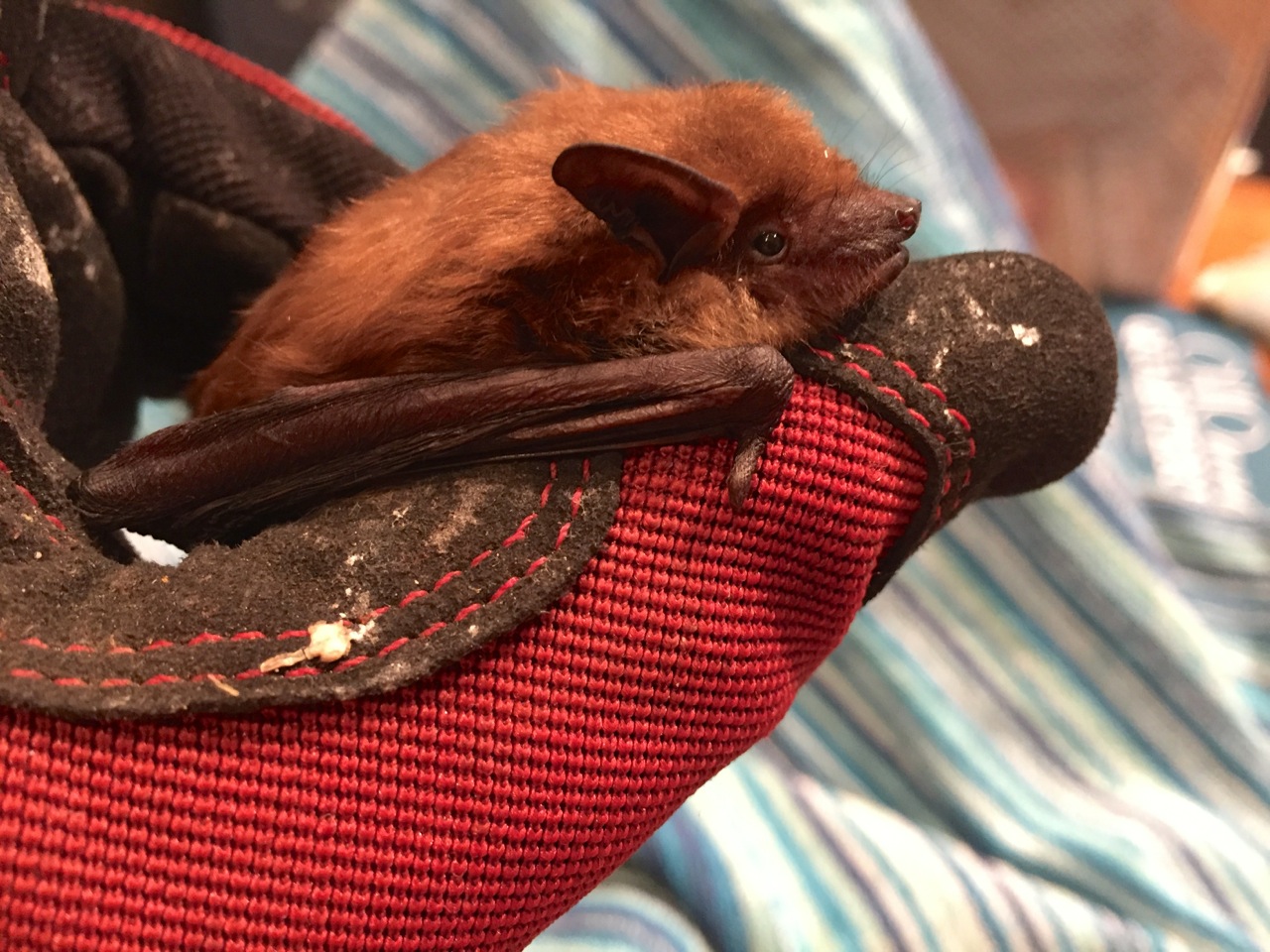
I've been feeding a big brown bat named Ambrose every night for the last two weeks. He was found by an Instagram pal of mine in a bathroom sink. Because of the weird and delicate web of Instagram, Leah knew I work with bats, knew to call on someone who'd know what to do for this wee foundling.
Bats that are found in heated homes in winter are in trouble, usually because their normal hibernacula (rhymes with Dracula!) have become too cold. People's pleas for help with bats they've found tend to come in when the Polar Express sweeps down from the Arctic with bitter temperatures. Bats that find themselves freezing to death, I surmise, somehow make their way from attics and sofits down into to warmer places, and that brings them into contact with people. That doesn't usually go well for the bat, unless someone like Leah is in the mix. She picked the little bat up with a hand towel, placed him in a box and taped it up securely. We met at a pet shop in town, where I was going to buy my third critter keeper so I could accommodate the new arrival (I've already got two bats in care).
Ambrose (named for one of Leah's adorable sons) came in weighing only ten grams. That's dangerously low for a big brown bat (low normal weight is 17 gm). They get as heavy as 22 gm., but after that, they're too fat to fly. I knew I had my hands full with this little guy. He was a lousy, reluctant eater, dehydrated and down. I sometimes had to coax him for ten minutes or more to take his first mealworm. Once he started eating, he'd down 7 or more at a go. I doggedly kept at it, and after two weeks, he was the bright-eyed, active little sprite you see in this video, weighing in at 16 gm. ( I weigh the bats before each feeding). I figured that was close enough to normal, and with a great sigh of relief, readied him for hibernation with a final big feeding.
Because we had three nights in a row in the 50's, I decided to wake up the other two bats, Lyle and Murcie, for a midwinter feeding. I let them sleep until nights get warm enough that, were they in the wild, they might go out looking for moths. So for three nights, I was feeding all three of them, and that took well over an hour each evening. I couldn't wait for it to get cold again so I could put them back to bed. By about 8 pm, I'm fried, and bats eat best after 9, I've found, so it was a struggle for me to stay up late enough to get them all taken care of.
I love this little unexpected flitter Ambrose executes, onto an old license plate in my bat room.
This is Lyle. He's also a refugee from a house.
And here's Murcie, the biggest and strongest of the three. Also the most opinionated.
What's involved in putting them back to sleep for a few weeks is cleaning their boxes and taking out their soiled linens (they sleep in hand towels, folded over and taped to the top of the boxes). I replace the paper toweling on the floor and put fresh clean linens in.
You see that the boxes are lined with nonskid drawer liner, extra thick. This is so they don't break their delicate finger bones on the plastic sides of the box, beating their wings.
Washing bat linens. It's pretty disgusting. Not going in my washing machine, nossir.
I keep the condos by a poorly-insulated door in the basement. It gets pretty darn cold down there on the floor, so I put the critter keepers up on a box.
I also cover their condos so they aren't drafty. The all-important thermometer gets checked frequently. It shouldn't drop below freezing. Ideally you keep them between 37-50 for torpor. I've learned to adjust the temperature by moving them closer to, or farther away, from the cold outside door.
And there they sleep, for three to four weeks at a time, until the next natural warmup comes. Then I'll wake them, weigh them and feed them for a couple of nights. I've little doubt my bats eat more in winter than wild bats do, but I feel a responsibility to keep them in tip top condition, and I worry about them getting dehydrated, too.
In order to qualify as a bat caretaker, I had to take a course in handling rabies vector species from the wonderful Barbara Ray of the Ohio Wildlife Center, and I've had two rabies inoculations--you have to provide proof that you've had the course and the shots before you can get a permit to keep bats. It is not for everyone, that's for sure. There is so very much to know about them, and they're teaching me more every single day. They are my best teachers.
I feel I'm getting better and better at handling, housing and understanding bats. I'm very fortunate to have a cold basement where they can be safely overwintered. I shudder at the thought of keeping them warm and having to feed them all winter long, especially with all I've got on my plate now. I've done that and it's a ton of work. More importantly, I think it's bad for the bats to be kept warm in winter. There's a considerable risk of overfeeding them and making them too fat to fly. I know, because I've done that. Sometimes I think learning is just doing everything wrong until you figure out how to do it better, how to do it right. Here's a post about my fat bats.
If you just can't get enough batitude, keep hitting Newer Post for the story of Bat Boot Camp. :)
I don't overfeed my bats any more. I keep them lean and sweet. Lyle again.
I find working with bats very rewarding, because gentle handling usually results in a tractable bat. They may start out terrified and chittering, but you can win them over with time, food and gentle hands. I've only had one bat (Drusilla) who came in horrid and remained horrid. I laugh just remembering her chewing away on my (double) glove. I loved her anyway. These three are total sweethearts by comparison.
Bats, for me, combine all the things that are most wonderful about birds and mammals. They're delicate and very beautiful, and they employ flapping flight like birds do. Yet they're possessed of the softest fur imaginable, and the most winsome faces, like very small puppies. What a combo! Add to that the ability to survive for months without food or water, and you have a very special animal indeed. Miracles, they are. Just miracles. And they help me every bit as much as I help them.
Friday, September 1, was an awful day. I'd pushed through August 30 and 31 thinking, oh, this isn't so bad, I'm relieved, actually. I've got work to do. I got up that day and gathered up all the trappings of a dog's life: the two nice clean beds, the funky bed, the food, the treats...couldn't touch the collars and leashes yet, so I left them in the drawers. I wanted to get all the obvious stuff, the countertop and living room and studio stuff, out of my sight. I buried my nose in the funky bed a couple times and carried it out to put with the trash. I mean, you don't save a giant dirty dog bed just so you can smell it...or do you? No. You don't. Stop it. Stop crying. Put it in the can.
It was like that. Awful. Fighting with myself the whole way, I drove to town with cans of expensive dog food and a 30 pound bag of Fromm's kibble that I'd recently opened. The cans rolled around in the back of the car, thrashing like a thing alive, and I fought back tears as the frugal child of Depression-era parents rounded the curves, determinedly taking all that good food back to the stores. I prayed that the customer service person at Giant Eagle would be the nice woman with frosted hair, and she was. She didn't bat an eye, understanding instantly why a person would up and buy $64 worth of canned dog food the same week her dog died. Crazy, hopeful heart, swimming up De Nile, hedging against reality. He can't be dying. Look. I have all this food.
This kind and lovely woman looked me in the eyes and told me a story about her two elderly pugs that both went blind and developed diabetes, requiring special food and two shots each per day. She had to leave work at 9 AM, rush home, shoot them both up and feed them, then rush back, all on her brief break. Same thing at dinnertime. Two and a half years of this, before she finally hit the wall and admitted to herself that it wasn't fair to the dogs or her; that it was nothing but a holding pattern against the inevitable. And she had them both put down on the same day. Good Lord. Crass as it sounds, she made me feel, I don't know...lucky... that Chet had been holding his own, more or less, until he wasn't. And that it was all so clear. We bonded. Dogs, man. They can lift you so high, but they can, through no fault of their own, rip your heart out, too. You can substitute "People" and "Love" in that sentence. "Life," while you're at it.
I went to my favorite pet store (the kind that has only shelter animals for adoption) and got sad faces and hugs from lovely Christy and Ethan. They took back the enormous bag of Fromm's, even though it had been opened. I felt humbled and grateful and appreciated in this small town. I felt embraced, figuratively and literally. I could buy people food with the money they gave me, and I did. It felt right. I was grateful. I seriously didn't know how much longer I could keep throwing fistfuls of money at poor Bacon, trying to keep him among the living. It had been a hard year and a half.
Prompted by the kindness I'd been shown, I was losing it again. At that moment, Shila texted to ask where I was, whether I was in town. (She's a little witchy, that way, and others).
Yes, I'm in a parking lot in Marietta, crying, why do you ask?
Come to my office, and I'll give you a session, she wrote.
I think that's about the only thing I'd have said yes to at that moment--cranio-sacral and polarity therapy from my best friend. Yes. Oh, yes.
So I drove out to Wellness Unlimited in Reno, Ohio, and lay on the table while Shila worked her magic on me, settling my nervous system, letting me cry and fall asleep three different times from the sheer comfort of healing touch and pure kindness, saving me yet again. After the session, Shila said, "Let's go out and gather some acorns for Jemima. The jays have been going crazy in the oaks out back." So we walked out to look for acorns on the ground. We couldn't find any. What were there were still small and very green, and hanging on the branches. Shila walked over to a second tree and I followed her.
I will say here that I wasn't exactly sure why Shila wanted to gather acorns for Jemima, she who eats so well on chicken and rice and sweet corn and pecans. But I knew enough to follow her out into the back lot behind her office.
Under the second tree, we were distracted by an enormous orange and yellow wasp darting back and forth just above the ground. "Ooh look, a cicada killer! What's it got?"
The wasp was making repeated sallies at something very odd looking, lying on the ground.
"Oh my God!" we said in unison. "It's a red bat!!"
The bat was in defensive posture, wings spread, but when we knelt beside it it brought its wings in and covered its eyes. My heart got a brand new crack in it. I mean, look at that little creature, legs spread wide, covering its eyes, so afraid, so helpless.
Oh, sweetie. How did you get yourself in this pickle, here on the ground?
I can't tell you. I just want to cover my eyes and forget about it. I want you to go away. But the big wasp is scaring me so.
For one of North America's larger bats, it was so, so tiny. What looks like its junk here--the pink protrusion--is actually the base of its tail, which extends down into the well-furred tail membrane. Examining these photos, I can see (in retrospect) that it's a female, probably a juvenile. The other hint to that is the heavy frosting of her fur. Males are more uniformly red. I was way too excited to do a proper evaluation of this little bat's junk. I was programmed to receive, and get this bat into Zick's Hotel, Spa and Hostel for whatever she might need. And she'd be able to check out whenever she was ready.
Shila ran to fetch a towel and lidded plastic shoebox from her office while I fought off the urge to pick it up with my bare hands (never! even after two rabies shot series). It was a cool, rainy afternoon and the poor craithur was cool to the touch, nearly torpid. I couldn't divine what on earth it was doing lying on the ground. Red bats occasionally roost on the ground in leaf litter, but this one had nowhere to hide. I didn't know what the cicada killer had in mind by circling around and darting at the bat, but I knew it was nothing good. Could the wasp have stung it, hoping to paralyze it and carve it up for food, the way they do cicadas? What an awful thought! And: Not on my watch! Begone, wasp!
Using the towel, we gently folded the bat up and put it in the Tupperware with the lid on tight. It'd be fine for the ride home. I started thinking about what I had at home to feed it. I'd had to throw out all three bins of homegrown mealworms when they became infested with mites, what a bummer! Teeming with lovely tiny worms, and a moving gray mat of mites. Nope. Not in my basement. Out they'd gone.
I couldn't think of a better food for a compromised bat than wasp larvae. I've resorted to robbing paper wasp nests many times in the past when I've been suddenly caught with a creature needing live food. I can't even remember now how I hit on it, but paper wasp larvae are the bomb, and easily obtainable, if you have the guts. I remember now that I might have gone into the combs I knocked out of my greenhouse out of curiosity, just to see the larvae and pupae in different stages, and then it occurred to me that the baby box turtles I was raising might appreciate them, and I was off, feeding wasp grubs to animals.
Having done this more than a few times, I have noticed, while harvesting wasp grubs, that in the past four years or so there is a situation with parasitic larvae in the combs. Pictured below are three healthy wasp grubs--the three big fat ones. Also in the picture are three parasitized wasp grubs--the small round shriveled ones with black heads. And there are five predatory larvae in with them (the thinner ones with tiny brown heads). I suspected these to be the larvae of another wasp or perhaps a fly, because structurally they are similar, if a lot slimmer and more mobile. Sharp eyes of entomologist Sam Jaffe spotted lepidopteran characteristics (the prolegs are a dead giveaway!) He suggested Chalcoela iphitalis, the Sooty-winged Chalcoela moth, as the parasite.
This is a healthy paper wasp nest--you can see eggs and grubs in the cells. Also, the cells with silken roofs are not perforated. There are healthy maturing wasp pupae in the roofed cells.
This me holding the healthy nest next to one that is badly parasitized. It's dirty and full of silk layers, and all the caps that should have pupae beneath them are perforated in many places. They've been chewed through, and there are predatory larvae in the cells that should hold healthy paper wasp pupae. Ut-oh.
A possible culprit is here in Jim McCormac's excellent blogpost about a moth that bedevils paper wasps. Many thanks to awesome entomologist Ted MacRae for helping me try to figure out what these larvae might be. And to similarly awesome Sam Jaffe for pointing me to Sooty-winged Chalcoela. And to Ohio's pride, all around naturalist Jim McCormac for writing it up. If I'd been smart I'd have let some mature to see what they pupated into. But I had a hungry bat!!
Inquiry fell behind the need to feed this beastlet. Between the three nests I knocked down (all I could find), I got enough larvae, both paper wasp and parasite, to feed the bat for four sessions.
And now, the bat. Movie 1 is her first feeding. Oh, she's so slow and cold and sad. But she gets a little more gusto with each juicy grub I give her.
She's perking up!
I fear I frightened her a bit with my chuckles and snorts. Look how much more lively she is after only three larvae!
Truly, I'd been so sad that finding this little waif and seeing her come back to life was almost too much for me to take. It was too sweet. I had to laugh in delight.
I just want to say that when Shila and I get together, stuff like this happens. She suggests we walk out into a light rain under some oak trees to look for acorns??? and we find no acorns. No, we stumble upon this magic little animal my favorite bat of all favorite bats who might have died had we not been right there, at that spot, at that moment.
The little voice is strong in Shila, and it's strong in me, and when we get together, it fairly shouts. And we listen. We listen hard.
Friday, February 8, 2019
17 comments