Background Switcher (Hidden)

Showing posts with label bat rehabilitation. Show all posts

I'll See Myself Out

Monday, May 29, 2023

0 comments


I’m limp with relief, giddy with joy. I’ve waited to write this post until Something Else happened. I knew something else was about to happen. I made this video the night of May 27. I’ve been so busy, stretched so thin, that I’ve released my four female bats without blogging about it. I’ve done a LOT of interesting things lately without blogging about them. The four female bats were ready for the big time the first week of May, and I was only too happy to release them, knowing that if I didn’t get them out, they might drop pups on me. Then I’d be saddled with caring for mother and baby until the pups were ready to fly…arrggh. Nope. Way beyond my expertise. The two males, for whatever reason, didn’t take to the wing like the females did, and I held them back for more flight practice. 

 When I made this video, I knew it would be Carmelo’s and my last night together. I wanted a little memento of just how special he is. He’s so perfect, so aware, so beautiful. And so very gentle. Of all six bats I had this winter, Carmelo was the gentlest. He never so much as cussed at me. I can’t say the same for Lustofin, Laura, Poppy, or Fuchsia. Even my little darling Jolie Blonde turned cussy as spring neared. Who could blame her? She was likely pregnant, and pregnant people don’t willingly put up with fools.

 And I am a fool. I’ve got this nice hi-tech tent, and I decided that Carmelo and Lustofin, who were lagging far behind the females, would fly better and faster if I just set them free in it and let them fly around unsupervised each night. It was great, and it worked for Carmelo. Within just a few nights, Carmelo got sharper and sharper, and he flew better each night I came in to exercise them. Lustofin isn’t flying well, and that’s another story—he’s not ready yet. He’s on two antibiotics now, and is about to go on an antiparasitic. More on that later… But Carmelo! You can see and hear the beauty of his flight in this video. I watched him do four rounds of the tent, with an expert about-face in mid-air, and a perfect drop into his little hamper, and I knew he was ready. Ready to go home. Ready to go free. Tomorrow night, May 28, my mom’s 103rd birth anniversary, Carmelo would be released at last! I’d been caring for him since New Year’s Eve, when he was found hanging in a doorway inside Monkey’s Uncle Tattoo Parlor in Harmar Village, Marietta. 

 I came out this morning, May 28, to check and see where Carmelo and Lustofin spent the night. They’ve always willingly returned to their hamper, to sleep in the folded fleece curtains hanging there. Just like in the video--it was so cute!  I lifted the fleece, and there was Lustofin. But where was Carmelo? For the next two hours, I searched that tent, high and low. I came back with a broom and dustpan. Took everything out of it, unfurled every single piece of nylon and window covering; turned my little camp table over, turned the chair over, looked in every pocket and cranny. NOTHING. Carmelo had left the building. But HOW? It was zipped up tight; I always neurotically checked the zippers twice when I left them in the evening after feeding. I found the hole. It was a little port made to admit an extension cord. An inch across, plenty for a clever bat. How he found it I have no idea--the nylon all around it is slick and I'd never seen either bat try to crawl on it or cling to it. But it's the only hole in the tent.


And that clever little bat had found the ONE portal in the entire 14 x 10’ tent, and seen himself out. And out was into my four-car garage, which was closed up tight for the night. Ohh boy. I knew the chances of finding a 3” long brown bat in that enormous garage were slim to none. I told myself that if he could find a 1” portal in a big nylon tent, he could certainly find a hole in a four-car garage to let himself out. But. Maybe he couldn’t. Maybe he was still in the garage, having fallen into a box, an old stovepipe baffle, a slick-sided flowerpot. Maybe he was trapped somewhere. Arrrgh. My mind went all kinds of places. I tried to keep it from going to pieces. I kept reminding myself what a clever bat my Carmelo was. 

And I resolved to go out to the garage at the Witching Hour of 9:15, when it’s finally dark, to see if he was flying around in there. I kept myself busy all day long, potting and moving plants, planting the tomatoes, emptying the greenhouse, watering, watering, watering. I can’t believe how many plants I have to deal with, but I got them all out of the plastic hut. Just in time too…it’s stifling hot in there now! I laid my two Creole Lady hibiscii on their sidse, and sprayed the bejesus out of them, washing away a living crawling felt of green aphids. I repotted the big one, marveling that she’s only two years old and taller than I am. 

 I fed a batch of orphaned baby birds every hour on the hour (another story there, too). Finally it was dusk, finally I could go out to the garage. I opened the small garage door and the first thing I heard was the flicker of leathern wings. CARMELO!! He circled and did figure eights in the light of my headlamp. He dove down and circled twice around my head! Then he flew up high into the rafters and tucked himself behind a beam. Just to be granted this sight of him flying like a star pilot; to know he was alive and well and ready to go; to be able to say hello again and goodbye, was such an enormous gift. I was overwhelmed with joy. I hurried over and opened the garage door on one end, then opened the two garage doors on the other end of the building. I flung the people door wide. I grabbed a chair and sat for almost an hour, listening, hoping to hear him fly down and out. I couldn’t hear anything. Perhaps he was resting. Perhaps he’d flown out as the doors were grinding open. I would never know. No matter.

 I didn’t need to see him go. Any bat who could find a 1” flap-covered cord hole halfway up the side of a slick nylon tent could find three huge garage door openings. Carmelo would be free tonight, free to course the meadows for moths, to dart through the blinking lightning bugs. To fly back to Marietta, if he wanted, to the brick streets he came from. He could do whatever he wanted, and this was the perfect moment I’d been working for since December 31. I was so glad that moment was granted to me. As for Carmelo, he knew when he was ready, and he made it easy for me. Sort of, if you don't count a few hours searching and maybe 10 hours worrying and that perfect hour sitting in the dark garage with the moonlight coming in and the crickets tuning up, and the lightning bugs playing all around in the soft almost-summer air.


Bat Hampers, At Last

Sunday, March 12, 2023

5 comments

 Although I've been taking bats in for 13 years, I still consider myself a newcomer to them. There are people who know ever so much more than I do. Amanda Lollar is one of them. She wrote this amazing book which should be required reading for anyone wanting to care for bats. It's so well-written and thorough, informative and clear. 


I also follow a couple of great accounts on Instagram: pabatrescue and azbatrescue. I have immense respect for these women and their volunteers. They take in an awful lot of bats, and do vet care as well. Way beyond my level, but they've been kind and encouraging. As a result of what I've learned from this wonderful book and my Instapals, I knew I had to give my bat housing an overhaul. I've ditched the individual critter keepers lined with rubber drawer liner and toweling for a whole new system, one that is more in tune with bat needs for socialization and softness.

Behold the new bat habitats! They're soft nylon laundry hampers that I bought at Wal-Mart. I can access the interior through two large zippered doors. 

The flooring is soft mattress foam, wrapped in a plastic garbage bag which is taped tightly, then put in a washable pillowcase. Any bat that falls is not going to be injured in the least.

Each hamper has two places to roost: the made-to-order black bat roosting pouch from batworld.org (Amanda Lollar's incredible bat conservation organization) and a double folded length of plushy fleece they can crawl up inside. I've got a little plastic water container zip-tied near the top of the enclosure, and a worm dish for self-feeding. 


There is one hamper for Carmelo, and one for all the girls. Males must be separated or they will be males, and will molest the females all winter long. These two hampers should be able to accommodate as many bats as I get, boys with boys and girls with girls. There's plenty of room to scuttle around, climb, groom, socialize, and flap wings.

Their first hour in the hamper together, the females gathered under the pink fleece. Jolie Blonde wanted a little separation at first. 


Fuchsia, Poppy and Laura cuddled right up. It made me so happy to see the bats able to do what they do in the wild, and to know they were cuddled in warm fleece (I have draped another double layer over the outside of the hamper, too, to protect them from drafts).

By the next morning, there were four in a neat row. Isn't that dear? One is hanging with her dark brown back to us; the rest are showing their paler bellies.


Keeping these bats at the proper temperature (between 35 and 55 degrees) is an interesting exercise.  Most of the time, my unheated detached garage is ideal. But when temperatures dip into the 20's, I bring them into my basement and put them right next to a cold door, where temperatures hover in the 40's on a very cold night. I swaddle them to protect them from drafts but it does stay cold by that door.

Ideally, they sleep most of the winter. Initial intake involves getting them up to proper weight (17-22 gm for a big brown) with intensive feeding for each bat for a week or more, and making sure they were strong and well-hydrated. Then I put them to bed in cold temperatures on Jan. 25.  I  took them out and fed them for the first time on Feb. 9 and 10, after three weeks in cold storage. Now that all are in good weight, I plan to stretch that to 4 or even 6 weeks in hibernation. Not gonna lie--I miss them when they're tucked away! As I update this post, they've been asleep for five weeks. I check on them daily. Temperatures have settled down at night, and the garage maintains nearly ideal conditions. Lovely!

When you think about it, these animals in natural conditions probably have no opportunity to eat and drink all winter long, since they don't fly on nights below 50 degrees. And if they were to fly on the occasional balmy night, there aren't any insects out for them to catch, anyway. So I've little doubt that a winter in Zick's Bat Hostel is a fat winter for these bats. And it sure beats wasting away in a heated space with your metabolism all revved up, but without food or water. Or worse, being caught and put outside to die in freezing temperatures, which is what happens to most bats that are found inside a home. I don't know what people think they're doing when they do that. It's not "letting it go." It's a death sentence for the bat. 

I make these posts so people will understand that bats are very much worth cherishing and caring for. When they get into homes, they need help. To find a bat rehabilitator near you, go to batworld.org and click on "I Found a Bat."

Chances are, it'll be someone a lot like me, who is willing to care for these incredible little animals in their home, because they are endearing and special creatures. Bottom line for me: Yes, it's a ton of work. But the alternative to offering these refugees a safe winter home is too sad to contemplate. If you find a bat in your home, do the right thing and call a bat rehabilitator. Put on leather gloves, pick it up gently with a hand towel around it, and put the bat in a box with the cloth. Make sure the box is SECURELY taped up with a couple small air holes, because bats can get out of the most amazingly tight spaces. Don't try what I'm doing--feeding and watering and handling-- without training and rabies vaccination. These are not pets--they're destined for release. They are going back to the sky!

                                                   
                                                Carmelo says thank you for the warm fleece and tasty worms.  


Laura says thank you very much for listening.  


Meet Laura and Fuchsia, Big Brown Bats

Monday, March 6, 2023

6 comments

 When I finally thought to check, I found out that my last rabies booster was in 2013. Wow, ten years can sure fly by! I dithered a bit and then set out in earnest, looking for someone who'd do an antibody titer for me. Finally, my new nurse and doctor at WVU Medicine came through. And I found out I'm still making sufficient antibodies to the rabies virus to be protected. That made me really happy--a lot of bats have gone through my winter hostel since 2013. Glad I don't have to drop $680 on the booster shots.

It's a privilege to care for these bats and learn from them, too. In my last post, we met Jolie Blonde, Poppy and Carmelo. There are two more females this year.

 f

Laura came to me a real spitfire--musking (a skunky smell from their facial glands); chittering, sometimes biting a little (but nothing like Drusilla of Old, the Worst Bat Ever). Now she's my best, most eager eater and not too tough to handle. She has an endearing way of gaping between worms, literally like a baby bird. We are pals now, and she hardly cusses at all. She was found on Christmas Eve 2022, hanging under a utility table in an unheated outbuilding. The naturalists who found her would have been delighted to let her stay, but with the Arctic cold blast of single digit temperatures, we think she might have died out there. Especially since her weight on admission was only 11 grams. She's between 17 and 19 gm now! She'll eat 20 or more worms if I let her, and I'll have to cut her back to a dozen as spring nears...a girl has to watch her weight if she's going to fly!

Fuchsia has been a special little bat from the get go. She was found in the same tattoo parlor as Carmelo on Jan. 28. Skinny and wasted at 11 gm,  Fuchsia had to eat bird formula from a syringe for six nights until she was able to chew mealworms. That last night, I added Delectables Lickable Treat for cats to her formula, and it woke her UP. She was chewing mealworms like she was paid to do it that same evening. 

She did something I've never had a bat do. They all arrive like this--huddled like a tiny mouse.


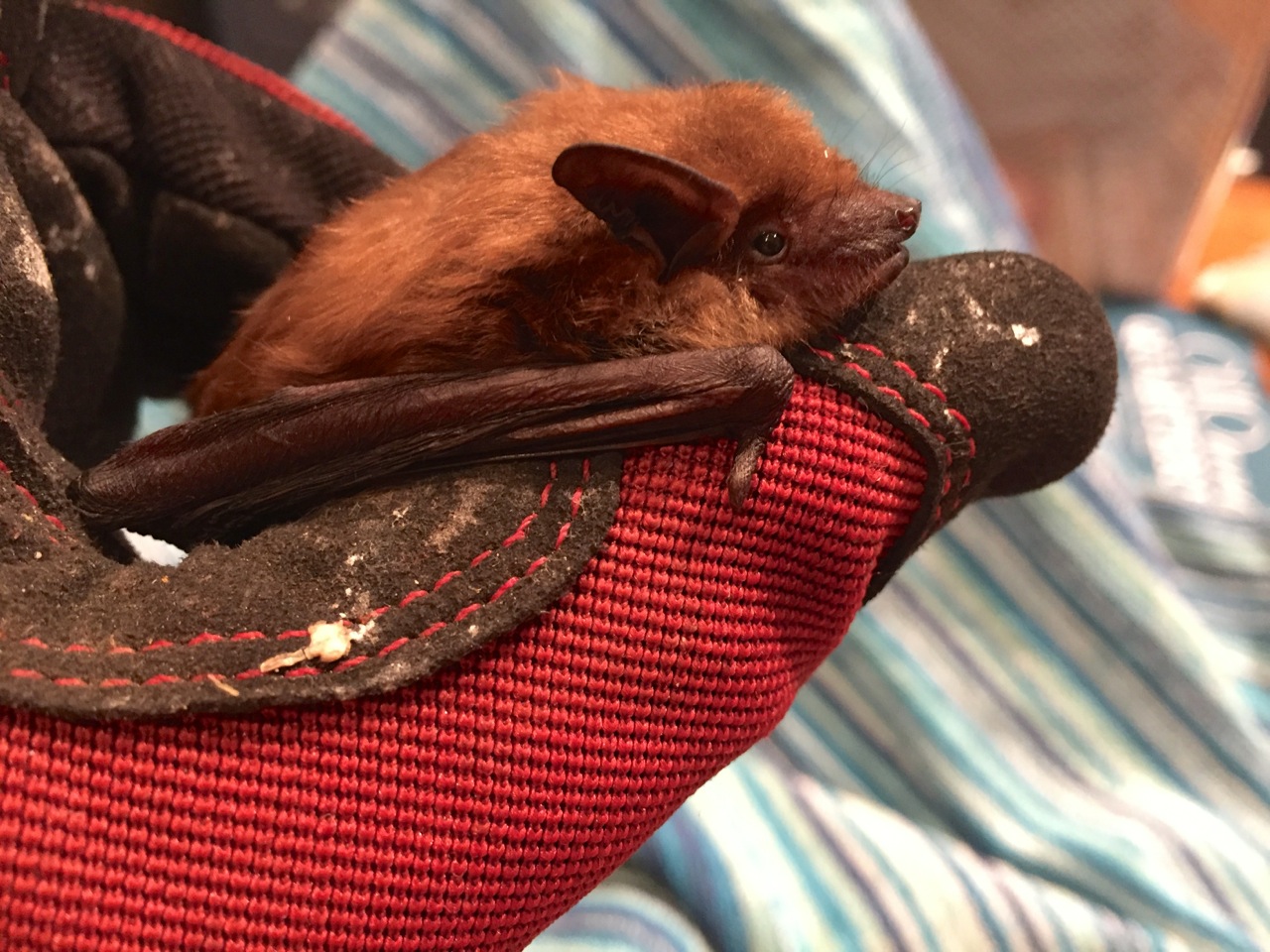
But when I picked her up, she was so terrified she threw out her wings and opened her mouth! Which gave me a fabulous look at her impressive dentition, a definitive look at her female bits, a beautiful view of her long tail and tail membrane...this is the basket in which bats catch their food! See how the tail tip extends beyond the membrane? One of the hallmarks of a big brown bat.  For big brown bats, the food that ends up in that tail basket is mostly flying beetles, and some moths. That's why they've got great big teeth--so they can crunch down beetles. The bite of a big brown bat--or any bat, for that matter-- is unbelievably strong. I wear deerskin on my handling hand (left) and more pliable goatskin on my feeding hand (right). Deerskin has proven more puncture-resistant than other leathers in a study designed to determine which gloves are best for handling bats.
I can tell you that deerskin outperforms all other leathers in the Multiflora Rose Test to which I put my gloves every morning. Puncture-resistant to the max! If a thorn goes through deerskin, it's time to replace that glove, for it's worn too thin.


The perfection of Fuchsia's architecture was unbelievable. 


She clung, wings still spread, for that whole first feeding. I couldn't get her to relax but I eventually worked her around to a more comfortable pose. But gentle talking and grooming with a mascara brush has calmed her down nicely. This series of photos are all by Liam Thompson, my most invaluable bat helper.


It's hard to believe this is the same bat, but here's Fuchsia eating on February 9.  Amazing what good food and gentle handling will do for a frightened little bat. 


A Batty Winter is 2023

Saturday, February 11, 2023

2 comments

It's time for a bat update. It's a bit much for Instagram and Facebook, and besides, I want the good stuff to go on the blog which is searchable and expandable. 2023 has been a surprisingly batty winter, with five clients coming in since right before Christmas. The weather has been pretty mild, save for a weeklong cold snap that sent night temperatures into the single digits. I emptied the Groanhouse, as is my wont, brought everything into the house, and hunkered down for the duration, only putting the plants back when it had warmed up considerably. And then the bats started coming into heated spaces around Marietta, and the pleas for help started, and I had to answer.

Jolie Blonde is possibly the cutest of the five (a dead heat, really, since they're all cute in their own ways) and she's also very calm and wicked smart. So far she's the only self-feeder I have, but I haven't really given them all ample chances to learn, to be truthful. She was seen clinging for days to an exposed brick wall behind People's Bank in Marietta, Ohio, and taken in on December 9. It took five days to get her to take mealworms. I gave her nestling bird formula until she was strong enough to chew. She came in at 17 gm, which is low normal for a big brown bat.  She weighs 19 with an empty tank now, so I have to watch  that she doesn't overeat and get too fat to fly. I can tell the second I pick a bat up whether it's in good weight or not. Kinda cool. I have marked the inside of each bat's right ear with a different color of acrylic paint. Jolie is orange. After three weeks in hibernation, she was not hungry, because she had eaten all the worms in her dish when the weather warmed up! 


This is Poppy. Pale pink in her ear marks her. She was found sleeping peacefully in an attic on January 21. Homeowners said nope so she was brought to me. Sigh. I wish they would have just let her leave come spring. But say "bat" and 99.99 percent of people say, "Not in my house/attic/basement/chimney!" She was in good shape at 17 gm, hibernating normally.

Carmelo is my only male. He's also the darkest, a deep espresso brown. And he's a sweetheart. He was found inside, hanging over the door at a local tattoo parlor. People who create tattoo art are generally very sympathetic toward bats, snakes, spiders and other fauna from which many people recoil. I like that about tattoo artists. Maybe it's because they wind up drawing a lot of those kinds of creatures in their work; maybe it's a more accepting and open state of mind. I love the way Carmelo snuffles around looking for another worm at the end of this clip.

These clips are very short because I am feeding the bats and making the videos all with my right hand while holding the animal in my left. I can only make a short clip because I have to pull my tight leather glove off my right hand with my teeth to make the video. I pull the glove off, give the bat a worm on tweezers, and then I have maybe ten seconds to make a video before the bat wants another worm. Then I pull the glove back on with my teeth. This is difficult to do through a surgical mask, but I have perfected the move. Haha! Needless to say I much prefer having Liam make the videos. 

More bats and some good news in my next post!


Crazy Bat Lady

Friday, February 8, 2019

17 comments
Breathing a huge sigh of satisfaction and relief. I've just put the bats back to bed. I've been feeding a big brown bat named Ambrose every night for the last two weeks. He was found by an Instagram pal of mine in a bathroom sink. Because of the weird and delicate web of Instagram, Leah knew I work with bats, knew to call on someone who'd know what to do for this wee foundling.

 Bats that are found in heated homes in winter are in trouble, usually because their normal hibernacula (rhymes with Dracula!) have become too cold. People's pleas for help with bats they've found tend to come in when the Polar Express sweeps down from the Arctic with bitter temperatures. Bats that find themselves freezing to death, I surmise, somehow make their way from attics and sofits down into to warmer places, and that brings them into contact with people. That doesn't usually go well for the bat, unless someone like Leah is in the mix. She picked the little bat up with a hand towel, placed him in a box and taped it up securely. We met at a pet shop in town, where I was going to buy my third critter keeper so I could accommodate the new arrival (I've already got two bats in care).

Ambrose (named for one of Leah's adorable sons) came in weighing only ten grams. That's dangerously low for a big brown bat (low normal weight is 17 gm). They get as heavy as 22 gm., but after that, they're too fat to fly. I knew I had my hands full with this little guy. He was a lousy, reluctant eater, dehydrated and down. I sometimes had to coax him for ten minutes or more to take his first mealworm. Once he started eating, he'd down 7 or more at a go. I doggedly kept at it, and after two weeks, he was the bright-eyed, active little sprite you see in this video, weighing in at 16 gm. ( I weigh the bats before each feeding). I figured that was close enough to normal, and with a great sigh of relief, readied him for hibernation with a final big feeding.


Because we had three nights in a row in the 50's, I decided to wake up the other two bats, Lyle and Murcie, for a midwinter feeding. I let them sleep until nights get warm enough that, were they in the wild, they might go out looking for moths. So for three nights, I was feeding all three of them, and that took well over an hour each evening. I couldn't wait for it to get cold again so I could put them back to bed. By about 8 pm, I'm fried, and bats eat best after 9, I've found, so it was a struggle for me to stay up late enough to get them all taken care of.

I love this little unexpected flitter Ambrose executes, onto an old license plate in my bat room.

This is Lyle. He's also a refugee from a house. 


And here's Murcie, the biggest and strongest of the three. Also the most opinionated.


What's involved in putting them back to sleep for a few weeks is cleaning their boxes and taking out their soiled linens (they sleep in hand towels, folded over and taped to the top of the boxes). I replace the paper toweling on the floor and put fresh clean linens in.  

You see that the boxes are lined with nonskid drawer liner, extra thick. This is so they don't break their delicate finger bones on the plastic sides of the box, beating their wings.


Washing bat linens. It's pretty disgusting. Not going in my washing machine, nossir.


I keep the condos by a poorly-insulated door in the basement. It gets pretty darn cold down there on the floor, so I put the critter keepers up on a box.

I also cover their condos so they aren't drafty. The all-important thermometer gets checked frequently. It shouldn't drop below freezing. Ideally you keep them between 37-50 for torpor. I've learned to adjust the temperature by moving them closer to, or farther away, from the cold outside door.

 And there they sleep, for three to four weeks at a time, until the next natural warmup comes. Then I'll wake them, weigh them and feed them for a couple of nights. I've little doubt my bats eat more in winter than wild bats do, but I feel a responsibility to keep them in tip top condition, and I worry about them getting dehydrated, too.


 In order to qualify as a bat caretaker, I had to take a course  in handling rabies vector species from the wonderful Barbara Ray of the Ohio Wildlife Center, and I've had two rabies inoculations--you have to provide proof that you've had the course and the shots before you can get a permit to keep bats. It is not for everyone, that's for sure. There is so very much to know about them, and they're teaching me more every single day. They are my best teachers. 

I feel I'm getting better and better at handling, housing and understanding bats. I'm very fortunate to have a cold basement where they can be safely overwintered. I shudder at the thought of keeping them warm and having to feed them all winter long, especially with all I've got on my plate now. I've done that and it's a ton of work. More importantly, I think it's bad for the bats to be kept warm in winter. There's a considerable risk of overfeeding them and making them too fat to fly. I know, because I've done that. Sometimes I think learning is just doing everything wrong until you figure out how to do it better, how to do it right. Here's a post about my fat bats
If you just can't get enough batitude, keep hitting Newer Post for the story of Bat Boot Camp. :)

I don't overfeed my bats any more. I keep them lean and sweet. Lyle again.


I find working with bats very rewarding, because gentle handling usually results in a tractable bat. They may start out terrified and chittering, but you can win them over with time, food and gentle hands.  I've only had one bat (Drusilla) who came in horrid and remained horrid. I laugh just remembering her chewing away on my (double) glove. I loved her anyway. These three are total sweethearts by comparison.

 Bats, for me, combine all the things that are most wonderful about birds and mammals. They're delicate and very beautiful, and they employ flapping flight like birds do. Yet they're possessed of the softest fur imaginable, and the most winsome faces, like very small puppies. What a combo! Add to that the ability to survive for months without food or water, and you have a very special animal indeed. Miracles, they are. Just miracles. And they help me every bit as much as I help them.


Big Brown Batfix!

Saturday, March 21, 2015

9 comments

Time for a big brown batfix!

In this undated file footage, a big brown bat named Velma, who was rescued from the foyer of a library on a frigid February day, dines on mealworms.  Bats (big browns around here) tend to show up in heated interior spaces when their hibernaculae, which tend to be dry unheated attics, get too cold for them. So I wait for bat calls when the temperature gets into the single digits, and they come in when the night temperatures get ridiculous. What the bats need then is a safe, 40-degreeish place to hibernate for the winter, with occasional feedings/waterings when nights get into the 50's, until they can be released right where they were found in the first week of May.

In this video, you will see an excellent example of what Phoebe calls "worm-mouth."
I find it endearing, Phoebe not so much.


Velma liked to eat unconfined, and she was able to pick the worms and pupae up by herself, though she never learned to use a bowl.

At about 0:43 in the video, you can see her raise her head, open her mouth and start emitting (almost inaudible) radar blasts. I hear them as sort of a low-frequency thrumming. She's going to go! and she does, hanging herself up neatly on the screen. You can hear me say, "Radar's on." She's fit as a fiddle here, and circled the room probably 30 times in one bout after this video was made. FYI, she always neatly avoided my hair and had no desire to get tangled up in it. That's what you want to see: strong sustained flight, precise maneuvering. That's a healthy, releasable bat.


Velma came in thin and remained so, at 17-18 gm. Better thin, I've learned, than too fat!
A highly entertaining post about my two obese bats, Stella and Mirabel, at this link.


I have learned to judge the condition of a bat by looking at its pelvic region. Just like you can look at a cow or horse and see what kind of shape it's in. Or hey, me.

 An overweight bat will have a roll of fat there, and you can't even see its bones. Velma's a little thin, but that's OK. As you can see in the video, she was flightworthy!


Beautiful Velma, overall.


While I'm at it, as many of you know, I'm on Facebook. I had to disallow posting from my friends on my Wall, because my Wall had turned into a solid stream of photos and videos of adorable flying foxes (a huge tropical fruit bat) drinking from doll bottles, being swaddled in baby blankets, being stroked and chucked under the chin etc. etc. Flying foxes have the distinct advantage of being big enough for people to be able to see their faces, and those faces look more like puppies' than bats'. Lucky flying foxes. They're hoplessly charismatic.

While I enjoy watching such videos, I never repost them, because I have a problem with them. It's the same problem I have with the Tubes of the Internet in general. And that's that there is almost never any useful (or in this case, vital) information accompanying the adorable photos and videos. They are meant for people to merely swoon over, but not learn from. But these cuddly baby bat videos could prove dangerous, even lethal, in a "don't try this at home" way.

I don't handle any bat without heavy gardening gloves and a dental hygienist's plastic face guard.  Nor should those Australian rescuers, in my opinion. Sometimes, as in the case of my hard-chompin' little nest of vipers, Drusilla, I used two layers of latex gloves underneath those Gore-tex and leather gloves. You do NOT want to be bitten by ANY bat, flying fox or big brown, adorable baby or grown-up, or anything in between. All bats have the potential of carrying viruses that kill humans. We know what the big one is. Although Australia, where most of the flying fox videos are coming from, doesn't have rabies, it has something similarly deadly called lyssavirus. It's rare, but probably more common in flying foxes than we suspect. There have been three human cases, all transmitted by flying foxes, in Australia since it was first identified in 1996, and all three were fatal. Read more here.

So. I can't pass up a teaching moment, and if you watch the video of adorable (peaceful) little Velma eating, then flying, you will see me reflected in the window, wearing long sleeves, a thick jacket, heavy gloves and a face shield (thank you Dr. Starship!) because that's how I roll. Even though Velma was perfectly healthy and I've had two series of rabies vaccinations. That said, enjoy the worm mouth! And keepa you hands off da bats!

Release Day for the Bats

Thursday, June 14, 2012

8 comments

Don't you want me back in your bedroom? How about your attic? I don't poop that much.

I’d already made contact with the owners of the house where Stella was captured, asking them if there were a quiet nook on a porch where I might tape up the bats’ roosting towel, with the girls bundled inside, for the afternoon. As fate would have it, the stately old house was under renovation, every square inch of it being scraped and prepped for painting. It was a forest of ladders and scaffolds and exactly the wrong place to hang up a couple of sensitive bats. It is ever thus with bats, and chimney swifts, too...the places where they can live are always being screened or boarded up, or in this case, scraped and painted. Uh-oh. 

 I thought hard. Bill’s mom lived only two blocks away, and her house looks out on Camp Tupper, a beautiful Revolutionary War encampment that’s now a tree-studded park. 


The mound you see is an ancient Hopewell burial mound made in the shape of a turtle. The turtle's head is facing you with a willow oak planted about where its beak would be. Its legs splay out to the sides. Bill and I had our first kiss on the head of that turtle. There's something nice about that. The park is also great bat foraging habitat. 

On the wall of her board-fenced back courtyard is a wooden cabinet that houses a garden hose—the perfect sheltered spot to hang a couple of bats for the day.

 I taped up the folded towel inside the cabinet, put food and water beneath just as I did at home, then peeled it back for one last look at the girls. Their eyes glittered in the bright light and they huddled smaller as bats will when they’re suddenly exposed. I stroked their backs gently with a bare finger. The last couple of days, I’d allowed myself to feel their fur without a glove. I ran my finger over the surprisingly cool, translucent membranes of their tails. As daytime bats will, they stayed perfectly still.  Good bye, sweet bats. Good luck, Godspeed.

I propped the cabinet door open so it couldn’t blow shut, giving them easy egress from their hiding place, and placed a bowl of mealworms and one of water just below the towel where they’d be sure to find it before they launched into the free night air. 


Three months later, I’d done wrong by them and then somehow managed to make it right again. They’d taught me what I’d need to know to truly be of help to other bats going forward. And they would live to fly again, maybe even have their babies.


A check of the cabinet a week later showed that they'd been in such a hurry to get out and wheel among the trees and old houses surrounding Camp Tupper that they didn't even stop to eat. They were probably tired of mealworms, anyway, probably lusting for the feel of mothwing powder on their tongues.


A last look at the cabinet where my girls were waiting for nightfall.


What a joy they'd been. So much more than flying mice; they were more like tiny flying Chihuahuas in their intelligence and sensitivity.

I like insectivores.


You can redefine "soft" just touching their fur. It's so soft you can barely feel it.

From Barb Stewart: My husband John just said, "One phone call to Julie, and the illustrated chapters on natural wonders we could never have know about or even imagined just keep on rolling into our lives."


Barb and John, how Stella enriched my life I can't begin to tell. What some might view as a mere nuisance (a bat circling a bedroom, ack!) was to me a gift beyond price or measure. I loved that bat, fiercely, for the short few months she was given to me to care for. Most of all she was a teacher. Everything she did gave me a glimmer of insight as to how to care for her. The final goal here is to do right by bats that come to me in the future. My instinct tells me that it is not right to keep them at room temperature in the winter; my instinct tells me that it's not right to feed them all winter. What I'm looking for is a protocol that will be the closest imitation of what nature would provide them. And that will probably be quickly integrating foundling bats into an existing winter colony where they can sleep and commune with others as nature intended. I don't know whether I can find an accessible colony, or even whether that will work, but it's got to be better than what I'm doing here.

Thank you, Barb and John, for my impetuous blonde, who is even now probably hanging back in your attic, and flittering over Camp Tupper in the evening. I miss her and Mirabel so!!


May 14, 2012. My to-do list for that day said, "Pack for Alaska.  Pack Liam for Camp Hervida. Liam orthodontist 4:15. Check on chewed turtle at Campus Martius. Release bats. Depart for Columbus PM." Two of these things are not like the others...

Here ends the bat saga.


The Flying Battista Sisters!

Tuesday, June 12, 2012

7 comments
Mirabel (left), Stella (right).


There were many nights when I never thought I'd see what you're about to see. It was odd--the bats just sort of coasted along, taking baby steps, until bam! one fine night they were ready for release. And yet…each night there was a little improvement. Mirabel, always the logy flier, makes two circuits of the tent without landing. And then two and a half. And then three. Stella does four, each small step forward a fresh cause for celebration. I’d come in and tell Bill and the kids what the bats had done that night. 


This video was taken on The Big Night, May 13, when there was no question in my mind that these bats needed to be OUT and AWAY from this flight tent that had been their home for the last month. That they were wild things and they could take care of themselves perfectly well, no more coddling, no more dishes of mealworms. They were onto moths in the clear night sky now; they would be finding a roost with other bats. Maybe Mirabel would even be delivering her baby soon, if baby there be. And Stella? A mate would find her this fall and the cycle would begin all over again. I hoped that she wouldn't find her way into a heated house in February again, hoped that they'd both be good girls and not go spelunking in walls or roosting in backpacks. I hoped the weather would treat them right this coming winter, would lull them to sleep and keep them there, not send them out looking for moths on a 65-degree night when there were no moths to be had.


I hoped that they'd both live into their 30's and that I'd never see them again. Most of all, I thanked them for all they'd taught me. Through their example, I'd know how to treat any bats that came my way in the future, and by writing about it, I could teach others what to do and what NOT to do for these dear little waifs of the winter night.


You'll see Stella first and Mirabel second, prodded back into flight after having circled the tent for 15 minutes. And then you'll see Stella, the next morning, shocked that I'd woken her up. She and Mirabel were going into town for release!


Astute viewers will also note my bare fingers being used to prod Mirabel back into flight. Well, I can't operate the video camera with gloves on, can I? Rest assured that a. this is the first time I'd touched either of them with bare hands and b. they'd been in "quarantine" for more than 100 days (the recommended time is 41 days) and they were most certainly not rabid and c. it felt fantastic to finally touch those cool fine membranes and that impossibly soft moley fur.


Next: Where to put them??

Dining with Bats

Sunday, June 10, 2012

5 comments
I have a nice bit of video here for you. This is Stella, who's had a nice evening of flight training and is getting her reward of a baker's dozen of mealworms. As the video opens, you'll hear a field cricket chirping, but if you turn your volume up, you'll also hear a low-pitched thrumming which is Stella echolocating her way to the mealworm dish. So turn it up and hit Play and listen hard as the video opens!


When she's had enough, I move her out of the dish (she'd happily eat 30 mealworms at a sitting) so Mirabel can have some, too. Mirabel was always the less enthusiastic flyer and eater, so she dropped her weight more slowly than did Stella. But I got them both down to 20 gm. and once the weight was off you could see that flying became a real joy to them. Next video: The Flying Battista Sisters!


In the Bat Tent

Sunday, May 27, 2012

9 comments

I've left you with the post "Fat Bats" for a week now. I've been busy doing all the things that don't get done when you're running around Alaska looking at moose and orcas. Spent much of the last two days washing orchids. I find I have to wash them a couple of times a year, scrub out all their humidity trays and most of all comb each one over for that nasty white Boisduval scale and regular scale. It does wonders for them, washing orchids. Take a look at yours. Are their leaves caked with dust? Well,take 'em in the shower and give those plants a good hard rinse with tepid water. They'll thank you for it.

Bats. When we last saw Mirabel and Stella, they were topping 25 gm. and unable to fly worth a nickel, certainly unable to catch their own food on the wing. In early April, I ordered the Zephyr Screen Gazebo by Wenzel. It’s made of super-soft polyester mesh and silky nylon fabric, and I didn’t see any way they could hurt themselves on that. Most importantly, it was fitted with tight-closing zippers and a welded nylon floor integral to the tent, which is designed to keep bugs off your picnic table, but also to thwart my hairy little Houdinis. A bat can get out of a ½” crack, and it will find that crack before you know it. They needed to be completely enclosed.

Zephyr is a good name for this tent because the slightest breeze will crumple it up and roll it across your yard. The steel poles are about the thickness of a good asparagus spear. Please. Sooo flimsy.  I don't recommend it for outdoor use at all; I can't imagine where you could put this up and not have it destroyed within a week by a good gust of wind. So I ditched my plans to erect the tent in the yard, and decided to set it up in our detached garage. Our cars could live outside for a month. This decision turned out to be a bit of genius. I didn't have to worry about inclement weather or raccoons, although I did say a frequent prayer that the black rat snakes in our garage wouldn't figure out how to open the zippers. Needless to say I was completely OCD about keeping all the zippers closed. What I did not want was to feed my miracle girls to the snakes.

I released the batgirls into their spacious tent on April 14, and was disappointed to find them uninterested in using it at all. They'd flutter down to the floor and hop along. They'd never be able to use the clever bat roost I'd devised out of a stepladder and some bathmats.  Once down, they'd never fly back up there.


So I took an old crate and a towel and made a little roost on the floor of the tent, one they could literally walk to. This conditioning thing was going to be a lot more work than I thought. Egad.
I sought advice from Lisa Fosco of the Ohio Wildlife Center. She confirmed my suspicion that a 25 gm. bat is too fat to fly. And she added a warning: Sometimes, despite a rehabilitator's best efforts to condition a fat bat, it will fail to lose the weight. "And THEN what??" I asked, horrified. "Well, then it has to be taken into permanent captivity. It's happened to me twice. I worked them and worked them and they just never dropped the weight."

Lisa warned that I had to keep the bats eating; that when I cut their rations to six mealworms apiece each day, they'd try to go back into torpor, and lose no more weight. "Keep them eating, keep them active," she said.

And Mirabel stopped eating. She wouldn't eat for a week, but she still didn't lose a gram. Uh oh. I racked my brains. What to do?? How do you force-feed a bat? Finally I decided to offer her a couple of droppers of the liquid nutritional supplement Ensure, which she eagerly drank. And the next evening she started eating again. Whew! 

I watched the bats. They were so ravenous when I’d feed them, always looking for more worms. I reasoned that since I was "flying" them each evening, they could probably stand to eat more than six worms a day. I doubled their allotment. And against all expectation, that was when they began to lose weight. It seemed counterintuitive for them to drop weight when they were eating more, but it was working. I was a few days into this new protocol when Rob Mies emailed.

Our lead keeper and I just talked and think you
should try giving them 12 mealworms each daily and see how they do in
a month or so.  We think their bodies may be shutting down fat
consumption because food has dwindled, but if they get used to 12
mealworms it should start to fall off.  Let me know how it goes.”

I felt like I did when I was raising four ruby-throated hummingbird nestlings and I started to worry that the soy-based adult maintenance formula I was feeding them was insufficient for their needs, growing so fast and making all those feathers. I decided to squeeze out the innards of mealworms like toothpaste and gave it to them on the round end of a blunt toothpick along with their nectar diet. Within hours I could literally see them pick up and begin to thrive. They all went on to fledge. A year later I learned from an experienced hummingbird rehabilitator that they probably wouldn’t have survived on maintenance formula alone—the soy protein settles out of the nectar and is indeed inadequate for a growing baby’s metabolic needs.

Once again, Instinct had stepped in and told me what to do. The bats had told me what to do.


Look at this photo. Isn't it weird? My little ectomorphic children, dwarfed by a giant bat. Eeee!

Ring of Fire

Sunday, March 28, 2010

7 comments
Love is a burning thing
And it makes a fiery ring
Bound by wild desire
I fell into a ring of fire

I fell into a burning ring of fire
I went down, down, down and the flames went higher
And it burns, burns, burns, the ring of fire
The ring of fire

The taste of love is sweet
When hearts like ours meet
I fell for you like a child
Oh, but the fire went wild

I fell into a burning ring of fire
I went down, down, down and the flames went higher
And it burns, burns, burns, the ring of fire
The ring of fire

"Ring of Fire" by June Carter and Merle Kilgore
Recorded by Johnny Cash March 25, 1963--47 years ago almost to the day!

For the past few weeks I feel as if I've been neck deep in a big black cauldron, a slow woodfire getting hotter beneath me (I have a vivid and politically incorrect Looney Toons image in mind of the little grass-skirted cannibals with bones in their hair dancing around me). As you may know, I generally write my blog essays well ahead of actually posting them. It's mostly a temperamental thing, a perfectionist's way of making sure that what gets posted is close to what I really wanted to say. But I also post ahead because life is strange and it takes lots of twists and turns, and I don't want to write about an event before I know how it turns out.

Encyclia cordigera bloom spike, taken March 11, 2010. It's three times that long now.

I have a draft post waiting on an orchid that I started writing in January, when its bloom spike first appeared, and now the spike is over a foot long and the buds are still weeks from opening, and you just never know. Maybe all the buds will drop off tomorrow or I'll close the brittle spike in the Venetian blind, as I narrowly avoided doing this morning, and I won't have a story after all, or I'll spin it into an even better story about how you can hope and wait and care for something for a long time and be rewarded only with disappointment. That's writing. E.L. Doctorow said, "Writing is like driving at night in the fog. You can only see as far as your headlights, but you can make the whole trip that way."


And that's life. Living is like driving at night in the fog.

Perfectionists don't like to admit they're not perfect. Leo perfectionists really hate admitting it. Worse than admitting it is plainly demonstrating it. I've done all that and more lately. I've had to surrender control and let my own ignorance wash over me like a big wave, and I've posted about every stage of that process here, for everyone to see. I got caught up with these little bats (yes, there are two now, and I haven't even gotten to THAT part of the story) and I fell in love and we all know that love is blind. Love is blind and dumb, excitable and heedless and love, in its giddy, wonderful way, can trample all over life.

In my own lame defense, bats are a special case. Bats are magic animals--smart, funny, weird and insanely lovable once you get over the eeps. It took me about four hours to get over my trepidation and walk right into the ring of fire. And I was there, cooking away, and I didn't even know it. And that's where the special case part kicks in, because bats, alone among any animal with which a Science Chimp could fall in love, can kill you without your knowing it.

Oh, I could probably love a copperhead or a lionfish, but I'd know how to keep it from killing me. You stay away from the fangs and the spines and you're good. But bats...bats. A bat can kill you without meaning to, because bats can have and transmit rabies without showing that they're ill. You stay away from the teeth and claws, OK, I've been successful at doing that, but can you stay away from the saliva when you've got a bat you're giving water to spluttering and cussing in your glove? Can you say for sure that a microdroplet hasn't landed on your lip or in your eye? Well, no, you can't. And can you say for sure that that bat isn't shedding rabies virus without cutting off its head? No, you can't. I didn't know that, and volumes of other things about bats and rabies, when I took them in. And now, thanks to the information provided by concerned readers and my own rooting around, I know more, enough to be deeply uncertain and troubled.

I know in my core that these bats are healthy. At least, they're healthy right now, and they've been healthy for the ten and six weeks, respectively, that I've kept them. They're gobbling down their food and preening and cuddling with each other. That's good, and every week that they're under observation helps. But we simply don't know enough about latent rabies in bats, about the incubation period of bat strain rabies in bats (which is highly variable, and can be weeks to months...or can it be years?), OR about just when and how they shed the virus, to say for certain, even though nobody in my house has been bitten or scratched, that we're safe.

All the studies about incubation period of rabies in bats has been on bats infected in a lab situation with the canine strain of rabies. And in those studies, the bats trace a typical mammalian arc, falling ill within a few weeks, and dying about a week later. But we don't know about the incubation period of the bat strain of rabies (and there are several), and it only makes sense that the particular genius behind viral evolutionary design might engineer a bug that can lie latent and infect other animals while keeping its host going strong for as long as possible. Whoever He is, there's ample evidence that the Virus God is not a benevolent one.

Speaking of benevolence, your generosity has been overwhelming, and the hot stew I've been sitting in has been seasoned with tears as the electronic transfers and now the mailed checks arrive. I'm deeply moved by your commitment to this weird and, I hope, unnecessary cause, by your willingness to send money to try to build rabies immunity in my blood, an imperfect hedge against a dreadful disease. Before this story fully unfolded, my animal-loving Liam helped me feed the bat off the end of a long tweezers, and because his dear little face was at the splutter level, he and I are going in together on Wednesday for our first shots. You've donated enough to cover me, and I'm going to cover him. If you wish to help, know that I am not yet cried out of grateful tears. Almost, but not quite. See the little bat button in the right sidebar if you wish to donate to the Zick Health Fund. Two courses of the vaccine will cost $1,230.00, six shots at $205/shot.

What looks like Liam's hand in this photo is actually a beige washcloth. No touching!

Tomorrow, I will load the bats in their deluxe tank, and a lovely adult male sharp-shinned hawk with a broken wing, into the back of my car and spend the day driving them all to Columbus, to the Ohio Wildlife Center, the only facility that will receive them and, in the case of the hawk, repair it. Bill of the Birds helped me see that the broken sharp-shin was a messenger for change, to tell me it was time to surrender the bats. The bat caretakers at OWC have already been vaccinated, and it only makes sense to lessen our risk by giving the animals over to them. I will miss the bats terribly; I look forward to our every contact. I'm choosing to look at the next month as their stay in a spa that has an exercise room. If all goes well with flight conditioning (which will start in mid-April), I may have the chance, come mid-May, to don my gloves yet again and hang the little couple high on a tree right near the house where they were originally found. Happy tears? Oh, bet on it. And by then, Liam and I should have enough antibodies coursing through our blood to blow them a goodbye kiss.

Thank you good readers, good people.

Dee Dee (left) and Darryl. Dee is cussing me out.
[Back to Top]