Background Switcher (Hidden)

Countershading and Caterpillars--Hickory Horned Devil, August 27-31

Sunday, October 2, 2022

7 comments

I know it's been awhile since I posted a Hickory Horned Devil installment. Whoa it's been a busy fall! Thank goodness I took a few days to gather, edit, and upload all these photos so I could write the posts later. It takes forever to get them to load on my LTE-based Internet. Anyway, enough yangin'. I've got power and Internet, and that's a lot more than about a million Floridians have after that SOB Ian hit them.

This post covers a four-day span when the Devilworm was growing into its long silk stockings, getting more colorful by the day--even by the hour! 

27 August, 4:10 pm


Its face on 28 August. I love the little true legs clasped up under its chin like Dr. Evil!


The Alice in Wonderland comparison is apt. All this worm needs is a big amanita to sit on, and a hookah. Why didn't I arrange that?

People have been sending me newspaper clippings about people finding hickory horned devils. I love that. I think it reflects a growing awareness of caterpillars and just how cool they are. Would that have made the newspaper ten years ago? Doubting it. 

30 August--the dorsal zone is turning pale turquoise. This fifth instar is really a gas, with the psychedelic colors coming in. 
And here is where the Devil name comes from--the Ray-Bans on the dorsal surface of its thorax. The caterpillar has to be kind of annoyed to expose them. When it's feeling threatened, the caterpillar tucks its head against its underside, stretching the thorax to display the black "eyes." I love this look so much.


Just the best smile, don't you think? Or some say it's a Dali mustache. To me it looks like a devil with an orange crown, slightly askew. 


The caterpillar is so used to me I have a hard time getting it to expose the black spots I love to photograph. This is what the Ray-Ban's look like, closed up. I'm trying to get the bug to bow its head but nothing doing. Look how pale the dorsum, or back, of the animal is in this photo. Stay tuned for the reason.


Some mega-frass from the fifth instar devil. I open the sleeve and shake it to the ground daily to keep things clean in there. They look enough like grenades that I'm worried they'll blow up. The frass reflects the shape of the gut. That's a lot of absorptive surface!


Countershading is a fascinating natural phenomenon, and it is employed  by invertebrates and ungulates, fish and birds, to name a few. Check out the elegant countershading on these impala kids I photographed grooming each other in the Kruger of South Africa. Just where the belly starts to turn under and would be thrown into shadow in strong light, the local color of the animal lightens. And it goes to pure white on the underbelly. The net effect is that the animal's form loses its apparent shape and is flattened out, making the impala harder to see at a distance. They melt into the grass. 
This is called countershading, because the paler local color of the belly counteracts natural shadows. 


So when you've got a large, tasty caterpillar that habitually hangs upside down under twigs, the countershading is applied backward! With the HHD, its underside is darker than its dorsum, or top side. 
So it's hard to discern the creature as a rounded form--it dissolves into a patchwork of patterns, flattens out, and is really hard to see. The pale chevrons further break up its form. Perfect camouflage!


This is the sleeve. The caterpillar is about a third of the way down. Its camouflage is terrific. Sometimes I spent many minutes looking for it before I could see it. I knew it couldn't get out of the sleeve with the rope tightly wrapped at both ends, but I still sometimes concluded it had escaped before I finally saw it.

The pale chevrons on its flanks perfectly mimic the sun striking leaf edges, as you can see in this photo.
They and the countershading of the pale dorsum and dark underside make it simply disappear. Click on the photo to enlarge it for a better look--I'm going to bet you have a really hard time finding it in the small form.


And then there's the fascination of watching it demolish persimmon leaves. 


31 August,  7:22 pm . Enjoy your meal! 


Hickory Horned Devil: Shedding Into Beauty

Tuesday, September 20, 2022

6 comments

 When we left the Hickory Horned Devil, it was preparing to molt, hanging limp, then pulsing and extending its front half. I was in a tizzy because I had to take Curtis to the vet to get his staples out after surgery, and I couldn't be there for its last molt as a caterpillar. Dang it! Priorities. I did, however, get to come home that afternoon to a changed beast.


No, not Curtis. The worm. Well, Curtis was happy without the staples in his neck and brisket. 


Aug 24 4:43pm LOOK WHAT IT DID


Morning August 26. Hoooo Weeee!!

I was SO excited to see the transformation. All my worry about the anorexia and dull coloration dissipates as I see what the caterpillar was working up to. It didn't eat for 2 1/2 days while it was preparing to molt, and that coincided with my taking it inside, so of course I concluded that I'd done something dumb and ruined everything. That's how it goes, every time, for the first-time helicopter HHD mom. 
I'm an HHHD mom.


26 August 2022. In this video I'm showing you how the "devil eyes" work. The caterpillar really only displays them under duress, when it's frightened and thinks it needs to scare someone back. They're just square black spots on the caterpillar's nape, or thorax I guess. And the worm can sort of flex to display them when necessary, by tucking its head down against its underside. That move expands the nape, reveals the Ray Bans, and also deploys the scary horns, which don't
hurt at all, and have no poison in them. All for show. 


Here's the new sleeve I deployed on 26 August. I ordered it from raisingbutterflies.org
It's the biggest one they make, a habitat fit for the King of Caterpillars, the Regal Moth's larva.


It's so big that I never had to move the caterpillar for its whole time inside. With smaller sleeves, you have to move them to a fresh branch when the worm eats all the leaves inside. You want to shake the branch you're about to enclose quite hard before you sleeve it, to make sure you've got all the stinkbugs and spiders off it. Then you run the sleeve over the branch and tie it very tightly and securely at both ends. You can't tie it too tightly, or run the cord around the closure too many times. Things get in. Things get out, otherwise.
The beauty of the sleeve is that the caterpillar is outdoors, exposed to sun, rain, wind and changing temperatures, just as it would be in nature. For monarchs, at least, this is VITAL to their picking up navigational skills. Shockingly, monarchs raised inside a house don't know how to get to Mexico, apparently. What a thought--that in trying to help them we could be hampering them, keeping them from fulfilling their destiny. So you've got to raise them outdoors, and sleeves are the way to go. 
The only difference in sleeve raising and wild life, for the caterpillar, is that nothing can kill it.


I loved all the stages of the HHD, but I have to say I found this newly shed fifth instar caterpillar the most beautiful of all. I loved its proportions--still with ridiculously long horns and prolegs; gorgeous shades of beige and brown, set off by all that orange red bling. 


Aug 25 7 pm New 5th Instar Molt coloration--maybe my favorite! He finally started eating again that evening. Whew!! Had not eaten since I took him in on the 23rd! I was worried. But it was just him getting ready to molt. I have to say the worry was worth it.

26 August 11 AM, I got a good shot of the gripperdoodle off the back of the worm. It's basically constructed like an oven mitt with Velcro tips. It clamps onto the branch like a vise, and that worm is NOT going to fall while the gripperdoodle is engaged. Yes that is a Zick neologism and yes you may use it. As I age and am unable to come up with the words I want, I spontaneously invent them. Often they're better than the word I was searching for; just ask my kids.  Kind of a natural history Casey Stengel at this stage of my life.


The correct term for the gripperdoodle would be  "modified anal prolegs" but what fun is that? And also gross. Come to think of it I wish I'd figured out where the frass comes out. Inside/behind the gripperdoodle? Does it have to release the oven mitt to take a sh-t? Darn! Wish I'd poked around to better understand this remarkable naughty bit.


By 26 August, 7:20 pm, the caterpillar was turning pale before my eyes, especially along the dorsum. 

26 aug 720 pm

In the sunlight, I could see some green creeping into the bronzy brown it had before.

There's a Curtis bomb in this photo. Not an accident. He tries to get in the frame just like Chet did.


And wait--is that turquoise coming into the foreparts?? Is this thing changing color before my eyes, like an octopus? Why not? In the Devil World, anything is possible. 

You're just too good to be true
Can't take my eyes off of you
You'd be like heaven to touch
I want to hold you so much
Well, that last part, not so much.

Hickory Horned Devil 2: Avoiding Predators and Parasites

Wednesday, September 14, 2022

4 comments


Years ago, I saw a small tree coming up in the meadow, not far from the yard. Huh. Wonder what it is? Well, it was a persimmon, and that being one of my very favorite trees, I decreed that it should not be mowed.  It grew quickly, quickly enough that an orchard oriole pair tried nesting in it in the summer of 2021, how wonderful! 
And now, it would find a new use.


The persimmon branches I cut and put in a vase for my now captive hickory horned devil did something unexpected, wilting dramatically overnight. Some plants just do that, especially woody plants. Oh no! I couldn't feed my Precious dry, dying/dead leaves. What to do? Well, I got online in the wee hours and searched and searched for sleeves to put on live trees, before I realized I had an answer right in front of me. I'd just take the mesh clothes basket and zip it right onto the living tree! Brilliant! or so I thought at the time. It's never as brilliant as it seems.

Walmart to the rescue! I'd been meaning to buy one of these groovy clothes baskets (as opposed to hampers) for awhile, to house little things like insects and small birds. It would be a good hummingbird home, for instance...maybe even a good bat home, a good nestling home...I like it.

The beauty being that it has great big windows AND it zips completely closed.
I would let the persimmon tree do all the work of keeping its leaves alive and juicy, and just zip the Worm inside, on a living branch full of leaves!


I ran the branch in one window and zipped it closed with the worm inside on August 23.


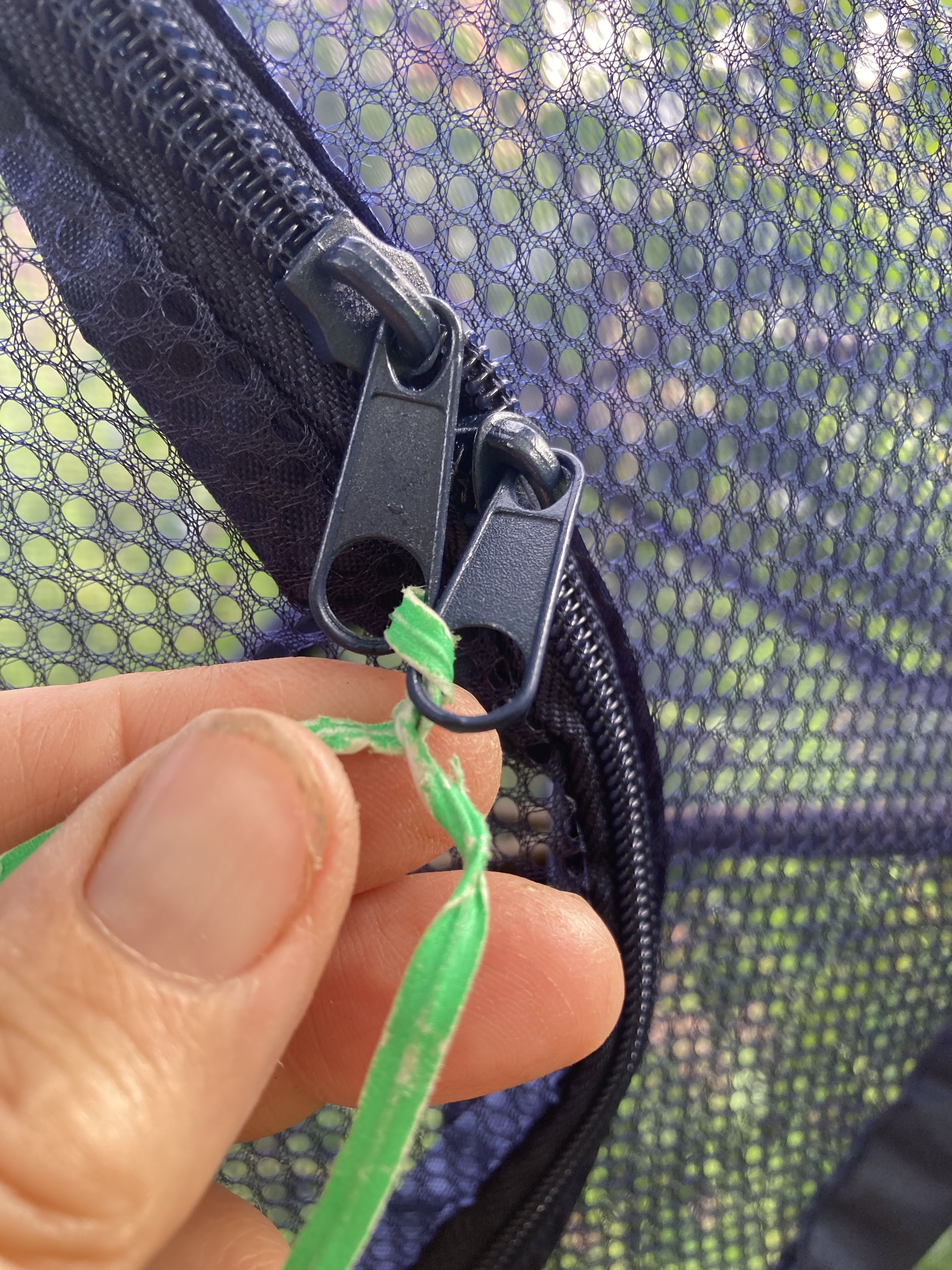
Pretty slick, huh? I twist-tied it in place by its various straps. That thing wasn't going anywhere.


Just to make sure, I twist-tied the zippers closed. However.

I woke up in the wee hours the next morning, as I am wont to do, thinking...is that mesh small enough to keep braconid wasps out? I knew it would keep cuckoos out, and big old tachinid flies, which lay eggs on caterpillars, but parasitic wasps? I asked my guru for all things insect, Laura Stalder Hughes. Nope, she said. Braconids can definitely get through that mesh. ARRRGH. Back to the drawing board.

 I must diverge for a bit, to explain why I woke up thinking about braconids. Here are some images from my blog from 2010, showing a glorious tobacco hornworm Manduca sexta decimating a tomato plant.


 The adult of this impressive worm is the Carolina sphinx, shown here on large-flowered evening primrose Oenothera glazioviana, in my garden.


Those flowers are more than 4" across. The Carolina sphinx moths are so big you can hear and feel them fly in. They have a low thrum like a hummingbird. They are miracles on wings.

And this is why you should not squish or toss or otherwise torment the hornworms on your tomatoes. Find a "victim" tomato plant (everybody has one) and put them on it. Please. Let them live. They are getting rare, at least around here. I get very excited when I get one on a tomato plant, but they rarely make it to adulthood, thanks to birds and braconids.

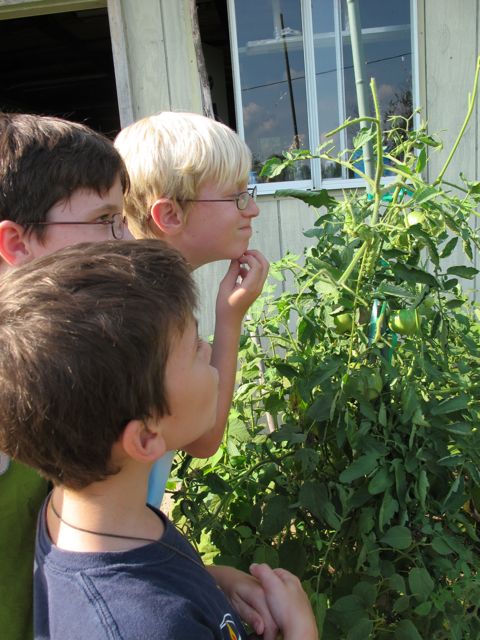
To show you how long ago that lovely caterpillar encounter was...here are Liam, Grady and Arlo, all of whom are either graduated from or in college now, inspecting the worm. Liam's gonna love this picture...


And this is what braconid wasps do to large caterpillars.


The little braconid female lays her eggs on the caterpillar. The eggs hatch, and the tiny larvae burrow through the skin and eat the caterpillar from the inside out. They avoid eating vital organs until they are ready to pupate and exit the decimated husk of what was once a turgid, healthy caterpillar. As a final thank-you, they eat the circulatory and digestive organs. Bye, thanks for giving us your life. We'll be leaving now.


You can see the tops of the cocoons flipped off, as the adult wasp exited each one. The braconid might be called the gardener's friend, unless the gardener loves tobacco hornworms and giant sphinxes as I do.


Here's a braconid cocoon mass I found Sept. 11 '22. There may or may not be the husk of a caterpillar under all that. 


You see, these are the nightmares of a naturalist who is trying to do her best by one charismatic caterpillar. These are the things that keep us up at night.

So on the advice of Tami Gingrich, a legendary Geauga Co. Ohio naturalist,  I went online and ordered a giant mesh sleeve from raisingbutterflies.org

the biggest one they make. Its polyester mesh is too small to admit braconids. Hooray!
And I kept the caterpillar in the hamper on the live persimmon branch because I had no choice but to do that until the sleeve arrived. And I am happy to say that no braconids had gotten in to parasitize it before it came in the mail. 

Meanwhile, the little brown caterpillar was about to go through some serious changes. It was growing but it wasn't eating. It hadn't eaten a bite since I took it in on Aug. 23. Here it is on Aug. 24. Of course I was blaming myself and the wilty persimmon leaves, but something else was clearly going on.


At 11:11 AM on Aug. 24, this is how it presented:


Just hanging there, bent double, anorexic...arrgh! I was in turmoil because I had to take Curtis to the vet to get a bunch of stitches out. He'd had two tumors removed, both of them benign, thankfully. And this caterpillar was going to shed its skin, I was pretty sure.

Wouldn't you know that I'd have to be gone for the last instar skin shed of the most special caterpillar I had ever found? Oh how I wanted to see it, and make a timelapse, but Mr. Loew was more important than that!
He had been a Very Good Boy and not scratched his incision but maybe once in two weeks, and he needed to get his Frankenstein staples out, and get his good lab report, so off we went, hoping to see a brand new caterpiggle on our return.


[Back to Top]