Background Switcher (Hidden)

Showing posts with label caterpillar sleeve. Show all posts

The Devil in My Refrigerator

Tuesday, August 8, 2023

0 comments

 No, the devil in my fridge is not Whit's Frozen Custard, though that stuff is temptingly close. It's a honkin' big worm! Read on...

By September 6, 2022, the hickory horned devil was walking nonstop. In nature it would be seeking soft soil it could dig down into to shed its skin and pupate.  It was time to bring the caterpillar into the house, and give it a medium it could burrow in and pupate safely. I received detailed instruction from Tami on the proper substrate. Apparently putting the caterpillar in potting soil can cause issues when perlite and peat get lodged in the exoskeleton, so clean long-fiber sphagnum is the medium of choice. I dampened it a bit with water. The caterpillar made circuits around the big plastic footlocker, tunneling through the medium. 


It had shrunken from nearly 6" to only  4, and it would continue to shrink.


Once the caterpillar starts to walk, it does little else, pausing only to curl up and sleep, and probably dream (spiders have been proven to dream, so why not devils?), then resuming its ceaseless circuit of the bin. I don't know how much ground they must cover in nature, but it's probably considerable.
Here, I briefly lift it,  then it continues to walk. 


The caterpillar was undergoing big changes inside as it walked. 
It was shrinking more and more each day. 

Yes, this is the caterpillar that once spanned my entire hand end to end. 


Here's a  photo from Tami Gingrich that highlights the size change in devils who are ready to pupate. She's gone out and plucked some examples from her mystical caterpillar farm in northern Ohio. The huge green ones are still eating,  as evidenced by the leafy twigs they're on, and the little turquoise curled ones are ready to pupate. Isn't that crazy?


Finally, the caterpillar lay still. It was time to transfer it to the plastic lunch meat container that would be its home until sometime next summer.


I could hardly believe this was the same caterpillar! A quarter for size comparison. 


The shrinking happened because it was losing water weight, and there were little droplets all over it as if it were condensing moisture, like a cold glass of ice water.  In fact, it was excreting moisture through its skin, soaking the paper towels it rested in! I kept changing them, as if it had wet its bed. It let off a strong and characteristic acrid chemical smell, which perhaps would help to protect it from being eaten, if the prickly horns and fearsome size didn't work.  It certainly didn't smell like something I'd want to eat. Even when it pupated, it kept this chemical smell. 

Here you can see the droplets it's exuding. It's going wee from every pore.


ln this photo from Sept. 11, you can see that its fabulous silk-stockinged prolegs are now just empty socklets, bits of skin. This caterpillar couldn't go anywhere now if it wanted to. Again, I wondered what it feels like to metamorphose. Does it hurt? Is it awful? Or is it like a dream state? 


The whole animal is dissolving, changing, contracting.


 Tami told me to watch for the caterpillar to turn from turquoise to olive, which would indicate it was ready to shed. This didn't happen until September 11. It seemed as good a way as any to observe Bill's and my wedding anniversary--watching a caterpillar get ready to shed its skin.  I knew the change would come soon. I hoped it wouldn't happen while I slept! 


I am pretty proud of this next video, and thankful that Tami gave me the information I needed to set myself up to catch it. On the 12th of September, 2022, the caterpillar was nearly motionless and unresponsive, as one would be with one's insides turning to goo. I set up a time-lapse with my old iPhone 6 and captured the process of shedding the caterpillar skin so the new soft pupa can emerge. Note how you can see the huge black false eyespots become part of the pupa!


Some still photos from the shedding process:


When the shedding process was complete and the pupa had darkened to mahogany brown, becoming  hard-shelled, Tami instructed me to close the pupa in its plastic sandwich container, lying on clean paper towels, and put it in the cool basement. Then, when the weather finally turned cold, I was to put it in the refrigerator. And from November to mid-May, there it would stay. Once a month, I would check on it, put two drops of water on the paper towels, and put it back in the fridge. I know I checked on it more often than that. I didn't want to forget there was a miracle going on in my basement refrigerator.

The whole process seemed so bizarre to me, so apart from nature, and I was a little uncomfortable with keeping this magnificent beast in mesh netting, albeit outdoors on a live tree; and then in a footlocker; and then in a Hillshire Farms sliced ham container. I was afraid I'd mess up somewhere along the way and doom it. At the same time, I knew I was locking it away from any number of predators and parasitic wasps and flies. I had been chosen by Fate to be the keeper of this precious gem. This was to be my quest. I had taken the insect in on August 8, when its sibling was eaten by a bird,  and I realized this one would probably die, too, unless I did something. Kept fed and safe within a mesh sleeve on my persimmon tree until September 6; watched as it walked until it pupated on September 12...then stored in my basement fridge until mid May  2023... I felt so privileged to be able to witness the caterpillar's entire life cycle and even participate in it. One caterpillar--what a gift it was; nearly a whole year of watching and waiting.

And the reason I've waited to tell you what happened with the caterpillar is because I needed to know how it all worked out. I didn't want to have you fall in love with this magnificent creature, only to have to tell you it ended up as a puddle of goo in my refrigerator, oops, sorry, got you all worked up for nothing. I waited to see her through. Blogging about the life of something like this is like being a press agent to a large green and blue tubular celebrity, and I take that responsibility seriously. 

Next: we wait eight months, and hope eight months. But you won't have to wait that long.

Devil on the Move

Saturday, August 5, 2023

0 comments

The ironweed was in bloom, and a Pleasing Picture-winged Ant Lion paused for its portrait on September 5, 2022. Fairies exist! If you ever see one fly, you'll believe it. These insects fly like they're doing it for the first time, suspended half-vertically, beating those lovely pictured wings madly...they look like someone impersonating a dragonfly, and doing it very badly. Oh they are so special! 

 If it kind of snaps your neck to go back nearly a year to September 2022, it does that to me, too. But now I have to tell  you the rest of the story of the hickory horned devil I protected in the summer of 2022.  I can't say I raised it; the persimmon tree did that; I just covered it with a huge fine mesh sleeve to keep the braconid wasps and tachinid flies from parasitizing it. Here it is, in situ, with the sleeve open for photography. You'll have to click on the photo to see it very well.

The caterpillar was undergoing some dramatic color changes as it grew, and grew, and grew. 

Let's have a close look at the amazing gripperdoodle at the stern of this beast.

It reminded me of a silicone potholder, the way it folded over the twig and fastened with something akin to Velcro, ensuring the massive caterpillar would not fall to its death. 

My caterpillar guru Tami Gingrich told me that when it turned color to a pale and vibrant turquoise, it would begin the wandering phase, and indeed it did, ceasing to eat and walking all over its enclosure. This is the stage at which most people find hickory horned devils walking around, looking for a place to dig into the earth. I was bemused to see one make the newspapers that same month. I can't think of anything more newsworthy than seeing this creature gallumphing down a sidewalk.

Figuring it was at its largest and heaviest, and knowing it would eat no more, I weighed it to see where it topped out, on September 5, 2022.

It's about 22 gm, almost an ounce. 

Let's put that in perspective. 

It weighs as much as a fat adult big brown bat (22 gm)! 

Almost twice as much as a chipping sparrow (12gm)! 

More than a junco, or an orchard oriole (both 19 gm)!

You get the idea. It's a Very Large Caterpillar.

But it is soon to become something entirely other. 

Throwback Thursday: Remember That Hickory Horned Devil?

Thursday, July 27, 2023

0 comments

I knew it would be a mistake not to write about these photos when I uploaded them. September being what it is, I never found the time. My good readers will recall that much of the summer of 2022 was spent fussing over one enormous worm, protected by a fine mesh sleeve on my open-grown persimmon tree: the HICKORY HORNED DEVIL!! 

I think everybody overloaded on HH Devil last summer, so it's really fun to go back and see them now, when these huge caterpillars aren't even a gleam in their parents' compound eyes. 

Let's shoot back to September, when the orange-striped oakworms were defoliating my beloved little mailbox oak. (They're not gonna do that again! It was TOTAL.)


And I discovered brown-eyed Susans Rudbeckia triloba--blooming long after the classic black-eyed Susan, Rudbeckia hirta, is done--on a roadside bank--Lawd, how beautiful!


and the Conoclinium coelestinum (Mistflower, wild ageratum) was in full bloom in the orchard.
There's about 3x as much this year, thanks to intelligent mowing! I absolutely adore this spreading native perennial. It can just spread all over the clearing at the orchard's end, as far as I'm concerned. Butterflies and bees love it, and so do I. 


It was September 2, and I found the first wild persimmon on the ground, and it was sweet and edible!


Something not sweet nor edible: the gargantuan frass (poop) of a Very Large Caterpillar.


By Sept. 3, it was very, very  big, as big as it was going to get. 
Click on the photo to enjoy its black silk stockings, and the way the claspers wrap around the twig. 
It feels like a cool, velvety hotdog to hold. 


Sept. 3, Shila came out to photograph this wonder. Don't miss the worm...it's right in front of her phone lens, hanging upside down. Huge. YOOOOGE.


I can't span it with my hand. It's 6 3/4" long. 


The worm had become so used to being photographed and moved this way and that, that I had trouble getting it to show me its Ray-Bans any more. 


I literally had to tickle the tubular being into displaying its terrifying false eyes.


More stockings...the caterpillar clings like its life depends on it, and indeed it does. Being so huge and heavy, a fall from high in a tree would spell death; it'd split like a ripe melon. 


We aren't going to let it fall. It's cushioned in its parasitic wasp-proof mesh sleeve, anyway. 
And the custodian comes every few days to empty out handfuls of its frass to keep things 
nice and clean. 


Absolutely fantastic blue. I have a Specialized bike helmet exactly this color. 


Yes, we'd become very fond of our terrifying but utterly harmless Devil, 
and I don't think it minded us one bit. 


Changes soon to come for this creature! I've saved these last few posts from September and October 2022 until I knew what would become of our colorful, horned friend. Stay tuned...

Hickory Horned Devil: Shedding Into Beauty

Tuesday, September 20, 2022

6 comments

 When we left the Hickory Horned Devil, it was preparing to molt, hanging limp, then pulsing and extending its front half. I was in a tizzy because I had to take Curtis to the vet to get his staples out after surgery, and I couldn't be there for its last molt as a caterpillar. Dang it! Priorities. I did, however, get to come home that afternoon to a changed beast.


No, not Curtis. The worm. Well, Curtis was happy without the staples in his neck and brisket. 


Aug 24 4:43pm LOOK WHAT IT DID


Morning August 26. Hoooo Weeee!!

I was SO excited to see the transformation. All my worry about the anorexia and dull coloration dissipates as I see what the caterpillar was working up to. It didn't eat for 2 1/2 days while it was preparing to molt, and that coincided with my taking it inside, so of course I concluded that I'd done something dumb and ruined everything. That's how it goes, every time, for the first-time helicopter HHD mom. 
I'm an HHHD mom.


26 August 2022. In this video I'm showing you how the "devil eyes" work. The caterpillar really only displays them under duress, when it's frightened and thinks it needs to scare someone back. They're just square black spots on the caterpillar's nape, or thorax I guess. And the worm can sort of flex to display them when necessary, by tucking its head down against its underside. That move expands the nape, reveals the Ray Bans, and also deploys the scary horns, which don't
hurt at all, and have no poison in them. All for show. 


Here's the new sleeve I deployed on 26 August. I ordered it from raisingbutterflies.org
It's the biggest one they make, a habitat fit for the King of Caterpillars, the Regal Moth's larva.


It's so big that I never had to move the caterpillar for its whole time inside. With smaller sleeves, you have to move them to a fresh branch when the worm eats all the leaves inside. You want to shake the branch you're about to enclose quite hard before you sleeve it, to make sure you've got all the stinkbugs and spiders off it. Then you run the sleeve over the branch and tie it very tightly and securely at both ends. You can't tie it too tightly, or run the cord around the closure too many times. Things get in. Things get out, otherwise.
The beauty of the sleeve is that the caterpillar is outdoors, exposed to sun, rain, wind and changing temperatures, just as it would be in nature. For monarchs, at least, this is VITAL to their picking up navigational skills. Shockingly, monarchs raised inside a house don't know how to get to Mexico, apparently. What a thought--that in trying to help them we could be hampering them, keeping them from fulfilling their destiny. So you've got to raise them outdoors, and sleeves are the way to go. 
The only difference in sleeve raising and wild life, for the caterpillar, is that nothing can kill it.


I loved all the stages of the HHD, but I have to say I found this newly shed fifth instar caterpillar the most beautiful of all. I loved its proportions--still with ridiculously long horns and prolegs; gorgeous shades of beige and brown, set off by all that orange red bling. 


Aug 25 7 pm New 5th Instar Molt coloration--maybe my favorite! He finally started eating again that evening. Whew!! Had not eaten since I took him in on the 23rd! I was worried. But it was just him getting ready to molt. I have to say the worry was worth it.

26 August 11 AM, I got a good shot of the gripperdoodle off the back of the worm. It's basically constructed like an oven mitt with Velcro tips. It clamps onto the branch like a vise, and that worm is NOT going to fall while the gripperdoodle is engaged. Yes that is a Zick neologism and yes you may use it. As I age and am unable to come up with the words I want, I spontaneously invent them. Often they're better than the word I was searching for; just ask my kids.  Kind of a natural history Casey Stengel at this stage of my life.


The correct term for the gripperdoodle would be  "modified anal prolegs" but what fun is that? And also gross. Come to think of it I wish I'd figured out where the frass comes out. Inside/behind the gripperdoodle? Does it have to release the oven mitt to take a sh-t? Darn! Wish I'd poked around to better understand this remarkable naughty bit.


By 26 August, 7:20 pm, the caterpillar was turning pale before my eyes, especially along the dorsum. 

26 aug 720 pm

In the sunlight, I could see some green creeping into the bronzy brown it had before.

There's a Curtis bomb in this photo. Not an accident. He tries to get in the frame just like Chet did.


And wait--is that turquoise coming into the foreparts?? Is this thing changing color before my eyes, like an octopus? Why not? In the Devil World, anything is possible. 

You're just too good to be true
Can't take my eyes off of you
You'd be like heaven to touch
I want to hold you so much
Well, that last part, not so much.

Hickory Horned Devil 2: Avoiding Predators and Parasites

Wednesday, September 14, 2022

4 comments


Years ago, I saw a small tree coming up in the meadow, not far from the yard. Huh. Wonder what it is? Well, it was a persimmon, and that being one of my very favorite trees, I decreed that it should not be mowed.  It grew quickly, quickly enough that an orchard oriole pair tried nesting in it in the summer of 2021, how wonderful! 
And now, it would find a new use.


The persimmon branches I cut and put in a vase for my now captive hickory horned devil did something unexpected, wilting dramatically overnight. Some plants just do that, especially woody plants. Oh no! I couldn't feed my Precious dry, dying/dead leaves. What to do? Well, I got online in the wee hours and searched and searched for sleeves to put on live trees, before I realized I had an answer right in front of me. I'd just take the mesh clothes basket and zip it right onto the living tree! Brilliant! or so I thought at the time. It's never as brilliant as it seems.

Walmart to the rescue! I'd been meaning to buy one of these groovy clothes baskets (as opposed to hampers) for awhile, to house little things like insects and small birds. It would be a good hummingbird home, for instance...maybe even a good bat home, a good nestling home...I like it.

The beauty being that it has great big windows AND it zips completely closed.
I would let the persimmon tree do all the work of keeping its leaves alive and juicy, and just zip the Worm inside, on a living branch full of leaves!


I ran the branch in one window and zipped it closed with the worm inside on August 23.


Pretty slick, huh? I twist-tied it in place by its various straps. That thing wasn't going anywhere.


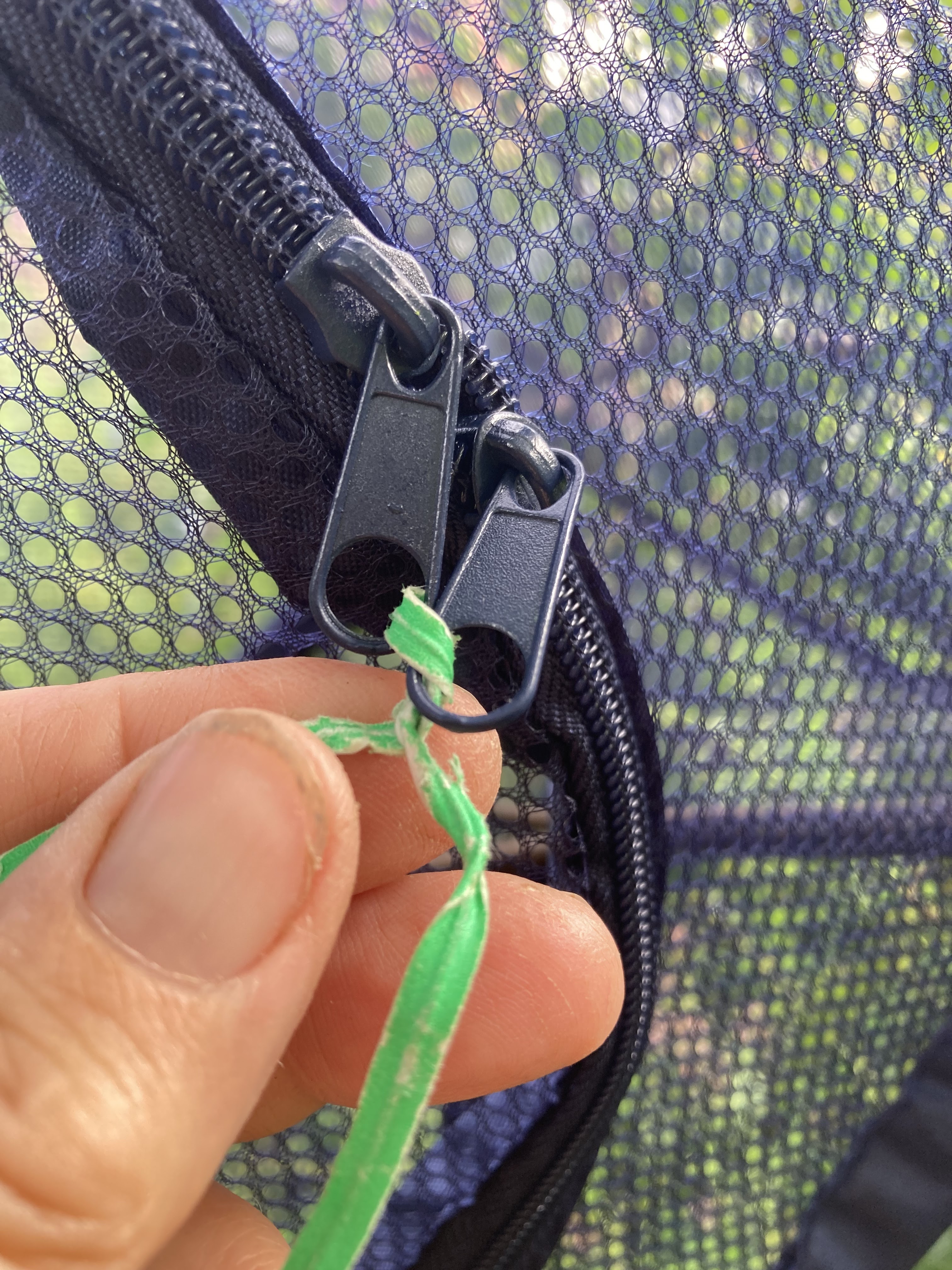
Just to make sure, I twist-tied the zippers closed. However.

I woke up in the wee hours the next morning, as I am wont to do, thinking...is that mesh small enough to keep braconid wasps out? I knew it would keep cuckoos out, and big old tachinid flies, which lay eggs on caterpillars, but parasitic wasps? I asked my guru for all things insect, Laura Stalder Hughes. Nope, she said. Braconids can definitely get through that mesh. ARRRGH. Back to the drawing board.

 I must diverge for a bit, to explain why I woke up thinking about braconids. Here are some images from my blog from 2010, showing a glorious tobacco hornworm Manduca sexta decimating a tomato plant.


 The adult of this impressive worm is the Carolina sphinx, shown here on large-flowered evening primrose Oenothera glazioviana, in my garden.


Those flowers are more than 4" across. The Carolina sphinx moths are so big you can hear and feel them fly in. They have a low thrum like a hummingbird. They are miracles on wings.

And this is why you should not squish or toss or otherwise torment the hornworms on your tomatoes. Find a "victim" tomato plant (everybody has one) and put them on it. Please. Let them live. They are getting rare, at least around here. I get very excited when I get one on a tomato plant, but they rarely make it to adulthood, thanks to birds and braconids.

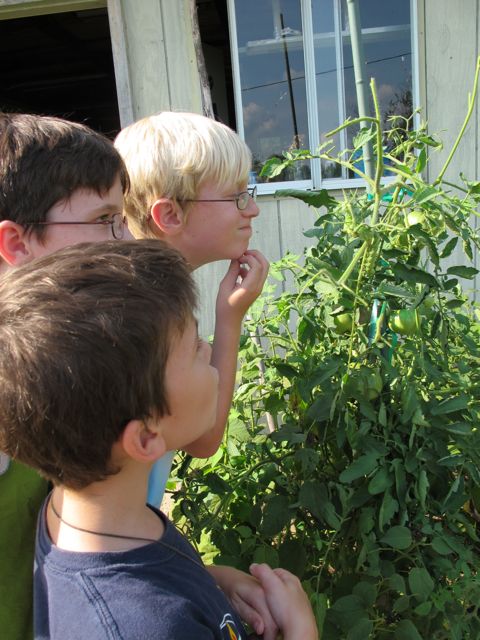
To show you how long ago that lovely caterpillar encounter was...here are Liam, Grady and Arlo, all of whom are either graduated from or in college now, inspecting the worm. Liam's gonna love this picture...


And this is what braconid wasps do to large caterpillars.


The little braconid female lays her eggs on the caterpillar. The eggs hatch, and the tiny larvae burrow through the skin and eat the caterpillar from the inside out. They avoid eating vital organs until they are ready to pupate and exit the decimated husk of what was once a turgid, healthy caterpillar. As a final thank-you, they eat the circulatory and digestive organs. Bye, thanks for giving us your life. We'll be leaving now.


You can see the tops of the cocoons flipped off, as the adult wasp exited each one. The braconid might be called the gardener's friend, unless the gardener loves tobacco hornworms and giant sphinxes as I do.


Here's a braconid cocoon mass I found Sept. 11 '22. There may or may not be the husk of a caterpillar under all that. 


You see, these are the nightmares of a naturalist who is trying to do her best by one charismatic caterpillar. These are the things that keep us up at night.

So on the advice of Tami Gingrich, a legendary Geauga Co. Ohio naturalist,  I went online and ordered a giant mesh sleeve from raisingbutterflies.org

the biggest one they make. Its polyester mesh is too small to admit braconids. Hooray!
And I kept the caterpillar in the hamper on the live persimmon branch because I had no choice but to do that until the sleeve arrived. And I am happy to say that no braconids had gotten in to parasitize it before it came in the mail. 

Meanwhile, the little brown caterpillar was about to go through some serious changes. It was growing but it wasn't eating. It hadn't eaten a bite since I took it in on Aug. 23. Here it is on Aug. 24. Of course I was blaming myself and the wilty persimmon leaves, but something else was clearly going on.


At 11:11 AM on Aug. 24, this is how it presented:


Just hanging there, bent double, anorexic...arrgh! I was in turmoil because I had to take Curtis to the vet to get a bunch of stitches out. He'd had two tumors removed, both of them benign, thankfully. And this caterpillar was going to shed its skin, I was pretty sure.

Wouldn't you know that I'd have to be gone for the last instar skin shed of the most special caterpillar I had ever found? Oh how I wanted to see it, and make a timelapse, but Mr. Loew was more important than that!
He had been a Very Good Boy and not scratched his incision but maybe once in two weeks, and he needed to get his Frankenstein staples out, and get his good lab report, so off we went, hoping to see a brand new caterpiggle on our return.


[Back to Top]