Background Switcher (Hidden)

Meet the Hickory Horned Devil

Monday, September 12, 2022

1 comments

Well, you never, ever know what you're going to get into around here. Who could have known that one person's overnight visit here on August 10, 2022, would set me on a road of discovery, thought, and effort
that is only winding up now, September 12? 
But that's inspiration, and that's life when the Muse leads. And Heather was the conduit to the Muse.
A spiky, spiny, colorful, crazy Muse.

August 10, 7 pm. Heather is taking it all in. She's coming back from Chicago,
stopping to reconnect and rest.


There's so much to see and photograph and discover!
And Indigo Hill is showing well, the skies piled with huge thunderheads. 


We walked out the orchard slowly. At the end I showed her one of my littlest persimmon trees. And she looked up into its leaves and said, "Well, what's this?"


August 10, 7:14 pm. My life changed. I didn't know it yet; I just knew I was tremendously excited 
to see my second hickory horned devil on the sanctuary. And such a small one! It was barely two inches long. I hadn't even known they'd eat persimmon leaves, but the caterpillar couldn't be wrong. Heather began Googling madly on the good LTE reception we get in the orchard, and found that hickory horned devils eat a wide array of trees**, but they grow best on persimmon!


** Ash, butternut, cherry, cotton, hickory, lilac, pecan, sumac, sweet gum, sycamore, walnut...Persimmon!


Heather had to leave the morning of August 11. We went out to enjoy the better light and get some good pictures of her find. This was taken at 9:21 am. What a handsome caterpillar!


 On the morning of August 12, I walked out to visit the caterpillar and found it hanging high in the tree.


 Then I promptly found a second one! It was much smaller and lower in the tree. I couldn't believe my good luck!


By August 12, the big one was hanging sort of limply, looking like it was ready to shed. I think it was at this point I began to worry about the caterpillars. That state of worry would not abate until September 12.


You see, I didn't know that they go through periods of anorexia and inactivity before they shed their skins, and they do this four times in their caterpillar life. Like, they don't eat for a couple of days. They just hang there, looking like they've contracted something awful. (My too-informed tortured mind at work here). 


Aug 15 8:16 am--the big one has shed, and looks new and smart with white zags along its sides!
It's eating again, too, whew.

This is my last photo of the big one, from 15August, at 8:36am.

I love the red horns and the side markings. You can also see black spots on the upper back. More on those later. 

By the next morning, the big caterpillar had disappeared. 

I could find only the little one. 


15Aug 8:36am--little one.

I kept thinking I'd see the big one again, but it never happened. There were so many yellow-billed cuckoos in the orchard at that time, I had to conclude something had grabbed and eaten the big one. And that would be right in character for a YBCU. 


16 August, 8:25 AM.  I worried more with each passing day that this one would meet the same fate, spikes and horns and all. That's nothing to a cuckoo. 


The fields were turning gold, and September was doing her best, but I kept thinking about the opportunity that would be lost if I didn't do something about this. 


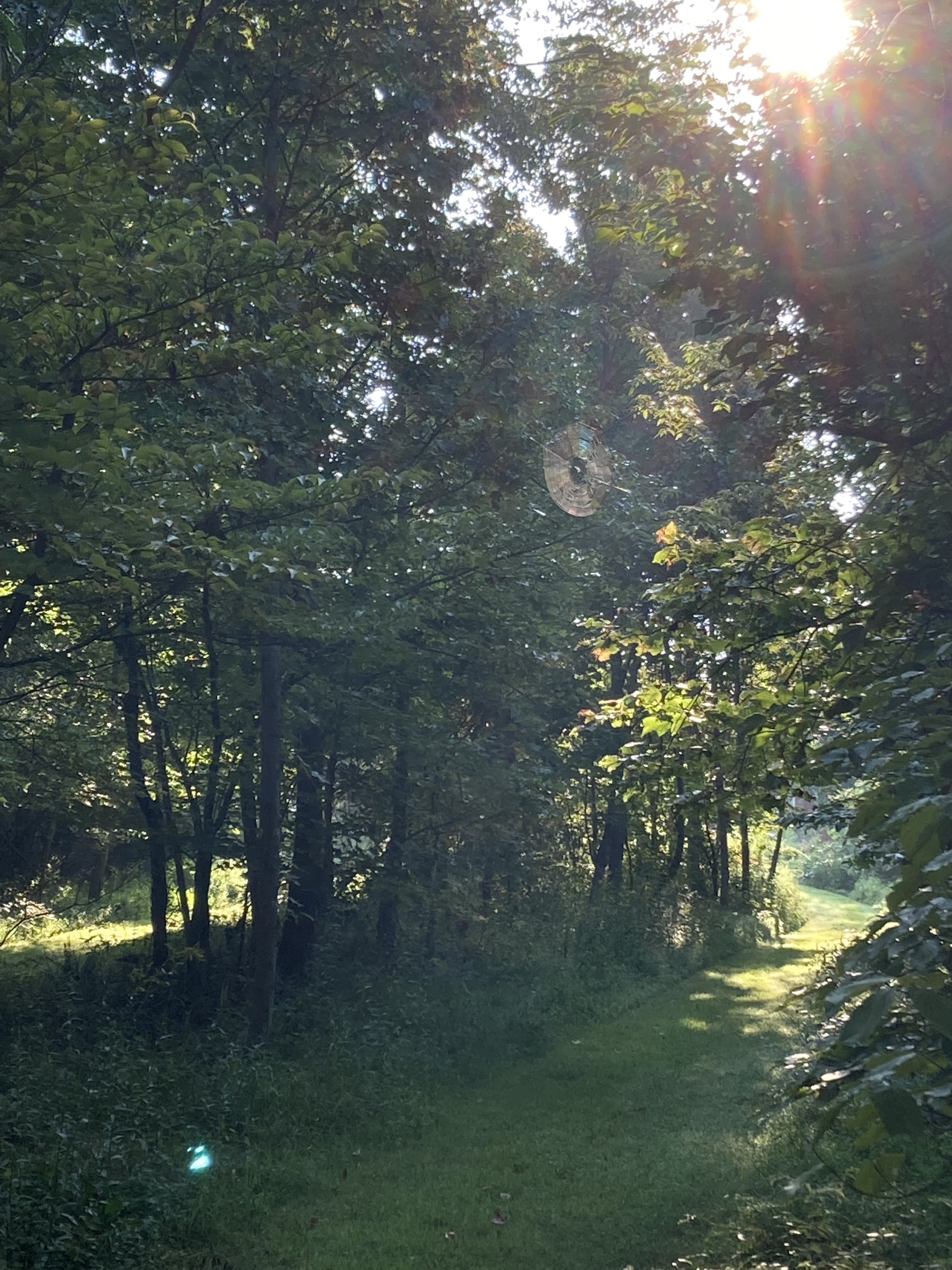
Lined orbweaver in its tilted web.

Day after day went by and somehow it was still there to greet me each morning, though it seemed to spend most of its time hanging upside down doing nothing. 
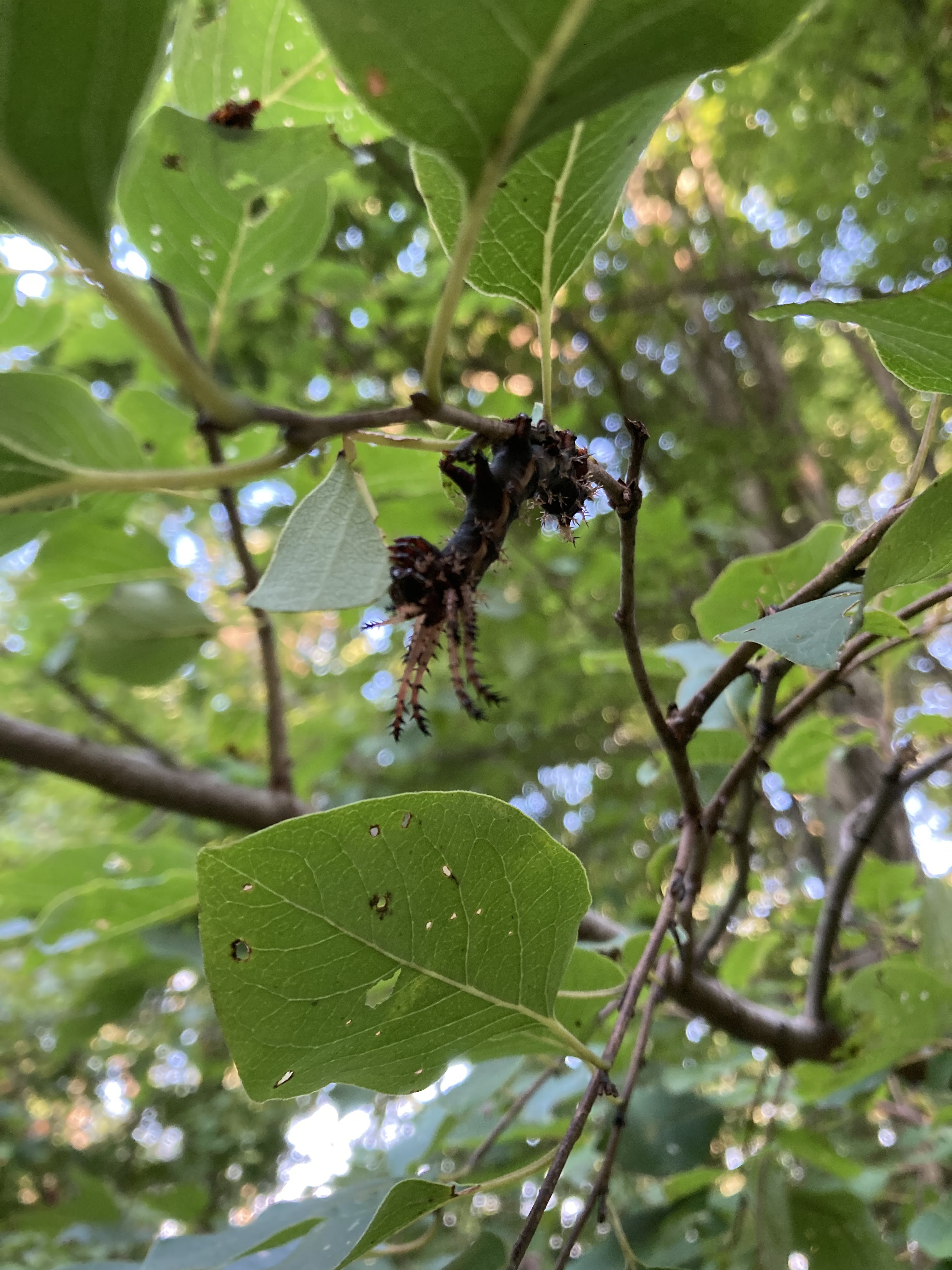


By 10 am on August 19, it was eating and looked snappy--must have shed its skin in there somewhere.

The caterpillar became more precious to me with each passing day. Watching it change fascinated me. I knew I had something very special in it, and I also knew that could all be snatched away with one click of a cuckoo's bill. I wrestled with myself about whether to take it in. I wanted so badly for it to realize its life in the wild. But I also wanted to witness it, and to avoid the seemingly inevitable abrupt end to our budding relationship. 

I so enjoyed my pilgrimages out to the end of the orchard to find it each morning. I would miss that!
But by the evening of August 22 I had decided to take it in. 


I got Liam to come with me to embolden me to do this thing I had thought and fought so hard and long to do.

Aug 22, 2022, 7:04 pm. The little one is now the size of the big one when it was eaten. Something about saving it felt right now. It was just too plump and tempting a target. I had to intervene.

Liam snapped this of me as we walked back from the end of the orchard. Just a woman and her 
foster worm.

I had bought a zip-up laundry basket I could keep it in, I thought. I clipped some persimmon branches and put them in water.


But as always, Nature led me down another path--the right one. 
To be continued...


Not-so-Crazy Caterpillar Lady

Tuesday, August 30, 2022

9 comments

 Year in, year out, I fight it, that urge to take in all the little caterpillars and keep them safe from harm. 


Usually, things go well for the monarchs and I see them hatch, eat, grow, thrive, pupate and flutter away in the wild. This year is different. Very different. 

For one, monarchs have been declared endangered. Not by the U.S. Fish and Wildlife Service, no...that takes for-freakin'-ever. The change in status was announced, rather, by the International Union for Conservation of Nature a few weeks ago. Essentially they're yelling at the USFWS that somebody's got to say something about this disappearing insect. Monarchs are big and charismatic and people notice them, which makes it all the more dispiriting that we are letting them slip away before our eyes. 

Here on a micro-scale, it's a very wet year in Ohio (like almost nowhere else in the country). I don't know if that is why there are so many predatory stinkbugs, but every monarch caterpillar I've found on my yard "ranch" in the first part of the season was eventually killed by stinkbugs. It really bothers me to see a great fat fourth instar monarch that I've been watching since it was a tiny hatchling, hanging limply from the sucking beak of a stinkbug. If there's anything that bothers me, it's seeing a young thing die.

So, reluctantly, I've climbed aboard the Crazy Caterpillar Lady Train again. But I'm only bringing them inside while they're tiny, and then again when they turn into chrysalides. I'm researching and experimenting with ways to keep them outside in the sun and wind and rain, chewing away on live milkweed, with fine mesh sleeves to protect them from parasites and predators. It's been a thing. I just don't think they were meant to grow up in an air conditioned house, or jammed together in a plastic box.


Outdoors is the thing. They've got three species of Asclepius to choose from in my yard. 


My obsession with watching the caterpillars in transition has pushed me to learn some things about time lapses and video editing. I'm proud to present my latest effort: five hours of caterpillar to chrysalis transition, condensed to a very satisfying minute and a half. Made the video today, August 30, 2022. 

 I hope you enjoy it.


WarblerFall Joy

Tuesday, August 23, 2022

7 comments

It's that time of year when I sit at my drawing table and write with my head turned all the way to the left.

Out the window is my WarblerFall. I have the window open no matter the weather so I can hear the relaxing burble of trickling water. I can also hear the flllltttttpp! of little bird wings as they bathe, and can grab my camera to record the action! 

 Mourning dove family (baby is atop the fountain).

August and September are the prime months for the WarblerFall,  up here on my usually dry ridge. Gobs of birds are passing through, largely unnoticed, until they hear its siren call! 

A female American redstart graces the WarblerFall 20Aug2022

See how I have flat stones covering the entire bottom of the basin? You want water no more than an inch deep for the small birds you're trying to attract. Give them a variety of depths using flat rocks to adjust.

I've found no better way to keep track of what fall warblers, vireos, thrushes, finches, buntings, sparrows, and tanagers are slipping through my sanctuary than the WarblerFall. Its trickle draws them into my yard and down to drink and bathe. That gentle burble is an irresistible come-hither to a wonderful array of birds.

Mourning doves have an adorable habit of holding one wing up when they're bathing.

Sprinkle me there. Right there. 

As a little recap, I spent the last 30 or so years thinking about it, and then spent last summer figuring out how to economically construct the best bird bath possible--where to get the right components and how to put it all together. I made an instructional video and a set of detailed pictorial instructions. Both are available at 

                                                              www.warblerfall.com

If you haven't visited yet, there's a fun 2-minute promotional video that ought to give you a laugh at the very least. Zick as Bobby Flay. But I'm dead serious about the product. Since its official launch in the pages of BWD Magazine's inaugural issue July 1, this little bird bath has blown me and a LOT of others away. People have fun building it. They set it up and get wonderful bird action, often from species they wouldn't expect to see in their yards. Then they share their photos and videos on social media. I have been delighted with what I've seen from all over the country. And it's a gas to see how others interpret my instructions and use the materials at hand.

Cardinals are in the WarblerFall all the time, proving that it's not just for warblers!

Just a note: In the instructional video, I talk about placement of your WarblerFall, and make a point about why placing it on the ground is important. However I would love to do this, I can't, though. That's because I have a pack of murderous eastern chipmunks, who, over the past year, developed the habit of trying to pounce on birds as they bathed. They never caught one, but they got close. After much cussing and thought, I solved the problem by elevating the WarblerFall about 16" on an overturned ceramic planter. The chipmunks don't even try to get up there, and the birds bathe in peace. The elevation doesn't seem to deter anyone but those flat-footed 'munks.

Here's a common yellowthroat enjoying a good soak. 

 I think the most compelling thing about this fountain is the way it draws the completely unexpected. Watching it is kind of like playing the slots. You get these intermittent rewards that keep you watching. And then you hit the jackpot! 

Did my dear friend Laura ever think a yellow-billed cuckoo would come down to her backyard to bathe? No, and neither did I!! I didn't even know they bathed in water! 


That is WarblerFall Magic, right there. Laura told me that she quit feeding birds in summer because she thinks it's better for them not to have supplemental food. But the WarblerFall more than made up for it. She's had an absolute blast with it, as you'll see in subsequent posts. 

I'm posting this to remind you that NOW, August and especially September, is prime WarblerFall time. Birds are migrating. Flying so far and for so long builds up a powerful thirst. They just can't resist
a drink and a cool bath. Welcome them to your yard! Visit


and thank you so much for supporting me by investing in my invention--the little bird fountain that could! 


[Back to Top]