Background Switcher (Hidden)

Showing posts with label warblerfall. Show all posts

Tanagers Eating Weird Stuff

Wednesday, November 6, 2024

0 comments

I have huge dark Chamaecyparis trees hanging over my north studio windows. This is bad. It cuts my light. Gosh, they were so tiny when I planted them 30 years ago! Who'd think they'd shoot up to 20' plus, and get so thick and plumy? In desperation to get my view back I have limbed them up, but their bushy tops still cut a ton of light, especially on those dark winter days when the sun seems to set at 3 pm. Good times! 

 One of the good things about having huge dark Chamaecyparis trees hanging over my north studio windows, however, is the intimate look they give me into the lives of birds. They feel safe in those dark trees and they do things most people don’t get to see, right at eye level. It’s my mini canopy walk, I guess. I’m perched on my high drafting chair and they’re a good 12’ off the ground, and I’m looking right into their eyes. One of the more thrilling birds who perched in there was a Cooper's hawk, on April 6, 2023.
                                                                                   

Most are songbirds, though, like this hatch-year female scarlet tanager who just calmly studied me as I looked back through the big lens. She was but a few feet away, and I was moving slowly, as always, so as not to frighten her. Sept. 16, 2024. My Canon is permanently to my left on the drawing table as I write or draw, and I've perfected a very fluid, slow way of hoisting it to my eye.


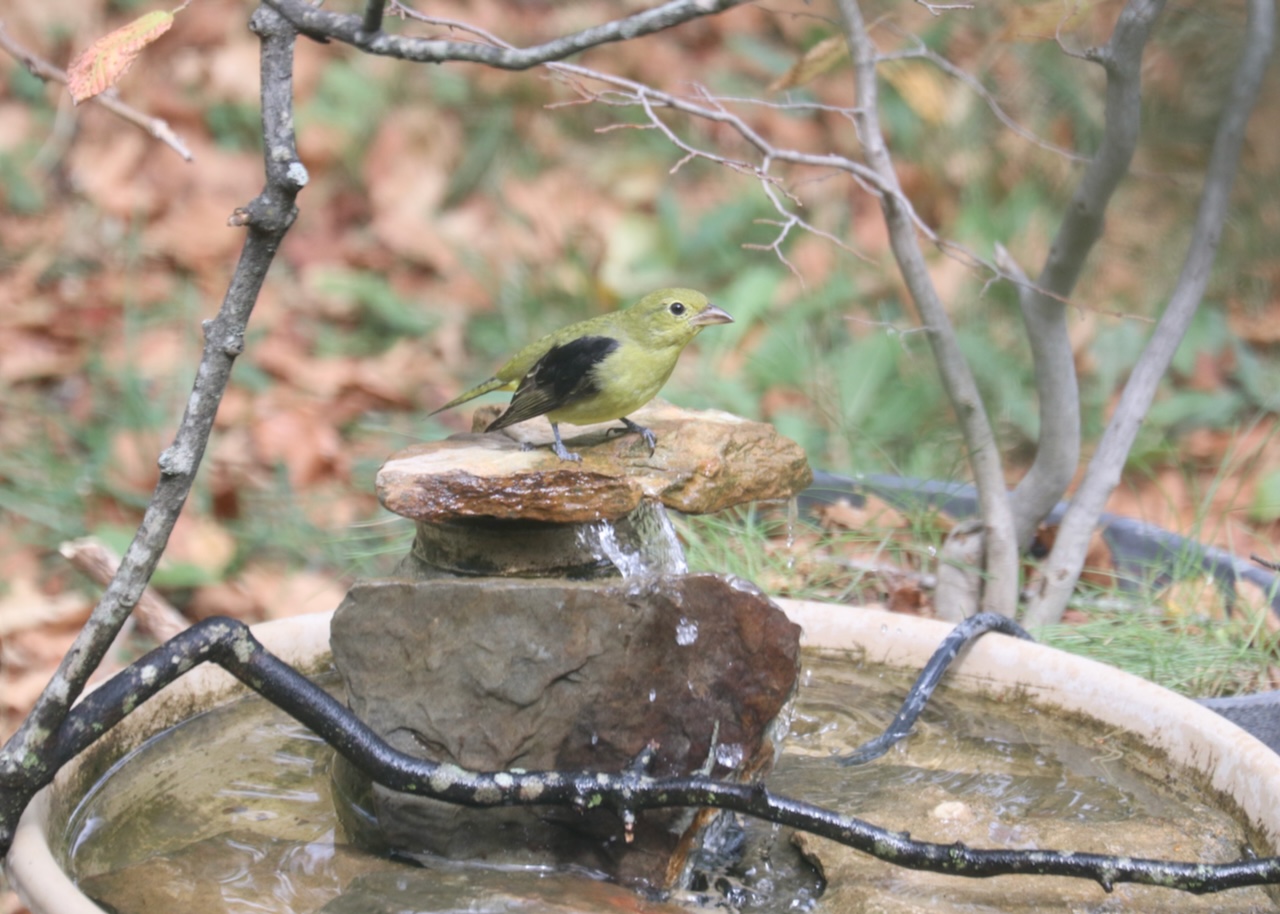
The water features, especially the trickling WarblerFall, draw in forest birds like nobody's business, especially during fall migration. Look at this gorgeous young male scarlet tanager molting into his first adult plumage on Sept. 16, 2024. He starts with the lesser coverts and will gradually replace the fresh flight feathers with jet black ones. And by next spring, he'll be replacing those green body feathers with brilliant scarlet ones. 
I like how he looks like he's wearing a cape around his shoulders. 


On Sept. 22, I was shocked to see a young male scarlet tanager eating a brown marmorated stinkbug, which would have to be the most odious mouthful a bird could ingest. But there he was, crunching it down like a toasted almond. 

Maybe a little gag reflex happening here, but the bug went down the hatch. Zow! 


The same day, I was thrilled to bits to see a young male summer tanager come in to drink at the WarblerFall, then perch in the Chamecyparis! Unlike the scarlet, summer tanagers don't breed on my land, though I do have the mix of Virginia pine and deciduous trees they seem to like. 


Summer tanagers are a late summer and fall phenomenon here, and they are almost always hunting hymenopterans when they're here. I've had them catching yellowjackets off the deck railing! 


Summer tanagers have an old folk name of "bee bird"  because they are notorious for staking out beehives and feasting on their occupants, often catching them in air. My old friend Hank had one spend a Connecticut winter at his beehives in Old Lyme, living on honeybees. He was happy to donate bees, but he did offer other foods, hoping to cut the damage. This is where the extra long, strong beak of the summer tanager comes in really handy. It's good to distance your eyes and face from an angry bee, wasp or hornet. 
This young bird was looking for something, and there was plenty of what he was looking for in my yard.


I have mentioned the absolute Jobian plague of yellowjackets that ruled my life and land all summer. I couldn't go anywhere without having to walk through swarms of yellowjackets, which spent the summer coursing low over the ground, looking for prey, and stinging me and Curtis. Curtis was stung nine times, and I was stung four times, and it was a huge drag. Yellowjacket stings hurt for a couple days and then itch for a week or more. I came to loathe those insects, which always seemed to be in between me and what I was trying to do. There were three huge ground nests in my backyard alone. In September, I accidentally mowed over a nest and got two yellowjackets down inside my hiking boots, stinging the blue-eyed crap out of me as I tried to stop the rider mower and slap them out of my socks. That was fun.


So I was thrilled to see the summer tanager chewin' on a yellowjacket in one of my birch trees.


He masticated that thing into a pulp before he swallowed it, stinger first. You want to make really sure the wasp's head is separated from its body before you pass it through your tender esophagus. Just looking at this photo hurts me, but that bird certainly knows what he's doing. Anyway, my theory as to why summer tanagers have evolved that big honkin' beak is to help them in their quest for stinging insects--an unexploited resource! They can quickly and safely process a large stinging insect with a long, strong beak. From seeing bees hit my windshield and leave a clear puddle of nectar, I imagine that they are sometimes quite sweet to eat, though I doubt I'll ever find out. 


Score two tanagers and a couple cool sightings of Tanagers Eating Weird Stuff for the WarblerFall!

If you haven't got your plans yet, by all means go to warblerfall.com and join the growing family of folks who know the magic attraction of moving water.

And remember, a WarblerFall makes a fabulous holiday gift. All you have to do is fill in your credit card info, and your recipient's email, and the plans will be emailed to your friend. You'll have to give them a heads up to look for it in their email.

Crazy cool bird sightings will follow! Thanks for your support. 

The Family that Bathes Together...

Monday, August 21, 2023

0 comments

On mornings when it's getting hot fast, I always give the WarblerFall a quick scrub. I change out the rocks to clean ones (all I have to do is leave them in the sun between cleanings, and its heat does my work for me!), scrub the basin with a Magic Eraser, and rinse and refill with clean water. It only takes a few minutes to make the bath fresh, clean and sparkling again. Thank you, Sun!

I knew there would be serious action today, August 21, with a humid high of 88.

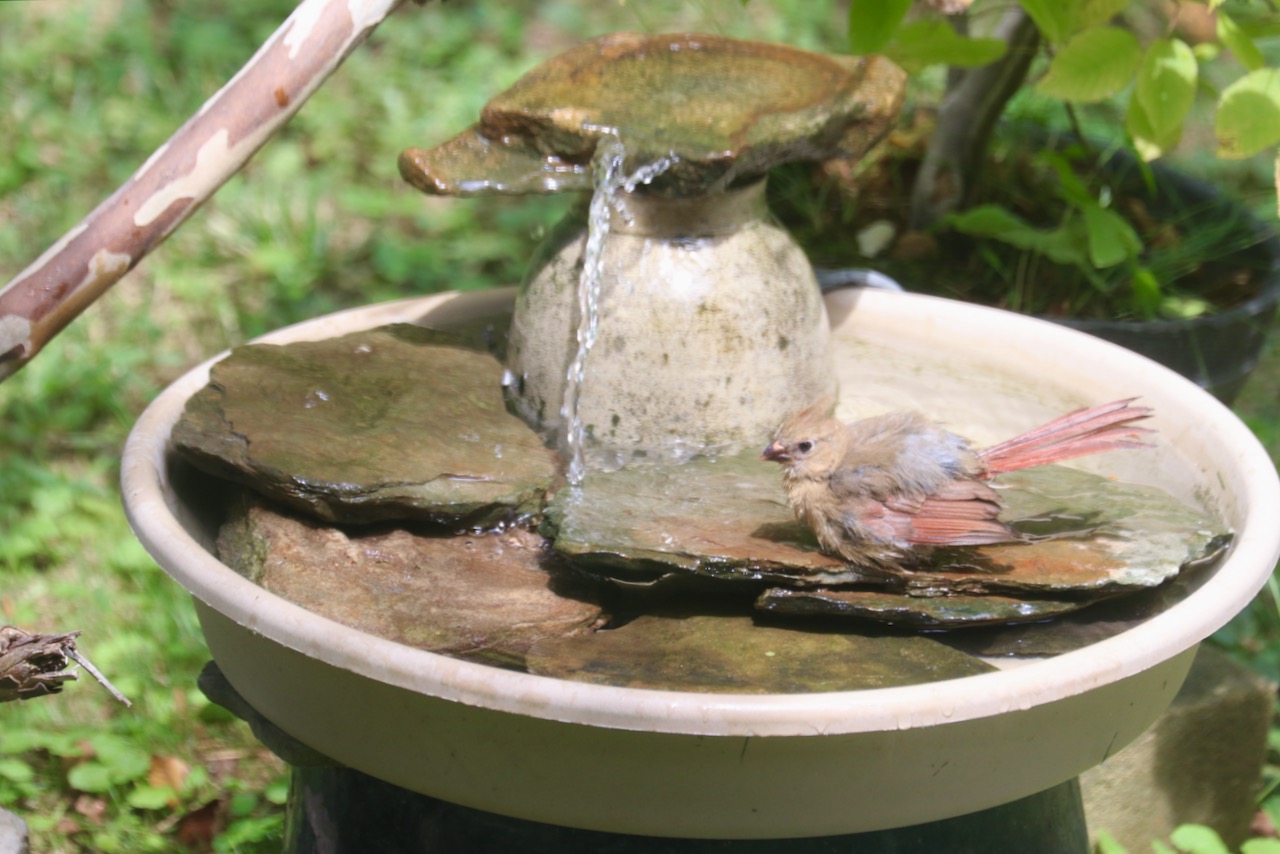
Sure enough, along came a baby cardinal, a female. 

She still has the blackish bill she was born with. She's likely still being fed by her parents.

She had such fun in the cool bath it wasn't long before her parents came to join her!

I was thrilled to get the whole family in one shot. That doesn't happen often.

The 'rents look considerably less fresh-faced than she does. Well, they've probably been feeding her for 50 days. I know. I've done it. Baby cardinals beg for forever, and then add a few weeks. 

Mom Cardinal was down to the last two feathers in her crest. Maybe she pulled them out in frustration...

Anyway, I'm projecting. The little family was having a nice bath together, and it was Baby's idea.

Then someone new showed up, startling everyone!

It was a male scarlet tanager! Mom didn't mind. She was just happy to be able to take a bath without anyone clamoring at her for something.

Dad Cardinal made a classic dad move, rudely crowding the tanager, who protested with a little squeal.

The tanager, a juvenile male, held his own.

At length, the Cardinal family left, and the tanager was finally able to take a long soaker.

At one point a female American goldfinch joined him, looking like a mini-me!

Finally even the goldfinch left. Every time I looked out the window for the next ten minutes, the tanager was there, soaking. It was sweet to see him enjoy the bath so very much. 


The WarblerFall got a nice shoutout last week on the Martha Stewart website!
They called to interview me and I had to tell them about the WarblerFall.


I sent them photos, but they didn't use them. The WarblerFall beats all the bird baths featured in the article by a country mile. I'm not bragging here. It just does. It's the best bird bath you can get. I've had 28 species in mine just this summer. My friend Briana at The Hungry Little Birdie in Michigan hit 42 species for the summer today with a young Blackburnian warbler! I'm waiting for my friend and neighbor Laura to tally up her species. I think she'll blow us both out of the shallow pool. ***see end of post for an update!

                                              photo courtesy The Hungry Little Birdie

I got a SWEET pair of juvenile Kentucky warblers recently, though! The female arrived first and poked around the shade garden amid the ferns and pink Angelonia (a new favorite flower!)


And then she came to the WarblerFall!


soon to be joined by her splendid brother, here perched on a tomato cage. Oh man, I love this warbler. This pair were probably hatched and fledged just a few hundred yards away, in my orchard, where their handsome daddy scolded me every morning as I walked by their nest. I saw at least two fledglings being fed, and then along come these jewels on 27 July. My cup runneth over--KEWA was species #25 in the WarblerFall this summer. 


 The best part about the WarblerFall, after the ridiculous bird diversity it attracts, is that you make it yourself, and customize it to your liking. 
But please take close note of the type of rock and shallow depth of the water in our creations.

I'd recommend getting your WarblerFall built as soon as you can, because fall migration is coming into full swing. Just ask that young tanager! Migrating is thirsty work, and warblers, tanagers, vireos and finches are delighted to find cool running water to bathe in on these hot, hot August days. 
September is even better, and October holds such surprises! Kinglets, anyone?

See what the fuss is about at https://warblerfall.com

Here's an update from my neighbor Laura, whose trail cameras capture the most outrageous things.
She's got two baths, one with a recirculating pump and one without. The classic WarblerFall with a pump has 43 species for this season, so she has edged me out by a long shot, and she has only one more than Briana in Michigan. 

We'll start you off easy. Here is a photo from August 8, 2023.
An older female Baltimore oriole and a two-year-old rose-breasted grosbeak bathe together.


Here is Laura's trailcam photo from early July 2023. Not one, but FIVE blue-winged warblers consider a bath. This has to be a pair with their three fledglings. Can you stand it? 


And the piece de resistance: SEVEN species at the bath at one time, 13 September 2022. From left, Laura identified them as common yellowthroat (male); scarlet tanager imm (big bird in front with pale bill); a bay-breasted warbler in the water behind the tanager; an imm. Tennessee warbler on the rim in back; an imm. chestnut-sided warbler in the water to the right; a tufted titmouse on the rock; and a song sparrow at the far right. I just squealed when I saw this. Thank you, Laura, for this insane clown posse of birds in your WarblerFall!


My Best WarblerFall Hacks

Saturday, June 24, 2023

0 comments

 We'd all love our WarblerFalls to be as sparkly clean as the day we first set them up, but the reality is somewhat, um, different.


If you're just tuning in and wondering, "What's a WarblerFall?" please go to


if only to see my two-minute video pitch for the plans to my little invention. You'll get a laugh out of it. Or maybe you'll bite, and build the world's best bubbling bird spa! 

I'm going to give you some pro tips for keeping your WarblerFall clean as a whistle.

All it takes is a few mourning doves to turn a sparkly fountain into a latrine. Next to European starlings, mourning doves are the poopinest birds on the planet. And they seem to enjoy sitting on the rim, butts in, making their next deposit. And don't get me started on common grackles who, if they're nesting nearby, take pains to bring their fecal sacs to birdbaths for safe deposit. Arrgh! Thank you for keeping your nest location secret, bringing all the droppings here to fool any potential predators, and polluting everyone's water supply in the process, grackles.


Keeping the WarblerFall clean is a challenge when lots of birds are using it. When the temperatures are warm, green and brown algae can grow seemingly overnight, especially with the high nitrogen content of poopy water. Birds avoid slimy rocks, seeming to know they're unhealthy. And who wants to look at this? Not me! 


I made a couple of mistakes with my first WarblerFall basin. Everything was groovy for awhile, and then it wasn't. I used Comet and a wire brush on the stubborn green algae that grew in it, and wound up deeply scoring the plastic basin. This in turn made little valleys for algae to grow in, and I couldn't get it out of those scratches. Ugh! Now that's groovy. And grody. I have to remember that it's only plastic, and it can't take that rough Zick-style scrubbing. This northern cardinal is enjoying a just-cleaned bath, but that green you can see around him is algae that lingers, even after a good cleaning, in the scratches in the old basin. My bad!


 So I advise that you use only a nylon scrub brush--avoid metal. I like scrub brushes with long handles (made for pots and pans) as opposed to the classic scrub brush that you grab with your hand. And see if you can get it clean just by scrubbing and rinsing it, without using a powdered cleanser like Comet or Ajax. Wire brushes and powdered sink cleansers abrade the surface and ultimately give more lodging surface to algae.

I use Kaboom foam cleanser now. It does a number on the algae and turns from a fabulous shade of purple to white when you spray it. Kaboom, scrub, rinse, you're done.

If you really want to save yourself some work, buy another basin that you can switch out to when the first one gets gross. With a clean basin in reserve, you can get the bath up and running again immediately. You can then clean the gross one at your leisure, and set it out in the sun to kill any remaining algae after you scrub it.

Here's my second hack. Get yourself more rocks. LOTS of rocks. When you take the slimy ones out, lay them out in the hot sun for a week or so and let it clean them--no scrubbing required. Switch out the slimy ones for a stack of clean ones, and you're ready to rock with a sparkly clean bath. 


Once you've seen how much the birds enjoy a clean bath, you won't want to let it get slimy green again.


A sweet blue jay sips off the topper rock.

I know many of us aren't fond of brown-headed cowbirds, but look at this juvenile figuring out how to take its first shower. The ideal Warblerfall has a gentle but noisy stream of burbling water, and a variety of depths of water--nothing over an inch deep. I like to cover the entire bottom of the basin with flat rocks.


The little cowbird walks right up to the stream, and lets it hit its chest.


That was fun! Now I'm going under...


I've never seen any bird but a cowbird use the WarblerFall this way. It's completely submerged and loving it!


While I'm giving tips, let me answer an FAQ. YES, you can elevate your WarblerFall to protect it from small mammalian predators. Mine are chipmunks, who try to jump on bathing birds and eat them. I had to elevate my WarblerFall about 20", placing it on an overturned terra cotta planter. Problem solved.


As a corollary, you can also put your WarblerFall on a raised deck or balcony. The birds will find it. 


If you've been meaning to treat yourself to a WarblerFall, do it now. You'll have it in place for the hottest part of the summer. And fall is when the WarblerFall really shines. Autumn can be very dry, and migration is thirsty work. I'm so excited for all the people who have their WarblerFalls in place, who will experience their first fall migration with the best little birdbath going.


Please note: If you don't get your WarblerFall welcome email right away upon ordering, check your SPAM file! My outgoing email has links in it, and many email filters see those and toss it into SPAM. 

If you still can't find it there, email me at 

julieATjuliezickefooseDOTCOM

(putting it in proper format first, of course)

and I will sent you your plans forthwith!

A huge and heartfelt thank you to all of you who've ordered the WarblerFall plans; to those who've emailed me with great photos of birds using their new bath; to everyone who has supported me on this fun journey. A special shoutout to my friend Briana in Michigan, who curates amazing backyard songbird content at
  The Hungry Little Birdie on Facebook.

Thanks in part to Briana's bubbling fountain of beautiful videos of her setup, The WarblerFall is going to help me build a real greenhouse, and that is pretty darn wonderful! 
I am grateful, so grateful.

The Fifth of April

Thursday, April 6, 2023

19 comments

On April 5, it seemed like everything happened at once. I credit Curtis for getting me out every single day, rain or shine, for a walkaround. I suit up and out we go. The day dawned so mild that for the first time since...I don't know when... I danced out in a tank top and cropped pants. Oh, the feel of the warm breeze on bare skin, lifting my arm hairs at long last. I love that feeling.

The first azure bluets have opened! Who can blame them, on a 68 degree morning?


Here come the dogwoods! So early, early in the spring. 
My dad used to say that a warm wind will whip the flowers and leaves out. And so it does.


I saw a female bluebird slip out of the house by my mailbox. As far as I know, this is the first nest on
my trail. I'm so glad to keep finding empty boxes in early April. With the way springs go around here, the longer they wait, the better! My enthusiasm for bluebirds is heavily tempered by worry for them when the weather turns nasty. The early nests are likely to be snowed upon, and then comes the worry and work of feeding babies through snowstorms. Please, please, please not this year. I've got so much travel coming, and a magazine to edit, and six bats to condition for release, and it all has to happen in April and May. 


Out in the orchard, a blue-gray gnatcatcher whined, but I couldn't find it against the white-gray sky. Same for the liquid twitter of the first tree swallow. Oh my gosh, how those quiet songs electrify me! Spring is here, it's here, ready or not.

I did find the first yellow-rumped warbler of the year, though, and was very surprised to see it was a female. Usually, male warblers come through first. 


When you click on the photo you can see that she's catching and eating little bees who are visiting the elm flowers. There is a whole world of small bees I know nothing about, but I have friends who know. This one's for you, Laura H!


I was amazed to see the first clouded sulfur butterfly of the spring fluttering erratically over the dead grasstops, and elated to find a Henry's elfin feeding at spicebush in the orchard. You have to look for this tiny brown butterfly early, early in the spring. Its caterpillar eats redbud (obligingly blooming as the butterflies emerge)


it flies in March and early April; it's cute as a button and I've been looking for them and usually finding them in my orchard for 30 years now. I like the silken spider line in this shot. 

Henry's elfin  Callophrys henricii on spicebush

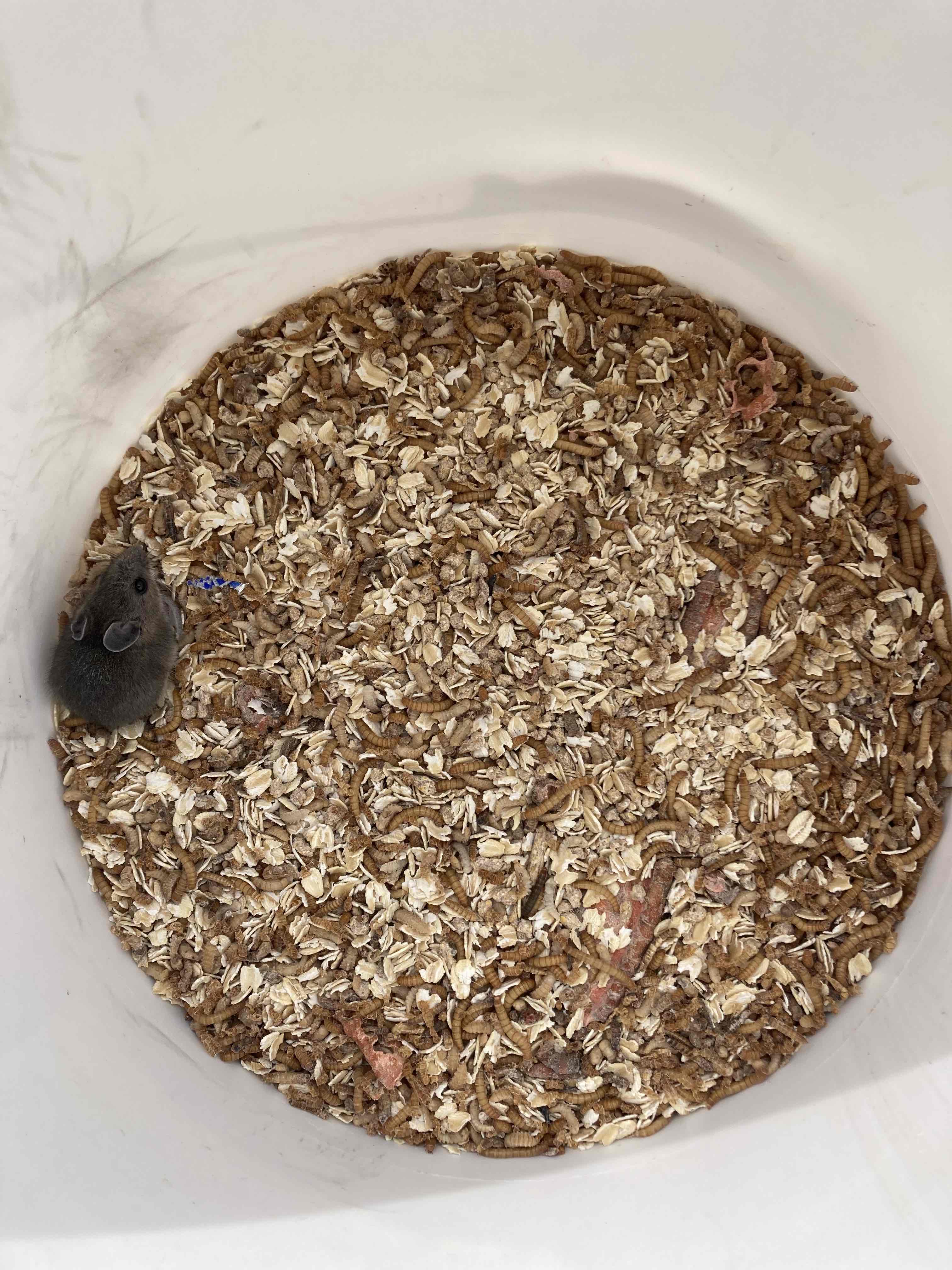
Since I've had to keep mealworms to feed my bat clients over the winter, I've discovered the perfect mouse trap. Mice love to eat mealworms, and with a stack of unused critter keepers, I'd inadvertently made a ramp up to top of my joint compound bucket full of mealworms. Mouse climbs ramp, sees feast, jumps in, can't jump back out. It started with one...


and then came a mama mouse with four babies (how did this happen?? Were they hanging off her teats when she jumped down into the bucket?? Or did each one climb up behind her, see her, and jump in to join the others?) I need a trailcam in my basement. 


All told, I've now caught ten mice (two mamas with broods) in this gentle trap. I am SO glad to get them out of my basement!


I release them in a place where they can have shelter but won't annoy anyone, with a pile of seed to feed from until they find their way.

With the latest white-footed mouse family as impetus, I decided to make a trek up to an old farmstead I used to visit with Chet. I knew the trees and shrubs would be in full bloom around the swiftly decaying house, my favorite combo of weathered wood and colored petals. 


It did not disappoint.

I'd heard toads trilling in the puddles at home, and here in a road puddle was the coiled evidence of their work in the night. 


I must revisit and see if these peaches are any good! The tree is enormous.


It hurts to see the lath fall and expose the old house's bones. One by one the buildings I love have fallen or been torn down, so I photograph them while I can.


Beautiful spirea, weathered lath.


The first tiger of the year in a riot of peach blossoms. I'd see one back at home too, flirting with daffodils...there's not a lilac flower (their usual first food) to be found this early. 


Birdseye speedwell has such a sweet true blue, the first of early spring.

I turned for home, hearing the first yellow-throated warbler of the spring singing his sweet descending  notes from the tall pines along the farm road. 

There was a pair of courting falcate orangetip butterflies at my last daffodils!
Click on the photo, please, to see the orange tips of the male fluttering above the female, who has her abdomen sticking straight up--a butterfly's way of saying "I have a headache."


A chipping sparrow sorted through seed hulls beneath the feeder. They've arrived and are singing, adding their somewhat tuneless trill to the mix of nearly identical trills in my yard.


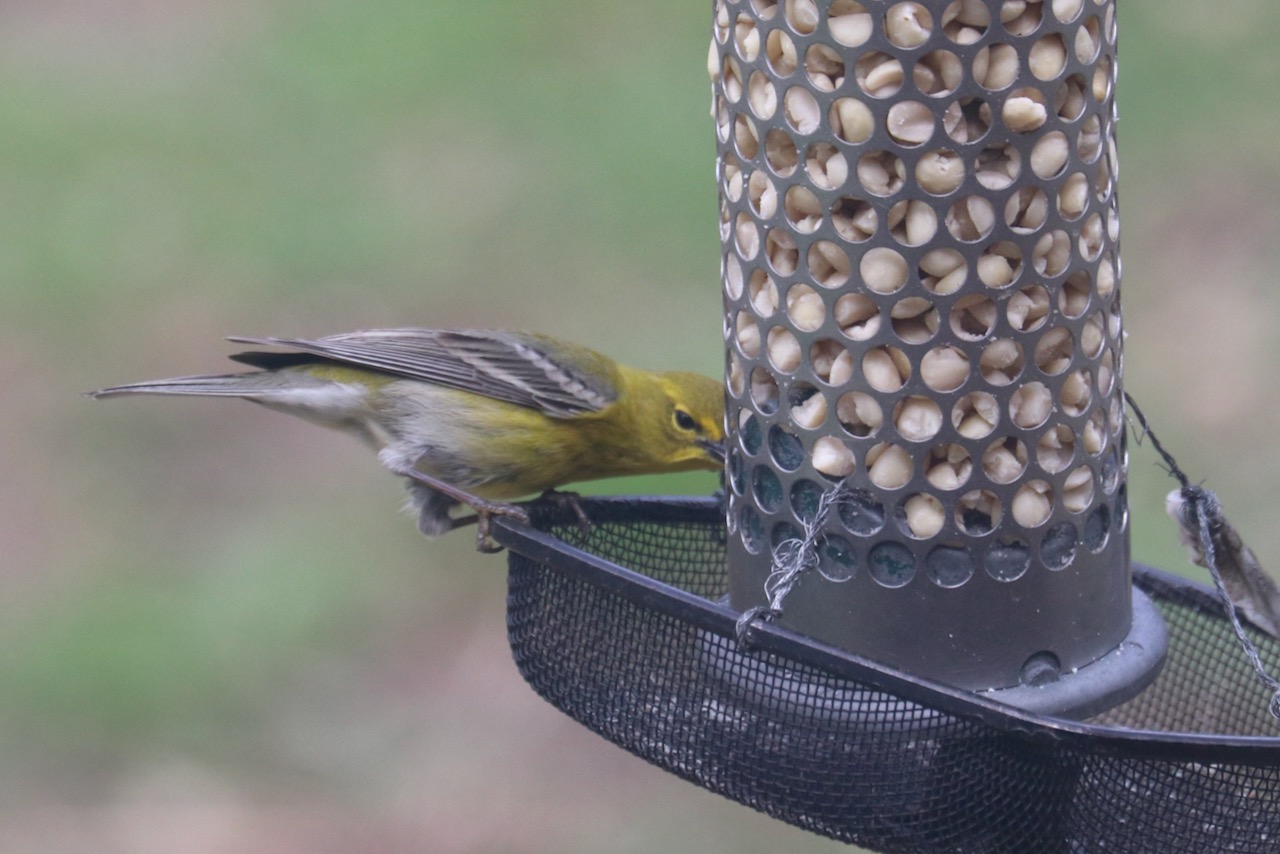
The pine warbler pair is still around; the male expertly extricating bits of peanut


and gagging them down before my delighted eyes.


He sings constantly, his trill softer and more melodious than the more percussive chipping sparrow's...
and more constant in pulse than the looser trills of dark-eyed juncos. It's a lot to sort out for the ear birder!

All this warbler action and the 85 degree temperature on this fifth of April finally moved me to get the WarblerFall going! I've never put it out this early, but like Steven Tyler, I don't want to miss a thing!

I made a presoak bucket of cold water, another big bucket of hot soapy water and a rinse bucket as well, and I commenced scrubbing clean all the flat rocks that had been lying unused all winter. Finally I was ready to construct the WarblerFall.

I plugged it in, got the water music just right and popped into the studio to watch and shoot through the window. First clients were a cardinal and a house finch!

The Carolina chickadee slaked its thirst


and finches gold and house descended again and again. 


A house sparrow took a drink, and then two male brown-headed cowbirds took the first baths,


Maybe you don't like cowbirds. But remember: These are native birds with a very, very interesting life history. And LOOK at them!


 and within minutes, six species of birds had joyfully broken the champagne bottle on the prow of my 2023 WarblerFall. It was so clear to me that they all remembered the setup from last season, and were delighted to welcome it back.

And so was I. I cranked open the studio window so I could hear the sound of fluttering wings and water droplets flying, and together the birds and I welcomed spring with water music. 
I washed the heated pet dish and put it aside, knowing I'll have to watch night temperatures for at least the next month. But it's worth it to see this cavalcade of happy drinkers and bathers again. What a treat, what a delight--the gift that gives and gives.

If you've been meaning to order your WarblerFall plans, don't let me stop you! :) 


THANK YOU for your continuing support!

JZ
 

[Back to Top]