I'm an artist and writer who lives in the Appalachian foothills of Ohio. With this blog, I hope to show what happens when you make room in your life, every day, for the things that bring you joy. Strange...most of them are free.
Thurs. Feb. 27, 2020, 7 PM: "Saving Jemima: Life and Love with a Hard-luck Jay" at
Mt. St. Joseph University Theater, 5701 Delhi Rd., Cincinnati, OH 45233. Doors open 6:30 pm.
For info call Colleen McSwiggin (513) 244-4864
Mar. 11-15, 2020: Bird Friendly Backyard workshop and Saving Jemima talk at Joint Conference, N. Am.
Bluebird Society/Bluebirds Across Nebraska, Holiday Inn Convention Center, Kearney, NE. Right in the middle of
sandhill crane migration! Call (308) 237-5971 for reservations.
Mon. Mar. 23, 2020, 6 PM: "Saving Jemima: Life and Love with a Hard-luck Jay" at Morgan Co. Master Gardeners Event, Twin City Opera House, 15 W. Main St., McConnelsville, OH. Free and open to the public. Call (740) 962-4854 for information.
Sun. Mar. 29, 2020, 3 PM: "Saving Jemima: Life and Love with a Hard-luck Jay" at
Sunday With Friends,, Washington Co. Public Library, 205 Oak Hill St. NE, Abingdon, VA 24210. For more information, call (276) 676-6390
Apr. 30-May 2, 2020: Julie Zickefoose at New River Birding Festival, Opossum Creek Retreat, Fayetteville, WV. Friday night keynote: Saving Jemima. Curtis Loew, miracle curdoggie, presiding.
May 7, 2020, 7 pm: "Saving Jemima: Life and Love with a Hard-luck Jay" at Campus Martius Museum, Washington and Third Streets, Marietta, OH. Booksigning after. If you missed the Esbenshade lecture/ People's Bank talk in November 2019, this is your event!
Weds. May 13 2020, 5:30 PM: "Saving Jemima: Life and Love with a Hard-luck Jay" at Roger Tory Peterson Estuary Center's event at Essex Meadows, 30 Bokum Rd., Essex, CT 06426
This event is open to the public.
Thurs. May 14 2020, 6 PM: "Saving Jemima: Life and Love with a Hard-luck Jay" at New Haven Bird Club's Annual Banquet, Amarante's Restaurant, 62 Cove St., New Haven, CT 06512. This event is open to the public!
Sat. May 16, 2020: "Saving Jemima: Life and Love with a Hard-luck Jay" for Bergen Co. Audubon Society at
Meadowlands Environment Center, 2 DeKorte Park Plz, Lyndhurst, NJ 07071
Time to be announced. Call (201) 460-1700 for more info.
Sun. May 17, 2020, 2 PM: "Saving Jemima: Life and Love with a Hard-luck Jay" at White Memorial Conservation Center, 80 Whitehall Rd., Litchfield, CT 06759. Call (860) 567-0857 for information.
Tues. May 19, 2020, 7 PM: Good Reads on Earth Author Series, by PRI's Living On Earth with Julie Zickefoose and Saving Jemima at Mass Audubon's Drumlin Farm Wildlife Sanctuary, 208 South Great Rd., Lincoln MA 01773. Includes audience participation, and will be taped for airing on public radio! Get the book first, read up and call (781) 259-2200 for information.
Thurs. May 21, 2020 6 pm: Julie Zickefoose, "Saving Jemima: Life and Love with a Hard-luck Jay" at
Bigelow Chapel, Mount Auburn Cemetery, 580 Mt. Auburn St. Cambridge MA 02138. Call (617) 547-7105 for more info.
On April 5, it seemed like everything happened at once. I credit Curtis for getting me out every single day, rain or shine, for a walkaround. I suit up and out we go. The day dawned so mild that for the first time since...I don't know when... I danced out in a tank top and cropped pants. Oh, the feel of the warm breeze on bare skin, lifting my arm hairs at long last. I love that feeling.
The first azure bluets have opened! Who can blame them, on a 68 degree morning?
Here come the dogwoods! So early, early in the spring.
My dad used to say that a warm wind will whip the flowers and leaves out. And so it does.
I saw a female bluebird slip out of the house by my mailbox. As far as I know, this is the first nest on
my trail. I'm so glad to keep finding empty boxes in early April. With the way springs go around here, the longer they wait, the better! My enthusiasm for bluebirds is heavily tempered by worry for them when the weather turns nasty. The early nests are likely to be snowed upon, and then comes the worry and work of feeding babies through snowstorms. Please, please, please not this year. I've got so much travel coming, and a magazine to edit, and six bats to condition for release, and it all has to happen in April and May.
Out in the orchard, a blue-gray gnatcatcher whined, but I couldn't find it against the white-gray sky. Same for the liquid twitter of the first tree swallow. Oh my gosh, how those quiet songs electrify me! Spring is here, it's here, ready or not.
I did find the first yellow-rumped warbler of the year, though, and was very surprised to see it was a female. Usually, male warblers come through first.
When you click on the photo you can see that she's catching and eating little bees who are visiting the elm flowers. There is a whole world of small bees I know nothing about, but I have friends who know. This one's for you, Laura H!
I was amazed to see the first clouded sulfur butterfly of the spring fluttering erratically over the dead grasstops, and elated to find a Henry's elfin feeding at spicebush in the orchard. You have to look for this tiny brown butterfly early, early in the spring. Its caterpillar eats redbud (obligingly blooming as the butterflies emerge)
it flies in March and early April; it's cute as a button and I've been looking for them and usually finding them in my orchard for 30 years now. I like the silken spider line in this shot.
Henry's elfin Callophrys henricii on spicebush
Since I've had to keep mealworms to feed my bat clients over the winter, I've discovered the perfect mouse trap. Mice love to eat mealworms, and with a stack of unused critter keepers, I'd inadvertently made a ramp up to top of my joint compound bucket full of mealworms. Mouse climbs ramp, sees feast, jumps in, can't jump back out. It started with one...
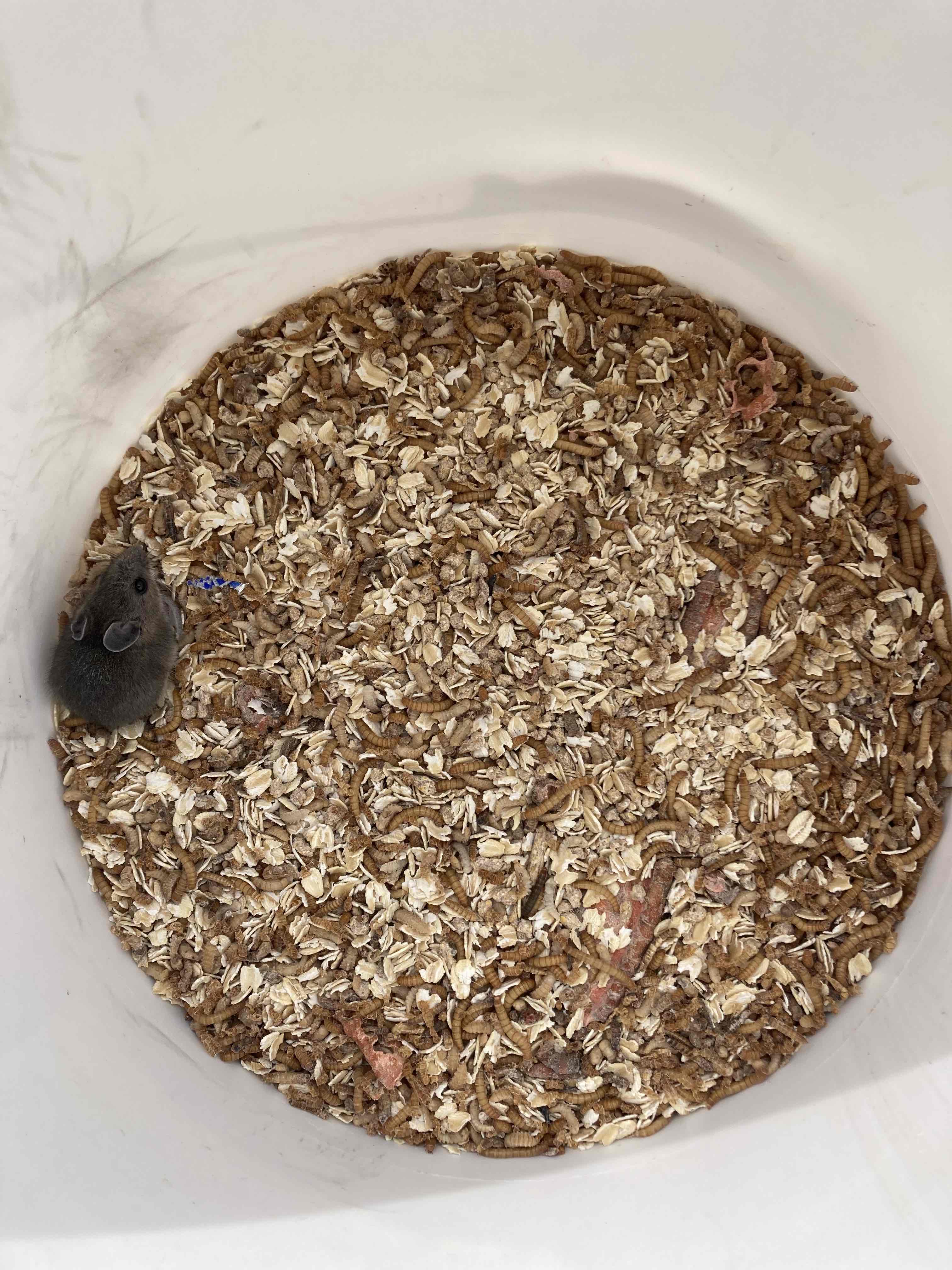
and then came a mama mouse with four babies (how did this happen?? Were they hanging off her teats when she jumped down into the bucket?? Or did each one climb up behind her, see her, and jump in to join the others?) I need a trailcam in my basement.
All told, I've now caught ten mice (two mamas with broods) in this gentle trap. I am SO glad to get them out of my basement!
I release them in a place where they can have shelter but won't annoy anyone, with a pile of seed to feed from until they find their way.
With the latest white-footed mouse family as impetus, I decided to make a trek up to an old farmstead I used to visit with Chet. I knew the trees and shrubs would be in full bloom around the swiftly decaying house, my favorite combo of weathered wood and colored petals.
It did not disappoint.
I'd heard toads trilling in the puddles at home, and here in a road puddle was the coiled evidence of their work in the night.
I must revisit and see if these peaches are any good! The tree is enormous.
It hurts to see the lath fall and expose the old house's bones. One by one the buildings I love have fallen or been torn down, so I photograph them while I can.
Beautiful spirea, weathered lath.
The first tiger of the year in a riot of peach blossoms. I'd see one back at home too, flirting with daffodils...there's not a lilac flower (their usual first food) to be found this early.
Birdseye speedwell has such a sweet true blue, the first of early spring.
I turned for home, hearing the first yellow-throated warbler of the spring singing his sweet descending notes from the tall pines along the farm road.
There was a pair of courting falcate orangetip butterflies at my last daffodils!
Click on the photo, please, to see the orange tips of the male fluttering above the female, who has her abdomen sticking straight up--a butterfly's way of saying "I have a headache."
A chipping sparrow sorted through seed hulls beneath the feeder. They've arrived and are singing, adding their somewhat tuneless trill to the mix of nearly identical trills in my yard.
The pine warbler pair is still around; the male expertly extricating bits of peanut
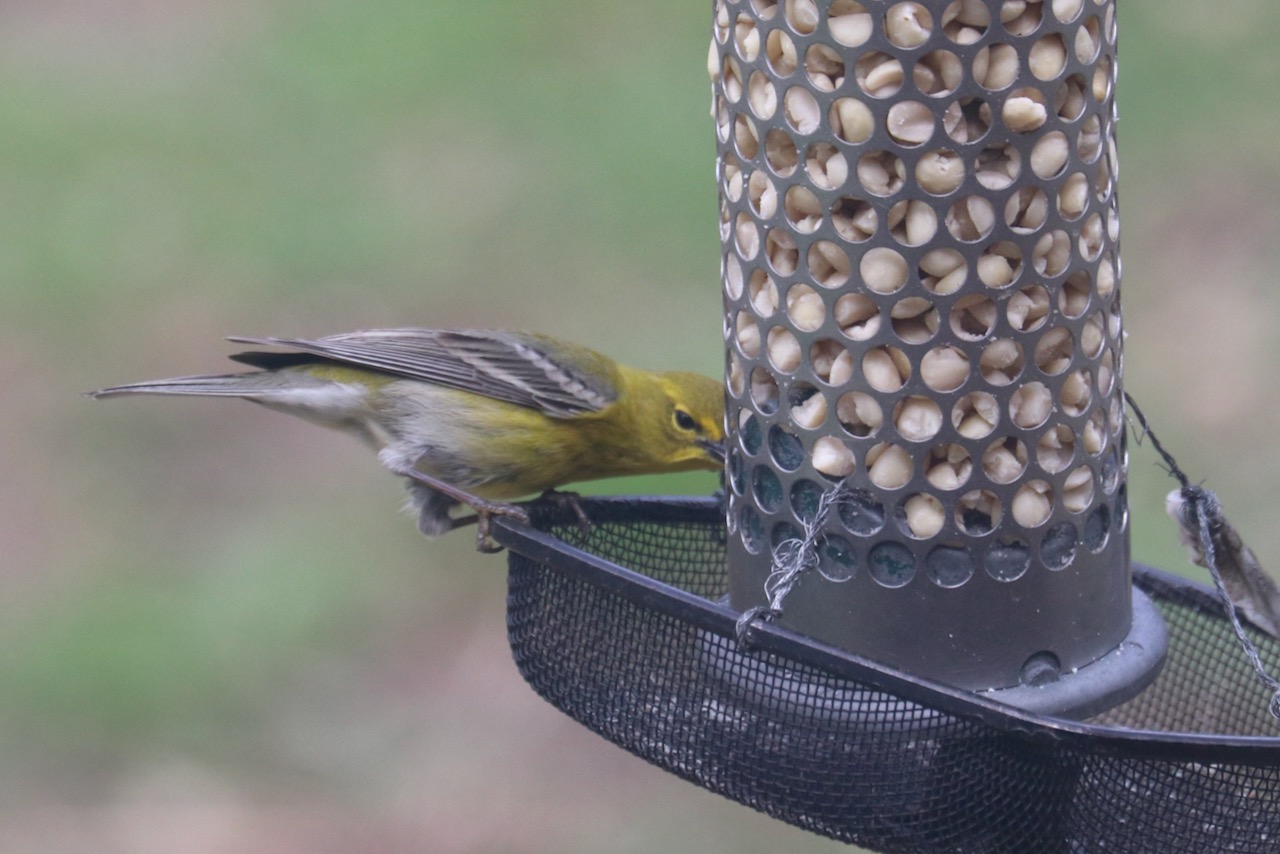
and gagging them down before my delighted eyes.
He sings constantly, his trill softer and more melodious than the more percussive chipping sparrow's...
and more constant in pulse than the looser trills of dark-eyed juncos. It's a lot to sort out for the ear birder!
All this warbler action and the 85 degree temperature on this fifth of April finally moved me to get the WarblerFall going! I've never put it out this early, but like Steven Tyler, I don't want to miss a thing!
I made a presoak bucket of cold water, another big bucket of hot soapy water and a rinse bucket as well, and I commenced scrubbing clean all the flat rocks that had been lying unused all winter. Finally I was ready to construct the WarblerFall.
I plugged it in, got the water music just right and popped into the studio to watch and shoot through the window. First clients were a cardinal and a house finch!
The Carolina chickadee slaked its thirst
and finches gold and house descended again and again.
A house sparrow took a drink, and then two male brown-headed cowbirds took the first baths,
Maybe you don't like cowbirds. But remember: These are native birds with a very, very interesting life history. And LOOK at them!
and within minutes, six species of birds had joyfully broken the champagne bottle on the prow of my 2023 WarblerFall. It was so clear to me that they all remembered the setup from last season, and were delighted to welcome it back.
And so was I. I cranked open the studio window so I could hear the sound of fluttering wings and water droplets flying, and together the birds and I welcomed spring with water music. I washed the heated pet dish and put it aside, knowing I'll have to watch night temperatures for at least the next month. But it's worth it to see this cavalcade of happy drinkers and bathers again. What a treat, what a delight--the gift that gives and gives.
If you've been meaning to order your WarblerFall plans, don't let me stop you! :)
I started this post before I left for Ecuador October 24. I wound up leaving only one day to pack and prep for the trip, so it has been orphaned for awhile, floating around in cyberspace, hoping to become a whole blogpost. I'll leave the first part as it is, and finish it up. Heads up: It's going to be tough going for people who aren't used to looking at kills. Proceed with caution, and, I hope, with the same sense of wonder and curiosity that I have.
I've been working really hard lately to get Saving Jemima as done as I can get it before I go to Ecuador. I've barely looked up. One good thing about having no one around is I can work a 14 or 16-hour day and not offend a soul. So that's what I've been doing. I have loved every minute of it.
I glance up a lot, watching the blue jays at the feeder, watching the red and white- breasted nuthatches, the cardinals, the woodpeckers. I'd been seeing turkey vultures sailing over all day, which I found unusual for late October. I thought about it and wondered what was up.
Late afternoon came and it was spitting rain. I wanted to get out and see the sky, but I knew better than to start a run. So, uncharacteristically, instead of heading out on foot, I climbed in the car to drive out into the country. I took my big camera along. I just had a feeling.
And there they were, lots of them, circling over a big hayfield on the corner of my road and the county road. Glory rays streamed down. They looked so fine up there.
I parked the car to take some photos and wonder what they were up to.
I decided to head into the hayfield to see. I had a feeling I knew what it was. There were too many vultures for it to be something small. And bow season has just started here.
Yep. Knew it. In early November of 2016, they killed my crooked doe Ellen this way. Just a small, inconsequential doe, an animal nobody would miss, a little something for live target practice. Maybe the same person who killed Ellen had turned his truck into the approach to this field, just one over from ours, fixed this doe in the glare of his headlights, and taken her down. What sport, what fun. Just getting in shape for the season, sighting in the bow or gun.
I know the poachers are stalking when I find things like this, when the beer cans start to accumulate along my road. They show the same disregard for beauty as they do for life.
I didn't know this animal, thank goodness. Though it would be hard to tell who she was now. Now, she was nothing but a carcass.
I made some images. How could I not? The grass was flattened all around her where the vultures had been tramping. I could see that no other animals had been there, because the carcass was opened only at the back and front, the way vultures do.
They'd been working on her all day. I stood there, with the fermented contents of her rumen scenting the air, thinking that at least she'd go to feed a nice flock of vultures, to speed them on their way to Central America.
I left her then, and went on to see some old house friends on up the county road. It was that kind of day, glowering and gloomy, and old houses look good in this kind of light.
If there's a classic Ohio farmhouse, this is it. Although the beveled corner is atypical, the porch and foursquare design is not. There's a ramshackle addition off the back, which adds to its interest. Gosh, I'd love to go inside. But I have never tried the door.
Across the street, two other dwellings are slowly deliquescing.
I like the addition on the big house, like a sloping rump off the back. Sooner or later, people ran out of space, and then they'd tack something on the side or back of the house to give them a little breathing room, a place to hang some coats, stack some boots, keep the egg baskets.
I'm not sure what the little building is off to the side. A summer kitchen?
Whatever it is, it's sweet, and it reminds me of North Dakota.
The birds have been perching on what little furniture remains inside.
I'm thinking that's an eastern phoebe's latrine there.
I love this little scene. The table isn't much good any more. But oh, the patina on the walls and floor.
Heck of a view out the window: cattle moving easily across the land. While I was shooting the scene, an osprey flew over. A late osprey! They usually like to be gone before it gets very cold, as they don't have down feathers.
It was getting so dark I figured I'd head back home. A pale spot in the woods border resolved into a young red-shouldered hawk. If you click on the photo you'll see it can't be anything else. Well, I could see that. So many things go into telling me that's a redshoulder and not a redtail or a Cooper's hawk. I'm not even considering broad-wing, because they're long gone, having migrated in September.
It's got big blobby markings on its belly, and no belly band--the blobs are just scattered across the white. It's got really small feet. Redtails have big feet. The tail is banded, but nondescript, as would be that of a young redtail. Overall it's small but chunky, not lean and long like a Cooper's hawk would be, or urn-shaped like a redtail. And it's just a-settin' there, redshoulder style. Yep. For whatever reason young redshoulders just pop up this time of year. Maybe that's where they get the old name, Winterhawk.
I passed the carcass site again, and the vultures were still wheeling very low. I left them to their meal.
The next morning, I came out early to see what had happened to the carcass overnight.
When I last saw her, she looked like this. Entire, but for some missing bits.
There was still a vulture coursing low, unusual for so early in the morning.
As I approached, a great flock of crows rose up cawing. It was such a beautiful ragged sight I had to make a video. One vulture was already up and feeding.
I walked up to where the doe, who had weighed more than 100 pounds, had been, and she was simply gone.
I hadn't expected that!
Nothing but the stain of her last meal remained.
But there were plenty of clues. A stray bone:
One ear.
I could see the drag mark where she'd been pulled away toward a distant line of firs, originally planted as a windbreak for the farmhouse that no longer graces this field. I stood, stunned, thinking about the power of the coy-wolf or coy-wolves that must have done this.
A forelimb!
I continued to follow the trail. Here's the other ear.
Finally I found all that was left of the doe.
I was flabbergasted.
How many coy-wolves would it take to reduce her to a ribcage and a head, overnight?
A single turkey vulture feather, black with a surprising white base, reminded me that the coy-wolves had had help.
There she lay, in the dancer's point in which they'd left her, dragged by one hind hoof hundreds of yards down the haymeadow. And there they had finished her off.
I could only marvel at the efficiency of the operation; the day shift of vultures and crows starting the cleanup, and giving way after dark to a pack of coy-wolves. She was gone, overnight.
In the ditch, a brace of asters and the spent heads of Queen Anne's lace gave a shot of fresh beauty to my wondering eye.
Back home, the flowers bloomed as if there were no tomorrow
and the bonsais promised to peak while I was away.
when I left October 24
I don't want to leave in late October, ever again. There is too much beauty, both harsh and soft, all around.
Thursday, April 6, 2023
19 comments