Background Switcher (Hidden)

Showing posts with label tiger swallowtail. Show all posts

The Fifth of April

Thursday, April 6, 2023

19 comments

On April 5, it seemed like everything happened at once. I credit Curtis for getting me out every single day, rain or shine, for a walkaround. I suit up and out we go. The day dawned so mild that for the first time since...I don't know when... I danced out in a tank top and cropped pants. Oh, the feel of the warm breeze on bare skin, lifting my arm hairs at long last. I love that feeling.

The first azure bluets have opened! Who can blame them, on a 68 degree morning?


Here come the dogwoods! So early, early in the spring. 
My dad used to say that a warm wind will whip the flowers and leaves out. And so it does.


I saw a female bluebird slip out of the house by my mailbox. As far as I know, this is the first nest on
my trail. I'm so glad to keep finding empty boxes in early April. With the way springs go around here, the longer they wait, the better! My enthusiasm for bluebirds is heavily tempered by worry for them when the weather turns nasty. The early nests are likely to be snowed upon, and then comes the worry and work of feeding babies through snowstorms. Please, please, please not this year. I've got so much travel coming, and a magazine to edit, and six bats to condition for release, and it all has to happen in April and May. 


Out in the orchard, a blue-gray gnatcatcher whined, but I couldn't find it against the white-gray sky. Same for the liquid twitter of the first tree swallow. Oh my gosh, how those quiet songs electrify me! Spring is here, it's here, ready or not.

I did find the first yellow-rumped warbler of the year, though, and was very surprised to see it was a female. Usually, male warblers come through first. 


When you click on the photo you can see that she's catching and eating little bees who are visiting the elm flowers. There is a whole world of small bees I know nothing about, but I have friends who know. This one's for you, Laura H!


I was amazed to see the first clouded sulfur butterfly of the spring fluttering erratically over the dead grasstops, and elated to find a Henry's elfin feeding at spicebush in the orchard. You have to look for this tiny brown butterfly early, early in the spring. Its caterpillar eats redbud (obligingly blooming as the butterflies emerge)


it flies in March and early April; it's cute as a button and I've been looking for them and usually finding them in my orchard for 30 years now. I like the silken spider line in this shot. 

Henry's elfin  Callophrys henricii on spicebush

Since I've had to keep mealworms to feed my bat clients over the winter, I've discovered the perfect mouse trap. Mice love to eat mealworms, and with a stack of unused critter keepers, I'd inadvertently made a ramp up to top of my joint compound bucket full of mealworms. Mouse climbs ramp, sees feast, jumps in, can't jump back out. It started with one...
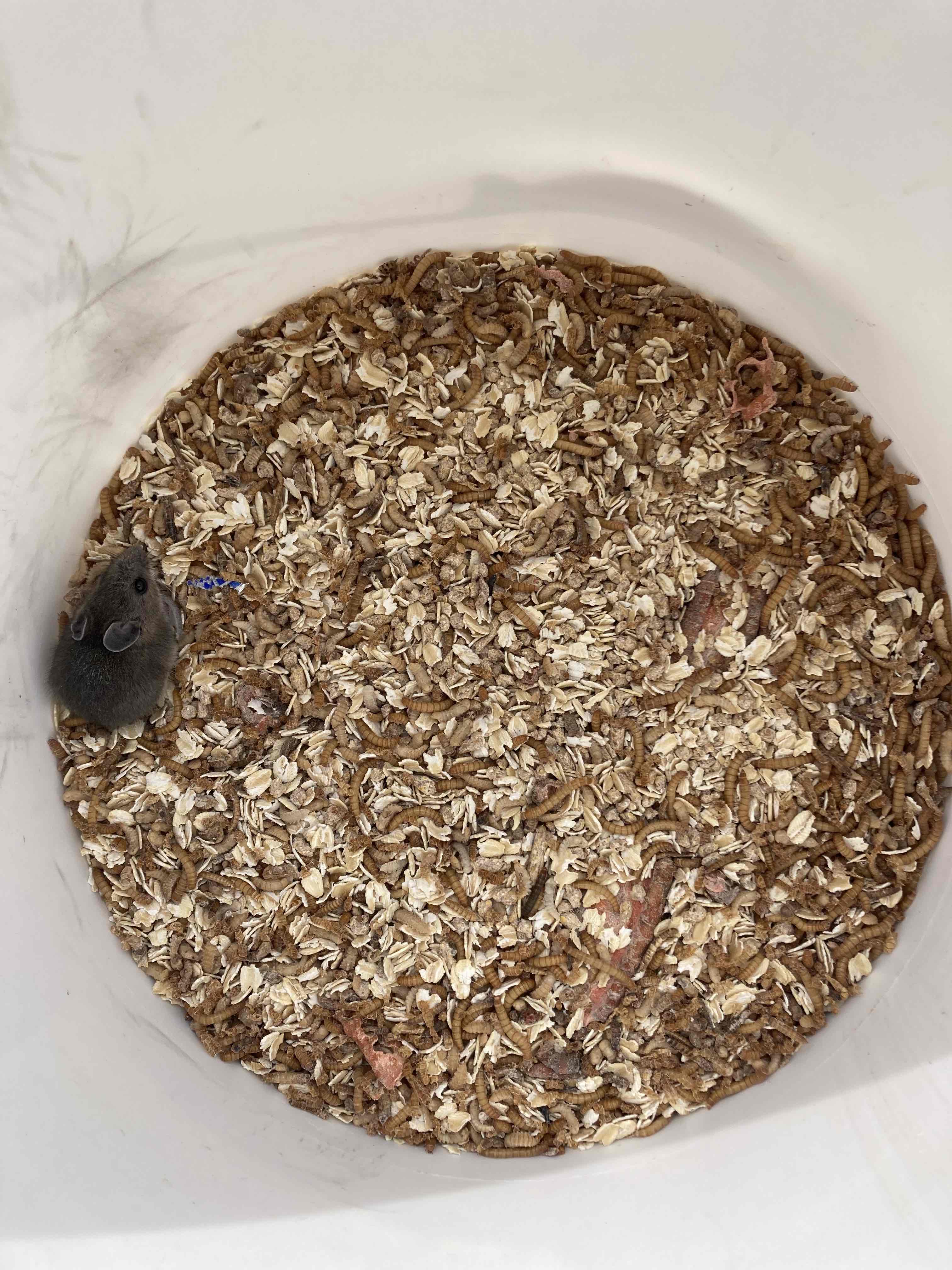

and then came a mama mouse with four babies (how did this happen?? Were they hanging off her teats when she jumped down into the bucket?? Or did each one climb up behind her, see her, and jump in to join the others?) I need a trailcam in my basement. 


All told, I've now caught ten mice (two mamas with broods) in this gentle trap. I am SO glad to get them out of my basement!


I release them in a place where they can have shelter but won't annoy anyone, with a pile of seed to feed from until they find their way.

With the latest white-footed mouse family as impetus, I decided to make a trek up to an old farmstead I used to visit with Chet. I knew the trees and shrubs would be in full bloom around the swiftly decaying house, my favorite combo of weathered wood and colored petals. 


It did not disappoint.

I'd heard toads trilling in the puddles at home, and here in a road puddle was the coiled evidence of their work in the night. 


I must revisit and see if these peaches are any good! The tree is enormous.


It hurts to see the lath fall and expose the old house's bones. One by one the buildings I love have fallen or been torn down, so I photograph them while I can.


Beautiful spirea, weathered lath.


The first tiger of the year in a riot of peach blossoms. I'd see one back at home too, flirting with daffodils...there's not a lilac flower (their usual first food) to be found this early. 


Birdseye speedwell has such a sweet true blue, the first of early spring.

I turned for home, hearing the first yellow-throated warbler of the spring singing his sweet descending  notes from the tall pines along the farm road. 

There was a pair of courting falcate orangetip butterflies at my last daffodils!
Click on the photo, please, to see the orange tips of the male fluttering above the female, who has her abdomen sticking straight up--a butterfly's way of saying "I have a headache."


A chipping sparrow sorted through seed hulls beneath the feeder. They've arrived and are singing, adding their somewhat tuneless trill to the mix of nearly identical trills in my yard.


The pine warbler pair is still around; the male expertly extricating bits of peanut
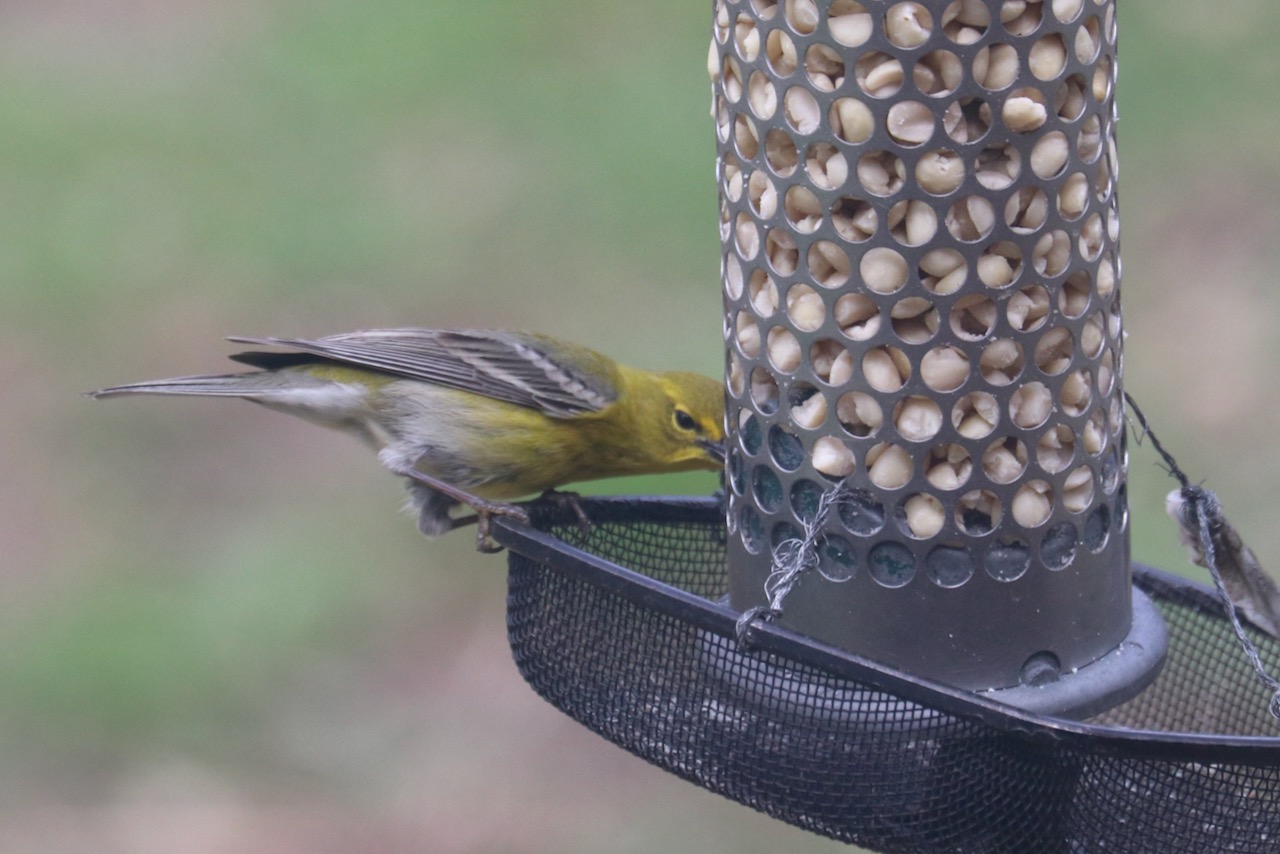

and gagging them down before my delighted eyes.


He sings constantly, his trill softer and more melodious than the more percussive chipping sparrow's...
and more constant in pulse than the looser trills of dark-eyed juncos. It's a lot to sort out for the ear birder!

All this warbler action and the 85 degree temperature on this fifth of April finally moved me to get the WarblerFall going! I've never put it out this early, but like Steven Tyler, I don't want to miss a thing!

I made a presoak bucket of cold water, another big bucket of hot soapy water and a rinse bucket as well, and I commenced scrubbing clean all the flat rocks that had been lying unused all winter. Finally I was ready to construct the WarblerFall.

I plugged it in, got the water music just right and popped into the studio to watch and shoot through the window. First clients were a cardinal and a house finch!

The Carolina chickadee slaked its thirst


and finches gold and house descended again and again. 


A house sparrow took a drink, and then two male brown-headed cowbirds took the first baths,


Maybe you don't like cowbirds. But remember: These are native birds with a very, very interesting life history. And LOOK at them!


 and within minutes, six species of birds had joyfully broken the champagne bottle on the prow of my 2023 WarblerFall. It was so clear to me that they all remembered the setup from last season, and were delighted to welcome it back.

And so was I. I cranked open the studio window so I could hear the sound of fluttering wings and water droplets flying, and together the birds and I welcomed spring with water music. 
I washed the heated pet dish and put it aside, knowing I'll have to watch night temperatures for at least the next month. But it's worth it to see this cavalcade of happy drinkers and bathers again. What a treat, what a delight--the gift that gives and gives.

If you've been meaning to order your WarblerFall plans, don't let me stop you! :) 


THANK YOU for your continuing support!

JZ
 

Midwest Native Plant Conference

Tuesday, August 17, 2010

11 comments
Science Chimp, ready for anything. Photo by William Ringer, a nature-loving Hoosier who gets around, from the Potholes of North Dakota to the Fens of Ohio.

On the first weekend in August, I traveled to Dayton to speak at the second annual Midwest Native Plant Conference. I couldn't know what a blast it would be. I was so freaked out at the thought that native plant purists would turn up their nose at my habitat gardening talk, rife as it is with Chinese buddleia and Mexican salvias

Autumn sage, Salvia greggii

and Chilean fuchsias, that I refused an invitation to speak at the first annual conference.

But my friend Kathy MacDonald persisted and assured me they really did want me to come, so I spent a couple of days tearing up my talk to emphasize native plants like these in my garden.

My cardinalflower Lobelia cardinalis bed, with some Salvia guaranitica "Black and Blue" and Salvia greggii "Cherry Chief" and Fuchsia "Gartenmeister Bonstedt" and Crocosmia "Lucifer" thrown in for fun and hummingbird appeal.


The naturalized purple coneflower Echinacea purpurea along our driveway. I find it grows best along woodland edges.


So I wrote a special piece for the occasion about native plant snobbery, useful exotics, why I love lilacs and tuberoses and crape myrtle and how I don't care what anyone says about them. I love them not because I am too dumb to know the difference between a good (native) plant and a bad (exotic) plant but because I love them. For my own reasons, for the memories and the beloved people I associate with them; just because they are beautiful and good.

Being non-native doesn't automatically make a plant (or any organism) bad, despite the awful, awful preponderance of invasive exotics from grass carp to bamboo. I was still nervous about how it might go over, scarred as I am from a few run-ins with people who consider anything non-native a noxious pest. I needn't have worried. The Native Plant conferees were the finest kind, friendly and warm and full of good humor. Front-loaded with Master Gardeners, in fact, who are used to working with plant material from all over the planet. The talk went well, I had a load of fun, and best of all there was a field trip to Cedar Bog just west of Springfield, Ohio. You must, must attend the next one if you love native plants and would like to learn more about using them in your landscaping.

The gorgeous conference room at the Bergamo Center in Dayton, where I was privileged to speak.

Cedar Bog, outside Springfield, is the only open fen where white cedar grows in Ohio. A fen is an open wet meadow through which little streams course. Heavily underlain by marl (limestone) and somehow having escaped the cement mining that ruined most of our other marl bogs, it's got a terrific floral and insect community, and it's full of things you can't see anywhere else.

Here's part of the open fen/wet meadow which was full of white boneset, tall ironweed (purple) and obedient plant ( Physostegia, pink, in background) as well as black-eyed Susans, hops, dodder, sandvine, nettles...on and on. It was full of butterflies!

Tiger swallowtails on pasture thistle.

A Monarch on tall ironweed.

And a black swallowtail, also enjoying pasture thistle.


A pugnacious hackberry emperor kept hitting me in the chest and sometimes below the belt as I trod upon his boardwalk. He looks mean, doesn't he? I was intimidated.

A gray hairstreak rubbed his hindwings together as he sipped from a yellow flower only Jim knows. Bog loosestrife? No. Some sorta St. Johnswort? I dunno. Hm. Sumpin'. This is the problem with being a generalist, and on the downside of 50. I should write this stuff down. I should know by now I won't remember it for ten minutes.


At Cedar Bog there are orchids in spring, like showy lady's slipper and dragonmouth. There are elfin skimmer dragonflies (exceedingly rare) and the also rare and charming seepage dancer, which were abundant when we visited.

Seepage dancer, Argia bipunctulata. Nice name! It has much shorter wings than the common bluet, but otherwise, it'd be hard to know you've got an endangered damselfly.

A far more common but unnamed damselfly. My field guide only does dragonflies. Rats! Arrgh! Jim told me what it was...I found a beautiful pdf, Dragonflies and Damselflies of Ohio, by my friend Dave McShaffrey online! Maybe maybe a female blue-ringed dancer?

Anyone?

There is spiked gayfeather Liatris spicata
and cowbane Oxypolis rigidior

which is host to black swallowtail larvae, which eat things in the parsley and carrot family.

There will be more natural wonders from Cedar Bog in the next post. If you're passing through Springfield, Ohio, on I-70 (and judging from the traffic, who isn't?) you must take a detour and walk this amazing boardwalk. I had time for less than half of it and came out wanting to return soon! What a glorious place, with a wonderfully appointed and staffed "green" visitor's center. Check out their website, and visit Weds-Sun 10-4.

Yes, I'm posting one more day a week, to make three: Sundays, Tuesdays and Thursdays. There's just too much good stuff to share and the backlog is tremendous now.

And today, August 17, is Charlie the chestnut-fronted macaw's 21st birthday. I found my check register from 1989 with the record of his purchase. That was before kids, house, dog, Ohio; even before Bill. We're in it for the long haul. He'll be trundling around the studio floor, playing Stab the Doll with Liam, stealing toys from Chet, hanging out on my shoulder as I paint, cackling maniacally under his favorite blue cabinet, and sharing stirfry and a beer with Bill at sundown--just another day for a kooky and well-loved little macaw.

Ooh, that's GOOD!

Caterpillar, Butterfly

Monday, August 4, 2008

9 comments

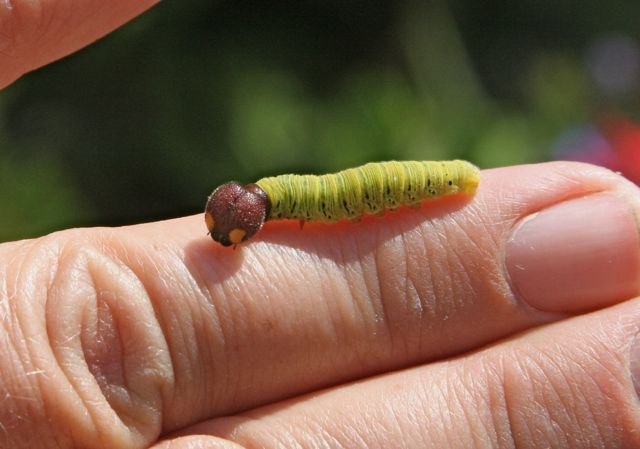
When Phoebe went to the garage to take out the trash not long ago, she was surprised to find this little character crawling on the can lid. Oh! what a marvelous little guy. She named him Fredward, and our quest to identify him began. He had to be the progenitor of something wonderful.

We turned to one of my favorite books, David L. Wagner's Caterpillars of Eastern North America: A Guide to Identification and Natural History.

Because I was in a hurry, I didn't have time to go through the whole book, and I failed to find him. Alas, my caterpillar classification skills are embryonic at best.

So when Martha Weiss, my dear college friend, came to visit recently, I described the little beast to her. "Did he have a head like an M&M?" she asked.

"Yes! An outsized ridiculous looking M&M wobbling around."

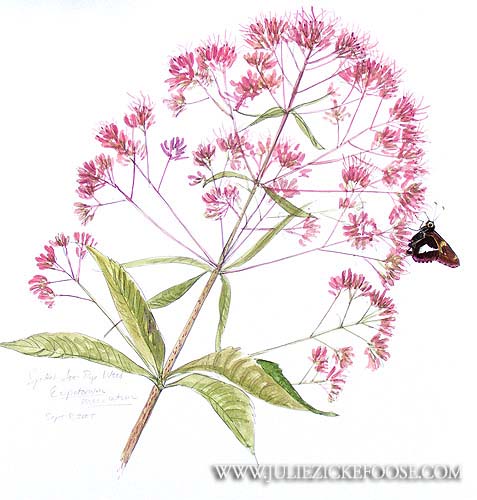
"Probably a skipper," she advised. So I ran to Wagner, turned to the section on skippers, and voila! there was Fredward. He is the larva of a silver-spotted skipper, and one of their brood plants is wisteria (among other legumes). Sadly, we are being devoured by the wisteria that was planted around the old farm place. But it is good for SSSK's, of which we have multitudes. Here is my painting of one, from Letters from Eden.


Reading further in Wagner, I found a citation regarding the anal comb of the silver-spotted skipper caterpillar, which enables it to shoot its feces quite a distance out of the little shelter it constructs in a glued-together wisteria leaf. The citation was for a scientist named Weiss.

It was one of those full-circle moments. Martha gave me the book a couple of Christmases ago, identified the caterpillar for me, and there she was in the text, telling us all how caterpillars keep their houses clean.

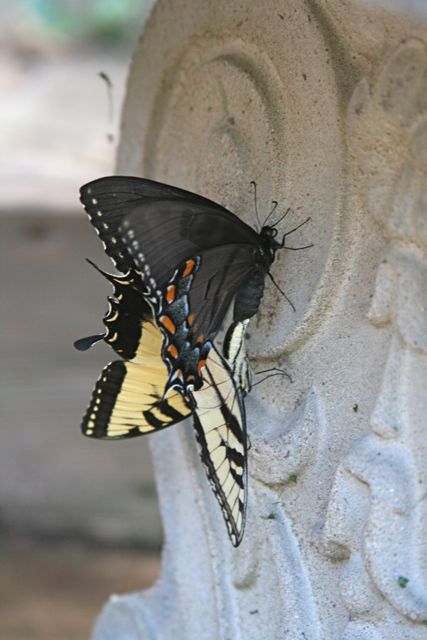
In a somewhat less-sublime lepidopteran moment, Phoebe spotted a pair of tiger swallowtails doing their thing. The male is yellow; the female often turns up in a black morph, especially in late summer. We happened to be having a band practice that afternoon, so when she sounded the alert, everyone came out of the garage to see this marvelous thing. Here's the money shot, female superior.
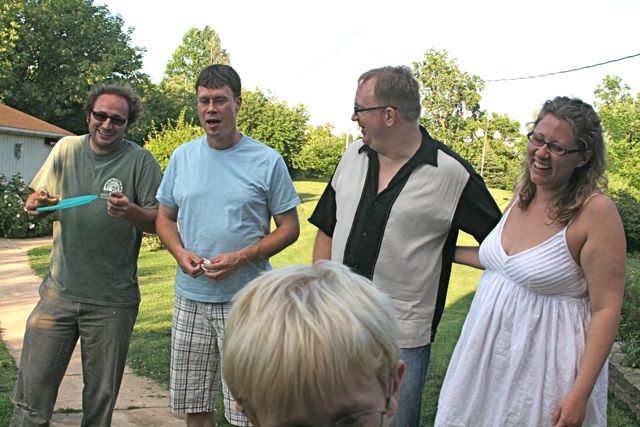
And, because these are my friends, I was not surprised but highly amused to find our bass player Clay launching into a beat-box porn soundtrack.
Chickawow chickawow wow wow chickawow.

Yes, that is my sweet Liam in the foreground, wondering what on earth these people could be doing. Well, honey, they are performing a porn music soundtrack for mating butterflies. I'll explain more when you're 21, but by then you'll have your own band, and you'll be goofing around just like us.
[Back to Top]