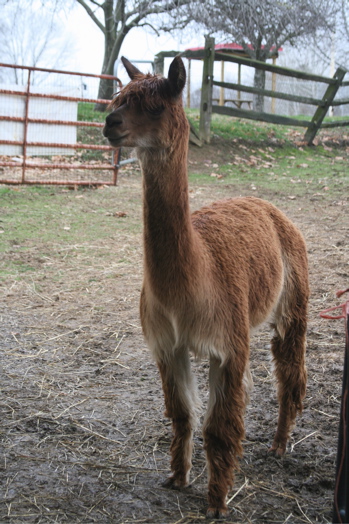
Alpacas are bred each year because their fiber is finer when they're pregnant or nursing.
The other reason the females are bred each year is because they're so darned valuable. That was a big eye-opener for me. There is an alpaca stud named Cantano of Peru who is valued at $250,000.00. Ann told me that prices for alpacas have come down in recent years, and a pregnant female of high quality can be bought for around $20,000.00, down from perhaps $25,000.00 a year ago. It's all about the fiber, folks. Cantano is the winningest alpaca in America, for the luster, fineness, and density of his fleece. Although a research paper published by the Agricultural Issues Center of the University of California in 2005 examined the US alpaca industry and concluded thus: Current prices for alpaca stock are not supportable by market fundamentals; the industry represents the latest in the rich history of speculative bubbles.
Yeeks. I hope not to be around to hear the alpaca crash. The dot-com crash was deafening enough. And that's their opinion, those Californians. We're in Ohio.
Alpaca breeding, ideally, is carefully controlled, to give crias with the finest fiber. A female cria can be bought for about $5,000. The price goes up as the cria gets older. Ann told me that people can buy alpacas affordably if they have the patience to mature them, but it's anything but a "get rich quick" proposition. And an alpaca's value changes every month as it matures or puts progeny on the ground. Understandably, there is a lot of bartering and trading going on the in alpaca world, which probably helps explain why it's such a close-knit (pun intended) community.
Last summer, one of the Riverboat studs opened a gate--actually dismantled it--and all the males got in with all the females. We helped, didn't we, girls?
From this one saturnalia, four alpacas came away with unplanned pregnancies; fifteen of the females are pregnant right now. Oh, I'm wiggling with delight at the prospect of having 15 new crias to photograph! They're like liquid-eyed fawns from outer space, wearing tiny toe shoes.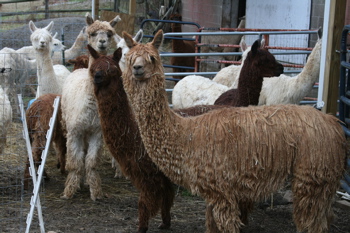 We helped, didn't we, girls?
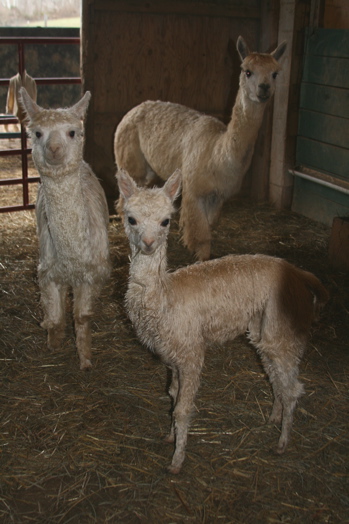 Since alpacas gestate for 11.5 months, most of the crias are due in June (the orgling orgy took place in July 2007).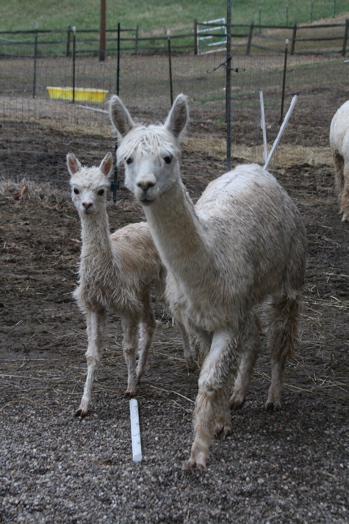
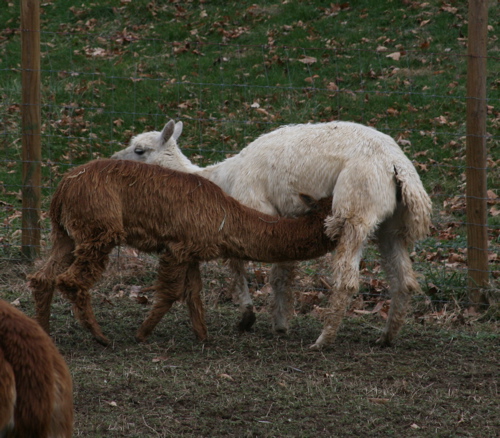
Crias nurse for about six months on average, though Annie and Charlie like to let the female alpaca decide when to wean her cria. This overgrown cria wasn't quite getting the message from its increasingly irritated mama.
Alpacas don't have a heat period like most animals; ovulation is stimulated by the act of mating, as it is in birds. They tend not to mature until age 2-3. Online, I found details about the male alpaca's wedding tackle that I noted with interest. It's extremely long, thin and prehensile. Ooo. Gotta navigate all that fluffy stuff, I reckon.
 White alpaca: Did your readers really need to know that?
Zick: PreHENsile??
Alpaca: So I expect we'll be seeing you in July.
Zick: Bet on it. I wanna learn how to orgle.
THIS JUST IN! Click here to hear an alpaca orgling!
If you listen to it for awhile, it is kind of sexy, in a Bogartesque way. Well, maybe a little more Peter Lorre than Bogart. Agggh!
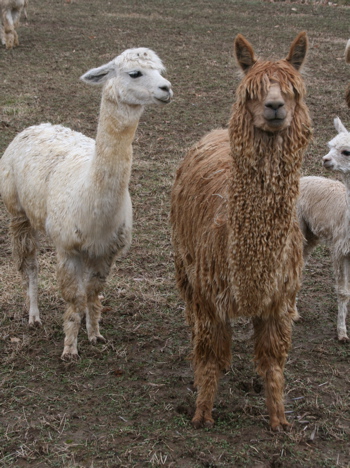
How gorgeous is this gal, with her lustrous dreadlocks? The alpacas in these shots have been shorn at different times, so some of them look all grown in, while others have shorter fleece. They're shorn once a year, but obviously, not all at the same time. More alpacas tomorrow. But no more prattle about speculative bubbles.








Wednesday, January 16, 2008
14 comments