Background Switcher (Hidden)

Showing posts with label ruby-throated hummingbird. Show all posts

Young Hummingbirds On the Loose!

Wednesday, August 4, 2021

6 comments

Summer. I love it. But I really, really love August, a month that doesn't get much respect because people remember it as too hot, too humid, too something or other. Here's how I see August. Everything is still growing and blooming as hard as it can. Baby birds have fledged, by and large, and are absolutely everywhere, at least on my ridgetop in southeast Ohio. Wherever I walk, I'm scolded by parent birds, who are telling me they have young ones hidden nearby. I hear a strange continuous rustling in pine needles and follow the sound to a male hooded warbler, puffed up, tail dragging, skittering slowly over the forest floor as he leads my eyes inexorably away from his nest. It is SO cool. To enjoy August, all you have to do is stop complaining and show up.


This is a typical move by a juvenile ruby-throated hummingbird. Young flight muscles tire easily, so they're always looking for a place to stand while learning to ply the flowers for nectar. You will not see an adult rubythroat busting a move like this.

They vie for privileges at the crocosmia blossoms with spicebush swallowtails. Crocosmia "Lucifer" is native to Africa, and is naturalized in places like Costa Rica and Scotland, my goodness. While it spreads in my beds, I haven't seen it popping up in other places in my yard or in southern Ohio. It grows from a bulb, but you don't have to lift it in the winter. Just leave it right where it is! For whatever reason, mine just went NUTS this summer of 2021. It was a gift from my friend Bonnie many years ago, but this year it took center stage, delighting the hummingbirds and swallowtails and me.

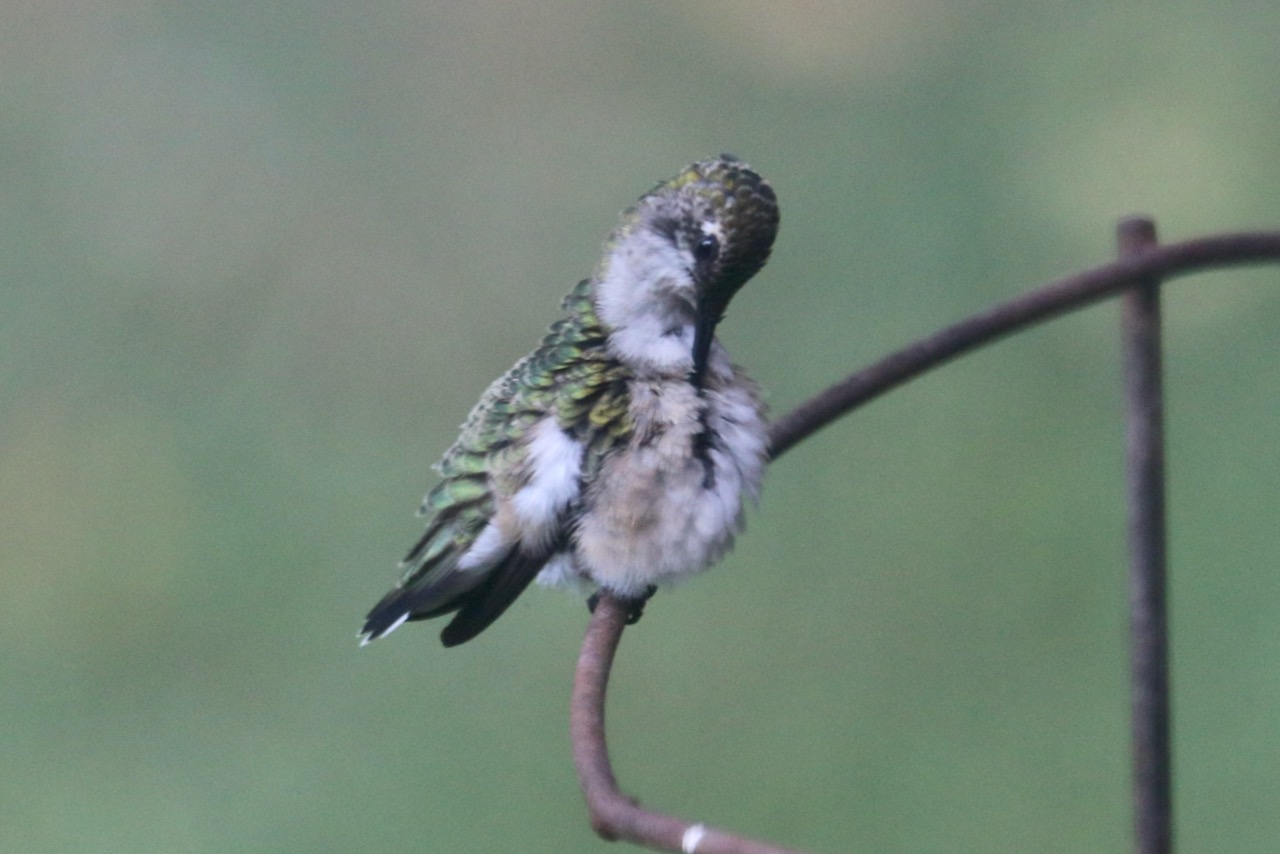
The young hummingbirds stop frequently to rest and preen.


I love being in on the intimate moments when they're acting like birds instead of insect helicopters.

Sometimes, when the sunlight is bright and clear and striking the flowers just below my studio window, I get some acceptable photos. Like this one:

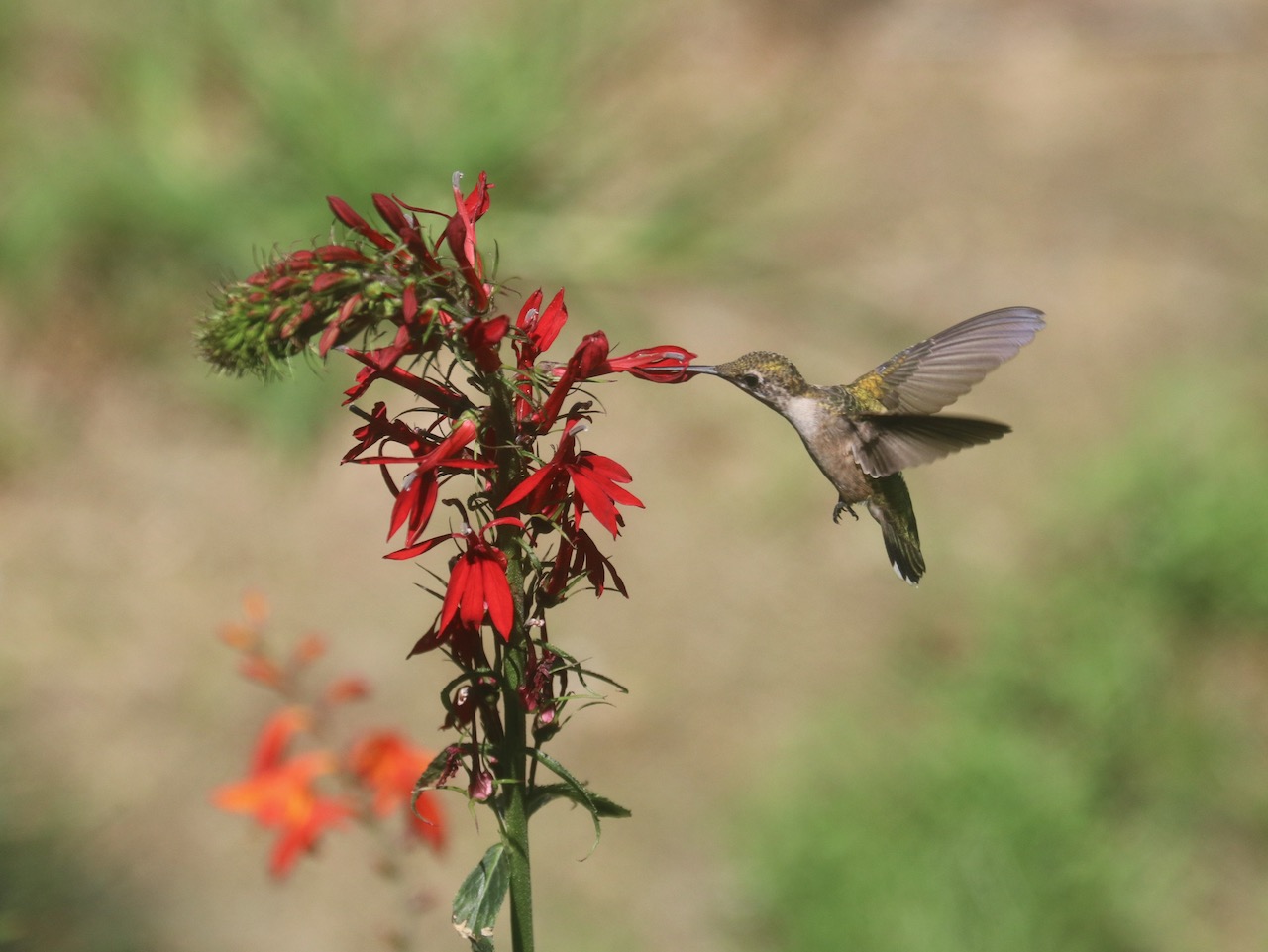
And this one, which is one of the better hummingbird photos I've taken. The trick is having sufficient light and fast enough shutter speed to freeze those wings.The brighter it is out there, the more likely you are to be happy with your shot.

I absolutely love the video game thrill of keeping my lens on a rapidly moving hummingbird. Or warbler, for that matter.

Pretty little glittering scrap of life, lighting up my world.

 I'm very grateful that the stem borers that attacked and killed my cardinalflowers last summer are nowhere to be seen this summer. This hardy native has thrown seed children all over the bed where it first started, and marched up along the north side of the house. I've aided the dispersal, transplanting many seedlings up into the front yard beds, which is now aflame with crimson blossoms and the little green sprites who feed on them. It is most satisfying. I've also given lots of cardinalflower seedlings to local friends, who very much appreciate these Ohio-tested natives adapted to our conditions. The trick in growing and propagating cardinalflower is not to deadhead it. Let it go to seed and disperse, then lay the ripe seedheads on bare soil where you want it to come up. Don't mulch a cardinalflower bed! you'll inhibit recruitment of seedlings. Do keep it moist. Be generous with water, especially in dry spells. 
Super tall stalks appreciate support, and hummingbirds love to perch on the rungs of tomato cages, too. Win-win. 
 
This is how the original bed, which I've had going for at least 20 years, looked in 2017. Borers killed these plants, but new ones have spring up and will soon be as tall and beautiful as the originals. In the meantime, the crocosmia has spread like mad, and I'll have to take some of it out to make room for more cardinalflower. A great problem to have!
 

Feeders are fine, as long as you keep them absolutely spotless and free of mold and bacteria. But there's nothing like watching hummingbirds feed the way they were designed to, at the plants they evolved with. Plant it and they will come!

JZ


Bokeh Bird

Tuesday, September 18, 2018

3 comments


This female ruby-throated hummingbird is sitting on one of the little shish kebab skewers that I provide for my clients. My clients being the gazillion birds who frequent my yard, who I'm trying constantly to please in creative ways. I've stuck the bamboo skewers, which are exactly the right gauge for tiny hummingbird feet, into the links of the chain holding up one of my hanging baskets. The skewers are almost never without a perching client, because they're close to the feeders and just right for fussy hummer feet.


I haven't known the term "bokeh" for too long. It sounds a bit like a Chet Baker word, doesn't it? It's Japanese, and it refers to the gorgeous thing that happens when the background of a shot goes all blurry and nice. What's behind this bird is my barn-red house siding with a blooming Achimenes "Pink Nighty" in a hanging basket. Wooo. That is some off-the charts nice bokeh. Especially the little dark patch framing the bird.


As soon as I saw her there on the skewer, with the flowers behind her, I knew I had a killer photo op. She was scratching away at her neck and head.


 You'd think a hummingbird's scratching foot would be lightning fast, but it isn't at all. She's got to bring that tiny leg up and over her big long wing, and that's really awkward. So she scratches very slowly.


Then she looks at her foot as if wondering how it got there, up over her wing, and how she's going to get it back where it belongs.


At length, she does, and she rests for a few moments.

Then it's time to scratch the other side of her face. You really must click on this one to embiggen it. Then you can see them all larger.


Because she is a hummingbird, there is always an argument in the offing. She cusses at an incoming bird


and sizes up her opponent. A second later, she shot straight up into the air in pursuit, and my precious moments with her were over.

I'm ridiculously attached to the few remaining hummingbirds in my gardens. I want them to stay forever. They won't, of course, but until they go, they'll get their portraits made. September is the month when the hummingbirds leave. Seems everyone leaves in September. But that also means everyone is passing through in September, and I get to photograph the parade!

Hummingbird Decoy Works!

Wednesday, August 29, 2018

6 comments

Along about Christmastime 2017, a package arrived from my new friend Susan Rankin-Pollard, a wonderful artist who specializes in picture book illustration.  See her amazing work on her Instagram account here. We'd met at a Highlights retreat where I was teaching, then been to Ecuador together for Sue's first real bird expedition. She was bitten hard by the birding bug, and what a place to receive one's baptism! In the box were some amazing ginger snaps from the Carolina Cookie Company, plus some lovely gewgaws that brought me joy. One of them appeared to be a hummingbird decoy. Well, maybe it was meant as  a Christmas ornament, but I decided to hang it outside this summer, hoping to attract hummingbirds.


 I am here to say it worked! I'm sure I'd never have had any hummingbirds on the cardinalflower unless that decoy had been doing its job. 


No way would they have checked out Pelargonium "Happy Thought" unless I'd hung the decoy.


When I see this, I imagine the bird going Neeerrrrrrroooooowwwww! under its breath.


Seriously though, I stare out the window a lot. Much less so this summer, because I'm nose to the grindstone on 20 watercolor paintings for Saving Jemima. They aren't just vignettes--they're full bleed full page chapter head illustrations. And they're SUCH FUN and SO AWESOME to do. I was meant to paint blue jays doing interesting stuff in cool settings. So lately I look at my work a lot more.  I've got a brutal deadline of October 1 to finish them, and September is just a hash of travel and speaking engagements and sending my kids off to far-away places. But that's life--it's what happens around the deadlines you set for yourself, that seem perfectly reasonable when you set them.

Thanks I'm sure to the bejeweled hummingbird decoy that brings them in to my gardens from far and wide, I see hummingbirds doing cool stuff every time I look up, and every once in awhile I raise the big rig and bang away at them. 

Caught this little feller flying backerds with rotational scoops of his tiny wings. Like backpaddling a canoe. That's really hard to do with anything but a hummingbird wing, because unlike most birds, the movable part of a hummingbird's wing is reduced to just the wrist and hand. If you're not at work and won't get stared at, spread your arms out to the sides and pretend you're a big hawk flying backward with rapid backstrokes. Doesn't work very well. It's hard. Now pull your elbows in tight to your sides so only your hand sticks out. Now pretend you're flying backerds. Works better when you can rotate the wrist, doesn't it? Psst...that's how they manage all those aerobatics. They fly with their hands.


The garden this time of year is dominated by juvenile rubythroats who are moving through on migration. It seems most of the adults have already migrated. Juvenile hummingbirds are really fun to watch, because they do funny, cute stuff. They're lazy, and like to see how many cardinalflower blossoms they can reach from the couch without having to fly. Mothers of teens will recognize this behavior.


But there's this thing they've been doing, that I've been trying to capture with my camera for weeks upon weeks. When they're done with a feeding bout, they fly up and for a micro nano split second they pay homage to the bejeweled hummingbird god that hangs just east of the cardinalflower bed.


I finally got some craptastic photos of the behavior. Since it's over almost before it starts, I have to prefocus on the ornament and wait for the bird to approach it. Because I have to shoot through a window which has bird netting over it, autofocus goes wild, focusing on everything but the bird, and most of the time I don't even get the ornament, much less the bird; I get great photos of the lawn behind the scene.

But I did get a few crummy-but-cute shots, and I wanted to share them with you.

Touching its wing


Checking out the other wing


 Flying together

and my favorite, lightly kissing its head.


 Knowing hummingbirds as I do, I'm pretty sure this juvenile is licking the ornament to try to figure out what it's all about. These are bad photos, but I'm happy to document the behavior, because I find it so predictable and endearing. It's not just one hummingbird that does it--they all do it.

So hang yourself a hummingbird decoy, and see what magic happens in your garden! This post is for Sue and Phil, with all best wishes on the move to OHIO!! Wahoo!! Smart move, if you ask me. Thanks for the decoy. It works!!

ZICK ALERT: The Rain Crows have a gig coming right up. 
 Blennerhassett Hotel, Parkersburg WV, Friday, Aug. 31, 7 pm.  We'll be in the beautiful Rose Garden if it's nice, in the sumptuous leather lounge if it's not; either way it'll be awesome. We have Matt First of the Sunset Roosters on guitar!! 


Red Alert for Hummingbirds

Wednesday, April 8, 2015

30 comments

Don't buy this. Don't pay $6.49 for something that you could make much better yourself for about a dime. This is not hummingbird food. It's sugar water, tarted up to look pretty with Red Dye #40. And it's really, really bad for hummingbirds. Read on.


She came to me as they all do, over the phone, with a worried, uncertain voice describing her predicament. She’d blundered into a chemical plant and was found, disabled, around 11 at night. Who knows how long she’d been there, circling the ceiling, bumping her tiny head until she fell senseless at someone’s feet? Repeated efforts to get her to drink nectar had failed, and she was fading fast. I met the caller in town, he on his lunch break, and he opened a makeshift containment system that consisted of two Chinet bowls, lined with tissues and taped together. She was lying on her side, curled in a C, as I would be were I a hummingbird who had been without food for 18 hours. I took the syringe of bright red nectar and inserted her bill into it, as he had repeatedly tried. I held her until she began to struggle, and in struggling her bill opened slightly. Some nectar flowed in and her tongue at last began to flicker, then lash, and red nectar poured out of the corners of her mouth as she took sustenance for the first time. Poor little thing. I smiled at the man. “The key is to piss them off enough so they cuss at you, and their bill opens, and then they get what you’re trying to do.”


He told me that she’d been able to fly when they first found her, as high as 12 feet in the air, but only in a tight spiral. That’s OK, as long as she can fly and get altitude, I thought. As long as her wings work, she has a chance at being a hummingbird again, instead of a sad little scrap of feathers like she is now.

I took her home and made a place for her in a ten-gallon tank, lined with paper towels and fitted with low perches and a feeder.


I filled it with Nektar-Plus, a hummingbird maintenance diet that includes proteins and vital nutrients—a far cry from the dyed commercial “hummingbird food” she’d been offered. I don’t fault people for buying it; the labeling makes it seem so much better than simple table sugar and water, but it’s not. It’s horrid. If you didn’t have doubts about feeding commercial preparations, check this out. She’d last had commercial nectar around 2 pm on Tuesday. At 2 pm on Wednesday, her droppings still were dyed vivid red.


Red dye that is used to color commercial “hummingbird food” (generally Red Dye #40) is derived from coal tar or petrochemicals. It has proven carcinogenic and mutagenic (meaning that it induces tumors) in rats and mice. Further, it decreases reproduction rates and increases the incidence of both internal and skin tumors in these animals. It is banned in Denmark, Belgium, France, Germany, Austria, Sweden, and Norway, but is still in use in the U.S.

Because it has not been directly tested on hummingbirds, manufacturers of artificial nectars containing red dye are on solid ground when they claim that no proof exists that it is harmful to hummingbirds. That’s true. But neither is there any research that indicates that red dye is not harmful to hummingbirds. They also state that the dyes used are FDA approved for human consumption. That’s true, but the FDA has also set limits for consumption, and recommends that people not ingest large quantities of a single dye product. However, when we set up a hummingbird feeder with dyed nectar, this is just what we’re encouraging hummingbirds to do. And that’s the core of the problem.

How much red dye does a hummingbird consume when it visits a feeder containing artificially colored nectar?  A banded and color-marked rufous hummingbird observed by hummingbird researcher David Patton took an average of 10 grams of nectar from the same feeder each day. A popular dry nectar mix contains .21 mg. of dye per gram of dry mix. Combined with water as directed, a gram of the solution contains .04 mg of Red #40. A hummingbird taking 10 grams of the mix ingests about .42 mg. of red dye per day. This works out to .12 mg/g of body weight. It doesn’t sound like much, until you note that the World Health Organization recommends a daily limit of only .007 mg/g of body weight in humans. And DNA damage in mice showed up at concentrations as low as .01 mg/g of body weight.

**Thanks to Stacy Jon Peterson, author of the original piece from which these calculations come. And to Sheri Williamson, for alerting me. If you'd like to learn more, go here.


The stunning truth is that a hummingbird taking artificially dyed nectar may be ingesting the dye in concentrations that are 17 times the accepted daily intake recommended for humans, and 12 times higher than the concentration found to induce DNA damage in mice. And they may be ingesting it every single day, all summer long. Yikes.  Suddenly, the anecdotal reports from hummingbird rehabilitators of bill and liver tumors in hummingbirds known to feed on dyed nectar are cast into an alarming light. It’s true that no solid research yet exists to prove that red dye is harmful to hummingbirds. Hummingbirds are not humans; are not mice. But all hummingbird feeders have red parts that serve to attract the birds, and artificial nectars have little if any added nutritional value over sugar water. We’re only pleasing ourselves with the dyed nectar. After all I’d read, I wondered why anyone who loves hummingbirds would feed them something that might be harmful to them, in concentrations that are 17 times what’s thought to be safe for humans.

If you'd like to know what happened to this little hummingbird, just hit Hummingbird Hospital Part II. And from there, you can hit Newer Post and get the rest of the story. We all love the rest of the story.

Thanks for letting me bend your ear about this. Now, on the tiny chance you've gone out and bought that ruby-red stuff, go dump it down the sink and mix up one part table sugar to four parts water. Boil it, let it cool, fill your feeders with something about 1/10 the cost that won't harm these precious little mites.

This post has gone through the roof, with almost 20,000 unique views since I posted it! I've been asked how to clean hummingbird feeders.  I'll write the answer here for your convenience. 
 I can tell you what I do. First, I avoid any feeder that can't be completely disassembled for washing. Second, I take the entire feeder apart and wash every part in very hot water with a little dish soap. Yep, soap. I rinse thoroughly, allow to dry, and refill. I use brushes and Q-tips around nectar ports.
If you've got mold problems, you're putting too much solution in and letting it sit too long. Put out only as much solution as will be taken in two or three days. If that means going to a smaller feeder, so be it.
The other thing that really helps, I've found, is to use filtered water for nectar solutions. Since I got a water filter for our home (it has four filters and a UV finisher) I used only that water for nectar, and I never have mold. But then again, I never let it sit for longer than five days in cool weather and three in warm weather, whether they're drinking it or not.

I also boil up 1:1 sugar-water concentrate (one cup white table sugar to one cup water) and store that in a jar in my fridge. When it's time to make up solution, I add one part concentrate to three parts filtered water. Much, much easier than mixing the 1 part sugar, 4 parts water solution every time. If I make several cups of concentrate, I've got nectar fixings for a long time. And I'm not taking up a bunch of room in my fridge with dilute solution. Been there, done that!


Hope this helps.


Hummingbirds of Toro Amarillo

Wednesday, March 18, 2015

5 comments
Rolling through the Central Highlands of Costa Rica in our Magic Bus, we saw some cool stuff. This adult fasciated tiger heron (had a bare-throated tiger heron in the last post) was waiting in a mountain stream for something hapless to float by. 


We were headed for a special mountain restaurant at a beautiful waterfall called El Toro Amarillo. 

The Brugmansias were spectacular, albeit, by virtue of their great size and long corollas, more attractive to nectivorous bats than hummingbirds. 


Spectacular. As was the restaurant seating area.


Proprietor Will speaks with John and Betty.


The very first bird I laid eyes on was strangely familiar. But it illustrated a tenet of birding--that if you see something familiar in an exotic place, it can look very unfamiliar. I was staring at this bird, struggling to identify it when Mario stepped over and said softly, "Look familiar?"


I turned to him in confusion. I'd never seen this molt stage of a ruby-throated hummingbird! You'd think, having raised four males from babies, I miiiight have some idea...


I moved on to the endemics and residents. They were easier than our ONE SPECIES of hummingbird east of the Mississippi. Yes, I am making fun of myself.

Here at the Yellow Bull, green-crowned brilliants joust and jabber


with the diminutive endemic coppery-headed emerald


and the impressive green hermit, a lunker with a fabulous decurved bill and bizarre pthalo green back. That's bounce light on his shiny bill, by the way; it's reddish but not that red in real life.


Oh you little mosasaur. I love you.


This montane squirrel (also an endemic) enjoyed some leftover pineapple.


And the hummingbirds just got better and better. I do love a good white-bellied mountain gem.


The violet sabrewings on this trip were elusive. Durned hard to catch.


If you want to know what they look like in good light, go to my post "I Sing the Sabrewing Electric."
where you will see more of THIS. I kept assuring folks we'd get great shots of this species...it never happened in 2015. I was rolling in them in 2014. Every year, every place is different.


 The bird I'd never seen that I was really after was the green thorntail. You can't really tell how cool it is from this shot...

and then you get a back view, and you're all...what is that stuff on your tail??


So you follow this minuscule creature around a magic flower garden until you finally luck into the shot of your lifetime. No bigger than your pinky, clothed in emerald mail, all fancy in the butt end.

 Green thorntail, seen at last. Fairies, they fly, still and forever.


[Back to Top]