Background Switcher (Hidden)

Showing posts with label pitcher plants. Show all posts

Pitcher Plants and Peacock Feathers

Sunday, January 8, 2012

10 comments
 I have this pitcher plant chock-full of insects; I had to share. So I took them to Science Club, which Mrs. Hendrix and I teach on Wednesday afternoons.

The kids were all over it. After a brief lesson on carnivory in plants (imagine!) I gave them some tweezers and encouraged them to find out what kinds of insects the plant had been trapping and digesting.


It wasn't long before we had a good pile o' bugs.


There were a lot of houseflies, some bumblebees; wasps and hapless moths, but the bulk of the catch was hoverflies of the family Syrphidae. I felt kind of bad about that because I really enjoy syrphid flies, especially the big ones that look like yellowjackets, the way they hover, humming loudly, right in front of your face, as if to say BOOGA BOOGA. When I get one in the house in the summer I always try to catch it because they seem to die very quickly in the confines of a house. Sweet bugs. I love their little downcurved abdomens, twitching as if to sting, which of course they can't.


We found an Asian multicolored ladybird beetle chewing her way out of the pitcher! Not stupid. She fell in, took a look at the carnage beneath her feet, and found her way back out. I guess you have to be resourceful to take America by storm. (AMLBB's are a huge pest; once introduced for alfalfa aphid control, they're now wintering by the bazillion in homes all over the East and Midwest). 

Once we had identified all the insects we could using the Kaufman Field Guide to Insects of North America, I asked the kids to stuff the dead insects back in the pitchers. It was awesome.

This was a very special Science Club. I had also brought a huge sheaf of peacock tail feathers that a friend had given us. See, you can balance a peacock feather on your hand or nose or cheek or what have you, and it will stand up elegantly. You only have to move back under it when it finally starts to topple.


T. was extremely good at it.  He passed 800 seconds and at that point nobody really cared to count any more. Chet Baker in the background, checking the premises as usual.  The Bacon loved this meeting, and only tried to grab a few feathers off hands and noses.


Phoebe comes to Science Club when she can. I have to say she looked kind of grown up around the 4th, 5th and 6th graders. Sigh. I've tried tying her up, putting a cinder block on her head, but she's 5'9" and still going. It's not easy to have a supermodel in the house. Makes me feel kinda sawed-off and lumpy.

That durn blonde boy is shooting up, too. He loves running around with a peacock feather on his nose.


Gross, Liam. Do you really want to put a tailfeather on your tongue? Don't you know where that feather's been? Bleh.


M. put it on his cheek. My favorite photo from the melee. M. loves birds, especially nighthawks. We showed him his first in September (a huge flock was migrating right over the school grounds) and he about self-combusted with excitement. I smile just thinking about that moment.


And a melee it was. Kids running and laughing everywhere, their faces alight with the wonder of air resistance and gravity, crispy dead hoverflies and plants that eat meat.


Science Club. It's whatever we want it to be.


Pitcher Plant Hell

Saturday, December 31, 2011

7 comments
I looked at my fine plant with new eyes. Not only was it beautiful, it was deadly!


As you might imagine, I had a problem leaving live moths in the pitchers, scrabbling helplessly against the leaf's slickly haired sides. 

Judging that the plants had more than enough to eat, I saved them.


oh thank you giant primate

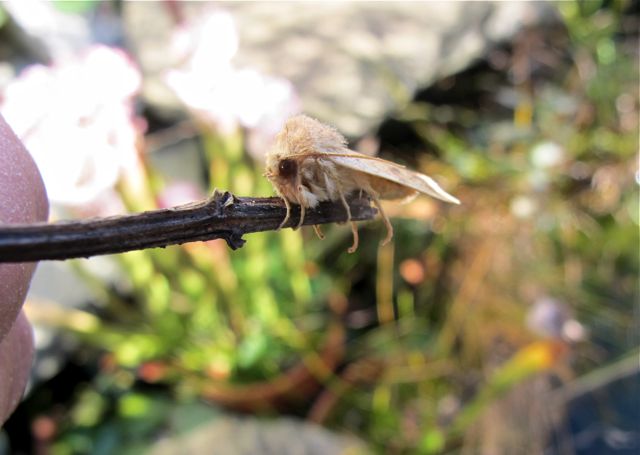
One I freed was a lovely Virginia Ctenucha, one of the wasp-mimic moths.


Just couldn't let it sink down into the goo.


Also had two gorgeous Ailanthus Webworm moths, Atteva punctella, one of the larger microlepidopterans, with a beautiful veined orange-and-white rolled wing. They flew away the second they were out in the air. Couldn't get a photo.


Earwigs, wasps, bees, flies, honeybees, syrphid flies, hoverflies--anything that comes to flowers will come to a pitcher plant, apparently, only it's the Hotel California for pollinators.


Even paper wasps are not immune to its sweet, honey-scented charms. It has a competitive advantage in that it's quite hardy and in full, sweet-scented bloom when practically everything else has croaked from the first frosts.


 Stick to flowers, guys. These plants are bad news.


Pollinators swarm my Suffolk Pink chrysanthemum just a few feet away. It's the hardiest and latest-blooming of all. It doesn't even get going until Halloween in southern Ohio, and it's a blessing blooming that late. (It's done now; these photos have aged a bit since I took them.) 

"Suffolk," in a few different colors, was probably the first mum ever brought to the New World. The foundation stock for my plants (yes, it spreads modestly and delightfully) came from peerless pastel painter and partner in peripatetic hilarity Cindy House, from her Vermont/New Hampshire gardens. (You may remember her spotting the "body bags" outside a Massachusetts restaurant).

A nice, super hardy, willing plant. Not like those nasty carnivorous ones.

I have the pitcher plants in the greenhouse, on the cold floor next to an outside vent, for the winter. Hoping I'm doing right by them. They're just too precious to me now to let them freeze into the pond ice again. Thanks again, Cheryl! All it took was five years and some sphagnum...

Pitcher Plant Magic

Thursday, December 29, 2011

4 comments
Don't do it, little flowerfly!
(probably Syrphus ribesii)


It is humbling to have, growing vigorously in my backyard pond (and now on the floor of my greenhouse), a plant that is so terribly rare in the wild, so over-exploited and endangered, that its very existence in the wild is in question. Native to low-nutrient longleaf pine savannas along the Gulf Coast (generally along the Florida panhandle), Sarracenia alba is one of the showiest and most beautiful of the pitcher plants.

S. alba, being so showy, is vulnerable to collection and the despicable exploitation by florists, whereby flowercutters will denude entire stands of all their pitchers to get the long-lasting specialized leaves for arrangements. Inexcusable. Never buy an arrangement with pitchers in it. Worse yet is habitat loss from wetland draining and development. Fire suppression also knocks back populations when they get shaded out by overgrowth. Yes, the white pitcher plant is getting it from all sides in the wild, even though it's easy to propagate in captivity.

I came by this plant from fellow blogger and plant maven Cheryl Harner, author of the wonderful Weedpicker's Journal,  who gave it and a red variant to me years ago. She told me it's best grown in distilled water, and warned that my fishpond would probably have too many nutrients for this entirely carnivorous plant. The way it works is that the plant takes all its nutrients from the bodies of insects it traps and digests, and it can't take nutrition through its roots. The pitchers are lined with slick, stiff, downward pointing hairs, and any insect that topples into the specialized leaf is not getting back out. Period. It falls in with the others being rapidly digested by the sweet-smelling fluids at the bottom of the pitcher. Eeek!

I looked at the plants a little dubiously. With all I have to care for here, did I really want plants I'd have to coddle along in containers of distilled water? And while I thought about  how to best provide for it, into the fishpond it went. And in the fishpond it stayed, through summer and winter, and it didn't do a whole lot, put up some little bitty pitchers here and there, and a bunch of long narrow leaves that never became pitchers. It was a little disappointing, but I only had myself to blame. Still wasn't really into the distilled water thing.

This spring, while cleaning the pond, I looked at that nice little plant and thought, "You've lived through all these winters, the snow and ice, and you've always come back, but you could be so much more." So I took the plant out of its pot and swaddled its paltry roots tightly in dried sphagnum moss because I thought it would like the acidity. I put it in a bigger clay pot and sank it in the pond.

And it did this:


Said thank you thank you thank you, it did, with a flush of the finest two-foot-tall fall pitchers I'd ever seen!

So I'm photographing it on a fine late October afternoon  and I happen to lift a lid to see what's going on in there and YIKES the entire flute is stuffed with hapless insects!


 Quickly I lifted the other lids and yep, they were full, too, absolutely crammed with dozens of insects.


Maybe hundreds. Here's a side view. Something has bitten into the flute and you can see black. That's the bodies of insects. They go all the way up to where the red and white markings start on each flute.

In my next post, I do a typically Zicklike thing about it all.
[Back to Top]