Background Switcher (Hidden)

Showing posts with label parula warbler. Show all posts

Parula Nest!

Thursday, July 12, 2012

9 comments

Parula warblers like to nest in lichens or bromeliads. Up north, they use these lovely pale green Usnea lichens, which are commonly called moss. Down south, they like Tillandsia usnenoides ("looks like Usnea," in Latin), which is a bromeliad related to the pineapple, which is also called Spanish moss. None of them mosses, but there you go. Parulas just tunnel into the hanging “moss” and line a little hollow with grasses and hair and you’d never know there was a nest there at all until you see the parent birds coming and going.

Mostly what we observed was the adults stripping caterpillars from the apple trees several hundred feet away


and ferrying them with great speed to the babies in this well-camoflaged hammock of a nest. 


Over the five days that we were there, the four baby parulas grew up and fledged in stages at the tender age of nine days. It was ridiculous. Meaning, ridiculously observable and very cute. The nest just kind of disintegrated; the adults were feeding and removing fecal sacs from the two nestlings still within via holes that formed in the bottom and sides, while two babies sat outside at the top of the nest.  A little knot of people just stood directly under the nest being completely ignored by the parulas who came and went a few feet over our heads hauling caterpiggles and fecal sacs and going about the business of raising their young. And as I thought about it, I realized that that little knot of people might just have saved the babies from the chickarees, who are brash but shy of being observed.


On the day after fledging when the cottonball parulababes were perched in the vicinity of the now defunct nest, I saw a chickaree dash out to the end of a spruce branch and grab something small and round and dash back to the trunk with it. By the parent parula’s frantic chipping leading up to and surrounding the capture, I knew what that damn squirrel had in its teeth. But I’d like to think that the other three fledglings made it. Sometimes I’m sorry I’ve honed my observational skills to the extent that I have. Mostly, it serves me well, but sometimes I think I pick up a bit too much for my own good.

No, that's not really true. I want to know it all, the good and the bad, the whiskers and the warts. Without the dark, the light wouldn't be so stunning.

This female was removing a very large fecal sac which didn't stop the fledglings' begging for a moment. Or maybe they were yelling, "Take it away! Oh, take it away!"


  Don't get me wrong. I'm not out to smear red squirrels. They're just making a living. But the island was absolutely seething with them, probably thanks to last year's heavy cone crop, and I'd have preferred to see more warblers and vastly fewer predatory climbing rodents. Islands are prone to outbreaks of all kinds of things, since the balance is so delicate and the influx of would-be red squirrel predators is limited, too. I think the island could use a couple fishers, personally. But see, there you go. People are always wanting to mess with island biogeography, because it all seems so easily controllable, and it's anything but.  All you can do is root, root, root for the parulas. And if standing under the nest enjoying them keeps the dang chickarees away, so much the better.


I absolutely love the bold wash of russet on this male parula's breast. Who came up with this color scheme? Whoever it was, I like their aesthetic.

One baby flew out and perched on a minuscule twig coming out of a spruce trunk about 20' away from the nest. That was the last I saw of him. He doubtless moved on from there. 

No, he doesn't really look flightworthy, but such are warbler fledglings. They don't need no stinkin' tail. They just go, little buzzbombs of hunger and potential.


 As the spruce forest on Hog Island reaches climax, the species diversity is falling and birds are fewer and farther between. Which is a bit ironic for a place that hosts birding camps. It's not a problem though, because the place alone is so glorious; island hikes are breathtaking, and what birds are there are so special: nesting merlins, hermit and Swainson's thrushes, brown creepers, winter wrens, black-throated green, myrtle and parula warbler, osprey, common eider, black guillemot. You get the picture. The songs alone undo me. And just over on the mainland is a huge diversity of breeding birds, and five or so miles offshore are breeding Atlantic puffins, razorbills, Arctic, common and roseate terns. Mmmmm. More on some of those in posts to come.

Hog Island: Parulas and Chickarees

Sunday, July 8, 2012

6 comments
Hog Island: It’s really just a hop from the shore of Bremen, Maine, which isn’t far from Damariscotta. You can row it if you know what you’re doing, which my friend Jamie, Registrar of Hog Island Audubon Camp, confesses she doesn’t yet. Still, she got there, in a zigzaggy way.


Jamie's headed to the mainland from Hog Island to do something or other.
I'm standing on the shore laughing and photographing her against her will.
Glad nobody's photographing me trying to row a boat!

People come here to hang out together, to watch birds together, to learn about ornithology, to look at cool boreal forest plants like these northern pitcher plants, holding their oxblood blooms high above fat pots.


 They come here to get away, to be surrounded by water. There is something peaceful about being surrounded by water. Like nobody’s going to bother you here, because nobody can get to you. At least that’s my theory of why people love islands so much. Castle with a moat. We’re safe there.


So we were asked to come and lead field trips and give talks and play a little music, just do our Bill and Julie thing. 


Asked by our dear friend Scott Weidensaul who knows not just a little but a lot about everything.  His latest book is The First Frontier and it's ridiculously good. Scott was running this field camp, and he figured that the title of the course, “Joy of Birding,” seemed a pretty good fit for what Bill and I do.


The place is infested with chickarees or red squirrels and oh how I wished Chet Baker could be there with me to chase them all. I don’t know how many songbirds manage to nest successfully there, for chickarees are bloodthirsty little beasts and there’s nothing they can’t climb to or sniff out. The island hikes are punctuated with their clock-winding chattery scolds.

 
Cute is as cute does, Mr. Egg Pirate.

Right off the bat there was a pair of northern parulas that made it their business to make about 90 people very, very happy. They built a nest and managed to hatch four eggs in this chickaree-infested camp and they foraged right over our heads completely ignoring us. They had babes to feed. The old apple trees were loaded with little caterpillars. You can see one hiding under webbing right in front of this female bird, and she nabbed it right after I got the photo.


Oh, I had me some fun with my new Canon EOS 7D with its EF 70-300 IS telephoto lens, and I was more convinced than ever that this is exactly the lens for me, who loves to dawdle near small birds and watch them do their birdy things.


Hover-gleaning.


What a gift these birds were, what a gift was their little nest. More anon.

I'm writing this Saturday, July 7, 3 pm. Our power just came back on, having been off for eight days. Today it's 100 degrees in the shade and we have had all manner of associated minor catastrophes going along with having no electricity. First there was the destruction of the Garden Pod, then there was a chest freezer leaking into and ruining our music room carpet, and this morning we discovered that the water heater had been in cahoots with the chest freezer because there's a small lake beneath it (and throughout the rest of the basement as well). We've done nothing since we got home but deal with one nasty stinky festering expensive problem after another, then sprawl exhausted but sleepless on piping-hot sheets until it's time to get up and start back to work.

This morning we took another count and we've lost probably a dozen large trees, some of which we'll have to deal with, some of which will rot where they lie. Seems like the wind picked off all the nice ones: a huge oak, our silver maple, our fruiting mulberry, our best wild cherry (haven for waxwings), a big black walnut, some great big Virginia pines.

June was pretty cool but I haven't much liked July so far. Still there are people much worse off than we thanks to this huge and horrible storm, and what we've lost are things and trees and appliances and about 8.2 gallons of sweat and money, not lives. Here's to the Washington Electric Coop crews who slaved around the clock in brutal heat to restore power; here's to our friends Dave and Marcy and Steve and Carol and Caroline and Keith who brought us a generator and a million extension cords and the last two of whom are even now replacing our water heater. My brains are like hot cornmeal mush now so I'll sign off with grateful thanks to good friends.

And thanks to you, dear readers, for your support in dark times. I'll keep the natural history stuff coming.

Parula Interlude

Wednesday, June 4, 2008

5 comments
Six years ago, I gave the inaugural keynote at the very first New River Neotropicals Festival, which has now evolved into the New River Birding and Nature Festival. The talk was about the natural history of wood warblers, with details about their lives, their foraging behavior, and their habitat use on the wintering grounds. Having given a talk every year since, I finally ran out of talks, and had to recycle this one. Whereas I'd used a Carousel slide projector in 1992, this time I had slick new photos in a Keynote presentation. And this year, I had a whole new section on threats to warblers, culminating in mountaintop removal mining. It wasn't fun to talk about such a thing at this festival. But a lot of people thanked me for making them aware of it, and I felt better when it was over.

Bill and I give talks at this festival, and we also lead field trips. Most of these convene at 6 AM with a very nice hot breakfast (eggs, bacon, the whole works) under a picnic shelter, and then everyone loads into those long church vans (most of them borrowed from the Baptist church in Oak Hill) to go to different warbler watching sites.

You can see 23 different species of warblers around Fayetteville, West Virginia. Not migrating, but breeding, on territory. These rumpled mountains hold the highest diversity of plant and animal species outside the tropical rainforest. Sometimes, well a lot of the time, it IS rainforest.

It rained this year, started raining the minute I got out of my car on Thursday night, and it stopped raining as I got out of my van at the very end of the last field trip on Saturday afternoon. Of course, it had been beautiful the whole week before I got there, and everyone had enjoyed field trips in sunshine in this week-long festival.

So I don't have as many pictures as I usually would, and many of them were taken in pouring rain. But rain or no rain, when there are so many warblers around, it's hard to have a bad time.
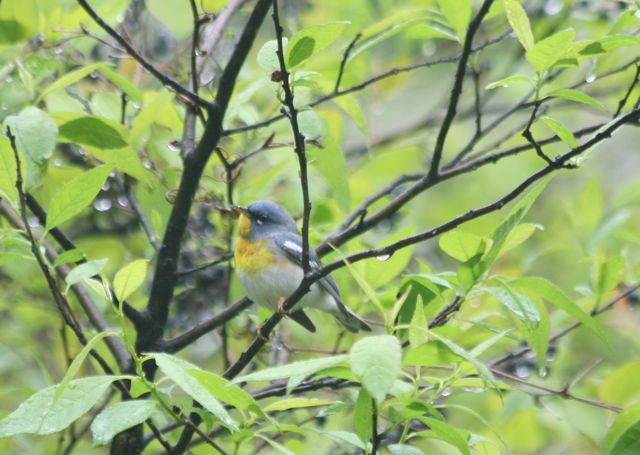
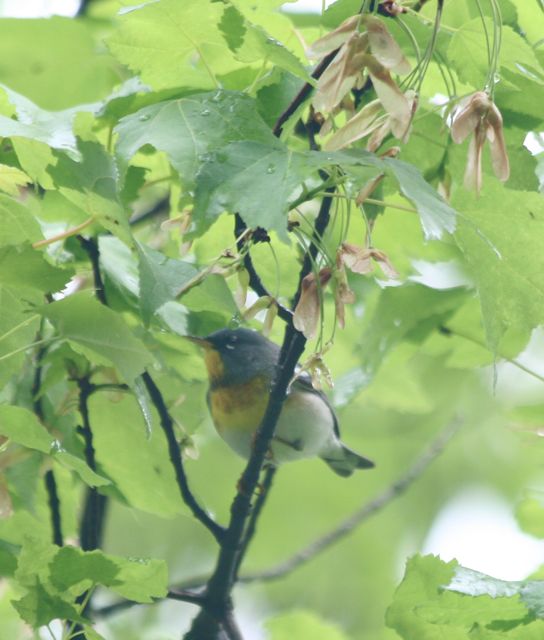
The northern parula is the smallest North American warbler, smaller than a chickadee, hovering around kinglet size.
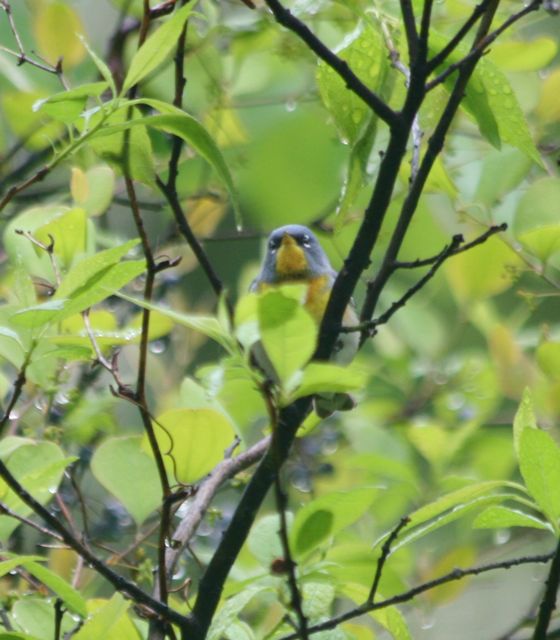
But the parula packs a lot of beauty into its tiny body. White eye crescents give it a quizzical look, and chestnut and blue bands adorn its breast. A peculiar olive-yellow patch marks its back. I love this head-on look.
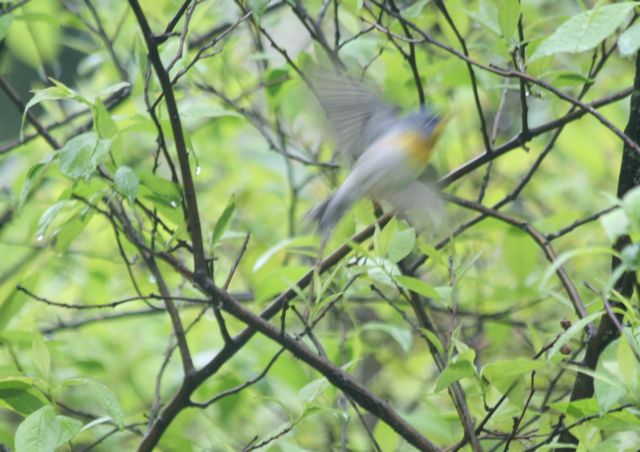
The parula's song is a buzzy, ascending trill: zzzzzzziiiiiiiip!--hard to mistake for anything else. Soon enough, the session was over, and the little parula headed for a spruce top.
It's hard to believe such things are tucked into these mountains, but they are. If only more people realized it. If you get a chance to go to this festival, grab it. If you've got holes on the warbler section of your life list, holes like golden-winged warbler and the elusive Swainson's warbler, parula, black-throated blue or Blackburnian warbler, it's the place to go. Shoot for April 27-May 2, 2009. We'll show the birds to you, serve them up on a silver platter, and your money will go toward nature education in local schools. Which I believe is the only hope for changing West Virginia's appallingly short-sighted giveaway of its very soul--its mountains--to huge international coal companies. Take down the mountains, and what will be left of "Almost Heaven?" Will people still come to hike, fish, camp, hunt and watch wildlife on exhausted, hydroseeded barrens? Will ginseng grow, or thrushes sing at twilight on what remains of SugarTree Road?

West Virginians have to come to believe there's a better way to live than by the rape and pillage that is the modus operandi of the coal companies many of them work for. Enlightenment will have to start with their children. Go to this festival. Find out what's there to save. Help fund nature education in West Virginia schools. It's a win-win deal.

And write your Federal representatives. Tell them this horrendous pillage of Appalachia must stop. Tell them to support the reinstatement of the Clean Water Act that the Bush Administration so insidiously gutted. Tell them that mine tailings are poisonous WASTE, not "fill." Tell them to call it like it is. And tell your friends. Click here to find out how.

Every time I start to write about what's so wonderful about West Virginia, every time I look at my pictures of these lovely birds in their sheltering trees, this is what comes out. We have to do something about it. Thank you for your help.
[Back to Top]