Background Switcher (Hidden)

Showing posts with label nestling. Show all posts

The Bird is All Right

Sunday, August 5, 2018

3 comments
I've left this post to simmer a little while because it takes time to make a whole bluebird. You shouldn't get it all in the same week! Bluebirds stay in the nest for around 18-21 days after hatching. So we're back, checking on the "not quite right" foster bluebird baby, and things have changed.

The next time I came out to check the bluebirds, it was going to be tricky. You shouldn't open a box after the babies are about 13 days old, because you risk their jumping out of the nest prematurely. But Phoebe and I were burning to know how Baby was doing on Day 16. I looked at the box, and noted that the ventilation slot just under the roof was juuust big enough to admit a curious iPhone!

Gingerly, I inserted my phone into the slot under the box roof and fired off a shot. July 26, 2018, Day 16. Look who's STILL begging!! The one in the back right corner...why, it has to be FosterBaby! What a hoot!

She's not dumb. She's opportunistic. And durn cute! Feathers and Everything!

She quickly realized her mistake and settled down, and I got this fabulous shot of the whole brood of five. As always, she's crowded into the right back corner of the box. After studying it for awhile, I could ascertain that FosterBaby is indeed a female. Not only are her secondary coverts a very dull blue, but even though there's a piece of grass over it, you can just make out a white edge to her outer tail feather--another nice and little-known early trait of female bluebird nestlings. One of those bluebird landlord secrets, ta-daaa!

The other thing you can see in this shot is the development of her tertial feathers, the ones that run in a little brown-edged stack of three atop her wing. Compare it to the development of the tertials you can see on the other babies. Hers are just coming out, while theirs are more fully developed.

Let's try a shot through the hole. You can really see the difference in her tertial development here. They're out, but not as far as those of her siblings. She's looking sleek and well-fed. I'm delighted!


Of course, I had to know if they were still in the box on July 27, her Day 17. Yep. You can just see her peeking in the back right corner in this shot taken through the entry hole. Man, I love my iPhone for applications like this! 


This would be my last shot of FosterBaby on Day 17. She's squished into the back corner, head down this time, and all three tertials are out, hooray! 


On the morning of July 29, FosterBaby's Day 19, I went down to Dean's Fork to visit the decorative box where this adventure had started. With some difficulty, I got a shot through the hole of her three biological siblings, looking fledge-ready in the back of the little blue barn house. I thought about the last time I'd pointed my phone camera in this hole, to find such a pathetic, shivering, cold, starved little thing, discarded by her mother but still hoping for help.


July 29: Three fat siblings, 19 days old, ready to fly. Nobody in the breach.


I left a slot box at the base of the pole with a note inside for Harvey, to wait about a week, then replace the decorative box with one the Science Chimp could get into and clean! 


The next time I walked out to the Fosters' box in our meadow was the evening of July 29. It would be Day 19 for Baby, Day 20 for her siblings. Her spot was empty. So was the box.


All that was left were the regurgitated seeds of wild cherries. I can see resorting to wild cherries when trying to fill the stomachs of five voracious youngun's. There is also the hard, scary-looking skull, complete with jaws, of a Nebraska conehead (a kind of grasshopper) in the nest cup, which had probably been regurgitated as well. But hardly a fecal sac to be seen. What efficient, good parents the Fosters were!
 

We'd had a most excellent adventure. There was one more bluebird out there who wouldn't have made it if we hadn't meddled. It's hard to say what it was that made the chick's biological mother toss her out. Even we dull-witted humans could tell she wasn't right at the outset. It seemed as if her issues resolved with time and good care, though one can never know for sure. She had flown with the rest when fledging day came. At best, she was good to go and would live a normal life. At worst, we'd given her a fighting chance to become a bluebird, and that seems like a good thing. As always, we'd learned a lot, and stored it all away for another day.


I have to say it feels good to be blogging again. There are so many stories out there,  begging for help, begging to be told.

Checking on the Bluebird

Tuesday, July 31, 2018

4 comments
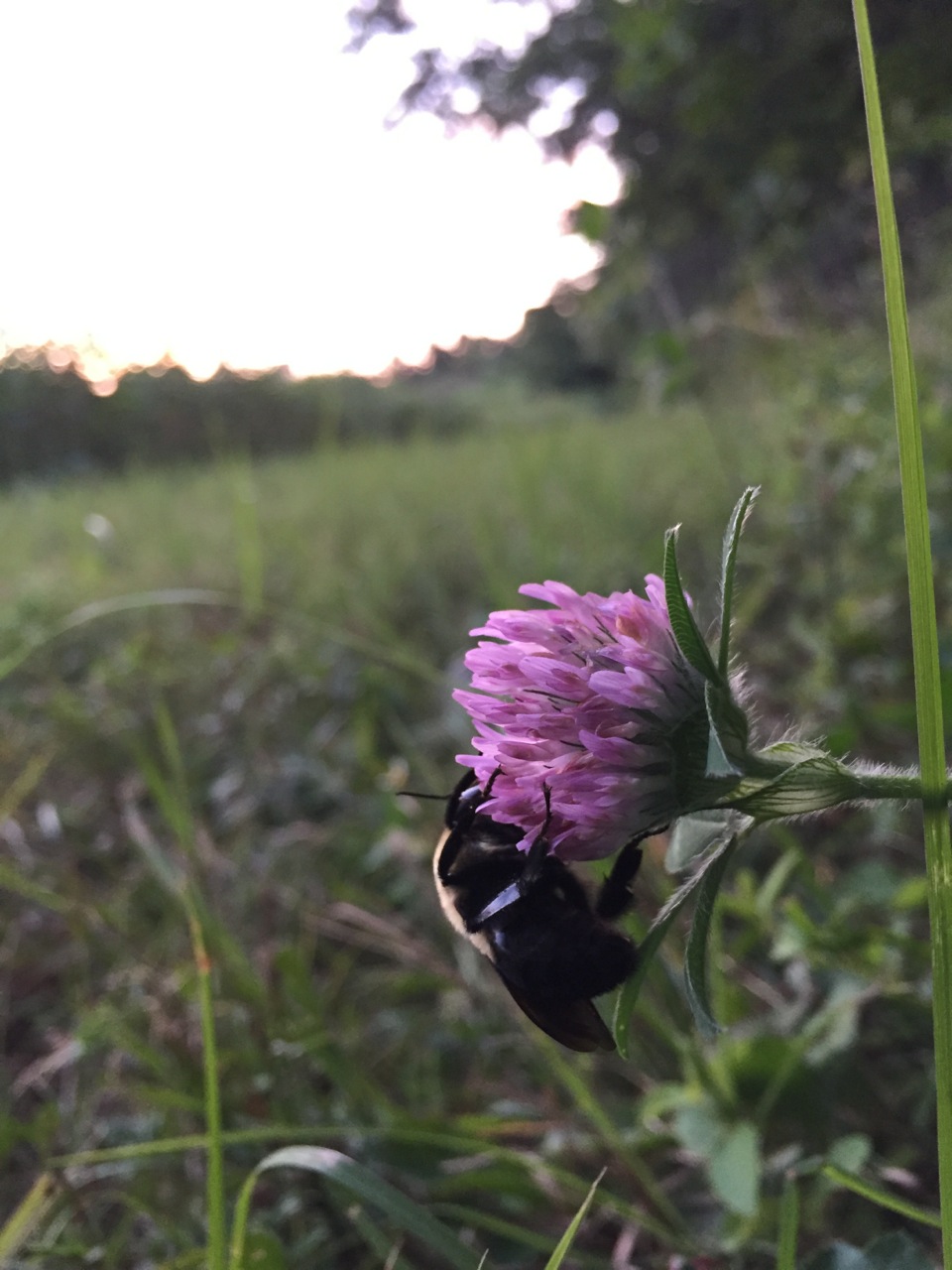
A sleepy bee, planning to spend the night with its face buried in red clover. One could do worse. 

Phoebe and I placed the starved baby bluebird with its foster family the evening of July 17. I gave it a day and a half to settle in, then went out early in the afternoon of July 19 to check and see how things were going. I figured it would either be a lot better or dead, but either way I had to know.


It was a lot better! Note that it's in the right front corner of the nest, which is where we put it on the 17th.  You can tell it from the others because it has more pink skin showing. It held that position in the nest, because none of the other babies were going to give their positions up. Most people don't know that baby birds hold their places in the nest, but the ones I've worked with all have. When I was painting nestlings for Baby Birds, all I had to do was take the baby at a certain position in the nest each time, and I'd have the same baby to paint day after day. That was good, because I wanted to track the development of one individual. But it was also good because the baby I was working with quickly learned the drill, settled down, enjoyed the extra feedings, and didn't fidget as much as a newbie would have. When you're drawing something tiny from life, a subject that doesn't fidget is a very good thing.


I'm sure this place-holding behavior helps the parents know who's been fed and who's been skipped and who's doing well and who's not doing so well, if they all keep to their seats. Teachers understand.

I was amused to find the foster chick still begging voraciously, and the two nestlings nearest the foster child decided that was a good idea too.


Then they all got the memo that I was not a bluebird, and suddenly went quiet. Oh. Oops.


Yes, our little foster is smaller, but it's alive and seemingly doing well, and that was cause for celebration! Its siblings are Day 8, and it's Day 7, on July 19. I was very pleased to see the hyperactivity and trembling had ceased. The baby seemed as right as rain, and bound to catch up with its siblings soon.

I felt comfortable leaving them be for a few days. The next time I checked was July 22. Liam and I went out this time, because he hadn't had a chance to meet the foster baby.  Day 11 is traditionally the day a bluebird's feathers have emerged sufficiently to sex them. I carefully pulled the nest out, because the foster family was now Day 12, and that is traditionally the day fledglings can get jumpy, even though it's way too early to jump.


I didn't really expect the foster child's feathers to have burst the sheaths yet, with the bad start it had had in life, but I could sex the other chicks.

This is a female. Its blue is sparse and dull, not the bright cobalt of a male. There was one male and three females in this batch of four. The fifth, foster child remained a mystery. I'd just have to come back!

In the photo below, you can see the exposed pink skin of the foster chick, in contrast to the dusky, feather-covered skin of the others.


I came back on July 23, Baby's Day 12, to scrutinize those feathers. I could see juust enough to guess that Foster Baby is a female. She's still behind for Day 12, but making progress. In this photo, you can also surmise that the blackberries are in. :) Fare well, little bluebird. We'll be back to check on you in a couple of days.


A Bird in Need

Sunday, July 29, 2018

9 comments

I was taking a run down Dean’s Fork, with the ulterior motive of checking a bluebird box at my friend Harvey’s man-cabin. In the spring of 2017, they’d put up a decorative box on a little post, never thinking anything might use it, when a bluebird pair decided it was just the thing and started hauling grass into it. That would have been OK, but the box was only about two feet off the ground, and the design of the box couldn't be worse.


Cute, yes, but there's nothing right about this box where bluebirds are concerned, except that the entry hole is 1 1/2". The A-frame roofline is nothing but wasted space; it's longer than it is tall; the hole's too close to the floor; there are no ventilation holes, and worst of all it can't be opened for checking or cleaning. I do love the hand-painted propane tank. But the box has got to go.


Last year, when Harvey told me he had bluebirds in the box, I scrambled to get him a pole and predator baffle setup so the decorative box wouldn’t become a coon and snake feeder. I mounted the box with nest on the baffled pole. The bluebirds weren’t happy about the change in height, and there were some worrisome hours while they scolded and refused to approach the box, but they eventually went back to finish incubating, and three healthy bluebirds fledged last summer.


I had meant to replace the decorative box with a real one over the winter, but time got away from me, as it loves to do. Here it was mid- July, a whole year later, and I knew I needed to check that box. And sure enough, I peeked in the box that July 17 morning and saw that it was occupied. Not only that, but there was a young bluebird chick visible through the entry hole, right up next to the entrance. How weird! I could hear the peeping of multiple chicks, but here was this one, right up by the hole. 
 
Using my iPhone, I shone a light in and gradually grasped what had happened. Way in the back of the box, which is barn shaped and longer than it is tall, was a grass bluebird nest with high walls. Three nestlings were snuggled in the cup. Somehow, this little one had gotten out of the nest cup, and was lying on excess nesting material, all by itself in the front of the box. I poked my finger in and touched the baby, which was begging weakly. It was cool to the touch. Uh-oh. Being out of the nest cup means the baby wasn't being brooded by the female. It could well have been out of the nest all night.  This baby was in trouble, and fading fast away from the warmth of its siblings.


I went and fetched a long stick, blunted the end of it, and tried to push the baby farther back into the box, and up over the high rim of the nest to join its siblings. No dice. I couldn’t push the little blob with one stick. It was like pushing soup with a fork. I fetched another and tried to use the two sticks as a sort of tongs, but that didn’t work either. It was like trying to do laparoscopic surgery with sticks. The more I struggled to move it, the more I realized that this baby couldn't have gotten out of the nest cup under its own steam. It was only five days old. It looked to me as though the female bluebird had thrown the baby out of the nest, but it was a little too big for her to get it out of the hole. 

Lest you be shocked, I have come to believe this culling behavior goes on in lots of bird nests. A bird decides that one of its offspring ain't right, and they just get rid of it, carry it out like so much garbage. People are always talking about mother birds "kicking a baby out of the nest." I never used to believe that would happen, but the baby birds that wind up on the ground are so often seriously compromised that I've revised my thinking.  I have come to believe that part of what makes avian rehab such a challenge is that in many cases we are dealing with birds that haven't fallen to the ground--they've been tossed. For a reason. And sometimes we find out what it is after we've taken them in. Or we never figure it out, because they up and die on us. We blame ourselves, but maybe the cards were stacked from the start. Geesh. Songbird rehab is hard enough without blaming ourselves for something that isn't our fault. Rehabbers take note.

In the end,  I couldn't get the baby back in its nest, and I had a strong feeling the female would just boot it out again if I did.

Nor could I leave the baby there, cold, not getting brooded and probably not getting fed, either. I decided to take it home with me, see what was going on with it, feed it and warm it, and try to foster it into another brood in one of my "real" bluebird boxes. One that can be opened by the well-meaning, meddlesome landlord. The one whose heart gets in the way of what Nature intends.


 Lord, it was skinny and starved and cold. I put it in my decolletage, such as it is, for the ride home, and amused myself by walking up to Phoebe, and letting her figure out where the incessant peeping was coming from. There is a video, but I'm not posting it. Ha!

While I was mixing up some Mazuri Nestling Formula, we got out our primary Baby Bird reference, to see how old it was. Yep. Five days. But so much skinnier than the bluebird I'd painted in 2002. Food. Warmth. Stat!


our foundling, on Page 27 of Baby Birds: An Artist Looks Into the Nest.


We rigged up a little cooler with a bottle of hot water and a strawberry box lined with tissues. I fed that nestling until it stopped begging, and then it begged some more. Poor wee thing.  

Phoebe has inherited my keen sense for when a wild thing just ain't right. As glad as she was to have a wee thing to care for, she looked at me solemnly. This baby was jittery, restless, hyperactive; it begged even when it was full. I wondered if there was something more wrong with it than just starvation. But we knew we had to give it the best chance possible.


That best chance would be to slip it into one of our boxes with young nearly the same age. That's the beauty of having 25 boxes up and running, most of them occupied. If something goes awry, or you get an orphan, there's usually a host family you can press into service to care for it. 

First, though, we had to feed that child UP. We fed it every 20 minutes or so, all day long, until it was as strong and well-hydrated as it was going to get. By evening, we figured it was as ready as it was going to get. It was time to put it in the far more expert care of bluebirds.

As we walked out to the far meadow box, Phoebe, who'd been checking boxes with me, warned, "Those babies are going to be so much bigger than this one. They're way too old." 

I answered, "By the calendar, they're six days old. This one's five. That's an acceptable span. And besides, it's our only option, short of prying the roof off that decorative box and dropping the baby back in the same nest. Only to have the female kick it out again."

When I pulled out the nest, and Phoebe carefully placed the jittery little thing in with its new foster siblings, something magical happened. It stopped trembling, fidgeting, moving. It lay down as quiet as a mouse, basking in the warmth and scent and feel of other hot-skinned babies pressed up against it. It was a beautiful thing to see. 

"Imagine going through all that without being able to see a thing," Phoebs observed. For its eyes were still sealed shut, though its foster siblings were beginning to peek through slowly-opening slits.


                 It can't see, but it can hear and feel, and if it knows nothing else, it knows it's home now.


As we turned to head back to the house, I was struck by the beauty of my daughter, in the cobbled-together outfit she'd chosen for the expotition: sports bra, skirt, and Hunter boots. She looked to me like a fairy warrior from Narnia, and the sky played along.


A half-moon sailed serenely over the fiesta of colors.


We scurried up the tower stairs to watch a sky gone wild.
And to think about the perfect twist of fate that had sent me down Dean's Fork and peeking in a nestbox, just when a baby bluebird needed help most.


We'll leave it here, safe in a nestbox on Indigo Hill on the night of July 17. Of course, the story continues...


-->
[Back to Top]