Background Switcher (Hidden)

Showing posts with label green kingfisher. Show all posts

Along a River Green

Tuesday, March 17, 2015

1 comments
For St. Patrick's day, I'm going to take you down a lovely green Costa Rican river. One of the most relaxing and fun things we did was our afternoon cruise on the Rio Sarapiqui. Just sit back and look for birds. We could do that! 

On the way we saw banana plantation workers lined up at the bank to get their money. Mario said they are waiting to cash their checks. They want to see the money, he said. 


Perhaps to spend some at 
El Palacio.


To buy some breadfruit--something I'd love to try someday.


Breadfruit trees are amazing, with huge lobed leaves and a rounded form. I understand it's edible at all stages, but fairly soft when ripe. It's roasted, boiled, or fried, and used in place of potatoes, so it's starchy. Not sweet.
I would like to taste it someday.


Soon we made it to the boat, and our cruise started. There was a foot belonging to someone napping at the dock. Seemed like the thing to do to document that.

 Our pilot was Esteban.


I'd seen so many anhingas in Florida in January I felt I was seeing an old friend.


Another familiar outline--this a Neotropic cormorant, a more gracile relative of the double-crested we know so well. 


But this young bare-throated tiger heron was a nice surprise. So well hidden and fierce! Tiger herons get their name from the striking barred plumage of the immatures. They generally don quieter pinstripes for adulthood.


A bay wren popped out for a glimmering second. What a beautiful color. So many tropical passerines are that rich, rusty red brown, but the bay wren is the prettiest brown of all.


More studies in brown and green...a pair of broad-billed motmots were hanging out near a bank where they may have been excavating a nest. They dig enormous holes with bills and their tiny feet, kicking the dirt out, kingfisher-style.


Glorious birds, with surprising turquoise on their throats. 


They looked like they had little bow ties on. Motmots are Coraciiformes, related to kingfishers.


 The little racquet-tips on their tails are fetching. The barbules around the tail tips are weak and the motmots preen them away to reveal the racquets. It's not given to us to know their function. Maybe chust for nice.


Speaking of nice: Long-nosed bats on a riverside tree. Love them! And these were the only species of bat we were lucky enough to see this year.


They utterly vanish if you don't know to look for them on their exposed daytime roosts. There are at least seven in the lower photo.


Massive root systems, clinging to an undercut bank.


A lone spectacled caiman. I remembered when I was a kid and some of my friends had tiny stunted baby caimans in tanks. We all thought they only got about a foot long. We were actually bonsai training them with poor nutrition and husbandry. I saw an 11-foot black caiman in Guyana. 


Some guys, fishing. I love shooting wildlife on the river. 


 An Amazon kingfisher was fishing, too


 alongside his smaller, rounder cousin, a green kingfisher. I love the oily viridian of their backs.


Another boat much like ours passed

and I wondered if they'd been lucky enough to spot a female slaty-tailed trogon, my favorite plumage of my favorite trogon.


I don't know who dipped a charcoal-gray bird in red paint, but I'm glad they did. Trogons are probably the most fun bird to draw from life because they sit so patiently, slowly turning their heads, looking at everything as if they're seeing it for the first time. They seem a bit dopey, but they're actually foraging, examining the leaves around them with keen eyes. When they sally out in a flurry of red, yellow, orange, blue, or green, snatch a huge katydid and return to the perch to bash it into pulp, you know they aren't just daydreaming up their on their branches. It's never good to assume anything about birds until you get to know them.


More Birding Estero Llano

Sunday, November 18, 2012

4 comments
As luck would have it, the Saturday field trip I was helping to lead went to Estero Llano Grande again. That's fine with me. I'd go there every day and be perfectly happy.

Who wouldn't be, with Harris' hawks perched overhead and rasping? This is North America's only social hawk. They hunt cooperatively, winged wolves; one of them driving the prey out into the open and another one or two snatching the hapless thing. So when you see one Harris' hawk, you often see a couple more.


Dawn clouds scudded in an already quickening breeze.


We had a whole charter busload of birders and Estero Llano did not disappoint. I was honored to co-lead with Dave Irons, Shawneen Finnegan and George Armistead. I love these people who love birds. Here's handsome George, pointing stuff out. His ornithologist/librarian/bibliophile father Harry reviewed The Bluebird Effect for Library Journal. Was mostly kind. George, Bill, Jeff Gordon and I worked together on Identify Yourself, as well. What fun to be in the field! The Rio Grande Valley Festival was a homecoming.


Estero Llano is a good place for birds and birders. You may recognize this name (Benton Basham) as an influential early member of the American Birding Association and holder of a North American Big Year listing record of 710 species for quite some time. He's an anesthesiologist who also catalogues butterflies (the logical next step when you run out of birds). His US life list hovers around 868 species. You'd kind of have to have a good day job to do that.


Nearby, a curve-billed thrasher took the sun in a brushpile.


A Teleos longtail, one of the tropical longtail skippers Basham probably sees every day.


Feeders at Estero Llano attract many birds, like this great kiskadee, whose lusty EAT your BEANS call brightens the already sunny days.


Sigh. My best photo of a green jay. I'd forgotten how electric, how elusive they can be. Flashes of neon, raspy calls, then they move on. Makes me love my comparatively phlegmatic but no less flashy blue jays all the more.


Now this is another thing we don't have: green kingfishers. Ohh beautiful bird.


Caught a fish, she did (you can tell it's a girl by her rusty bra).


And swallered it down.


 There's one of those fabulous great kiskadees again. That's a flycatcher what am a flycatcher. Doubt he bothers with flies, probably more into the dragonfly/grasshopper/katydid thing with a bill like that.


Devilishly difficult to photograph a ladder-backed woodpecker, which is the ecological equivalent of the downy in South Texas. They're always on the other side of the limb, tapping away.


A lovely flight of long-billed curlews goes over, reminding me yet again that I'm not in Ohio.


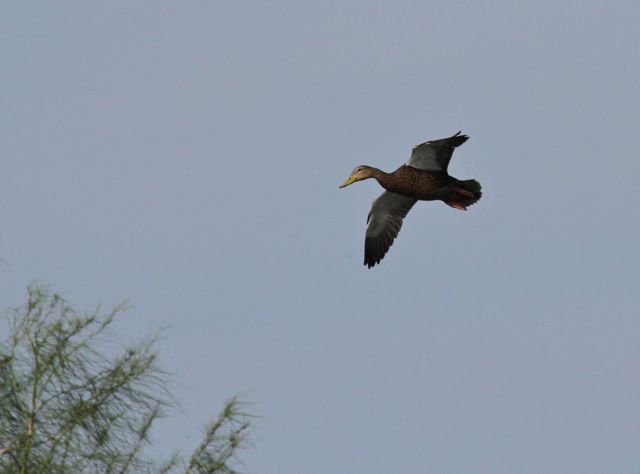
and a mottled duck drops into the lagoon.


The unlikely star of the show was a northern beardless tyrannulet, a tropical flycatcher much sought after in South Texas. Dave Irons knew just where he'd be, trilling dryly. I remembered beardless tyrannulets from the Brasilian Amazon, remembered their call. Amazing, to have that memory sift up through my much-used gray matter.


Liam's paraque was in exactly the same spot she was two days ago, but this time she was looking at us with eyes in the back of her head. I've got those too. Ask Liam. (He really thought I did have them for the longest time; he used to sort through my hair to find them. How else could I know what he was doing behind my back?)

I love this shot! The bird is facing away. I'm still trying to figure out why the paraque would roost just inches off the trail and put up with being awakened dozens of times each day by gawking birders. What is it about that exact spot that makes it worthwhile for the bird to stay there? File under Things I'll Never Understand But am Thankful For.


I didn't expect to come away from a bird festival in Texas with a vision straight out of the wild blue sky of North Dakota. White pelicans wheel over Estero Llano, and I found myself wondering if I'd look up smiling next June during our Prairie Ramble and draw in my breath at the same bird circling near Chase Lake.


You never know who you'll run into at a birding festival.
[Back to Top]