
If these fitness trackers you wear like a lojack do anything, it's get us out, even when the sky weeps and the chill goes to your bones. I'm thankful for that, though I'm having a heck of a time reaching my daily quota (10,000 steps) when trying to get over a cold. In decent weather, I fly past that picayune mark every day.
We went out for a slog through the shredded wheat meadows, trying to keep the dog clean by walking on grass. (I'd just washed him after a muddy run down Dean's Fork).
It was a day without much visual promise. And those are the kind of days you want to watch out for.
We were coming up the middle path in our field when we all saw this thing lying in the middle of it.
It had been rained on, but by the size and content it seemed to be an owl pellet, a big one.

I started speaking in tongues, the gibberish my family is used to hearing when we've found something BIG. Do you see what I see? I was jabbering in something other than English.

That's the entire foot of a raptor. In the pellet of an owl. I know it's a pellet because there's very little odor and the bolus is made up entirely of bone and a few digested feathers. It's pretty fresh and quite cohesive. If this were a coywolf dropping, which by its size it'd have to be, there would be colored fecal matter acting as a binder, obscuring the bone fragments, and stinkin' up the place. Plus, I can't see a coyote crunching a raptor's foot down whole. What mammal would swallow talons like that? I mean, besides a Labrador retriever? that was for Floridacracker.

My mind was jumping all over the place. Though I had already figured out whose pellet it was, I was mos def going to figure out whose foot it was. I tried to imagine any owl gagging down the entire needle-taloned foot of a raptor.
The only owl I could see being able to do that with any aplomb is a great horned. Nope, just can't see a doe-eyed barred owl gagging down a raptor's foot.
My first thought was that it might be a barred owl's foot, since great horneds are known to prey on all smaller owls. It's a tough world out there.
By the time we made it back to the house, I'd been turning that pellet over in my hand, and I'd figured out that this was not an owl's foot. How?

These. These are two rows of scutes, or scales, that run down the tarso-metatarsus (the visible yellow part of the leg) of a hawk. Owls have feathered tarso-metatarsae. The part you can see is covered with fine hairlike feathers. What few scutes they show are all on the foot proper. The exceptions are some of the fishing owls, but they're in Africa, not here. The possible owls here in a meadowy-wooded part southeast Ohio are great horned, barred, screech and saw-whet, and they all have feathered shanks.
So it's a scaly-legged hawk, with rather long toes. Bird-catching toes.
Bill asked, "You think it could be a Cooper's?"
Synchronicity being the word of the day (remember I'd just photographed that blazing beauty in the birch an hour earlier), I replied, "I think you've got it."
If this was a Coop's foot, it was a big Coop, a female. Just a hunch. I'd have to make some measurements to confirm it.
I thought about how the kill would have been made. The great horned owl, detecting a slight movement or sound from the Cooper's hawk, who was perhaps sleeping tucked into the Virginia pines on our oil well road. Owl flying soundlessly closer. Hearing her breathe, hearing her settle her feathers. Planning its kill. Coming in from behind, strong talons closing around the hawk's skull. Bringing her to the ground, severing her spinal cord with a single nip. The Coop may never have known what took her. I hope she didn't. For what else could kill a big strapping female Cooper's hawk? And how else to do it, but by surprise, in the night? She who surprised songbirds all her life, now facing the last great mystery, and ending up in pieces in an owl's pellet. Egad. I'm glad I sleep in a bed, in a room, in a house, under blankets.
This, amazingly enough, is not the best thing I've ever pulled out of a great horned owl pellet. On the shore of Selden Cove, Connecticut, under huge hemlocks now long dead at the sucking mouthparts of wooly adelgids, I found the carving block of a great horned owl. And there I found a pellet that had the entire, intact skull and hard beak of a belted kingfisher. Swallow THAT. Great horned owls are the honey badgers of the sky. Great horned owl don't care. She's hungry.
Because I am a Science Chimp, and have been properly permitted to make and store specimens salvaged from window and road kills for most of my life, I happened to have on hand a specimen of Cooper's hawk, and I remembered that it was a large immature female.
I called out to the kids, "Come down here by the washing machine and I'll give you a lesson in bird foot ID." Phoebe replied, "Let me tweet that first, and I'll come down." Which made me laugh. She has made a Twitter account called (pardon me) @ShitZickSays
which has a rather intermittent feed, since I'm not the one tweeting away. I have no power there. But I do find it amusing, to have it revealed occasionally what my kids find amusing about me.
I pulled out my Cooper's hawk skin. Laid the pellet next to it. Talon size looked real good. The big talon you can see in the pellet, that still has its outer sheath, is the inner front toe of the bird's left foot. The one you're seeing clearly on the skin in my hand. That's the killing toe.

Started dissecting the pellet. It smelled, disgustingly and surprisingly, of turkey. Turkey! And Phoebe agreed, recoiling, her nose wrinkling. This gory remnant should not smell like something I eat. I was so glad we'd finally finished the last of the leftover turkey soup from New Year's. I think it's going to be a good solid year before I want to smell turkey again. Couldn't get it off my fingers...I remember my specimen prep days...yep. That clinging smell. Bleh!
 |
| photo by Phoebe Thompson |
Back to science. Measured the talons, just to be sure.

photo by Phoebe Thompson
Perfect match. Not only did we have a Cooper's hawk's left foot, but we had a female Cooper's hawk's left foot. The talon in the pellet was ever so slightly longer than the immature bird's talon, which might mean it was an adult bird, but that's farther than I want to take my avian CSI. The foot belonged to a female Cooper's hawk. And that, my friends, is some nice sleuthing. Helps to have the reference resources right on hand, down by the washer...

Even the metatarsal length was perfect. This was a big female Coop. That's a foot-long ruler there. Dorsal view


Look how perfect that foot is next to the specimen.
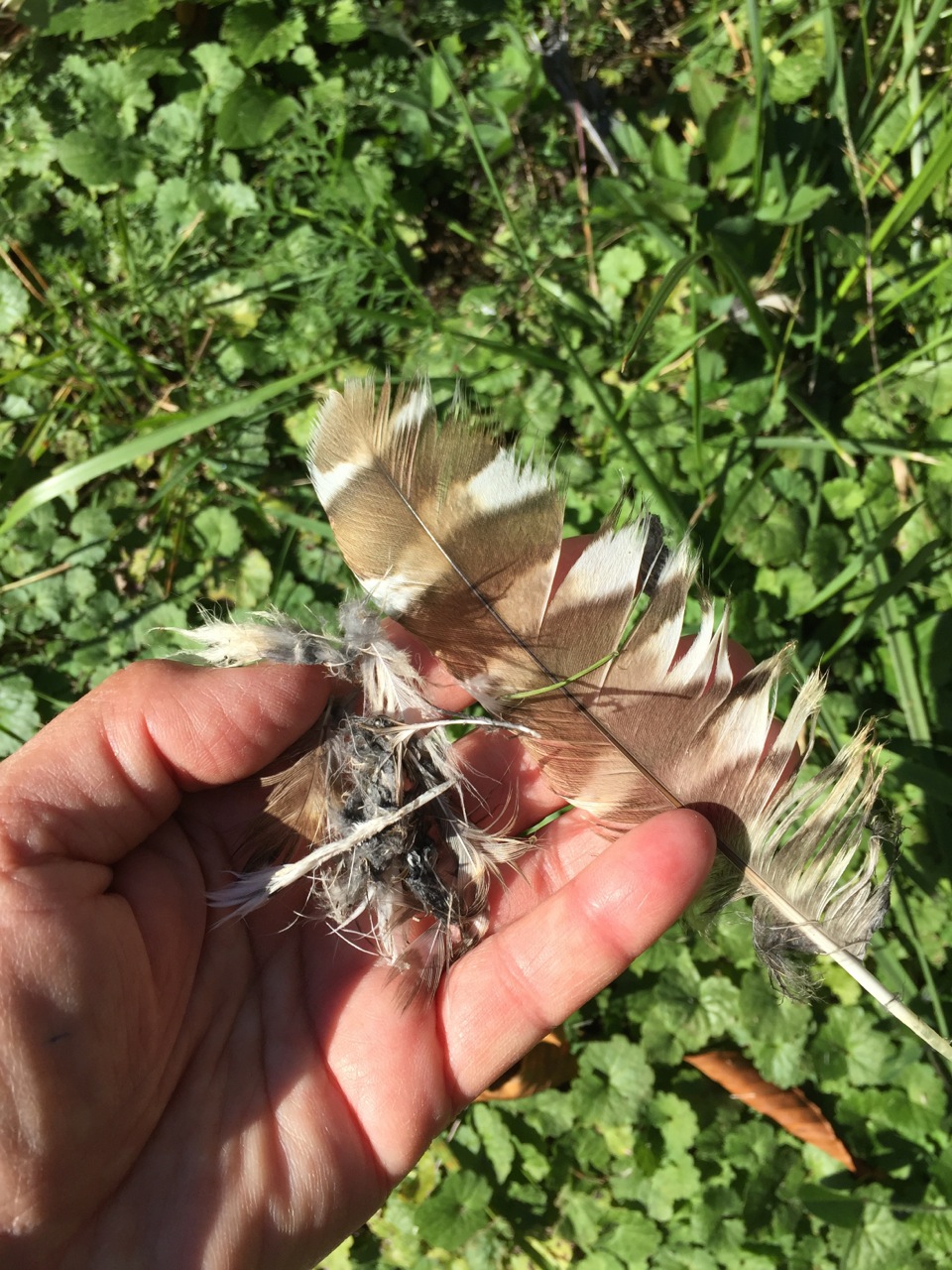
Here are the scutes, gleaned from the pellet, that initially told me it was a hawk's leg and not an owl's. I'm holding them up to the hawk's leg so you can see how perfect is the match.

Just for fun, look at a male sharp-shinned hawk in the same setting.
He's 10" long to the female Cooper's 18 3/8".
He's 10" long to the female Cooper's 18 3/8".
Just the foot size difference is astounding. And we get so confused, trying to tell them apart.
Based on what I see on bird ID forums (10 gazillion photos of Cooper's hawks in people's backyards, all of them asking for ID, over and over and over), I have proposed to rename Cooper's hawk "FAQ Hawk." Think it'll take?
Based on what I see on bird ID forums (10 gazillion photos of Cooper's hawks in people's backyards, all of them asking for ID, over and over and over), I have proposed to rename Cooper's hawk "FAQ Hawk." Think it'll take?


And her label. Here comes the synchronicity again. Look who collected it. Well, picked it up dead. My dad, Charles Dale Zickefoose, on December 22, 1983. I was 25 and already well versed in skinning and stuffing bird specimens, thanks to experience both in college and in Amazonian Brazil, where I prepared specimens for a small museum at INPA (Instituto Nacional de Pesquisas de Amazonas). I remember her crop being dead empty, no fat reserves, nothing left of her breast muscles, either. She'd burned herself up trying to survive. HY means hatch year. I've got total length (TL), wing chord (WC) and other measurements. A pitiful 12 oz-- a well fed female Coop should weigh 16 oz or more.

On the flip side of the tag, badly oiled by age and fat in her skin, is her story. I found that a small twig had pierced her right eye, blinding her. She was probably diving into thorns to get a bird, James Bond style, and that simple accident ended her career.

I was so honored that my father would think of me and pick her up and bring her to me that I painted a life-sized death study of her, freshly dead. I'd show it to you, but I gave it to my brother. It's nice. I did a lot of death studies back then, learning from the birds how they are built, how things work and go together. She did not go to waste. Someday she'll go to the Cleveland Museum of Natural History, where they already have probably 150 Zickefoose specimens in their collection.
Here's one from that period of my bird-painting life, a pied-billed grebe that hit a wire in the night and plopped dead onto a golf course in Connecticut. You can imagine what the Cooper's hawk looked like, and see what I learned about it just by painting it, dead. Click on it to read the writing. It's life-size. I still have a penchant for working exactly life-size. It makes sense to me. Look how small the wing is for that dense, compact bird! Look how the legs work--like oars at the stern. Look at the bird of this hour.

I'm still writing everything down, still picking things apart. And that grebe is still with me, like the hawk, stuffed with cotton and with all its data intact on a tag. I'll save the hawk's leg, too, because it tells a story, and that's what I do.

I watched my little family make their way back to the house on this dreary afternoon. I lagged behind, shorter of leg, always behind; and now carrying my precious find.

But I was all lit up with discovery and curiosity, and burning with the certain knowledge that my Dad is still with me, placing inspiration right in my path.

A friend and mentor of mine, recently departed,
had studied raptors at the Appalachian Environmental Lab at Frostburg State in MD. His name
was Floyd Presley.
We don't always know the whole story. We can pick at the edges...










Tuesday, January 19, 2016
21 comments