Background Switcher (Hidden)

Showing posts with label gray-necked wood rail. Show all posts

Serendipity Drives the Magic Bus: A Day at Cope's

Tuesday, March 10, 2015

7 comments

Serendipity was our best traveling companion on this trip. She had an excellent assistant in guide Mario Cordoba, who is always ready with a Plan B should things fall through. We had been scheduled to visit a butterfly garden that also attracts myriad hummingbirds, but upon arriving there, we found the caretaker nowhere in evidence, and a rather large mastiff cross barking vigorously, circling our bus, and eager to show us the door. 

I briefly considered unleashing my Dog Whisperer charm on him, but I knew Mario would never let me off the bus. 
It didn't take Mario long to deploy Plan B, and we headed for Cope's place. (say it CO-pay.)

The first bird who greeted us was an olive-backed euphonia, busy building a nest in an old oropendola nest Cope had hung from an eave. A very good omen in this peaceable kingdom. 


Cope is an extraordinary natural history artist who started out by making death studies of road and window-killed birds and animals. Hey, I did that too, for years. I felt an immediate kinship with him, which deepened as I looked at his gorgeous pencil and watercolor studies. He's a great photographer as well, and he knows where all the cool stuff lives.


He's created a little paradise for birds and birdwatchers in his yard. Simple, but highly effective. He's got a two-sided blind in which people can sit quietly and observe hummingbirds, oropendolas, tanagers, finches, even rails! at the feeders just outside in a small clearing. He's made pools and plantings and snags and perches that offer perfect photo-ops. Here's part of our happy group in the lean-to.

 Photo by Jenny Minton

Here, we got great shots and looks at some elusive species, including blue-chested hummingbird


crowned wood-nymph (this is a little hen)


violet-headed hummingbird (why do they call it that?)


 the ubiquitous rufous-tailed hummingbird

 here feeding naturally...


Cope brings a reptile guide for Betty.

 photo by Jenny Minton

I think we all melted simultaneously when Cope's beautiful, poised daughter Alina emerged from the studio with a gray snail-eater coiled companionably in her little hand.

photo by Jenny Minton


This slender but powerfully-jawed snake was placid and calm. I'm guessing it uses those strong boxy jaws to crush snail shells before swallowing them?

Meanwhile, the Passerini tanagers dazzled us at the banana feeder. Their rumps are so brilliant that they cornfuse my camera. It doesn't know what to do with a red that bright.


Cope's place is the best I've found for photographing the exquisite white-necked jacobin, who always reminds me of an elegantly dressed waiter.


Hummingbird eyelids work like human eyelids, closing from the top down instead of the bottom up like most birds'.


But their tongues don't...their long hyoid bones wrap around the back of their skull and shoot the tongue way out beyond the bill tip.


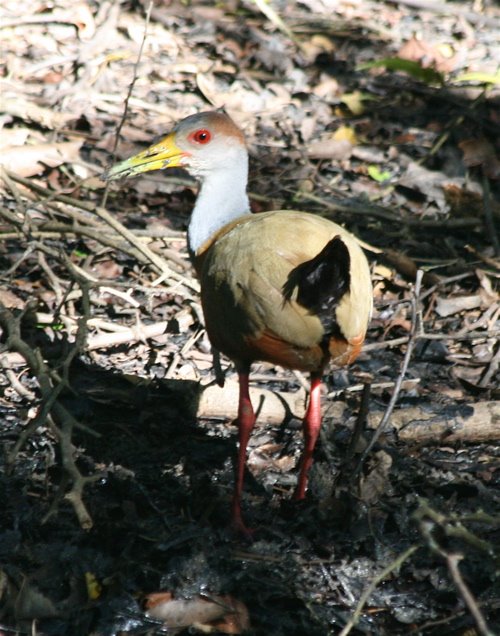
All the while, a gorgeous but comical gray-necked wood rail danced on and offstage, making me laugh with delight every time it appeared. I don't know by what provenance we have been given a wood rail that's not in the least shy and incredibly gaudy, with lipstick-pink legs and the most marvelous shading from gray to rust to olive to ebony...but we have, and I love them.


 It curtsied in the most amusing way on its hot lava legs


 and I wondered what the world would do without birds in all their splendor. Surely, as Roger Peterson said, they are "the most vivid expression of life."


It was at Cope's that I made my favorite hummingbird image of the trip--a blue-chested hummingbird pausing in mid-air for a split second that will enchant me forever. 


 Thank you, Cope, for all the beauty you have packed into your backyard sanctuary. An inspiration and lesson for us all. Visit him when you're in Costa Rica!


Cope Arte's website

Sungrebe on the Sarapiqui!!

Thursday, March 20, 2014

9 comments

We're still floating down the Rio Sarapiqui on a dreamy warm morning.


 Floating through La Selva Biological Reserve, taking in this male Amazon kingfisher, with bonus Tillandsia.

This crested guan, looking down at us.

And this young emerald basilisk, like an extra from the Star Wars bar scene. What a helmet he's got! It's a new basilisk for me.


They're called Jesus Christ Lizards because young ones run bipedally right across the water's surface! Later they get too heavy to pull that off, but it's killer to watch them light out, little pipestem arms flung out to the side, long toes ticking on the water's surface, skittering across the stream like tiny crazy monkeys. Imagine being light and fast enough to run on water.


We can only stand on the edge, fishing.


Gray-necked wood-rail is such a crowd-pleaser--fearless and smooth, its plumage like watercolor satin. Keeping with the theme set by the Amazon kingfisher who showed up in south Texas, this is a close relative of the bird (rufous necked wood-rail) that  turned up in an amateur video at Bosque del Apache NWR in New Mexico. Matt Daw was just minding his own business,  making a video of a fishing least bittern, when...You have to see this video for the funniest bird photobomb ever


Birding's like that. It's a box of chocolates, with an occasional jack-in-the-box.

Speaking of weird, this green iguana met with misfortune, lost its tail, and grew two new ones. Oops. 


Mangrove swallows watched our every move, accompanying the boat and even sitting on the bow.


some rather large spectacled caimans were hauled out here and there.


They just appear. You don't so much see them as sense them.


Believe it or not, the bird species below has shown up at Bosque del Apache, too. Who knows how it got there. Likely flew...but why? The sungrebe is a usually secretive denizen of rivers and backwaters. We were incredibly lucky to happen upon a female (males have white cheeks, so she's the prize!) just doodling along the bank. Despite their name, sungrebes don't dive. All their foraging is done on the surface of the water, picking at floating insects and foraging along the shore.




There ensued a photo frenzy between Mario and me. We couldn't stop clicking at this rare, often sought, seldom seen but cooperative little bird.

She was so beautiful, steaming along against the current.


One challenge of photographing her turned out to be the fact that her head moved ceaselessly, like that of a city pigeon. With every stroke of her tiger-striped lobed feet, her head jerked forward. So I got hundreds of photos in which her body is razor-sharp, but her head's a blur.


In the low light, I had to click at the precise moment that her head was still to get a sharp photo. 


I loved the ever-changing compositions offered by snags and leaves, shore and shadows.


It was then that the group collectively realized they were in the grip of an obsessive bird photographer.


But it's a SUNGREBE!!  Not just any bird. The only New World member of the finfoot family, Heliornithidiae. There are only two others. Not only that, but in researching this post I stumbled across grllscientists's excellent blog, in which she cites The Handbook of Birds of the World in an utterly bizarre observation. Get THIS.

M. Alvarez del Toro, who observed a nesting pair in Mexico, discovered that the male has a shallow pocket under each wing into which the two young can fit. The pocket is formed by a pleat of skin, and made more secure by the feathers on the side of the body just below. The heads of the chicks could be seen from below as the bird flew. Alvarez del Toro collected the bird in order to examine it and confirm the unlikely discovery. Subsequently, he found it confirmed also by a report published by Prince Maximilian of Wied 138 years earlier but apparently ignored, forgotten or not believed.
This adaptation is unique among birds: in no other species is there any mechanism whereby altricial young can be transported. Of course, the precocial young of some swans and grebes may hitch rides on their swimming parents' backs, and a male jaçana can transport his chicks about holding them between his wings and body, but neither of these cases applies when the adults are in flight....
The transport system of the Sungrebe raises numerous further questions. How do the chicks get into the pocket? Are they put in by the male? Does he feed them in there? Do they stay inside, or get in and out? Why does the female not have similar pockets?
(Bertrand, B. C. R. (1996). "Family Heliornithidae (Finfoots)" in del Hoyo, J., Elliott, A., & Sargatal, J., eds. Handbook of the Birds of the World: Hoatzin to Auks. Vol. 3. Lynx Edicions, Barcelona, ISBN 84-87334-20-2 [Amazon UK;Amazon US]).
Another question inspired by the citation: What did he do with the poor orphaned sungrebe chicks once he collected their dad? OK, that was a cheap shot. He had to collect it to confirm what would otherwise be an apocryphal observation. I'm glad to live in the digital age, where I can collect birds, bats, insects and butterflies with a harmless click of the shutter. And store them on a hard drive instead of big mothbally cabinets. And they can go on raising their young and picking insects off the water surface.


I kept collecting images. Here is her outstretched wing. Looking for a pocket under it... I could easily have done this all day, but eventually we chugged along past her.


A couple of residents, enjoying some fresh river air. It was time to leave the beautiful Rio Sarapiqui. On to another adventure.

Tottering Farther Afield

Wednesday, April 9, 2008

12 comments
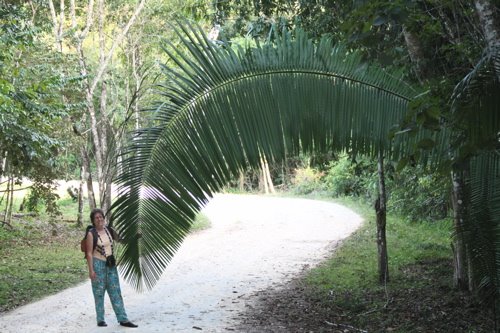
Zick with the frond of a cahoon palm, the largest leaf in the world!! Thanks to Jeff Gordon for telling me that tidbit, and to BOTB for taking this shot.

After a day and a half of lying around like a burlap bag, I was really ready to get out and watch some birds somewhere other than off my balcony. My balcony had been beddy good to me, but a girl has her limits. So I wandered alone on and off the hotel grounds, seeing what I could see.

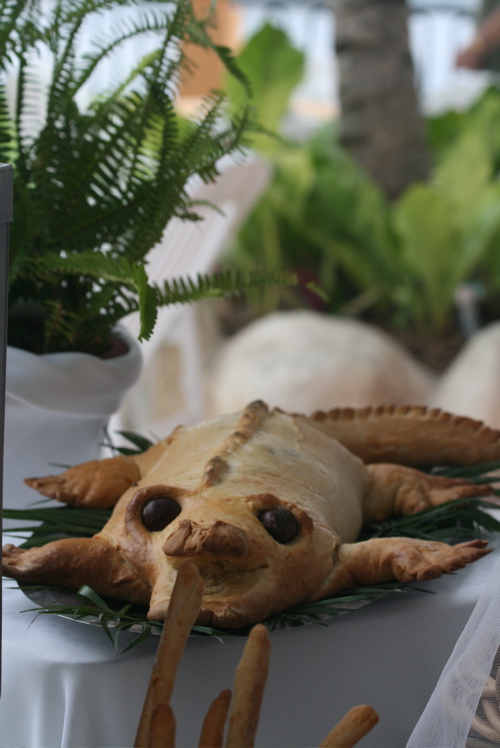
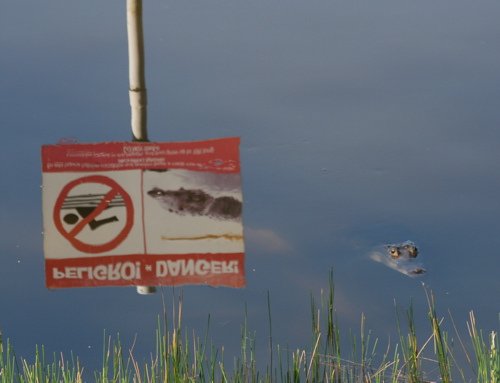
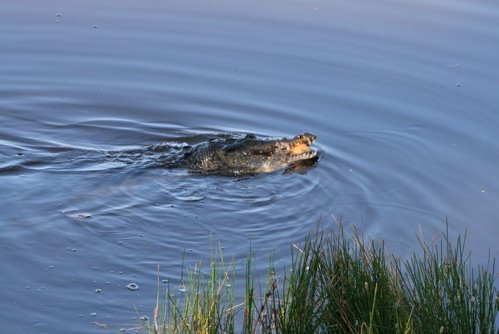
Others have blogged about the crocodile made of dough that greeted us at our first breakfast at PetenItza. Well, that was cute, but I thought this was cuter. A Morelet's crocodile Crocodylus moreletii (an endemic, rare, and sometimes quite dangerous creature native to coastal Mexico, Belize and Guatemala) waits next to the reflection of a sign warning us of its malevolence. Patricia says "Watch this!" and grabs a bun out of our basket and tosses it into the water.

CLOMP!B'bye, bun. Although one of the two Morelet's crocs who live in a small lagoon at Tikal has been reputed to be a man-eater, I felt comfortable walking the edge of this lake, knowing at least one of the crocs had a belly full of buns.

I decided to make a photo safari, to get pictures of as many lakeside denizens as I could. To tell you the truth, since I got a good camera, every excursion turns into a photo safari. I wouldn't know what it's like just to hike, swinging my arms and covering ground, without a lead weight on my left shoulder and my eye always ready for the photo-op. But I'm not complaining. Hunting down and bringing back digital trophies is tons o' fun.

A gray-necked wood rail padded softly by a muddy inlet.
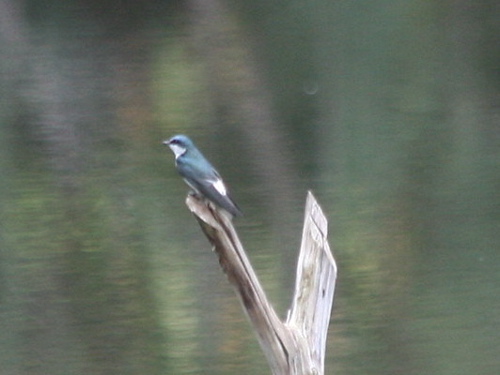
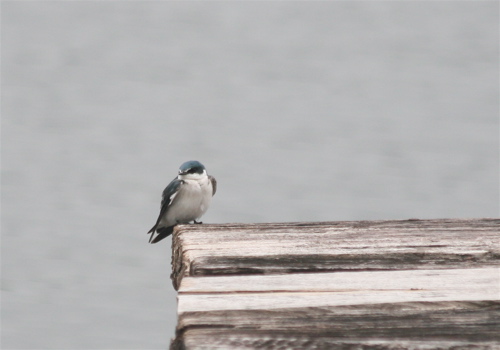
Mangrove swallows, cousins of our tree swallows who've only just arrived in Ohio for the spring, showed white rumps as they waited for insects to fly by their little posts.
Yes, there's something very familiar about this Tachycineta (albilinea).

A northern jacana teetered on spindly legs as it pecked at...buns. I'd love to say it was eating crustaceans, but it was eating part of a bun the croc had missed.
Get a load of that inflated, cushy frontal shield. Oh, I'd love to poke it with my fingertip, to see if it's as soft as it looks. Birds like me, but not that much. Someday, I'll poke a jacana's frontal shield. Before I die. We all must have goals.
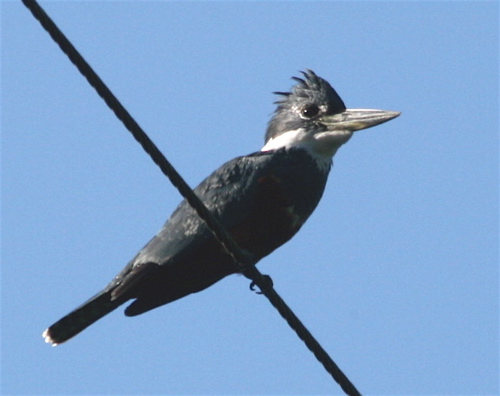
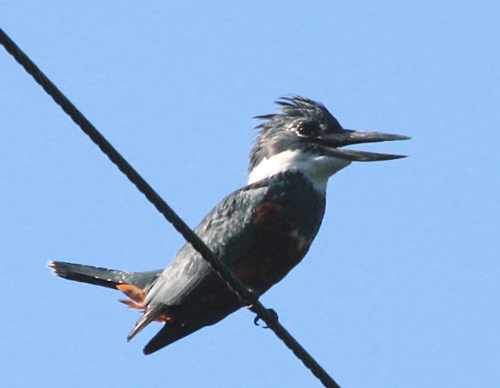
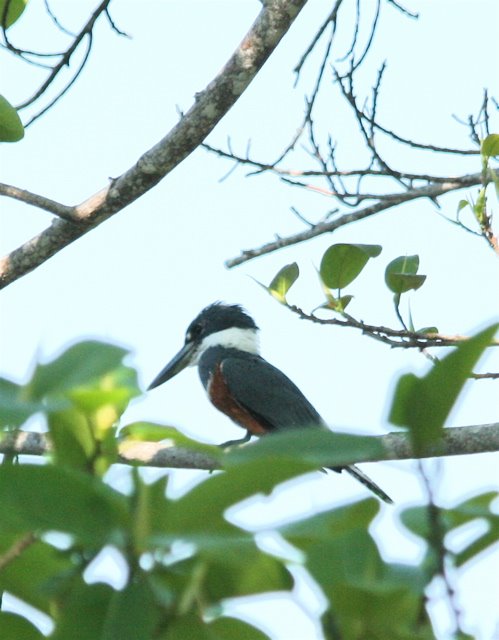
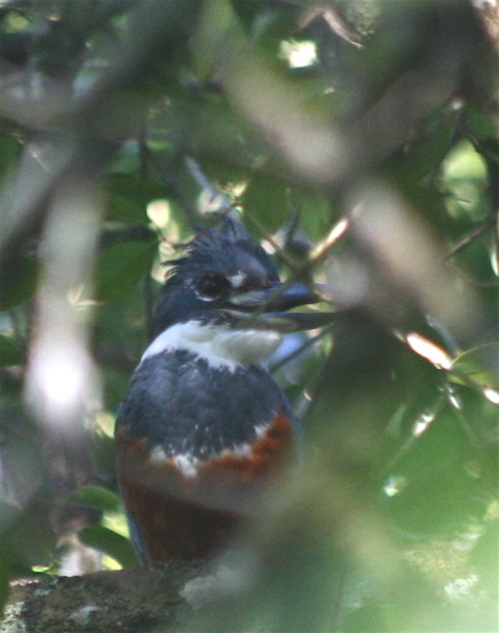
Not far from a huge exposed earthen bank along the road, a harsh call rang out. Thirteen "yik's" in a row. Then another 13, then another. A female ringed kingfisher (discernible by her blue "bra," which the male lacks) was perched on a wire, scolding me. I thought she probably had a nest in the bank. For a kingfisher, she allowed a ridiculously close approach. I remember Susan Gets Native's plaintive caption, "Does ANYBODY get a good photo of a kingfisher?" Well, until now, I sure thought not!
You will notice that this kingfisher is huge, and equipped with a dagger for a bill. It's 16" long, to the belted kingfisher's 12". Oh, I would hate to be a fish in a lagoon under a ringed kingfisher.

At the start of each series of 13 calls, she'd jet her tail and let it fall as she yikked her complaint out into the hot, still air.
She perched briefly in a tree, letting me see her brilliant rufous underparts.
Then she flew into the woods, where she could keep scolding from a leafy fastness. What a satisfying encounter with the King Kongfisher.I spent today pulling up last year's vegetable garden, burning the stalks, raking up all the straw and finally rototilling the whole thing. I am semi-liquid, but must gather enough energy for a band practice in 1/2 hour. Oh, and cook dinner in between. Yeah, I'm wondering how I do it all, too.
[Back to Top]