Background Switcher (Hidden)

Showing posts with label gray tree frog tadpoles. Show all posts

Happy Birthday to Me!

Monday, July 25, 2016

26 comments
 I usually get a post up on Sundays, but I was working on a new talk and I had to get it done. 
It's only supposed to be 20 minutes, and it'll be delivered at the Saturday banquet for the Sedona Hummingbird Festival (Squee!!). I've figured out that I work something like two hours for each minute of the talk. The amount of time and brainpower I expend on these things is ridiculous. If it comes out right, it sounds extemporaneous. Well, it isn't. Snort.

So I was tied to the desk all day, except for an insanely cool evening walk down Dean's Fork, the subject of its own post. Sunday happened to be my birthday, so I decided if I had to sit all day, I would count the blessings that came my way. Each one would be a present.

My first gift was a handful of protoplasm. A couple of days ago, I looked down at a tire rut at a construction site and saw a puddle of tadpole goo where the day before there'd been rainwater. Because it's late July, the only thing they could be is Cope's gray treefrogs.  I touched them and sure enough a few wriggled in a SAVE ME!! kind of way. Oh no. More than a mile from home, and it's going to be a blistering hot day, and there is no natural water I can reach in shorts for at least another mile, unless...


I glanced around the site and saw a gallon of drinking water on a folding table, with a stack of plastic cups. Eureka!

I scooped up the taddies and a good bit of silt and plopped them in a cup, pouring life-giving water over them. Imagine how good that feels to a tadpole on its dying day. Jogged that mile home carrying the cup of taddies, laughing to myself about how that must've looked to the neighbors. Poured it in a plastic jar and added beaucoup rainwater. I gave them a couple of days to rehydrate before releasing them, and they needed it. When they started acting like tadpoles instead of crumpled bent fetuses, I knew they were ready to go.


This was my first birthday gift.


For future reference, they love koi sticks. Nomnomnom.

On this morning, I took the jar down to our fishpond, fed the comets to repletion, then installed the jar on a shelf in the pond.  One by one, the taddies who had survived their ordeal came up for air, saw the great expanse of water and delicious algae, and swam off into the deep. 


This one swam curlicues, dove, wriggled through the algae; its joy on being in proper habitat that wouldn't dry up was palpable. Honestly, I don't know how tadpoles do it, always watching the water levels, praying for rain, facing the imminent prospect of death by baking. Ugh.


There being no puddles left anywhere in the sweltering July heat, our water garden was my best choice. I had to hope the fish would leave them be. Comets aren't very predatory where small swimmers are concerned. As I was monitoring their exodus from the jar, I saw a tiny comet, the first spawn of my four fish, swim by. If he can make it, they can, too. 

Second present: BUN.
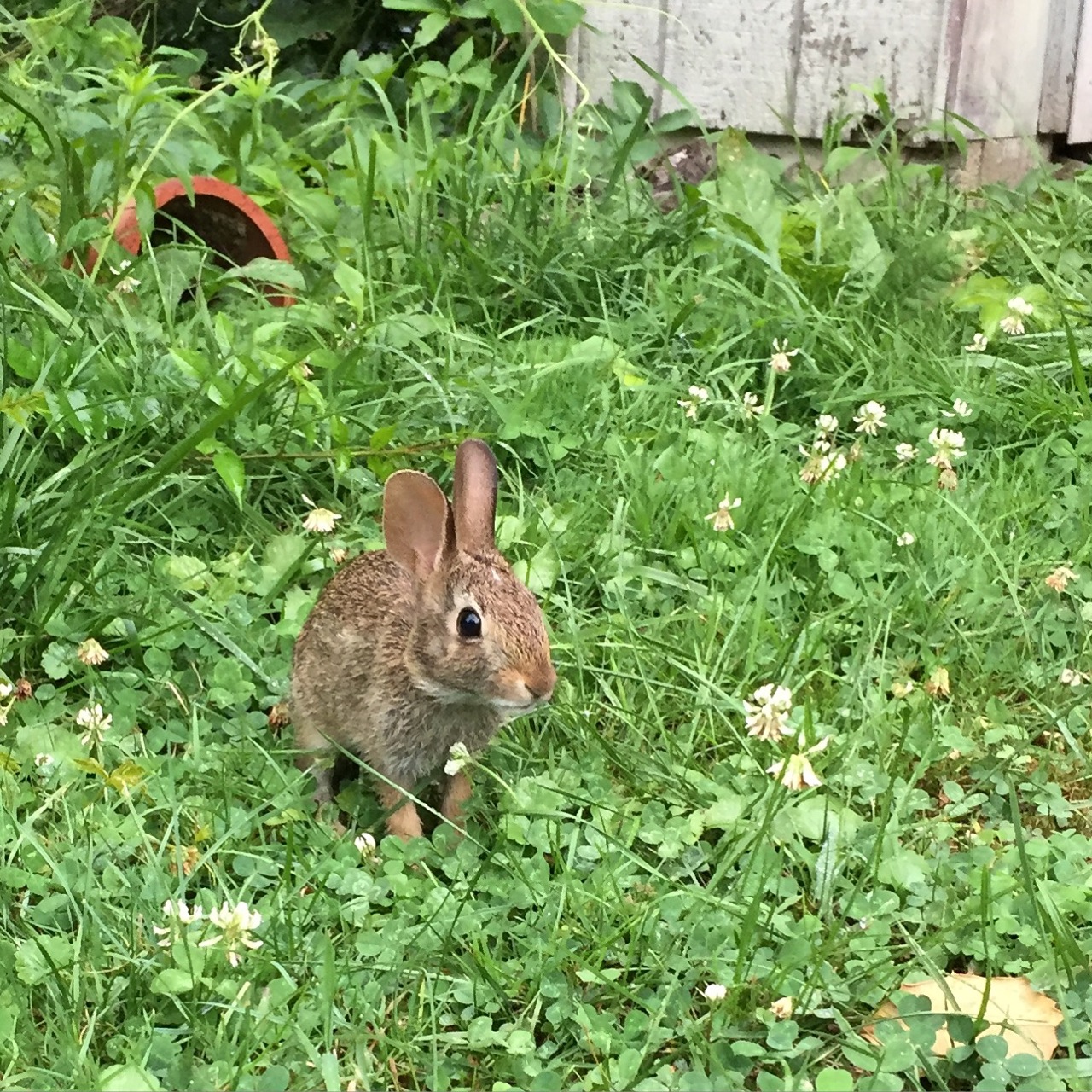


 There's a litter of three young cottontails in the yard who, having grown up in the sanctum sanctorum of Indigo Hill, have no frame of reference for humans as dangerous animals. They barely recognize Chet as a threat, which (let's be frank) he barely is. So these foolish little animals perk their ears attentively but go on chewing clover when I speak to them, kneel down and take iPhone photos of them from barely five feet away. Dumb bunnies. But of course, I adore them. So, Bun. They're all three named Bun.

I have a little family of brown thrashers in the yard! I don't know if any of them are Cletus, Melba or Harper; I think not, because the adults aren't tame at all. But oh, being able to look out and see thrashers doing thrasher things, dust bathing, sunning, hunting bugs or, in the case of one of the parents, grabbing a sunflower seed and pounding the shell off--it's just the best. This is a juvenile. Gift 3.


Seeing the laborious way a thrasher, which doesn't hold seeds in its toes for shelling, has to pound the hull off a seed, I spread sunflower hearts in all their favorite spots. Watching them gobble them down: Gift 4.

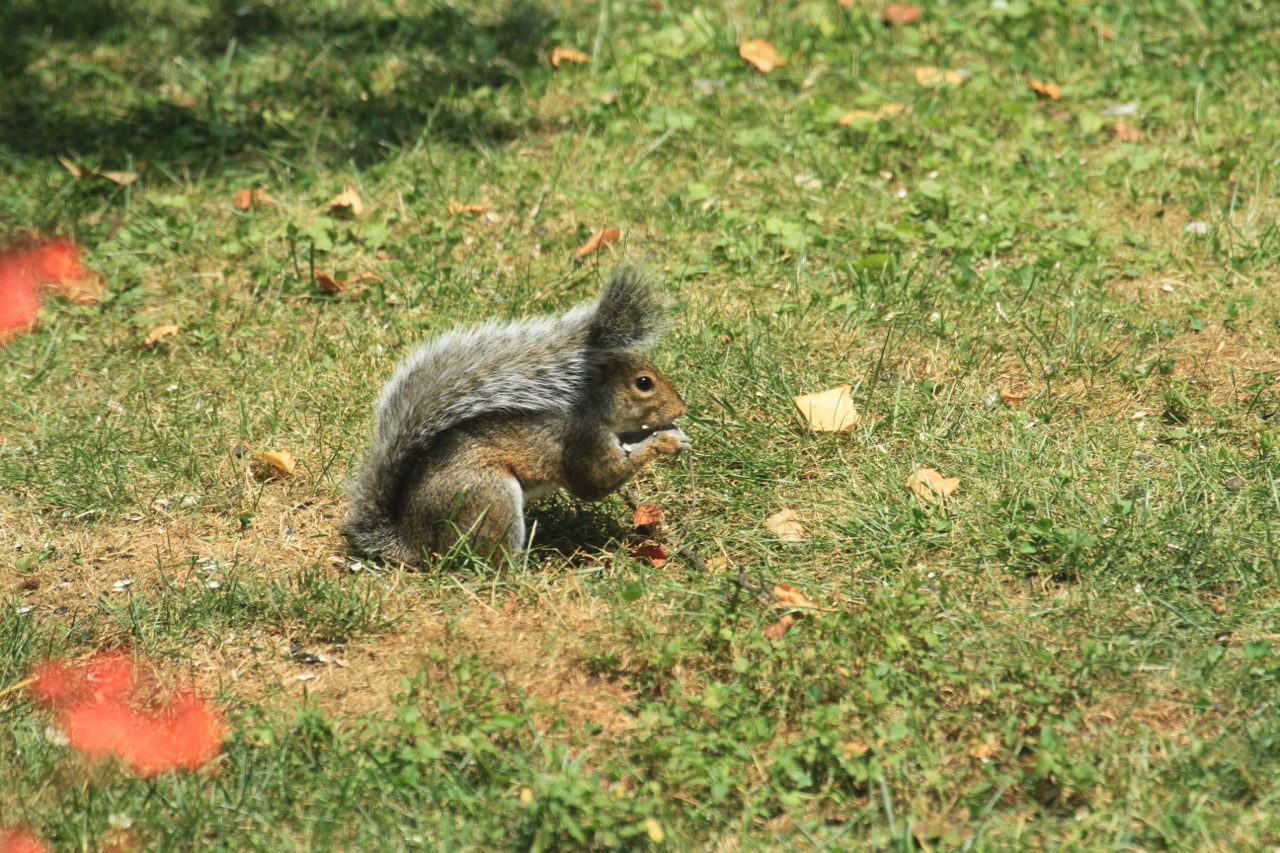
Present # 5: Someone dribbled squirrel! He appreciates the sunflower hearts very much. He ooches around on his belly picking them up one by one. I have to say I love my squirrels. They annoy the hell out of me, but they're such fun to watch! So they're paying their way, at least partly.


The sunflower hearts brought in MamaCoon and her three kits! Gift #6: July 24 was first day she's brought them out at noontime.


It's amazing how long those raccoon babies are dependent. The smarter the animal; the more complex and comprehensive its diet, the longer the juvenile dependency period.


It takes a long time to learn to be a raccoon.

Gift 7: the yard robin resents crowding by a ruffian house sparrow, tells him to back off! Just having a robin in the Spa, ahhh. But this combo was too much.


#8: speaking of Back Off, a mourning dove warns a squirrel it's too close.  I am big! I will beat you with my wing! Interestingly, a dove would NEVER let a chipmunk get that close. Chipmunks are far more dangerous than squirrels. They're nastya-s little animals. Chipmunks remind me of the killer rabbit in Monty Python and the Holy Grail. 


 Adult male Cooper's hawk makes two passes through the feeder zone. I manage to capture its bill, leg and foot, enough to identify it, as it fetches up in the Japanese maple. Not a great photo, but still gift #9.


This just in!! July 25: I saw the Coop take a pass at some doves just now and scuttled with camera downstairs to shoot it from the bedroom. This is through two panes of glass, at a terrible angle, but OH MY. Talk about a gift, hurled from the Other Side. Thanks DOD!!


On the first shot, I captured the whole hawk. When it turned toward me, I lost my head and focused on its face. Ah well. Too excited to shoot well.
Please note that this hawk is perched in a retired, or as I love to say, recovering bonsai. DOD, you place your gifts so well. He adored my bonsai. 
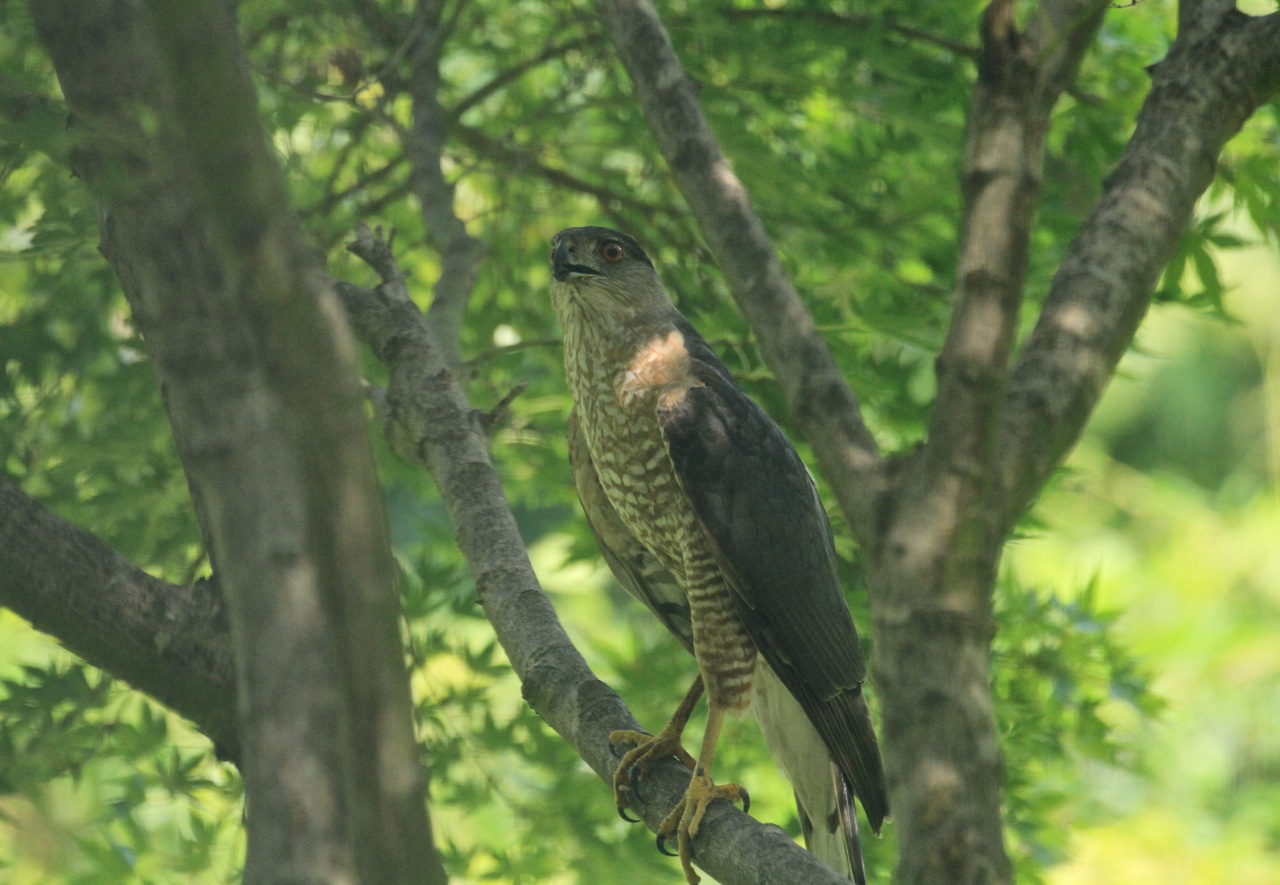

You beautiful thing!! Please help yourself to mourning doves, and  take a house sparrow as a chaser, willya? You're also most welcome to squirrels, but please not the one who sccoches around on his belleh.


#10: Seeing a gray squirrel use its tail as a hat and parasol.


At this point it's 98 in the shade,  easily 102 in the sun, and I'm so thankful to be inside mostly (not) working on my talk. 

 # 11: a rubythroat investigates the coneflower, seeming to find a sip of nectar in the disc. Not something I see every day, but these midsummer juveniles try everything.


There has to be nectar in this big fat bud. Just has to. I'll wait for it to open. This photo: Gift 12.


I have a variety of wire supports for my tall cardinalflower and Fuchsias, and the hummingbirds adore them. Hummies appreciate thin perches. They can watch for Cooper's hawks from them. It must be nice to be too small and fast to bother with. But you still have to stay vigilant. 


This photo: Gift 13.

Meanwhile, fall migrants (yes, I said it; fall begins in July for warblers!) are sifting through the yard. A young yellow-throated warbler on its leisurely path southward. Or westward, or eastward...they do a bit of wandering.  This has to be one of my favorite warblers, Gift #14. Get the picture? Everything out there is a gift. I had intended to put all my birthday gifts in one blogpost, but it's evolved into at least three. And that is a gift in itself.


Happy birthday to me! Now you can see why it takes me so dang long to put together a talk. Or a blogpost. A giant set of Venetian blinds for the studio window would probably go a long way toward increasing efficiency, but ignoring the show going on just outside those windows in late July? Unthinkable! All but a couple of these photos were taken through my studio window, through the crop netting screens that cover them. Gift #14: having such a big, comfortable blind for a house!


Blessed, that's all!

Tadpole Postscript

Thursday, December 15, 2011

13 comments

On October 7, 2011, as I was pruning my huge gardenia tree with the braided trunk for its annual trip inside, something jumped, and it wasn't a tree cricket. It was one of my tadpoles, all growed up.
Well, sort of. She was still minuscule. But man, she looked like a tree frog now. (basing this guess on the fact that females have pale throats while male throats tend to be darker). Hello, sweetheart!


Charmed beyond all measure to see a successful frog fledgling, I set about making portraits.


She climbed with that special reptilian flow that tree frogs are so good at.


I think this is my favorite shot, those long fingers, that wise face...


I reflected on how a pailful of tadpoles had enriched our lives all summer long, what a miracle, what a gift they'd been.
From watching them hatch to seeing them learn to recognize me and anticipate feeding time, watching them grow limbs and leave their watery world for the air and leaves and sun, they'd opened up a new world to us.


But as things go when one messes with nature, not everything went so swimmingly. For the only frogs that actually metamorphosed were the older tadpoles we'd saved from the driveway. The eggs I'd scooped out of the fishpond had hatched, eaten, swum, grown, and then simply stopped growing. By late November, they still hadn't metamorphosed into frogs. Why? What could be going on?

Perhaps a clue can be found in the fact that about 20 of the older tadpoles also failed to metamorphose. They didn't even sprout legs.  None of the group raised from eggs sprouted legs at all. Oh, they'd had time--the eggs were laid July 10, and gray tree frogs take about two months to mature. 


Delving into the literature, I found that several things can retard development in tadpoles. Removing the thyroid keeps them from becoming frogs. Well, that wasn't it. I hadn't touched their thyroids.  Starvation can cause retardation. With my fish food supplements, that was unlikely to be the problem. Crowding can also cause retarded growth. Hmm. These tadpoles, it seemed to me, had ample elbow room and a greater water volume than in most of our roadside puddles. But they never grew elbows.

Thinking about it (and I did, for weeks!) I concluded that perhaps the answer to the riddle could be revealed by turning it upside down. What speeds development in tadpoles? Shallow water and higher temperatures, that's what. When a tadpole in a natural pool feels the water heating up because the pool is drying, that can cause accelerated development, a race to metamorphose and be able to gulp oxygen before the watery habitat is no more. 

Perhaps my tadpoles never felt that pressure, never felt the need to metamorphose. As the summer wore on and turned to fall, the sun stopped striking their pools; on the north side, they were now in the shadow of the house. The water, which had been very warm in July and August, stayed deep, and more importantly, it cooled. And the tadpoles simply stopped growing. 

I wondered what had happened in the pond to the eggs I'd left (I'd taken half and left half to hatch there). I suspected that they'd become fish food as soon as they hatched, being tiny and wormlike. I never saw a tadpole there. 

And now, what to do with the remaining tads? We'd already had a couple of hard freezes, and their pools had become covered with ice. Amazingly, they were still alive under there, still moving feebly. When the weather warmed back up they were their lively selves again. I decided to put them in the pond where they'd started out in the first place, to see if perhaps they could survive the winter in a dormant state and take up the business of metamorphosis next spring. It was an imperfect solution, but I didn't see any other alternatives. I couldn't throw them in the Amazon tank indoors, because there were all kinds of nasty things in those pools that would probably kill my home-bred tetras. 

Neither could I simply tip the tadpools into the pond. Over the course of the summer, tiny snails had proliferated, and there were doubtless flukes and leeches, too--all of which can mess up fish. No, I'd have to dip-net the tads into clean water and then transfer them with a net. Which I did, on November 20. 

When I emptied the large tadpole pool, the bottom was covered in leeches! Yicccch!


Yep, that's a leech on my thumb, its tiny head searching for a victim. I was very glad I'd followed my instincts not to tip the water into the pond. 

For all I know, that's full of leeches, too...just about bound to be. But I didn't want to introduce anything new.


I netted all the taddies and put them through a couple of rainwater rinses. There were about 50 remaining, about 20 of those older and larger, from the driveway batch, and the rest from the July egg mass in the fish pond.


I poured the water through the net, which is the only way to catch tadpoles. Much less stressful for them than chasing them around.


Wriggling life, about to be given their second snowball's chance. I hope it works. It probably won't, but...

Into the pond they went, swimming tentatively out into the vast spaces. I felt OK about putting them in with the fish now that they were bigger--American toad tadpoles seem to do fine once they reach this size; the fish no longer seem to regard them as prey.


Maybe we'll see you next spring. Hope so.


More lessons learned, more curiosity fueled. You can think you're doing wild things a favor by helping them out, but as often as not you're just messing them up. It seems to me, mulling this over, that tadpoles were meant to grow up in shallow, hot, barren-looking mud puddles, not the Club Med for Frogs I'd so lovingly and lavishly created. They're meant to grow up without fish to prey on them, and that dictates a most ephemeral watery habitat--a puddle. Perhaps I'd doomed them by giving them everything I thought they could need. Maybe something in the food I gave them retarded their growth--I don't know...but I fed the older tadpoles, too, and most of them made it to frogdom. 

I was humbled by some photos I found online of gray tree frog eggs hatching and maturing in a large plastic plant pot saucer full of rainwater. The frog had laid its eggs there and in that almost impossibly sterile environment they'd grown and thrived. Go figure. 

There's so much more that I don't know than I know.

That's what keeps me going.

They're Gray Tree Frogs!

Tuesday, December 13, 2011

8 comments

When a tadpole is hovering somewhere in the limboland between larva and froglet, it can be hard to tell just what it is. They're pretty nonspecific in color and markings, a little goopy in form. In this photo you can see the protofrog's jaw, this tiny lower mandible where once there was a sucker. He's coming along. He's still highly aquatic, and will drop back down into the water at the slightest inclination, but he's on his way.


At this point I still wasn't sure what I had. It would take some time before the froglets looked anything like adults.


What will you become, little blob?


But one morning I walked out and there was this little fella perched on the rim of his habitat, looking out into the big garden full of insects that he would soon inhabit. And even though he still had a bud of a tail something about the way his fingers wrapped around the rim of the pool said tree frog to me.  Gray tree frog. Whoopee!


The round sticky pads on his toes clinched it for me.


As the froglets got older they colored up a bit, too, some turning green. As I understand it gray tree frogs can change color the way anoles and chameleons can, from green to gray to almost black. Some sources have green being only a juvenile color, with adults ranging from nearly white to nearly black, but I've seen one full-grown individual that was lichen-green.


They have a distinctive slow walk when undisturbed, sort of oozing over the leaves.


Naturally, I became enamored of them.


Wouldn't you?


Once their tails were absorbed, they were ready to go. They dispersed into my nearby flower garden, a mighty jungle for a frog the size of your fingernail. I assumed they'd travel overland in rainy weather to reach larger trees, or perhaps dig in for the fall right in the flowerbed.


Whatever happened to them, they had survived because we'd bothered to save them, and that made us feel good. To think that they'd have dried up to sad black slime in the driveway, when they gave us so much happiness metamorphosing on our doorstep...I don't think I'll ever be able to walk by a drying tadpool again.


  To tell you the truth, I've never been able to do that. But usually I drop them into a larger pool somewhere. This is the first time I've gone so far as to make habitats for them. It was well worth the trouble, heavy coon grates, water changes and all.


 I recommend  getting involved with tadpoles. With caveats, as usual, which I will explain in the next post.


From Tadpole to Frog

Sunday, December 11, 2011

7 comments

There is a certain satisfaction in setting up a little ecosystem and seeing to it that it runs right. It's the allure of aquariums and terrariums, the challenge they present to us to create an environment that has everything our chosen denizens need.

Science Chimps have lots of aquariums and terrariums around all the time.


It took awhile to get the pondlets in balance. Thanks to all the nutrients in the silt (and probably in the goldfish pellets), I had a few weeks of severe algal blooms which I addressed with siphoning and water changes. Because I didn't want to suck up any taddies with the silt, I retrofitted my siphon with an onion bag, doubled over four times and secured with a rubber band. Worked pretty well.

The point being to see the tadpoles growing and changing, or what's the point? Finally, the algal blooms settled down, the water  cleared, and we got to enjoy them again. FYI I used only rainwater in the tadpools, just as I do in my Amazon tank. Tap water around here is pretty nasty for delicate aquatic organisms. About the only thing that does well in it is cichlids, which are adapted to its high pH.


As July wore into August, several froglets emerged each day. Such a magic moment, when this creature of water becomes a creature of air; when it switches from swimming with lashing tail to kicking with its brand new hinders. When it crawls out and does its first pushup with brand new arms, looks around and
suddenly lunges forward to nab a gnat.

I saw that, once. Where once there had been a sucker now there was a little frog mouth and it snapped open and the gnat was gone.


Cradled in the water hyacinth, a new frog wonders.


He'll go back to the water when danger threatens. And each day his tail will shrink until all of it has gone to his growing bones and body.


I noticed that the new frogs looked smaller than the tadpoles. They lost their big poochy guts and got waists. Which makes sense, since they're moving from herbivore to carnivore, too, and perhaps need a shorter intestine as an insectivore than they did as an algavore.


Some of them look downright skinny when they first climb out. There have to be some growing pains involved in switching mouths from little sucker to boca grande.


This perfect miracle played out each day for us to watch. The kids called the four-legged tadpoles "armies" and kept an eye on them, because they knew once the tads had grown arms that they'd be frogs soon.


Ah, the joy of maintaining a microcosm.


[Back to Top]