Background Switcher (Hidden)

Showing posts with label DOD. Show all posts

Painting in Audubon's Lines

Sunday, June 18, 2017

11 comments

We all have one in a closet somewhere: an old print that has lost its lustre. 

Sunlight happens. A print that's hanging in a corner that's dark in January is suddenly illuminated by a shaft of morning sun in June. Shine enough such June morning sunbeams on a print, even one behind conservation glass, and bad stuff happens. 


The Arctic tern loses all the color in its blood-red bill and feet, and falls to sea, a pallid, lifeless ghost. 
Red is a notoriously fugitive pigment, subject to fading. We painted our house red, and I hope when it fades it'll have some nice wabi-sabi going on, like an old barn. At least that's the plan. I had to paint it barn red.

My friend Alan Poole has the most beautiful home near the shore in Massachusetts. I wrote about it, and his elegant, spare yet abundant lifestyle, here

In that sweet home hung two identical Audubon prints of Arctic tern. They date to 1835, and they were taken from two Elephant Folios. Many of these original collections,  depicting America's birds at 100% life size, and sold by subscription in Audubon's day,  were broken up, with the pages being sold separately. I'm not sure how Alan wound up with two Arctic terns, but they looked nice in his seaside home. 

Well, they could have looked a lot better with some color.

Here's the little block of wood pasted to the paper on the back of one of the prints. Who knows when this thing was first framed? It was in the days of manual typewriters, and long enough ago for the paper to go yellow.  And I'm trying to imagine folding back the margins of an Elephant Folio print. Geesh!! I guess cutting it down to size was too horrifying to contemplate, and framing all that white paper expanse too expensive.


When I visited in December, Alan asked me if I'd color the tern's feet and bill for him. I gulped. Paint? On an original Audubon Elephant Folio print? Me??

Umm....sure....if you want me to...
Are you sure?

"Look," Alan said. "These aren't doing me any good all faded out like this. Just give it a shot, see how it goes. If the first one turns out well, I'll give you the second to restore."

It was hard getting the print out of its frame. Those glazier's points were rusted in place. But I finally wrassled it free, thinking that it would probably take me longer to do that than to do the restoration.
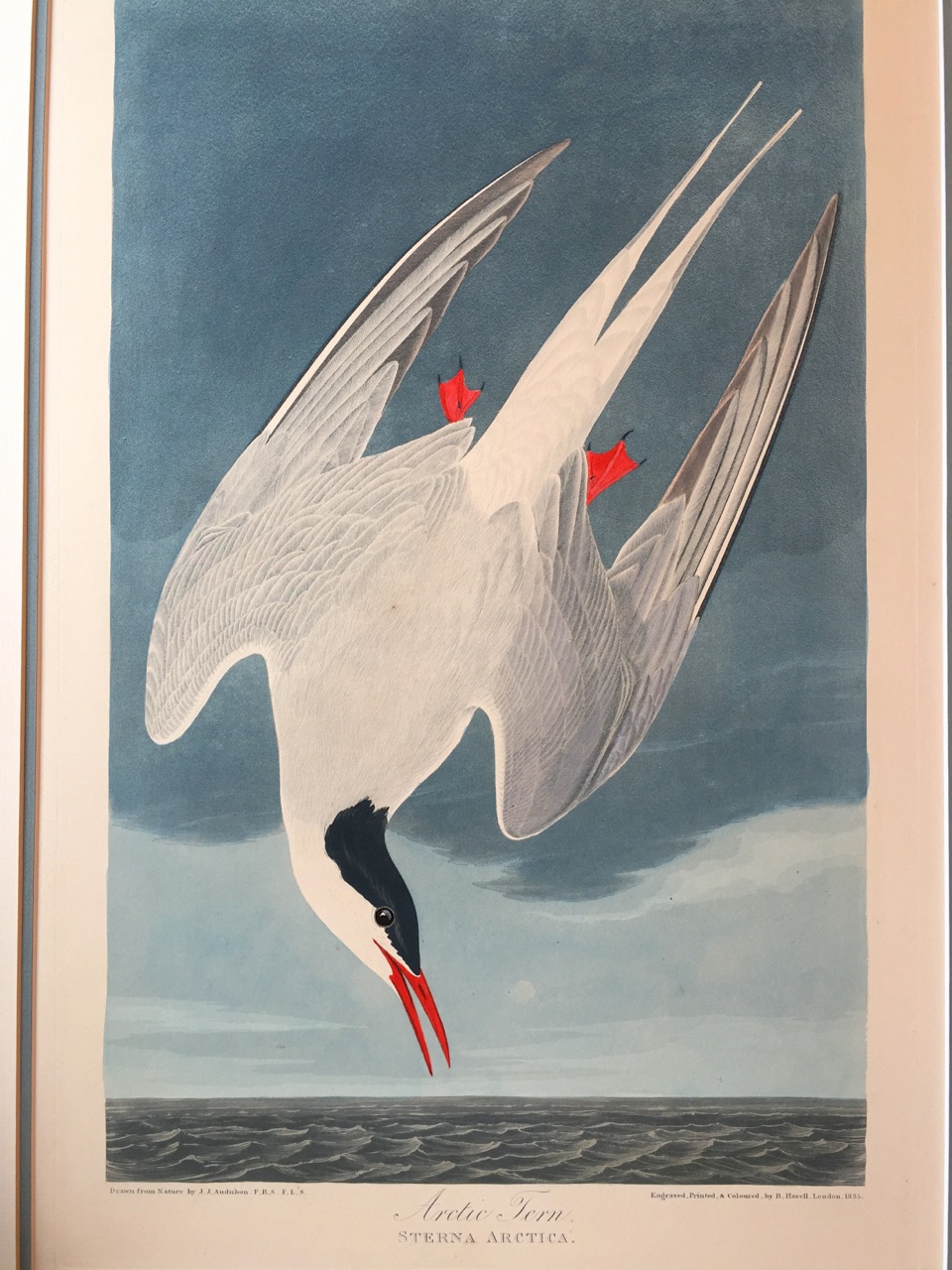

I Googled images of Audubon's Arctic tern to see how an unfaded print might look. Then I started small, with the eye, and immediately knew I was in for a ride. For though the ink had faded badly, it was still on the paper, and it was resisting my watercolors something fierce. I managed to darken that eye and the bird immediately looked better, more alive. From there I moved on to the bill and feet, holding my breath as I painted inside the tiny fine lines, trying very hard not to go outside them, for there would be no correcting any mistakes on this plushy soft paper. The corner and tips of that bill...aaaack. Fine brush, held breath, steady hand. I got this.

Already it looked so much better. 

The bird still looked flat to me, and I studied the images I'd pulled up. It needed some sense of light and a sense of the direction of that light. Looks like Audubon intended the light source to be in the upper left corner of the page. That's the classical mode, makes sense. I took a bunch of deep breaths and started in on the bird's left wing, which was in shadow. I painted a cool blue-gray wash over the wing, and it took on a roundness it had lacked. I then found Audubon's shadow line on the mantle and painted a darker cool gray wash along it and to the right of it. Boom. The bird began to pop. Do click on the images to see detail.


One of the bolder things I did was to paint some very pale shadow lines to delineate the edges of the white feathers on the rump and tail. I like how that worked. I also painted his faded toenails black while I was working on his feet. I darkened the black on the primary tips, too.


It was a thrilling sensation to run washes over the fine black lines of Robert Havell's engraving. I could feel them beneath the brush. I don't paint birds in anywhere near the detail these prints exhibit; I paint masses of feathers and don't bother with barbule lines. But oh I loved painting over Audubon's and Havell's meticulously detailed work. 

I am keenly aware that purists might faint to see me taking watercolor washes over an original Elephant Folio print. But the owner of the print had asked me to and I was having a ball! Was I altering an historical artifact? Sure. Polluting it? Maybe. Improving it? I thought so, and I hope Alan will too.


When I got to the bird's black cap, the faded ink stopped my progress. It was resisting my paint. So I painted what I could, keeping the faded blue top on the cap, but darkening the lower border of the cap and working with Audubon's highlight areas to create dimension on the bird's head. Yeah, that works.

Then I did something that took nerve. I had always disliked the hard, oversized, sharp, triangular highlight on the eye of this bird. It reminded me of early Walt Disney depictions of Mickey Mouse. Early Mickey is referred to as "Pie-eyed Mickey" by collectors of Disney ephemera. 



 To me, it dated the piece, to a time when that's how people painted highlights on eyes. It made the bird look like a static, dusty museum mount. I wanted this tern to come to life! So I took a deep breath and painted over most of that giant pie slice of white. Then I took a thin wash of Chinese white and cerulean over the top of the eyeball, following its curve. Again, BOOM. Maybe not historically correct, but history's taking a back seat to color and life here. I can almost hear this tern's ratchety growl as it plunges toward the sea.


I think I'm done. I didn't touch the sky and seascape at all.  I loved the colors. Somehow the blue hadn't faded nearly as much as the bird did. I was very thankful for that, because I didn't think I could keep a wash smooth and even over such a large area. Phew!

 With some difficulty, I held myself back from putting a white highlight on the culmen of the bill, because Audubon hadn't. It needs one, but I didn't want to gild the lily any more than I already had.


I was so excited by the time I finished the restoration that I thought I'd add a little historical footnote. If it got sold as a fabulous example of original aquatint whose color had somehow miraculously been maintained, I wanted an astute dealer to see this minuscule penciled annotation, which would explain a lot.


Can't keep a Science Chimp down. It's all about the data, and the story. Speaking of stories...

I'll close with this photo of me and DOD, ca. 1971. Check out the Audubon print we're discussing. I'm destroyed. It's too good. 

Photo by Dan Kemp, ca. 1971

Miss you so much, DOD.  Holy cow. I just noticed that I've scheduled this post for your birthday, without even meaning to. That's what you call synchronicity. Hope you're watching. Know you are. 

xoxoxox Doo-Baby

 (Two Too Many)

Travels with DOD: The Abandoned House

Sunday, April 16, 2017

5 comments
Curiosity is my constant companion. Must give credit where credit is due: Both my mother, Ida, and father Dale were curious people. Ida kept a Webster's Unabridged about ten feet from the kitchen sink so she could look up a word she wondered about. She had a terrific vocabulary and was a voracious reader (these things tend to go hand in hand). My dad, too, read stacks of books, with history, science and biography his favorite fields. My childhood, I realize now, was the heyday of magazines, with Popular Mechanics, Farm Journal, National Geographic and The West Virginia Hillbilly all gracing our coffee table and continually renewed. Oh how I loved reading them. 

As a result of this parentage, I find it impossible to drive by an abandoned house, if I have time and privacy to investigate. I'm still telling you about all the things I saw and did on April 10, 2017, in commemoration of DearOldDad's passing. 


They are getting harder and harder to find. But one doesn't go looking for abandoned houses. One just comes upon them.

And the upholstered chair outside the side door just calls to you.


And there sits the washing machine on the back porch,  just where Frieda Ruigh kept hers. 


And you've just got to go inside, though it's dark and spooky and the floor isn't so good.


World's Greatest Grandpa mug is no surprise. The last people to live here were likely old, old, old. 

The kitchen window. Oh, man. I'm loving this place. I'm seeing it in its glory days, and in its decrepitude, too. 


I'm certainly not the first to go snooping here. Someone's laid a cookbook out on the drainboard.


To my great surprise, it's a microwave cookbook, which spends a great deal of time explaining how microwave cooking is very different from conventional cooking. No kidding. I look around but don't see the oven in question. 


I do find a treasure in the rubble: a handblown tumbler from the Princess Anne Inn, Virginia Beach, Virginia. It looks to date from somewhere in the early 60's, judging from the turquoise font. It is now on my bedside table.  I do a quick Google and find this article from  The Virginian Pilot, Dec. 28, 1997.


The Princess Anne Inn, a fixture on the Oceanfront for 35 years, closed its doors in September in the wake of stepped-up city enforcement of the state's fire sprinkler law. The hotel was one of 33 resort inns cited by city fire officials last February for failure to comply with a 1990 law requiring inns three stories and higher to be equipped with fire sprinklers. Others either met the Sept. 1 deadline or their owners had signed consent orders drafted by the city attorney's office promising to complete sprinkler retrofitting within a day or two. 
Next, I search for images. Oh yeah. That's the one. A grande dame in her time. I think the newspaper article has it wrong. That place was built before 1962! The cars alone there look like mid 1940's to me. 


I run and fetch my tumbler. Its lines please me. The curved bottom reminds me of some of the  hand-blown glassware produced in the big West Virginia glass factories. No two were alike. My mother loooved to stop at the factory outlet glassware stores. I did, too. My DOD, not so much, but he humored her. 


As I look at the tumbler, I wonder if this is an apport from DOD. We used to, very occasionally, drive to Virginia Beach for vacations in very dark, very cold, very smoky motel rooms, where we would nurse our raging sunburns at night. Because there was no such thing as sunscreen, just suntan lotion. Which did nothing more than allow you to fry in your own oil. 

DOD hated the beach with a passion, because you couldn't grow anything there, and there was nothing to do or produce. And he wasn't much for water, or lying in the sun. As I think back on it, I remember him taking off in the car when Mom would take us to the beach. He probably hightailed it for the nearest agricultural land, to see what they were growing, check out a diner or two. 

I'm very pleased to see the similarity in font between tumbler and publicity postcards. I think we have now seen the Princess Anne Inn. And the tumbler is never going to go into the dishwasher if I have anything to say about it. And I do.

I also find a porcelain flower arrangement that has become an apt catcher for bat guano. I see where they've been hanging on the wall above. You can see more pellets in the background. I smile very broadly at this discovery.  Accompanied, by some of my favorite people.  This little knickknack I leave in its place. It's just too good there, brimful of bat-bockie.


I'm so struck by the verdant spring green and sun outside, in contrast to the gloom within. My iPhone does a wonderful job with the light, where my Canon would quail and fail to capture any of it.


I turn a corner and find a gunfight going on. I'm betting on Yellow Guy.


I absolutely love the evidence left by other curious explorers before me. 


And I love the scenes. Every window, a painting: shouting spring and whispering decay.


Colonial motifs were very popular in the 1960's and early 1970's. I grew up with colonial motifs. 
But the layers go back further, to the pale posy times of the 1930's.  I adore peely wallpaper, this stratified record of popular taste through the decades.


Moved to go outside**, I wander amongst the plantings. Pheasant eye narcissus is going nuts, having multiplied itself a thousand times over.

**family joke


This shot says it all. What once was, what is no more, and what persists. Still, they persist.


 And the souvenirs I bring home: my Princess Anne Inn tumbler, two spice bottles (one still full of very fragrant powdered cloves, which I throw out); one missing its lid, to use as a vase for Baby Moon narcissus from Murr. And a keepsake block from the Nelsonville (Ohio) Block factory. I have one at home, but it's broken in half. This one weighs in at a whoppin' 8.5 pounds, twice the weight of your average brick. It's my new doorstop, and the broken one has been demoted to paperweight.


You have to bring something home, right DOD? Otherwise it'll all go when the fire department burns the place down, or it collapses in on its wonderful self. It sure has been fun exploring this abandoned house with you, on April 10, 2017. I'll lift a tumbler to you tonight.


Honoring DOD: Spring Ephemerals Day

Thursday, April 13, 2017

6 comments
It always amazes me how many of my friends remember the day in 1994 the world lost the wise, wry light that was my Dear Old Dad (DOD, as he signed his typewritten letters).

With my newfound certainty that I'm accompanied in this life, I was delighted to find the weather report for April 10 was, in a word, ravishing. High of 79, abundant sunshine. Just the thing to make the spring ephemeral wildflowers pop out. I'll take it. 

So I decided to spend the day with DOD, doing all the things he and I loved doing. Mind you, he'd have been looking for bits of iron, wheels and crankshafts and the like in the weeds while I was looking at flowers, but still. We were going out into the country!

I hied myself first to Zaleski, Ohio, on the edge of the Hocking Hills region, where I'd gathered via some Facebook posts that there were flars to be seen. It was a drive of an hour and a half. Perfect for reflection and sightseeing.


The first thing that met my eye was a very large abandoned building that may have been an industrial mill. DOD could have told me. He also could have told me what the belt-driven machine overgrown by weeds might have been. I listened hard, but all I heard was moans. And the soft moaning issuing from its brickchinks told me this old mill was inhabited. 

Please click on the photo to see the amazing orange orbs on this rock pigeon.

He kept a watchful eye on the sky. Broad-winged hawks were just arriving, their thin whistles floating down from the warm sky. What a thing to hear!!


I love you so much, I believe I'll just sit on you.  Keep you safe. Hope that's OK.

My favorite shot. An accident, like most of my favorite shots. Some people don't understand why I love pigeons so much. It's because they don't understand pigeons. 


And it was on to the flars and the butterflies that love them! A fresh cabbage white nectaring on blue phlox has a lovely yellow wash.


Juvenal's Duskywing was to be expected on this hot sunny day.


Sleepy duskywing, on the other hand, was unexpected! I only added this one to our property list in 2004 (it was #67 for the property.) 


I thrilled to the first snowberry clearwing, one of the well-named hummingbird moths. Wild blue phlox Phlox divaricata must have some nice spicy nectar. Smells like a carnation, unsurprisingly, both being in the Caryophyllaceae, or Pink family.


Bloodroot Sanguinaria canadense  was, to my delight, still in full bloom. It's notorious for shedding its petals a few days after pollination. I just learned that if bloodroot comes out too early and pollinators fail to show up, its stamens will lengthen, bend over, and touch the pistil, in an impressive act of self-pollination! Thank you Andrew Lane Gibson! (The Buckeye Botanist on Instagram)


I chose a plant with several leaves so I could pick one to show y'all why it's called bloodroot. It's in the poppy family (Papaveraceae), most of which have lovely colored sap.


Here's your moment of Zen. What it's like to be out in the spring woods. No leaves yet, and the ephemerals exploit that narrow window of full sun for a couple of weeks to do their rush-rush blooming and growing!


Please pardon weird crackly leaf noises. Can't avoid it when shooting at ground level with iPhone6. They're right by the microphone. 

 Bluets. Innocence. Quaker ladies. By any name, Houstonia caerulea is an absolute charmer. I will never forget seeing a guy who lives on our road weedwhacking the drifts of bluets that come up on a bare steep bank in front of his house every spring. Because he couldn't get the mower there.
He also weedwhacked the white trillium until it gave up. And then he planted variegated hostas in its place. What a guy. What an ultramaroon. I probably should have said something, but where to start with a person who destroys Innocence on purpose?


A stunning composite with an unfortunate name, golden ragwort Senecio obovatus sounds like it should make you sneeze. Of course it doesn't. It's early and lovely.


I don't ignore the vetches. This is wood vetch, Vicia caroliniana. 


Cuckoopint! or swamp blue violet, Viola cucullata.  I was gobsmacked by the color variation in this species, from a brilliant rose-pink the likes of which I'd never seen in a violet, to that smashing true royal purple with a streak of delphinium blue in its hair.  If you click on this photo you may be able to see the fat white hairs in its throat, which differentiate it from other species.  Violets can be tricky.


Bloodroot, throwing a beautiful shadow. 


The first blooms from wild geranium or cranesbill, Geranium maculatum. Soon there will be gobs of it! But for now, its spectral rose pink lights up the forest.

Typical Dutchman's breeches Dicentra cucullaria

Some breeches for a very fat Dutchman.  I wondered if perhaps this could be a hybrid between Dutchman's breeches and squirrel corn Dicentra canadensis? Both Dicentra species. Probably not, but fun to consider.


The only yellow violet I found. Perhaps smooth yellow violet (Viola pensylvanica?)


With some hubris, I announced as I climbed this moist rich slope that I intended to find a dark blue hepatica. There was really no reason to grant my intention, but Fate intervened. I fell to my knees on viewing this round-lobed hepatica Hepatica americana with its leaves wholly obscured by a Christmas fern Polystichum acrostichoides.


What a blue!! Such a thrill for me. I was afraid the hepatica would all be done by now; it's among the first of the ephemerals to bloom, along with bloodroot.

Late to the party: This Mayapple  Podophyllum peltatum, just unfurling its little bumbershoot. Star chickweed behind it. 

I gazed up at the steep slope above me. It proceeded in a series of slumps, which told me that long ago, it was cleared for pasture, like most of Ohio. Erosion would take the soil downhill in slumps and tables. But clearly this mature forest had been here long enough to build up some lovely humus. And the richness gets richer the lower down the slope you look. There are far more and diverse populations of plants on the lower reaches than the upper ones, simply because the nutrients they need flow downhill. These spring ephemerals demand almost impossibly rich soil to do their thing in such a short window of time, while the forest is still leafless. And they get it, if we leave the forest alone. I don't see wildflower shows like this around where I live. People are too greedy, and have been for far too many years. They cut the forest before it's even a quarter of the way to mature: disturbing the soil, taking away nutrients, stamping out the ephemerals. 


Trout lily Erythronium americanum. It can take a decade or more for an individual plant to build up the nutrients and produce the number of leaves it needs to make enough food to bloom! You don't get trout lilies in disturbed forest. Needless to say, picking a trout lily is contraindicated.


It's all happening now. Right now, at least in southern Ohio. Wherever you are, get out there! This show of spring wildflowers lasts only a week or two, and it's gone until next spring. Hence the name "ephemeral!" If you don't know where to go, try searching for a Facebook wildflower group for your state. Ask a native plant gardener. Call your agricultural extension service. Look up your state Dept. of Natural Resources botanist. Then pick a day and go!


[Back to Top]