Background Switcher (Hidden)

Showing posts with label fixing mistakes in watercolor. Show all posts

Watercolor's so HARD!

Thursday, May 16, 2013

7 comments
The most oft-repeated and least true thing that gets said about watercolor.

"Oh. You paint in watercolor?? Watercolor's so HARD!"
Always makes me scratch my head. It's this thing that people who've never even tried watercolor say. It's this thing that people who've tried watercolor say. And I think they repeat it because everybody else says it. But...harder than what? Acrylic? Oil? Pastel? A rock? Diamond drill bits?

It may have something to do with the fable that you can't correct anything in watercolor after it's dried. Not so. I'm here to show you how.


As an illustrator, you do a lot of stuff. You get asked to illustrate things about which you may know next to nothing. Before the Age of The Google, you were stuck with what reference in books and magazines that you could get your physical gloms on.  And it was in this Age of Innocence that I painted a big brown bat using echolocation, for a Bird Watcher's Digest booklet by Rob and Kim Mies titled, "Understanding Bats."

I did my best, and my best pretty much sucked. I didn't know anything about bats, and I kind of made up the face. Maybe there's a bat somewhere on the planet that looks like this, but it sure isn't a big brown. Some kind of weird African mastiff bat, maybe. And those teeth? From hunger.

So Bill asked if BWD could re-use this and a couple of other paintings for  a new, revised edition of the "Understanding Bats" booklet. Sure, I said, and miraculously, and after four passes through a 12-drawer oaken flatfile, I finally found the originals. 

And was aghast. I couldn't let THAT fugly face go to print, with all I've learned and all I've loved about bats between 1996 and now! I remember it was 1996 because I was pregnant with Phoebe when I painted it, and Rob and Kim (then of the Organization for Bat Conservation) let me watch them feed their bats in their camper trailer in the parking lot of BWD. And I was all uncharacteristically spooky about contact with the bats and being pregnant and disease and stuff. Being pregnant will do that to you. Fortunately it was a correctible condition.


As was the mastiff-like face of the bat. Eminently correctible, even 17 years later. What you do is


you dip your brush in clear water, pool it on the offending area, and scrub. 
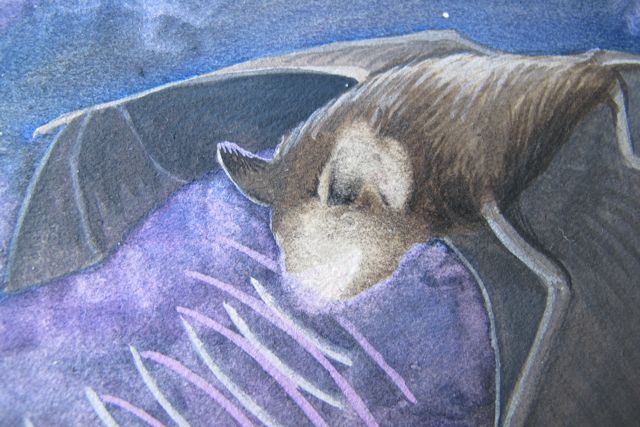

You suck up the pigment and the bad juju in the brush, rinse and repeat. If the ear's bad, you scrub that out, too.


And then when it's all dry, you paint a big brown bat face what am a big brown bat face over the scrubby part. Better. Far from perfect, but not fugly.


And the whole thing looks a lot better for it.


Ryan Amos, Big Brown Bat. Note blunt-tipped tragus. If he were a little brown bat, it'd be pointed and narrower.

Speaking of bat faces, I've been doing some retro-research on the True Identity of Ryan Amos and Drusilla, the two purported big brown bats I took through this past winter. I finally knuckled down and consulted some field guides. Couldn't make hide nor hair of the differences using photos in the Kaufman Focus Guide, because they didn't show the tragus (the little process in the front of the ear); nor did they show the back feet of big brown or little brown bats.

So I consulted Fiona Reid's Peterson Field Guide to Mammals of North America, which uses her careful watercolor paintings. And then it was clear. Both my kids were big browns, with a wide, blunt (not pointed) tragus, and short hairs (not long hairs) on their hind toes. Yes, these are the distinctions we use to differentiate bats. It's subtle stuff, and I'm always questioning myself. Do I even know what I'm looking at?? They looked like big browns; they acted like big browns (feisty as all get out, and bitey too), but they were small (15 gm for Ryan, and 17 for Dru). And I wondered. Now I know.

Yahoo. Here's to watercolor painting, here's to paintings in field guides, and here's to the search for truth and somewhat improved beauty.

And making your mistakes into birds. Yeah, they're birds now.

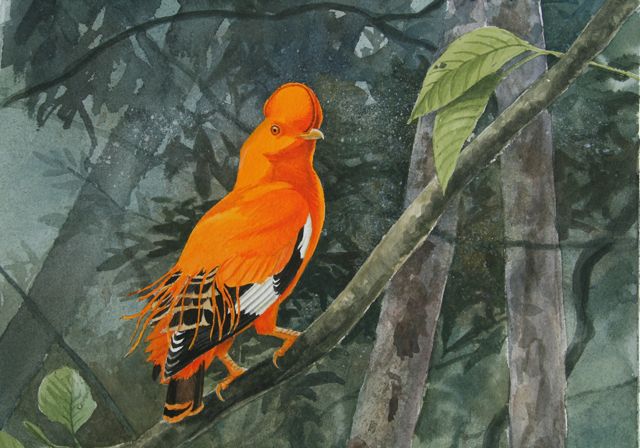
Painting a Cock of the Rock

Sunday, December 28, 2008

16 comments
Ready for another bird painting?

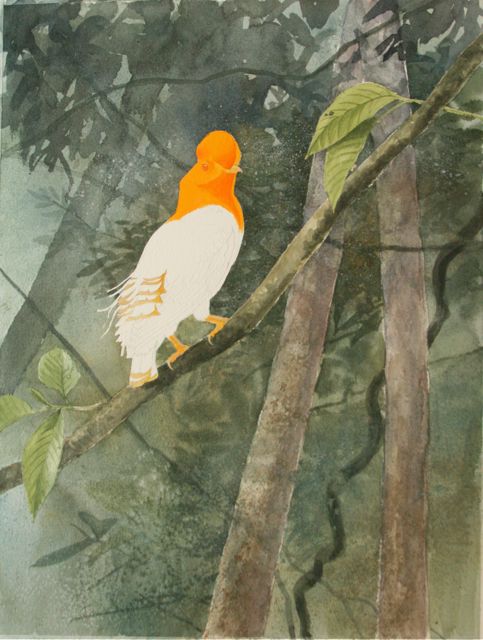
It's hard to have to wait to post my step-by-step descriptions of how a painting is made until after the surprise has passed. I don't know why I seem always to be painting on a surprise basis but that seems to be the case. Lately, I paint for gifts. In this case the giftee was none other than Bill of the Birds. He was the one asked to go on the trip to Guyana, and he passed the trip along to me. The least I could do is paint him a cock of the rock for Christmas.

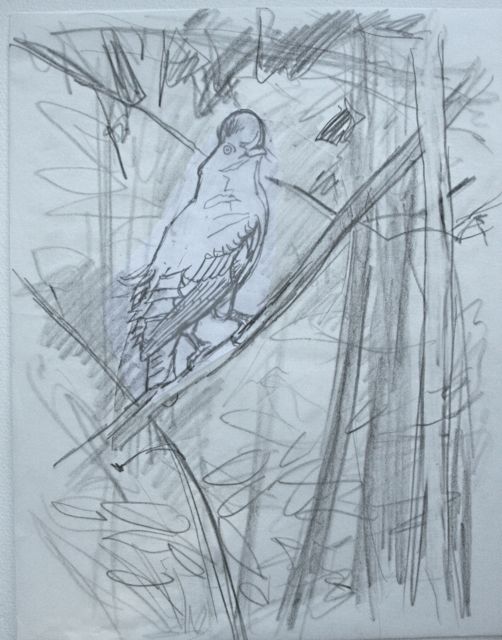
In my last post you saw the pose I knew I'd use for the painting. I'm not normally too wild about painting from photographs, unless I've made them. Given world enough and time, I'd sit there for a few days and draw COTR's from life, coming up with a composite pose that delighted me, and learning a lot about the bird in the process. Sigh. Lately the world doesn't seem to be working too well with Time, so I had to rely on what my camera was able to capture in the dark undergrowth. We had less than an hour on the COTR lek before we mushed onward to the next destination.
The sketch doesn't look like much, I know, but it's code for what I want to do in the painting.

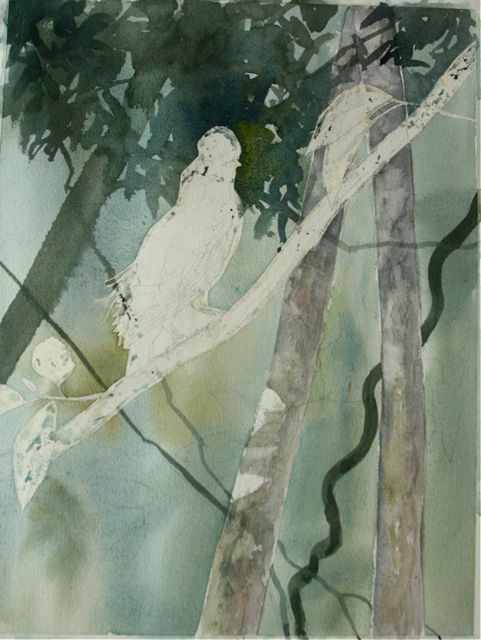
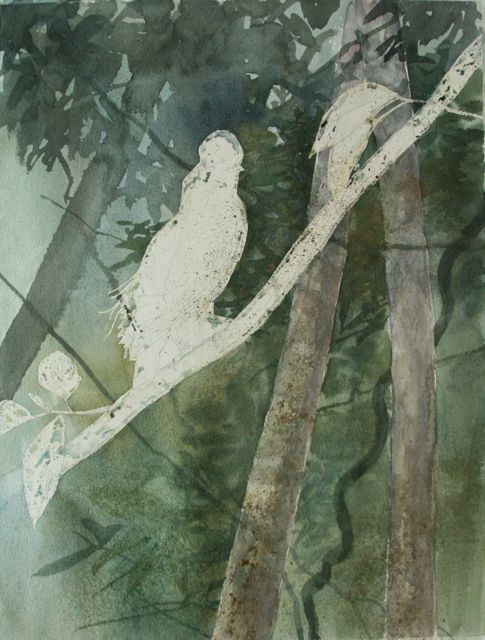
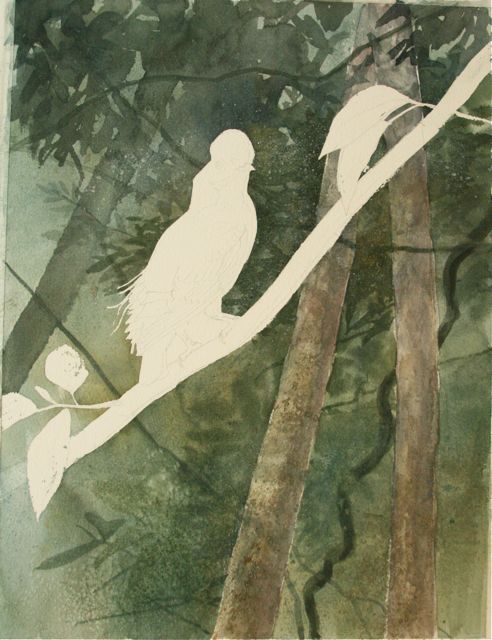
As usual, I masked out the bird, branches and foreground leaves with Incredible White masking compound and a clear film. When the masking compound dried, I dove right in. I had laid down a pale background wash and a bunch of darks before I remembered to pick up the camera. You do tend to leave your rational mind in the dust when you go galloping off across a big expanse of wet white watercolor paper.
While everything is still damp and diffusey, I throw in a bunch of vegetation. I try to paint background washes when there's no one around to distract me. That's why animals are such good studio companions (as I listen to Charlie riffling through his feathers by my right ear, and Chet snoring softly in his studio bed).
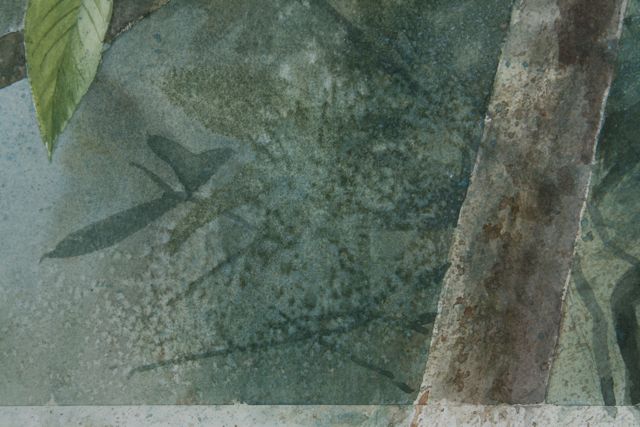
I run the painting across the studio, prop it on a chair, and decide I hate the three-parted leaf I've hurriedly painted in the lower left corner. It looks like a flying macaw, and this is not a painting of macaws. Charlie has sent me a telepathic message to include him in the painting, I guess. Sorry Chuck, you lose. So I wet my brush with clear water, spray down the offending macaw-leaf, and scrub it out. Bye!
I don't want it to leave a shadow, so while it's still wet I throw some salt on the wound. When it dries, it has a nice, organic look. It doesn't look like anyone had an artistic cow right there. It looks like whoever painted it actually knew what she was doing. Heh.
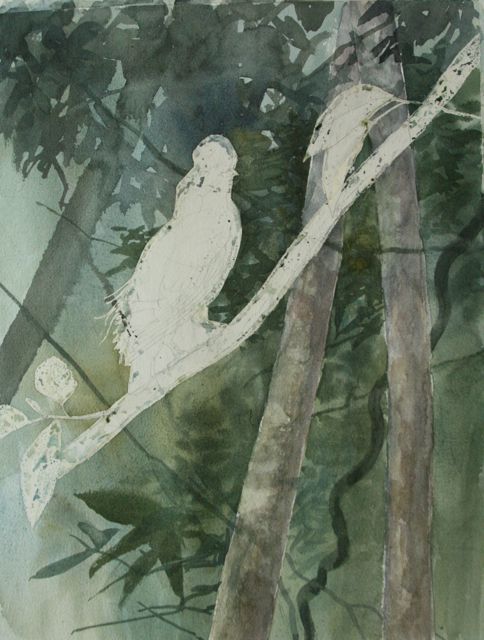
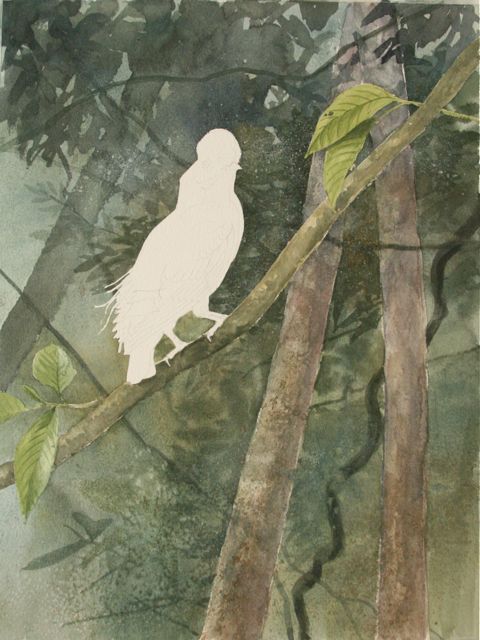
Time to peel off the masking film and get going on the bird's perch. If the painting looks paler and warmer, it's because it's now nightfall, and I'm shooting by incandescent light.I get that vine painted in, careful to vary the color and value along its length so it looks like it's part of the scene, not pasted on top of it. And then I paint in some leaves. You'll notice that my greens are pretty toned down. Greens can be tough to manage in watercolor. Have you ever seen a painting that's pretty OK, but has some too-vivid or fake-looking greens in it? There are a lot of paintings like that. I've done some of them. Nothing can spoil a painting faster than obnoxious greens. I'm being conservative with them, because I want the star of the show to be the bird. And when I put the first bit of him in, I'm glad I took it easy on the greens.Wouldn't want to hurt anyone's eyes.

Tomorrow we'll paint the bird. Or I will, and you'll watch (after the fact). Which reminds me of a recent comment, someone wishing they could stand and watch over my shoulder as I paint. I smiled at that one. My kids can attest that when it comes down to the actual painting part I get very distracted, and then kind of snarly. I think it's a way of protecting my subconscious brain, which has to be firing on all cylinders when I'm in the act of painting. My kids like to interact with my conscious brain, and when we're together they keep plucking at the conscious brain's hem, making sure it's engaged. They're not being pesky; they're just being human.

I've never shut my kids out of the studio; rather, I've schooled them in the art of leaving space for that subconscious creative action to go on around them. From their end, I'm sure they recognize the trance when it comes on, and they know that buggin' me for a popsicle, fighting over space at the desk computer, or asking for help with a math problem isn't the best move when I'm laying down a wash or trying to figure out if I've just painted something ugly. It's good for them to recognize another person's creative space, and it's good for them to see how to maintain their own, too. Call it subconscious/conscious or right brain/left brain; creative space is another space entirely from the everyday, conversational space we usually occupy.
[Back to Top]