I'm an artist and writer who lives in the Appalachian foothills of Ohio. With this blog, I hope to show what happens when you make room in your life, every day, for the things that bring you joy. Strange...most of them are free.
Thurs. Feb. 27, 2020, 7 PM: "Saving Jemima: Life and Love with a Hard-luck Jay" at
Mt. St. Joseph University Theater, 5701 Delhi Rd., Cincinnati, OH 45233. Doors open 6:30 pm.
For info call Colleen McSwiggin (513) 244-4864
Mar. 11-15, 2020: Bird Friendly Backyard workshop and Saving Jemima talk at Joint Conference, N. Am.
Bluebird Society/Bluebirds Across Nebraska, Holiday Inn Convention Center, Kearney, NE. Right in the middle of
sandhill crane migration! Call (308) 237-5971 for reservations.
Mon. Mar. 23, 2020, 6 PM: "Saving Jemima: Life and Love with a Hard-luck Jay" at Morgan Co. Master Gardeners Event, Twin City Opera House, 15 W. Main St., McConnelsville, OH. Free and open to the public. Call (740) 962-4854 for information.
Sun. Mar. 29, 2020, 3 PM: "Saving Jemima: Life and Love with a Hard-luck Jay" at
Sunday With Friends,, Washington Co. Public Library, 205 Oak Hill St. NE, Abingdon, VA 24210. For more information, call (276) 676-6390
Apr. 30-May 2, 2020: Julie Zickefoose at New River Birding Festival, Opossum Creek Retreat, Fayetteville, WV. Friday night keynote: Saving Jemima. Curtis Loew, miracle curdoggie, presiding.
May 7, 2020, 7 pm: "Saving Jemima: Life and Love with a Hard-luck Jay" at Campus Martius Museum, Washington and Third Streets, Marietta, OH. Booksigning after. If you missed the Esbenshade lecture/ People's Bank talk in November 2019, this is your event!
Weds. May 13 2020, 5:30 PM: "Saving Jemima: Life and Love with a Hard-luck Jay" at Roger Tory Peterson Estuary Center's event at Essex Meadows, 30 Bokum Rd., Essex, CT 06426
This event is open to the public.
Thurs. May 14 2020, 6 PM: "Saving Jemima: Life and Love with a Hard-luck Jay" at New Haven Bird Club's Annual Banquet, Amarante's Restaurant, 62 Cove St., New Haven, CT 06512. This event is open to the public!
Sat. May 16, 2020: "Saving Jemima: Life and Love with a Hard-luck Jay" for Bergen Co. Audubon Society at
Meadowlands Environment Center, 2 DeKorte Park Plz, Lyndhurst, NJ 07071
Time to be announced. Call (201) 460-1700 for more info.
Sun. May 17, 2020, 2 PM: "Saving Jemima: Life and Love with a Hard-luck Jay" at White Memorial Conservation Center, 80 Whitehall Rd., Litchfield, CT 06759. Call (860) 567-0857 for information.
Tues. May 19, 2020, 7 PM: Good Reads on Earth Author Series, by PRI's Living On Earth with Julie Zickefoose and Saving Jemima at Mass Audubon's Drumlin Farm Wildlife Sanctuary, 208 South Great Rd., Lincoln MA 01773. Includes audience participation, and will be taped for airing on public radio! Get the book first, read up and call (781) 259-2200 for information.
Thurs. May 21, 2020 6 pm: Julie Zickefoose, "Saving Jemima: Life and Love with a Hard-luck Jay" at
Bigelow Chapel, Mount Auburn Cemetery, 580 Mt. Auburn St. Cambridge MA 02138. Call (617) 547-7105 for more info.
I started this post before I left for Ecuador October 24. I wound up leaving only one day to pack and prep for the trip, so it has been orphaned for awhile, floating around in cyberspace, hoping to become a whole blogpost. I'll leave the first part as it is, and finish it up. Heads up: It's going to be tough going for people who aren't used to looking at kills. Proceed with caution, and, I hope, with the same sense of wonder and curiosity that I have.
I've been working really hard lately to get Saving Jemima as done as I can get it before I go to Ecuador. I've barely looked up. One good thing about having no one around is I can work a 14 or 16-hour day and not offend a soul. So that's what I've been doing. I have loved every minute of it.
I glance up a lot, watching the blue jays at the feeder, watching the red and white- breasted nuthatches, the cardinals, the woodpeckers. I'd been seeing turkey vultures sailing over all day, which I found unusual for late October. I thought about it and wondered what was up.
Late afternoon came and it was spitting rain. I wanted to get out and see the sky, but I knew better than to start a run. So, uncharacteristically, instead of heading out on foot, I climbed in the car to drive out into the country. I took my big camera along. I just had a feeling.
And there they were, lots of them, circling over a big hayfield on the corner of my road and the county road. Glory rays streamed down. They looked so fine up there.
I parked the car to take some photos and wonder what they were up to.
I decided to head into the hayfield to see. I had a feeling I knew what it was. There were too many vultures for it to be something small. And bow season has just started here.
Yep. Knew it. In early November of 2016, they killed my crooked doe Ellen this way. Just a small, inconsequential doe, an animal nobody would miss, a little something for live target practice. Maybe the same person who killed Ellen had turned his truck into the approach to this field, just one over from ours, fixed this doe in the glare of his headlights, and taken her down. What sport, what fun. Just getting in shape for the season, sighting in the bow or gun.
I know the poachers are stalking when I find things like this, when the beer cans start to accumulate along my road. They show the same disregard for beauty as they do for life.
I didn't know this animal, thank goodness. Though it would be hard to tell who she was now. Now, she was nothing but a carcass.
I made some images. How could I not? The grass was flattened all around her where the vultures had been tramping. I could see that no other animals had been there, because the carcass was opened only at the back and front, the way vultures do.
They'd been working on her all day. I stood there, with the fermented contents of her rumen scenting the air, thinking that at least she'd go to feed a nice flock of vultures, to speed them on their way to Central America.
I left her then, and went on to see some old house friends on up the county road. It was that kind of day, glowering and gloomy, and old houses look good in this kind of light.
If there's a classic Ohio farmhouse, this is it. Although the beveled corner is atypical, the porch and foursquare design is not. There's a ramshackle addition off the back, which adds to its interest. Gosh, I'd love to go inside. But I have never tried the door.
Across the street, two other dwellings are slowly deliquescing.
I like the addition on the big house, like a sloping rump off the back. Sooner or later, people ran out of space, and then they'd tack something on the side or back of the house to give them a little breathing room, a place to hang some coats, stack some boots, keep the egg baskets.
I'm not sure what the little building is off to the side. A summer kitchen?
Whatever it is, it's sweet, and it reminds me of North Dakota.
The birds have been perching on what little furniture remains inside.
I'm thinking that's an eastern phoebe's latrine there.
I love this little scene. The table isn't much good any more. But oh, the patina on the walls and floor.
Heck of a view out the window: cattle moving easily across the land. While I was shooting the scene, an osprey flew over. A late osprey! They usually like to be gone before it gets very cold, as they don't have down feathers.
It was getting so dark I figured I'd head back home. A pale spot in the woods border resolved into a young red-shouldered hawk. If you click on the photo you'll see it can't be anything else. Well, I could see that. So many things go into telling me that's a redshoulder and not a redtail or a Cooper's hawk. I'm not even considering broad-wing, because they're long gone, having migrated in September.
It's got big blobby markings on its belly, and no belly band--the blobs are just scattered across the white. It's got really small feet. Redtails have big feet. The tail is banded, but nondescript, as would be that of a young redtail. Overall it's small but chunky, not lean and long like a Cooper's hawk would be, or urn-shaped like a redtail. And it's just a-settin' there, redshoulder style. Yep. For whatever reason young redshoulders just pop up this time of year. Maybe that's where they get the old name, Winterhawk.
I passed the carcass site again, and the vultures were still wheeling very low. I left them to their meal.
The next morning, I came out early to see what had happened to the carcass overnight.
When I last saw her, she looked like this. Entire, but for some missing bits.
There was still a vulture coursing low, unusual for so early in the morning.
As I approached, a great flock of crows rose up cawing. It was such a beautiful ragged sight I had to make a video. One vulture was already up and feeding.
I walked up to where the doe, who had weighed more than 100 pounds, had been, and she was simply gone.
I hadn't expected that!
Nothing but the stain of her last meal remained.
But there were plenty of clues. A stray bone:
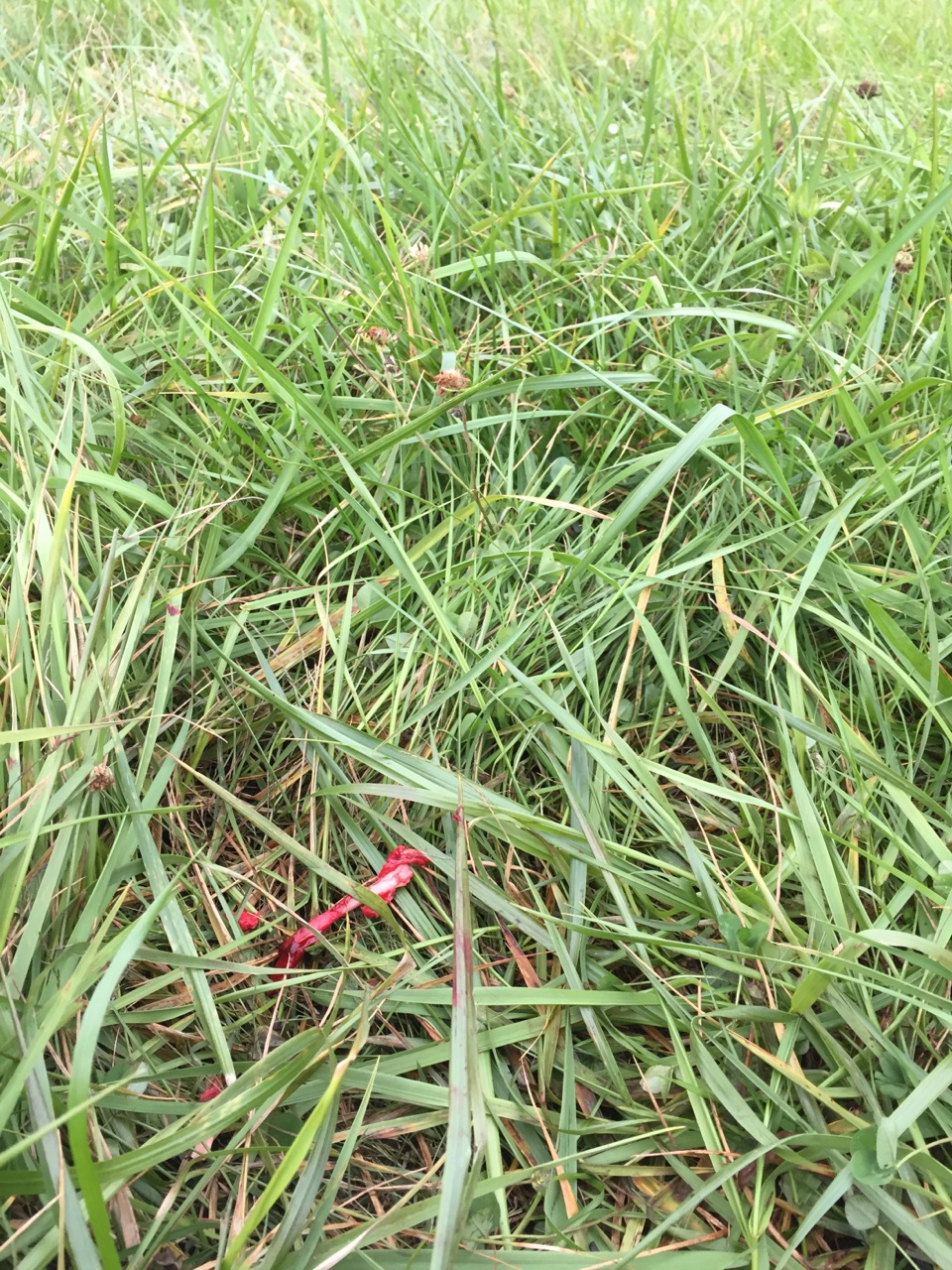
One ear.
I could see the drag mark where she'd been pulled away toward a distant line of firs, originally planted as a windbreak for the farmhouse that no longer graces this field. I stood, stunned, thinking about the power of the coy-wolf or coy-wolves that must have done this.
A forelimb!
I continued to follow the trail. Here's the other ear.
Finally I found all that was left of the doe.
I was flabbergasted.
How many coy-wolves would it take to reduce her to a ribcage and a head, overnight?
A single turkey vulture feather, black with a surprising white base, reminded me that the coy-wolves had had help.
There she lay, in the dancer's point in which they'd left her, dragged by one hind hoof hundreds of yards down the haymeadow. And there they had finished her off.
I could only marvel at the efficiency of the operation; the day shift of vultures and crows starting the cleanup, and giving way after dark to a pack of coy-wolves. She was gone, overnight.
In the ditch, a brace of asters and the spent heads of Queen Anne's lace gave a shot of fresh beauty to my wondering eye.
Back home, the flowers bloomed as if there were no tomorrow
and the bonsais promised to peak while I was away.
when I left October 24
I don't want to leave in late October, ever again. There is too much beauty, both harsh and soft, all around.
Thank you for the overwhelmingly positive and beautiful response to "The Thing About Jemima." I spend way too much time worrying about reader reaction to this or that revelation that's been bothering me for months or years until I finally up and say something. It was just wonderful to be able to say, "Here's the deal, and here's the kind of reaction I can handle, feeling as I do about it, so please let's stick to that." And to have everyone, to a person, come through with flying colors, writing lovely positive sentiments that are actually helping me through the glory, the wonder, the hope and, let's face it, the pain of it all.
My Instagram and Facebook friend Denise wrote,
"Thank you for sharing her plight. I can now pray for her safety."
To which I replied, "Oddly, that makes this near-pagan feel a lot better!"
Denise: "Ha ha! You be you, I'll be me. We both are for Jemima!"
So thank you for keeping Jem and her anxious foster Ma in your hearts. When I got up November 20, I hadn't seen her for five days. But it was an easier wait than the eight-day Jemima-free marathon I'd lived through before my last series of sightings. The weather this week had been lousy, cold and cloudy, then warm, with torrential rain, then cloudy and cold, and it just didn't feel like blue jay weather to me. And I barely saw any blue jays around the feeders or yard. That didn't keep me from my vigil. I watched. I waited. I got a little writing done. I did not curl into a ball. But mostly, I hung in there and had faith that she'd come back at least to check in. Baby steps, improvement.
I raised the blinds on the morning of November 20 and saw the red stain of sunrise spreading into a clear blue sky. Ahhhh. I will see my Jemima today, I thought.
And sure enough, as soon as I put the corn and seed out, jays were bouncing all over the place. But not The Jay.
So stuffed with cracked corn they look like bad taxidermists' mounts. Look at the leftmost bird. Glurp!
They're not Jemima, but oh they gladden my heart. I'm trying so hard to tell them apart as individuals, but it's really tough when the cast keeps changing.
A chipmunk (one of the scrappers from a previous post) streaks through and startles a jay into a little corvine capriole. Boing! Ha ha!!
Once again, Chippy sends the jittery jay airborne, while a red-bellied woodpecker says, "Ga-aaw-lee! What's up with you two?" Even brazen blue jays never quite get used to small bloodthirsty mammals zooming right under their feet. Nor should they.
Gosh, I look at those immaculate, intact wings, and just sigh. Jemima should be so lucky. But then it occurs to me that if she were that lucky, she might be in Georgia right now. It is what it is, and I am tremendously blessed to still be seeing a bird I released in mid-June, in November!
I tell Liam, "I know Jemima's going to show up this morning. I just have to be patient." The new bunny who is frequenting the feeder area (post the mid-August cleanout by Cindy the Bobcat) is amusing me greatly. This bunny has rather short ears and a very fat bottom, and it has a habit of coming out of the tangle behind the rhubarb, squirting up into the air with friskiness, then running back in. Soon it will be corn-fed and even fatter of bottom. Maybe I'll call it Julie.
So I watched the bunny for awhile.
And then she appears, at 8:53 AM, flying in from Stage Left. I'd know those tatty wings anywhere.
I start dancing around the studio snapping photos and laughing. I'm transformed from my everyday loose bundle of hope and anxiety to something approaching pure joy. I call Liam in and we holler endearments to her through the glass. She doesn't mind.
What were you ever worried about? I don't understand you and your handwringing. I'm off doing my stuff. You go ahead and do your stuff. We'll get together now and then. That's how it goes.
My wise friend Margarethe, who has raised several corvid species and studies them always, has been sharing her experiences. Nothing like the voice of experience! She advised that Jemima's absences could get longer and longer as she builds independence and social networks. She imparted this wisdom:
"You are both lucky and terribly exposed to hardship because you live right in Blue Jay territory, so Jemima could stay around. But as a juvenile, she still might have to join a more distant flock and find a new place of her own. Her disappearance could have any kind of reason. You seem to be extremely lucky as a mother. Now your Jay is giving you the experiences of anxiety that many face with their human teens. Open your heart and both joy and pain are inevitable. Lucky you."
Agreed on my luck as a mother to humans. And agreed on that open heart--how, being open, it's ready to love, and to hurt, too, always. I tell myself, "She's a BIRD." She's a bird. How does a bird get so deep into my heart?
She picks up some corn and flies up to the birch. With a good leap and a lot of flapping, she can get some altitude. Enough to get off the ground and into a tree. Yay for that.
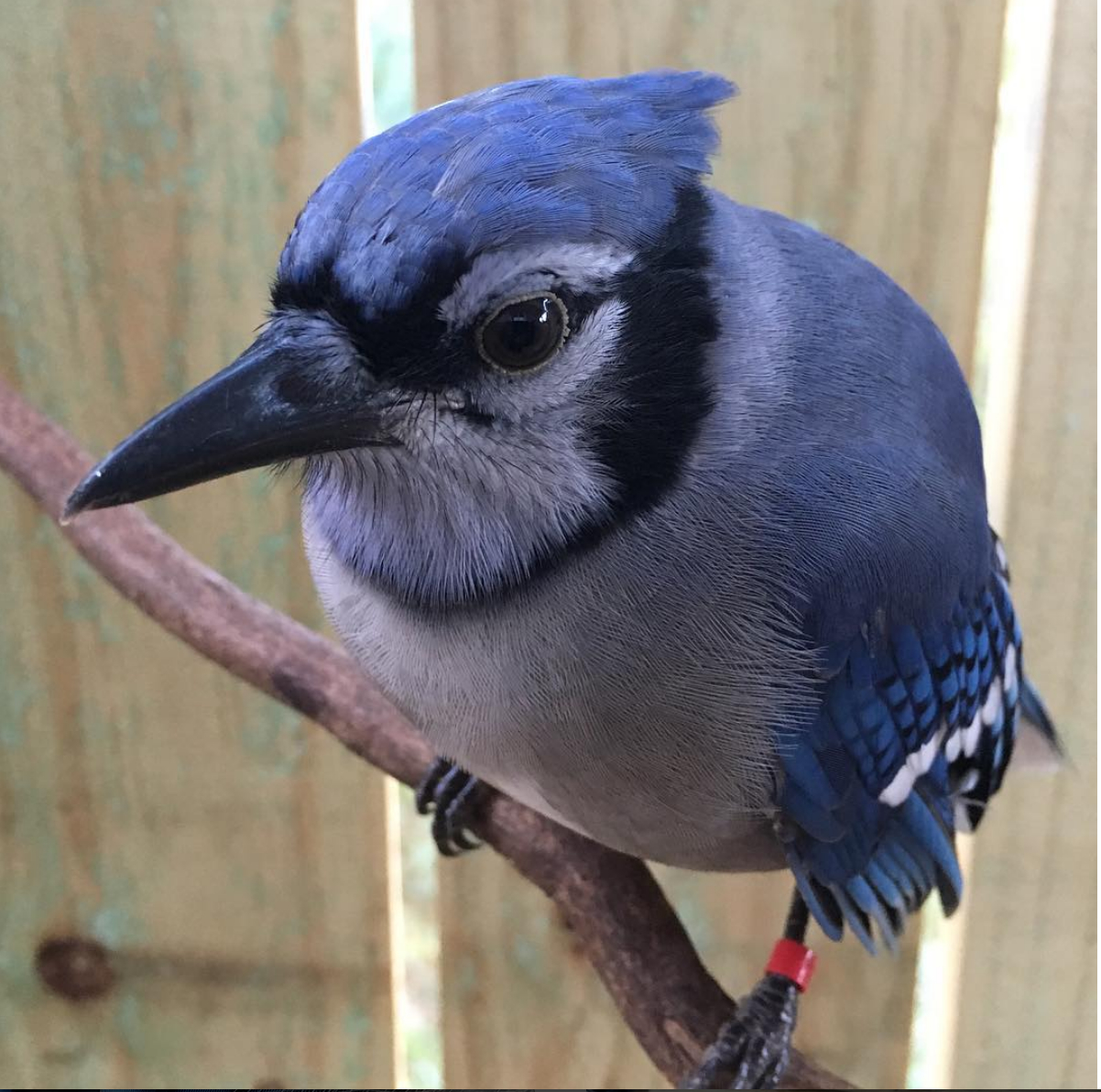
And she appears at her buffet, this glorious stained-glass medley of blue, black and white, and you'd never know there was anything amiss, really, unless you noticed that she has no primaries poking out from under those gaudy tertials.
She loads up on chicken, swallows some of it, then comes back to stuff her gular pouch full.
Ahh is she not the most beautiful? To think she used to let me kiss the top of that sweet head.
Full up, she hops to the top of the arbor vitae and exits stage left, toward the back yard. This is a new direction! She flies to an ash tree, hops up to near the top, then launches herself into the clear blue air.
Her flight is lopsided, because she has more feathers on her left wing than her right. Phoebe: "She looks like some kind of crazy falling leaf."
But by God she makes it into the crown of the big pine, one of three that Bill and I planted in the winter of 1992. It's the last pine standing. The other two fell last spring. Jemima needs this tree. I need it, too. Please keep standing, Pine. You're a very useful tree.
She disappears into the needles and I can see the branch shaking as she disgorges and pecks apart the wad of chicken she brought. Her moveable feast.
Full as a tick, she puffs out her feathers and lets the sun warm her belly. She rests for about ten minutes. I'm so proud to see my Jem in the very top of the pine. Altitude is her friend. It's her
hardest -won treasure.
When she's done resting, I'm lucky to see her launch back toward the feeders. She uses the altitude she gained to have a really good flutter-glide back into the yard, making a grand entrance as jays love to do. I'm agog and thrilled at this bird's adaptability. At the fact that she can disappear for 5 days, 8 days at a time, then show up fit as a fiddle and twice as fat, to gladden her Ma's heart once more.
How I would love to know where she's been. How far she goes. And how she does it.
This time, she comes in and finishes her chicken, which had been faithfully refreshed each morning, but lying untouched all week. Then she loads up on dry-roasted peanuts and heads toward the east hill.
I run to the front window just in time to see her launch off the phone line on her long diagonal flight (the 130' one, but who's counting) to the east hill. She amazes me. The robin is also impressed.
I know I probably won't see her again today. And since Liam and I are heading east for Thanksgiving, I know I won't see her for at least another five days. And then I'm home for two days, then headed to Ecuador for ten days. Am I a nervous wreck about it all? Of course. Do I think she'll survive my leaving? Yep. If she needed my subsidy, she'd be there every day.
But now I'm writing this post, all aglow with the thrill of having seen her at all. I learn so much from her every time she stops in.
I turn back to my work and, through the closed windows, I hear the croak of a raven! Ravens are rare vagrants to southeast Ohio, but I've had a real run of sightings in October and November. I think I've seen two different pairs and maybe 3 singles. Oh, bring them on!! When I hear a raven I run out onto the back deck, because I have the best chance of photographing them over our meadow. I'm pretty sure that when we take in the game camera, there will be ravens on it. I don't think it's a coincidence that they inspect that part of the meadow--the meatpile is there!
Sure enough, I'm incredibly lucky to see a raven, being harrassed by a crow. And even luckier to get a sharp shot of the action (with willow tree photobomb).
Every time the crow dives close to the raven, the huge bird goes tokatok! It sounds just like someone knocking on a hollow log. A most amazing, loud, sonorous, percussive sound.
My friend Greg Neise did a little Photoshop magic on my photo to better compare the relative shapes and sizes of crow and raven. Crow: top. Raven: lower bird. Look at the difference in their bills! And the length of that raven's wing!
Seeing this pair of corvids, right after having such a wonderful session with Jemima, feels to me like a great blessing, a benediction. A lucky sign.
What better Thanksgiving bounty than three corvids in one yard? And Jemima, well and independent and still, somehow, flying free. Keep her in your heart.
This post is dedicated to my sweet friend Melanie and beautiful Alex
Sunday, November 4, 2018
5 comments