Background Switcher (Hidden)

Showing posts with label box turtle. Show all posts

Tadpole Story 1: A Drama in Four Pieces

Monday, August 26, 2024

0 comments


If you were a frog or toad on Indigo Hill in southeast Ohio on April 4, 2024, the world was your oyster. Anything seemed possible. 
It seemed like all the water you'd ever need had fallen from the skies. 

This enormous puddle filled up with American toad eggs and tadpoles. When it dried up in early May, I saved several hundred tadpoles. I tried briefly to raise them in two containers, but the tubs were overcrowded and one morning the tadpoles began to die off. I loaded a couple hundred into a pail of fresh rainbarrel water, cared for them until they revived, and took them to a ditch down in Stark Hollow, where they successfully turned into toads. I'm happy about that. 
But I was chastened by the die-off, and leery of trying to raise any more tadpoles.


By mid May, it was still raining from time to time, and another puddle formed. The frogs hurried to lay their eggs again. Oh man. Tadpoles again. I knew I didn't want to take them in and risk killing them. So I made a fateful decision to try to keep the puddle filled until they changed into frogs, and marked it with a pylon on May 21 so the delivery trucks wouldn't drive through it. 


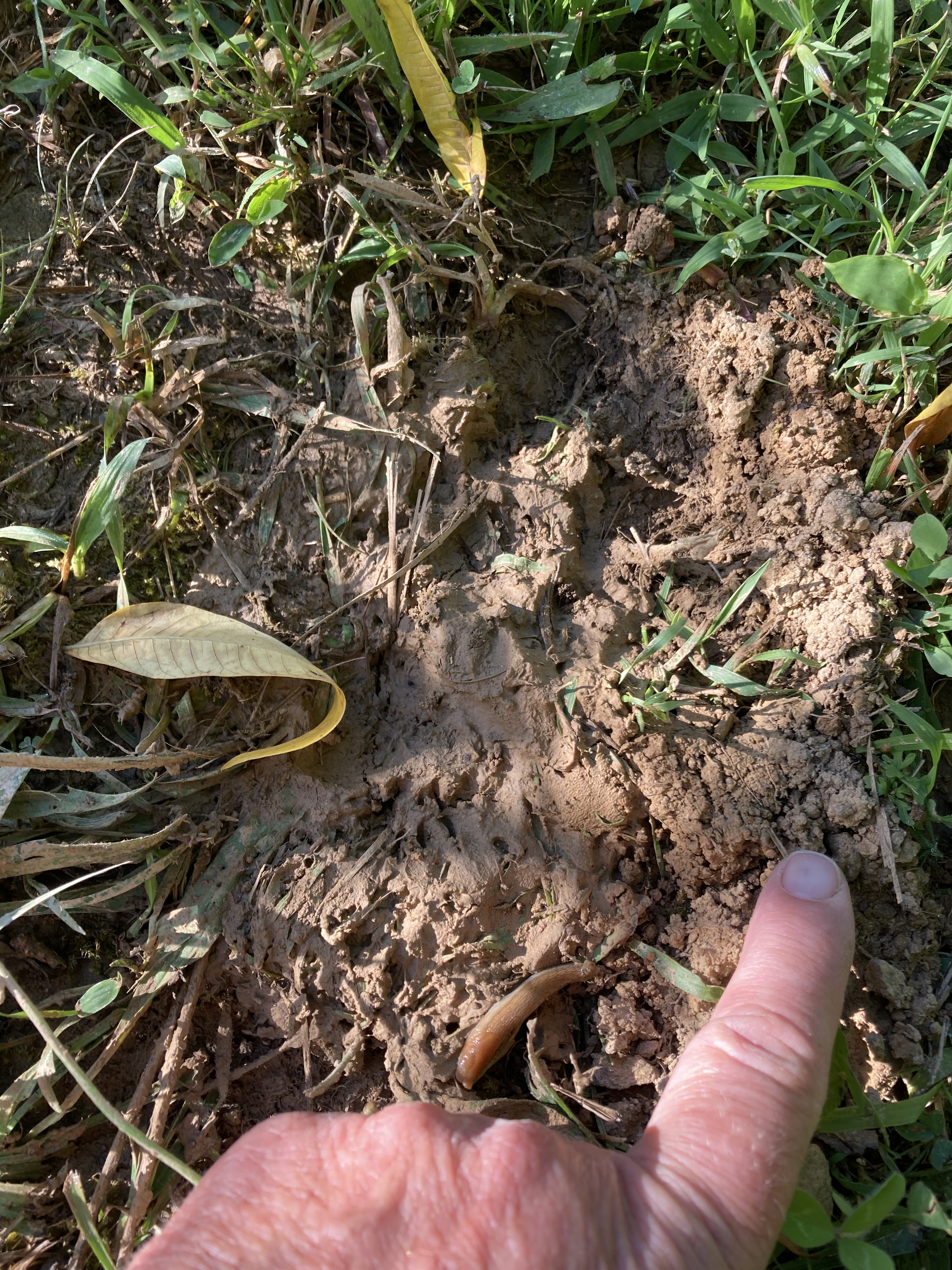
Crows keyed into the puddle and the family of five that nested in my north border came each morning to walk, hunt and stab. The tadpole numbers dwindled. I found the crow tracks and put two and two together.

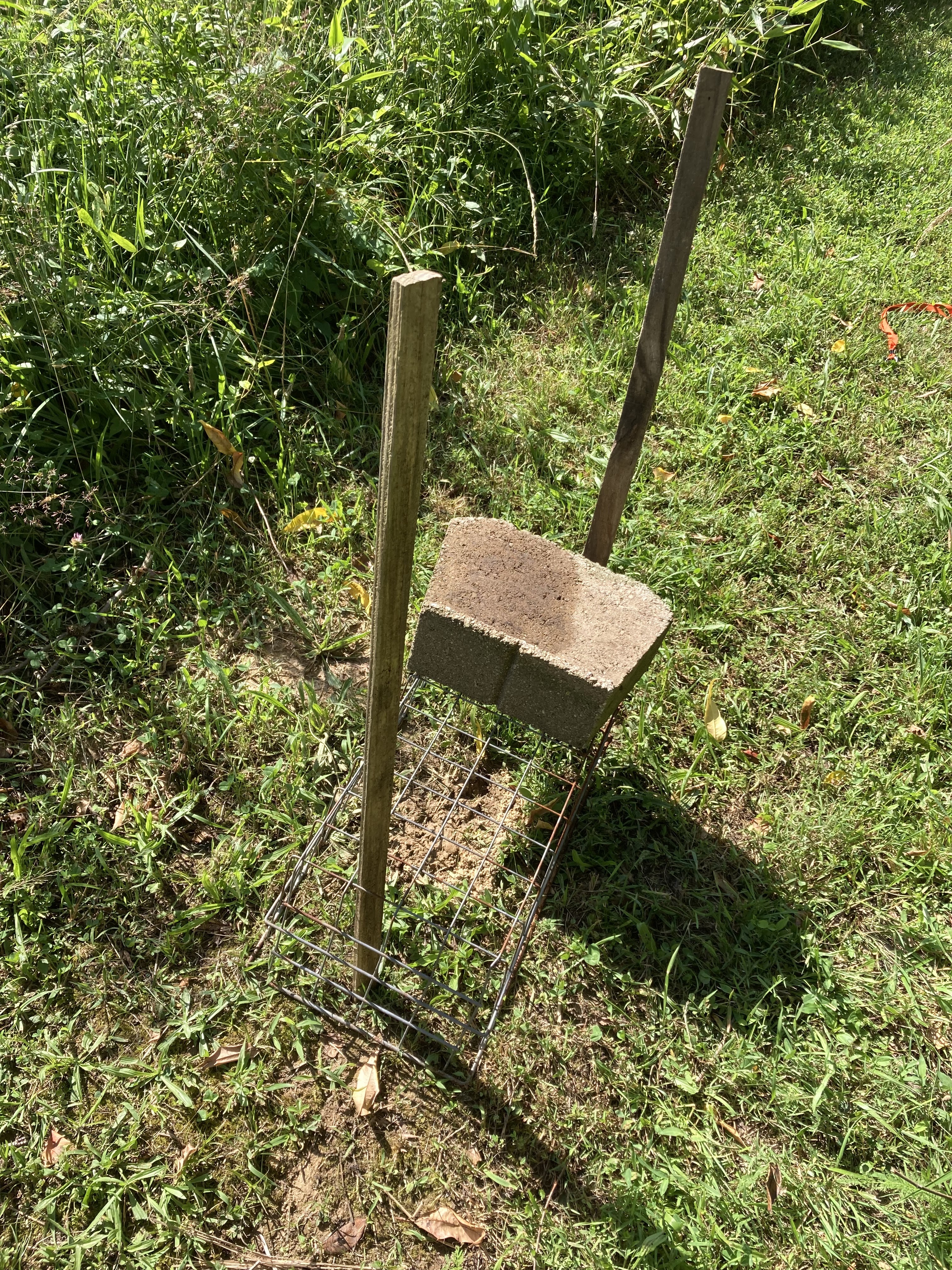
 Adapting as always, I improvised some tadpole shelters from a couple of wire baskets, weighted with bricks. The tadpoles took to them immediately. It was the only place they had to go where the crows couldn't get them. Tadpoles aren't dumb. See the wad of tadpoles in this one? 


Still going strong on 11 June. Periodic rains got farther apart, but the puddle persisted. I was happy to give my driveway over to such a collection of tadpoles. All the delivery people knew about it, and nobody ever drove through it.

By 16 June, the periodic rains had stopped. Water hauling began. Here, we've just refilled the puddle with the help of Oscar, Phoebe and my brother Bob, visiting from Virginia. 


We got a shower on 24 June, only a quarter inch, but it gave me a brief respite from water hauling. 


A female box turtle took up residence in another small shaded puddle in the driveway, staying there continuously for almost a month. She was trying to stay hydrated, hoping to be able to lay her eggs. It would be the worst turtle nesting season in memory. The ground was hard as a rock, but the female turtles had to dig their nests anyway.  Because there was no rain, I couldn't go out to look for the females when they'd normally be digging, right after a heavy rain. So I couldn't find their nests, to cage them against predators. 
Every single nest laid was predated, probably by skunks and raccoons, as soon as it was dug.
The eggs would have cooked and dried up in this ghastly summer, anyway.


Driveway Turtle got her own pylon. Nobody ran over her. I couldn't believe some predator didn't pick her off; she was there day and night. Seemed perfectly healthy, bright eyed and heavy, but tied to her puddle. She finally left when the puddle dried up in July. Phoebe found her about a half mile away on August 4. It was so good to see her again!  Correction: Phoebe informs me that CURTIS found Driveway Turtle. "He went sniffing around in the ditch and when I went to look at what he had there she was!"


My hunch that she had been healthy was vindicated. She was bright eyed and heavy when Phoebe found her in August. Box turtles often sit in water when they're ailing. But these are exceptional times, so I cut her some slack. She wasn't broke, so I didn't try to fix her.

This is a Rather Large story and a huuuge post, so I'm splitting it into several pieces for your reading enjoyment. 

Next: The Heat Clamps Down

How to Find Box Turtle Nests

Saturday, July 1, 2023

0 comments


Even on July 1, these hen box turtles are looking to enlarge the local population, and I applaud them. Black raspberry stains on the beak of the top female. The lower photo shows a female turtle backed into a possible nest site. I took both these from my mower on the evening of June 30.


Mowing the paths about every ten days has the primary purpose of keeping the forest from encroaching on my open meadow. Second and just as important is giving us access to the meadow for our daily walks.  Third, the mown grass provides good foraging for birds. And fourth, this is where the box turtles come to dig their nests in June. They look for little open patches of soil and go from there, digging with their incredibly strong hind legs almost 3" down, making a narrow-necked, ovoid chamber to receive their snow-white, leathery eggs.  

In the pano, you can see the central path, and the left and right paths that mark the field's perimeter. It takes me more than three hours to get the yard, paths, driveway and oil well road mowed, but it makes a big difference to us and the wildlife. Box turtles need sun on their nests if the eggs are to develop properly. And they can't dig through dense meadow grass roots. So they gravitate to these paths. 


The first nest I found was in the middle path.  Just a little digging revealed what I was looking for: white gold.


I love the end of this, my excitement as I run to grab the cage, post and block I set aside just for this moment. So magnificently nerdy.
I'm not about to let any mammal but me dig down to find those eggs!

Thinking about what I look for when hunting box turtle nests, it's muddy vegetation. Things seem to be generally undisturbed, but you can see that there's been excavation here, because the grass around the nest site is sandy and muddy. It's had dirt on top of it recently. The hen turtle has carefully replaced and tamped back all the tailings (amazing to think about the thought and intent that goes into this process). But she can't clean the grass, so I look for dirty grass. 


I dig down...and hit gold again.


It was quite a morning. I found a nest in each of the two paths I walked. Finally I made it to the third, lower path, and there was a slam-dunk fresh nest there. No reveal video this time, but I hit eggs!


I'd never found three turtle nests in a single morning. Well, I'd found three that had been dug out by skunks or raccoons, but never fresh, intact nests. HalleluJAH!! It's been a week now, and I haven't found a digout yet! Box turtles 3, skunks 0!

I had to walk back to the house to grab a mallet and a screwdriver and another cage. By the back door, I found a Protean Shieldback, a new (huge) katydid for me and the place. A very, very cool bug. That would be quite a find for a hungry bird. It looked somehow unfinished, but it assured me it was done.


 Then I found a Brown Rove Beetle scurrying down the sidewalk. Another large, cool, uncommon bug for the iNaturalist list. 


With my finding streak so hot, I trotted over to peek in the patio crack. Yep, the Faks are back!
A pair of adult copperheads cuddle in the morning sun. 
They are very placid, peaceful snakes who don't seem to mind our peeking in at them a few times a day.


We don't bother them, and they don't bother us, but we do use a flashlight if we need to go down to the patio at night. The Fak Crack is to the right of Curtis, between the poured cement and the sandstone block. 


Back out to the meadow I went. By noon, I had all three nests protected with wire caging and secure stakes holding the cages down. 
I looped the little tabs on the stake over the cage wire so nothing could force its way under the cage.


Here's the nest on the lower path. I put two stakes in to make sure that one was secure.


In case you're wondering, the mesh of the cages is plenty large to let the baby turtles out once they hatch. I don't want to impede them in any way. I just want these precious eggs to become box turtles, not skunk chow. 

It was a fine morning, June 21, the solstice morning! for finding gold in the dirt.


When you find digging attempts, where she's dug down and hit a root or a rock, you can assume she'll try again in the same general area. I am taking careful note of where I find these, and it seems that sun exposure is key. They do not dig nests under shady boughs, but try to get out in the open. I think about a female turtle plodding around, finding a likely spot, then sitting quietly, watching a prospective nest site all day to see what kind of sun exposure it gets. Isn't that an image?
As I look, I like to think about the thoughts turtles might have. As I find nests, I think about what each site has in common with the next. Good sun exposure has a lot to do with nest site selection, so I concentrate my search in mown paths that get all-day sun.

I was heartbroken to find on the morning of June 30 that a cursed chipmunk had dug out one of my protected nests. It went right through the wire, dug the eggs up, and carried them off cleanly. Only a chipmunk will do that; coons and possums and skunks eat them on the spot and leave the curled up eggshells as evidence.  It's that squirrel thing, the storing and cacheing.


Double-caged, with a stick wedged in to keep animals from getting under the fine-mesh cage. You do what you have to. Have I mentioned how much I hate chipmunks? A chipmunk, a member of an abundant species, is not worth a clutch of box turtle eggs, in my opinion. But my opinion has nothing to do with what actually rolls out on nature's stage, unless I make the effort to act on that bias.


And now you know a little more about how to find, confirm and protect box turtle nests. 

Box Turtle Nest CSI: Search and Recovery

Wednesday, June 21, 2023

0 comments

 I never feel luckier to live here on this 80-acre sanctuary I call Indigo Hill than in mid-June, when everything--everything--is making babies. As I sit at my desk, there are red-bellied woodpeckers and downy woodpeckers feeding young just outside the window. I can hear two of the five indigo buntings on the land singing their heads off. Fledgling eastern bluebirds are churring, being fed. A prairie warbler sings in the birch out the south studio window.  This morning, I watched our male pine warbler feed a couple of fledglings in the row of tall Virginia pines that edge the meadow. The breeze is sweeping through the house, the tall grass is waving around blooming butterfly weed, and it is grand, simply grand. 

I'm learning how to find box turtle nests. I've been looking for years, but the skunks and raccoons almost always get to them before I do. Oh, how I hate to find dug-out nests, but I find them every year. Last year was a warmup--I got out early, found and protected two before the mammals got them. One nest hatched successfully in the first week of November--late late late!  I wrote about it in "Another Box Turtle Morning" a few posts back. By May 29, I had decided to dig up the second nest, figuring the eggs were bad, or the babies had gotten entombed. That was an interesting exercise. I found the remains of four eggs, and the closer I looked, the more I discovered. There were embryos, all right, but they did not seem to be fully developed, because there was a lot of yolk, too, which seemed to have gotten saponified in the process of decomposition. It's the yellowish white stuff here. 

In this shot, you can see a scute, or scale, from the baby's shell at the bottom of the mess. So they were pretty well-developed when they died.

There were embryos in all four, with shell scutes and and wee tiny vertebrae. It made me sad. I don't know why they didn't hatch. The nest was in a pretty shady area and I'm guessing they might not have gotten sufficient sun to warm them enough to develop all the way. The small cement block I put on the cage with which it was protected may have blocked even more sun. Sometimes in trying to help, we harm. I don't know. I just knew they didn't make it, and that I needed to do better by the next nests I found.

We don't want this--babies dead in shell. What we want is this. Here's the only hatchling I found of four from the other nest, in the sun-drenched middle path of the meadow. The others dug out and got away before I found them, in early November 2022. This lil fella hatched but decided to stay in the nest chamber over the winter (not uncommon). I felt him in there, then saw him with my phone flashlight. I covered the hole with loose soil and left him all winter long, and he dug out on April 26!

I carried him down into the woods and let him go near a stream. Long may he crawl. 

Finding a juvenile box turtle on my land is the sweetest reward for my work. I found this little beauty, about the size of a lime, on June 4, 2023, on the first rainy morning in quite awhile.

I didn't pick him up or disturb him unduly, just made a couple shots and walked on. 

Found this old gent in the driveway May 13--doubtless looking for a hen to impregnate.

This spring, I was determined to find the female box turtles while they were laying, which is from the first to third week of June. They need heavy rain to soften the soil enough so it can be dug, and we didn't get that until June 3. On June 4, Phoebe, Liam and I went out looking, and we found three hen turtles making test digs that very evening! 

They are very wary while digging, and we didn't approach them--just took a quick snapshot and walked on as if we hadn't registered them.


None of these test holes resulted in eggs--the females hit roots or rocks. There's a lot of that, and you can always figure out what she hit that made her move on. But this is still informative, because it tells you the vicinity she's chosen, and will likely try to dig again.


June 4, 2023--Phoebe is finally on summer vacation from her high school counseling work, and she joins Liam and me at home for some nature reverie. We find three turtles digging this evening. If there's anything more heart-stirring than walking with my own babies, looking for turtles laying eggs, I haven't found it. 


BoxTurtle Morning

Tuesday, July 5, 2022

7 comments


I've found two so far this year: box turtle nests, freshly made, and immediately dug out, usually by skunks, opossums, or raccoons. Even crows will dig them out. The pliant shells, like bits of white plastic, scattered. You would walk right over it, and wouldn't think a thing of it, unless you live in a place where there's never any litter, and you stopped to investigate. With every year that goes by, finding these licked-clean eggshells breaks my heart more. Between predators and deaths on our dratted roads criscrossing their home ranges, box turtles cannot catch a break. 

So from mid-June through early July, which is egg-laying season for box turtles, I pace the mown paths that hold the perimeter of my meadow and bisect its center, looking for fresh nests, trying to find them before the predators do. Aided by their sense of smell, mammalian predators are much better at this than I am. Fishy-smelling protein awaits just an inch below the surface.

So on the morning of June 28, 2022, when I found THIS in the path, I was beside myself. I'd never seen such an obvious nest, the loose, crumbly excavation tailings to the left, and the mud freshly globbed on 


complete with adorable clawprints from the egg producer herself, as she carefully tamped down her excavation. Can't you picture her doing it??


And on the upper path, on the same morning, another nest!! 


Little footprint, like a tiny elephant foot with claws...


Here are the tailings she dug out.


On finding two turtle nests in the same morning, the direction of my day took a wild-mouse turn.

Off I did tread, to the garage. There, my predator-baffling accoutrements awaited on their designated shelving. Raccoon baffles, house sparrow traps, turtle nest cages, all gathered together in the Great Garage Cleanout of 2020. There are things you must have on hand for just such emergencies.


I grabbled what I needed


called mah best fren Curtis, and headed back out to the meadow as the sun rose higher in the sky.

I pounded stakes into the ground to secure the cages over the nests


then trudged back to the house for heavy insurance.


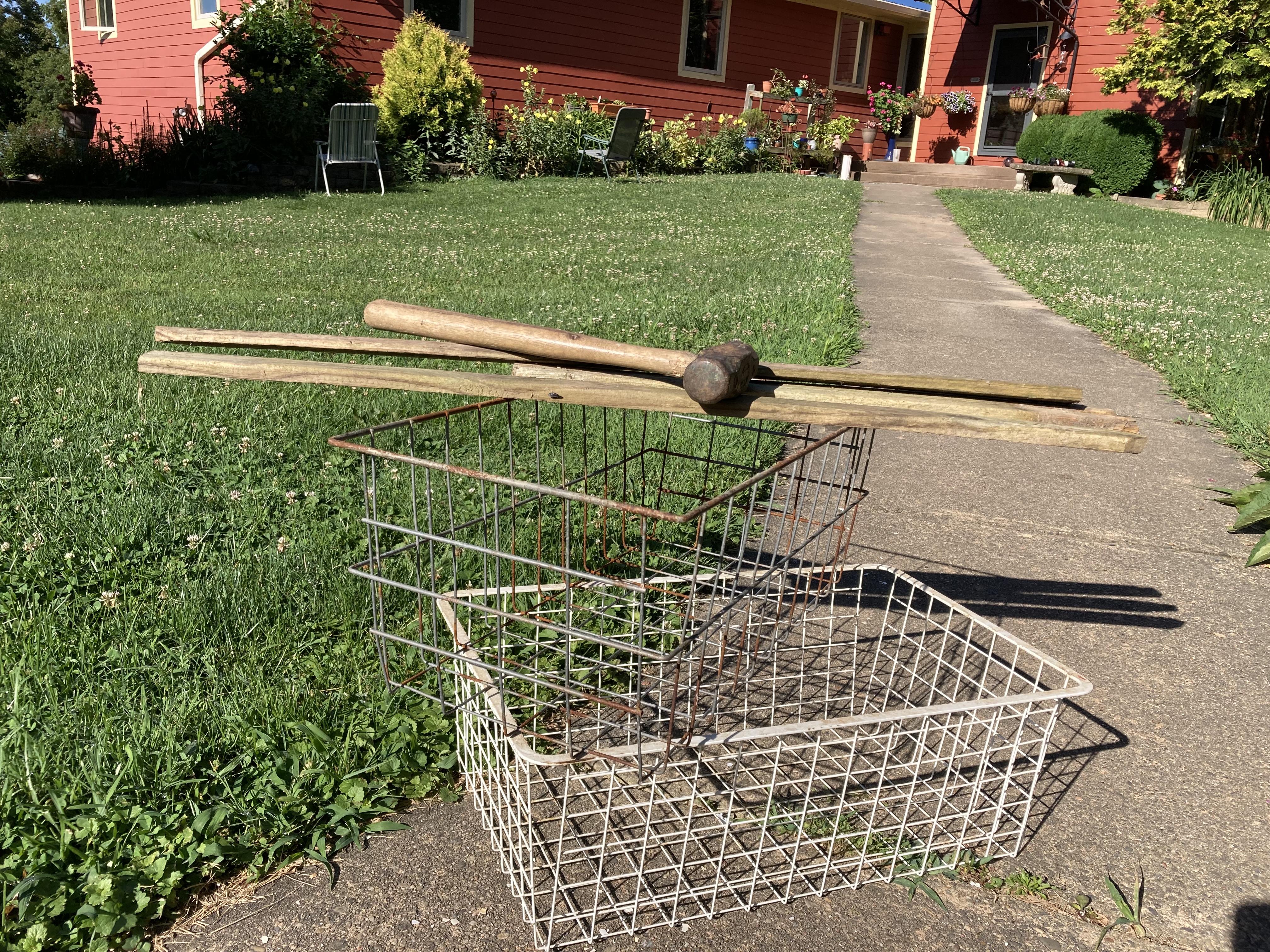
I knew the stakes wouldn't be enough to stop raccoons, so I went back up the meadow to fetch cinder blocks with which to weigh the cages down.


Here, I'm caught on my trail cam with a 63-pound pack full of concrete. From this experience, I know without question that I am not built for hiking the Appalachian Trail. Because I would certainly have at least 60 pounds of gear, food and water, and though I am strong, I know I'm not strong enough to haul all that I need.

Just to live in the country is more than enough.

When I got to the first nest with the 63-pound pack on, I had to drop to a sit and roll on my back like an upended turtle to get it off! Lord have mercy. Glad the trailcam didn't witness that!

I weighted each cage, careful to keep the nests exposed to the sun.


Curtis snoopervised. I think he worries about me more as we both get older. :)


Box turtles choose their nest sites carefully, assessing the soil and sun exposure and who knows what all else in their choice. They need sun to heat the eggs, and they prefer my wide mown trails to thick meadow. On the trails, they have a prayer of getting through the vegetation to be able to dig an egg chamber. But there, they're also much more exposed to predation. So I help where I can. I was over the moon to protect two nests this year. Predators 2, turtles...?  I won't know if the eggs made it until probably October, or maybe even next spring, for the eggs incubate for three months, and the babies sometimes hatch and overwinter in the nest. It's a long, long waiting game to find out. 

In case you're wondering, the cage grate is large enough (1 1/4" square) to let the babies out without a problem. That is absolutely vital! You can't cage a nest and then confine the babies when they eventually hatch! Nor can you monitor it closely enough to prevent their expiring inside the cage before you get there.

I took a cooldown walk to the orchard, which is largely too shady for turtle nesting, and found a female Io moth resting on one of my beloved milkweed plants.


She looks like a dead leaf, until you gently tease a wing aside, and she startle-flashes you with giant eyes! (naturalist parlor trick-- you're welcome)


At orchard's end, the butterfly weed I mow around and prop up with sticks was in full bloom.


The indigo buntings I'd been monitoring had finally fledged on Day 10. Hooray!!


As I walked up to check the patio crack for Fak, the copperhead,
I found this.  
I'd scratched our initials and our anniversary (9-11-93) into the concrete.


I forgot I'd ever done it. 

And now here we are

 and aren't,

 and I found two turtle nests in the same morning.

It was a good day in the country.


E. B. White


[Back to Top]