I was getting so many busted owls and hawks last winter--just giving them a way-station and transfer to the Ohio Wildlife Center via my Owl Angel Lee H. , that I asked my neighbors Sherm and Beth to save me their mice when they snap-trapped them. I got a nice fat bag of about ten frozen organic free-range white-footed mice. Yahoo! Plopped 'em in the freezer right next to the lima beans for the next raptor emergency. As soon as I got the call, I took one out to thaw.
It had occurred to me that Bobkit might appreciate some natural food, and his digestive system would likely need a tuneup after a couple of days of canned cat food. Mouse organ meat, fur and bones: just the ticket.
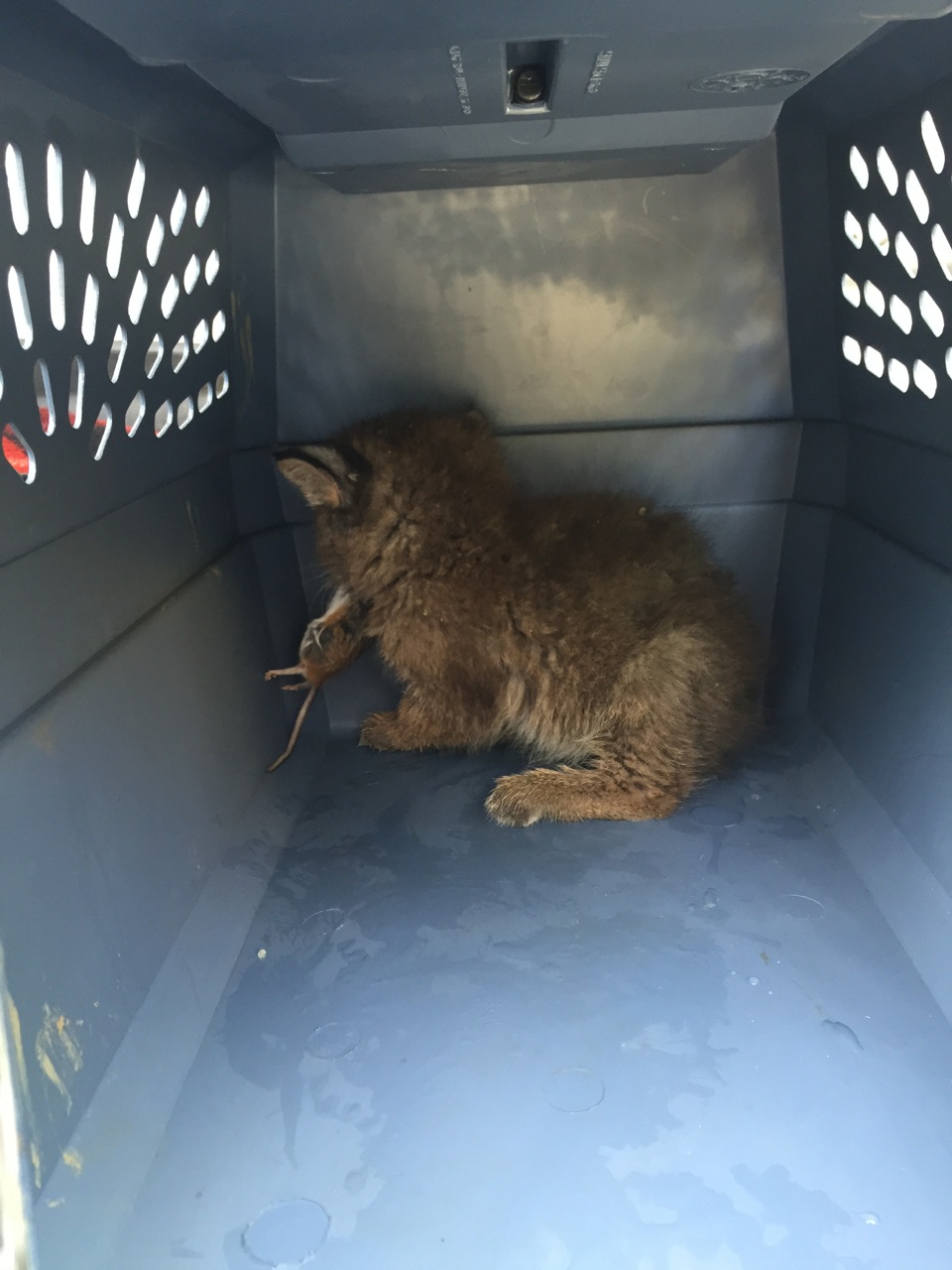
Speaking of galvanized: Bobkit sez GIMME THAT THING. NOW. This I know how to eat.

Mama brought us these and sometimes I didn't get one.

His wild thing came out to growl and play. Ahh, the blue eyes, still hazy and uncertain in sight. The rows of sapsucker holes on his forelegs. The dot dash and scrawl on his forehead. The eyeliner.
I forgot to mention his fur texture in the last post. It felt like shearling--incredibly thick and lush, nothing like a housecat's. Wool, really. Amazing.
After nibbling on its toes, he started chewing in earnest at the mouse's head. There was a mighty crunch and crack. The power evident in his teeth and jaws gave me pause. He simply pulverized that mouse, head to tail.

You'll just have to watch him in action. This is likely as close as most of y'all are ever going to get to a bobkitten. Until that day, I never figured I'd see, much less touch, a baby bobcat.
Life has been throwing so many roses at my feet lately. Fast and furious, and I'm fielding them as fast as I can. The trick is to slow down enough to gather them up and know when the really cool stuff is happening. And then, of course, to give them away. Roses on your pillow:
The next morning, I had to take Bill to work (car trouble). And to reprovision the house. I left early, around 7, and was back by 9 AM. I figured Eric Bear would call me to let me know where the kitten was going after 9. Wrong. He was sitting in his black truck right in my driveway when I got home, ready to take the bobkit to his foster home. Not fooling around.
A rehabilitator in Lake County had agreed to take our adorable little charge. A big outdoor acclimation pen, the right foods...it's not a trivial thing, raising a bobkitten up to be a bobcat, and keeping the wild in him in the process. I wouldn't pretend to know all that's involved. But I felt incredibly privileged to have housed, fed and touched him, to have gazed into those unfocused blue eyes and told him everything was going to be OK. To have felt a bobcat's purr.
I gave him a mouse for the road. Fare well, little beautiful thing. You already look better, just for a night and three good meals.

Thank you to my friends for doing the right thing for this sweet creature, and to Washington County Wildlife Officer Eric Bear for seeing him off to the right home. My heros.
Best part: If all goes well, he may come back to Indigo Hill for release. Wouldn't that be nice? Bobcat release party! A spotted streak, disappearing into the woods. Cross your fingers.
Best part: If all goes well, he may come back to Indigo Hill for release. Wouldn't that be nice? Bobcat release party! A spotted streak, disappearing into the woods. Cross your fingers.








Tuesday, June 16, 2015
16 comments