Background Switcher (Hidden)

Showing posts with label bird rehabilitation. Show all posts

About that Goldfinch

Friday, March 28, 2025

0 comments

On February 27, a sick goldfinch I'd been watching for a week or more finally became blind enough to catch. Her eyes had sealed all but shut. I walked up on her blind side, and caught her in my hand as she sat on the platform feeder.  Here's how she looked from above, her eyes so swollen by Mycoplasma  infection that her entire head looked weird and big. This is called house finch disease, because house finches are the primary vector. They first caught it in the early 1990's from our domestic chickens, and have little resistance to it. And now house finches have spread it to more than 35 species of wild birds. I like house finches. Nice little birds. I hate house finch disease. 

It's a painful thing, as you can see from her swollen red eyelids. 


She sat, quiet and still and mute. The first thing to do was mix up some tylosin tartrate (Tylan), an antibiotic effective against Mycoplasma spp. , which I get from my veterinarian. I held her in my hand as I administered that solution, drop by drop. Birds with house finch disease are very thirsty, and spend lots of time sitting on bird baths, which of course allows them to infect lots of other birds. I wanted to get this bird out of the mix at my feeder, so I caught her and put her in a small plastic Critter Keeper with a couple of small crocks of hulled sunflower seed and medicated water. By that evening, her eyes had opened enough so she could see me! It always feels like a miracle that Tylan works that fast. But she had a long way to go. To clear her system of the germ, I'd have to medicate her for three weeks. 


But here's the good part. Once she could see, I could move her into a large cage. Then, all I had to do was keep her in fresh Tylan-medicated water and food, and leave her the heck alone. The healing was up to her. 


Here she was only a week later. Understand: she wasn't always this agitated. This behavior is elicited by my entering the room and making a video. She was perfectly calm until she saw me! I was the monster who caught her and made her drink medicine.


By March 12, she was looking and acting ever so much better.


She'd had two weeks of treatment when I had to leave to speak at the Michigan Bluebird Festival. I left her in the loving care of my neighbor, Martha J., who is a bird whisperer. When I saw her last, canary babies had just hatched in two nests in her bird room! Martha kept my goldfinch isolated in a back room for almost a week, until I got back with Phoebe in tow. I felt confident leaving the wild bird with Martha, because she'd been medicated for two weeks and was asymptomatic, and Martha was careful about containment. I'm very grateful she could step in. Thank you SO much, Martha!!  It's really hard to do wildlife rehab when you travel for work.

Only one day to go until release time! I put her in the basement because Liam came home for a few days to see us, and I couldn't use his bedroom as a finch sanctuary any more. She's sharing space with an enormous geranium called Frank Headley, one of three huge mother plants I have kept over the winter. Ain't it gorgeous? A semi-dwarf zonal geranium developed in the U.K. in 1957. I adore it and plan to propagate it very soon. 


Finally, March 20 came. I love this little release video Phoebe made. Goldfinches don't stop to say thanks and goodbye. They just GO. 


May this bird be the only sick one I treat this spring. There's an element of luck to it, but more to the point, I'm not using tube feeders--only port-free mesh cylinders and small platform feeders. Everything is covered by hanging acrylic domes that keep droppings from falling into the food. 

I'm feeding sunflower hearts, safflower, and peanuts both in and out of shell in a small gray hanging platform feeder (behind the cylindrical peanut feeder), and suet and black oil sunflower hang from the other two hooks.


I just ran outside to shoot these photos. Brrr!! It's 56 and incredibly blustery. Gusts up to 39 mph make it feel like about 40 degrees out there! This is a somewhat better look at the small platform feeder in the foreground. I love this one because the birds tend to perch on the rim to feed, butts over the ground, and don't crap into their food. Good feeder hygiene is all about controlling poop.  And I don't use tube feeders because goopy sick bird eyes rub against the ports. So think about that. If you've got disease at your feeders, your first best step is to discontinue using tube feeders. Next, stop feeding when the weather is reliably warm. If you feed all summer long, you'll probably wind up feeding familes of house finches, who will happily breed nearby, producing multiple broods. Yay! you'll have even more disease vectors for your feeding program. See the connection?


My hanging system is the Denali Squirrel Stopper with four hooks, made by JCS Wildlife.
I save SO much money on seed now that the squirrels can't make it up the pole! The sliding baffle is very effective, as long as they can't leap from a nearby tree--which they sometimes manage to do.

Thought you'd appreciate some birdfeeding tips from someone who's been at it since she was about 10. Hard-won experience has led me to the conclusions I state here. Farewell, little goldfinch, and try to stay out of trouble now.


The Song Sparrows Stayed!

Saturday, March 12, 2022

3 comments

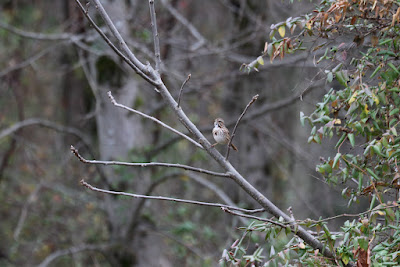
A wild song sparrow sings in Fairyland. 


This is the most current installment in the story of three orphaned song sparrows I raised upon receiving them August 30, 2021. You can find the prior three by scrolling down or hitting "Older Post." 

 The challenge I would face going forward was keeping track of my three song sparrow babies, who were, amazingly enough, hanging around through the autumn and early winter! 
This was worthy of note because I don't often have song sparrows here in winter--they seem to clear out. So to have three hanging around, and those being birds I'd raised, was an embarrassment of riches for me. 
I had expected them to take off soon after release, but they didn't. Fall migration time was already in full swing when they were hatched, for crying out loud--they fledged on August 31. 

As I thought more about it, it occurred to me that perhaps they were up against a metabolic wall. For no sooner had their juvenile plumage grown in than they--perhaps prompted by shorter daylength and the ebb in hormones that produces--began to molt it out. There were little feathers all over the fledging tent. They looked scruffy as could be. 

And it occurred to me that they may have been in no shape to attempt fall migration. Perhaps they had no choice but to stay the fall and winter with me here. Just born too late.
That was fine with me. I could help them through the winter. 

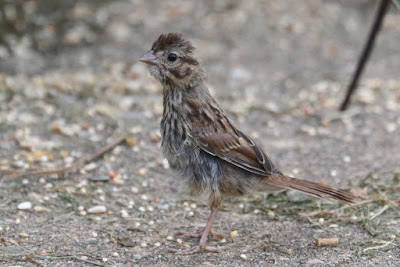
Baby, October 12, 2021. This is such a classic Baby pose. 
Lots of pinfeathers over her eye!


Baby, October 17, 2021. Still showing pinfeathers under the eye (click on photo to see).

About a zillion photos later, I finally got two of them together. 
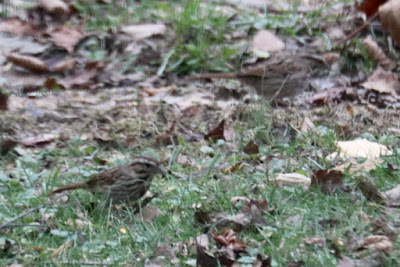
Imagine my surprise and delight when both Baby and Ball showed up together in the side yard on December 16, 2021! This is a crummy picture, but you can make out the fault bars on both their tails.


It had to be Baby and Ball, because Bob had lost his first tail to a chipmunk, and had grown in a perfect one.

What better Christmas present could there be than Ball, singing away on December 26,  2021, down along the meadow edge?


My baby boy is singing!! And I caught him at it! See the little pale bar on his tail?? That's diagnostic of my hand-raised babies. He looks wonderful, doesn't he?


When the ice storm hit in February, somebody turned up tailless. Oh jeez. Ice will pull out bird tails. It happens. I didn't know who it was. One of the three. Maybe Baby. Maybe Bob, again. Feb. 5, 2022


Whoever it was liked to hang out close to the studio window. How sweet!!
I'm kinda leaning toward Bob here. Feb. 6, 2022. Telling song sparrows apart with neither bands nor bar-marked tails is above my pay grade. I try, but I'm never sure. 


They liked dried mealworms, and I was only too glad to toss more out the window. 
Grow that little tail back, fast!!


And then, after I photographed the tailless one, here came one with a bar-marked tail, sitting right in the Zick Dough feeder, pigging out! Ball? Is that you? Baby?? I'm lost. 
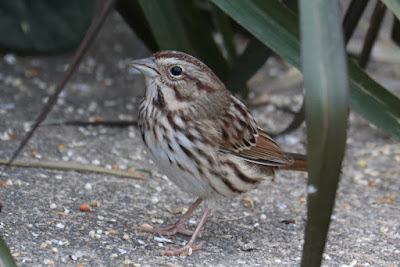

All I know is you're one of mine. And you're either Baby or Ball. If I can photograph you singing, I'll know you're Ball, because I'm pretty sure Baby's a female. Feb. 5, 2022


And so it goes for a Science Chimp and bird mom, forever watching, scrutinizing, photographing. Obsessively confirming, over and over, yes, you still draw breath, my dear ones.
It would be ever so much easier if I could band them, wouldn't it?

It's good to be pretty much caught up, to have followed these three for six months!
What a gift! 
I am looking forward to tracking down and photographing any song sparrow that sings, hops or scratches
on my place as spring comes on. I sure hope to see one with a marked tail. Maybe two.
You never know what little present awaits when you walk out the door. 

Latest sightings: Ball(?) turned up in the ZickDough feeder for the Great Backyard Bird Count on Feb. 19. I was so happy to see him. And he's been singing his distinctive scratchy song right under my bedroom window, Feb. 19 and 20 at first hint of light. He sings once, then takes off from his night roost in the blue spruce by the fishpond and sings farther down in the back, below the fallen willow. What a wonderful start to my day, to hear a bird singing who I've known since he was 8 days old!

On Feb. 24, Ball sang from the steps of my front porch. Oh, how I hope he establishes a territory and stays to breed here! 

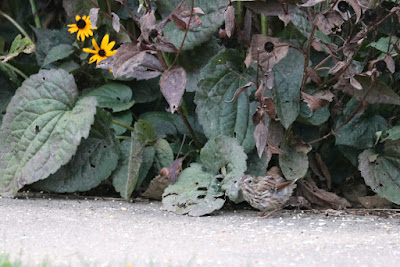
Speaking of gifts...On the 28th of September, I was sitting in my lawn chair, clicking away at the babies as they fed on the sidewalk, when someone else came hopping up. My eye, well trained, knew instantly that this was no song sparrow. Please click on the photos to see the fine penciling of a gorgeous fall Lincoln's sparrow, come down from the squishy bogs of the North Country to grace my yard, and feed on millet for one glorious September morning. 


Such are the gifts of being outside, and looking closely. Swoon! Feast your eyes on that ochre wash across malar and breast! The clean gull-gray above the eye! That white belly! Oh, what a bird!


Release the Song Sparrows!

Friday, February 25, 2022

1 comments


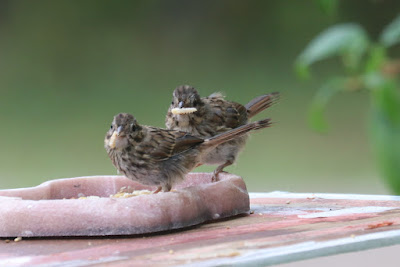
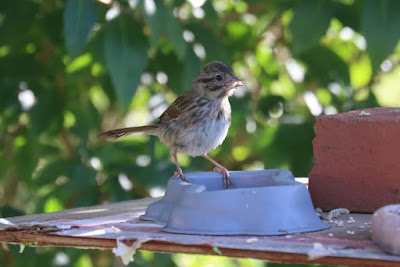
Mmm. Pupae. 33 day old Baby, front, and Ball, behind, Sept. 23

If you're just picking up this story, please scroll down and check out the first two installments in the tale of the rehab and release of the song sparrows I took in August 30, 2021. It was a process!


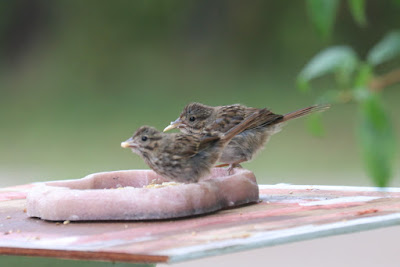
Once the three orphaned song sparrows were used to flying up to a pedestal to feed, I switched to topping it with a large flat board. All these changes took place over the week and a half they were in the tent. I wanted them to be completely comfortable with the feeding setup before they were released. Once they were reliably feeding on the board-topped pedestal, they were ready to go. It was September 17, and they were 27 days old. I had chosen this day for release because Margaret Morse Nice, Ohio song sparrow guru and author of one of the finest single-species studies ever done, wrote that the longest she’d ever observed her subjects feeding their young was Day 27. So be it. 


I opened the tent at 11:15. Baby sunbathed in the unaccustomed bright rays, but the birds acted as though they didn’t notice the open sky, now revealed with the screen rolled back. At 12:14 pm, Bob was the first to fly out, leaving Ball and Baby stunned and standing still at the mouth of the tent. It was a beautiful warm calm day, perfect for them to get their bearings outdoors. At 12:45 pm, Baby flew out into the driveway. 


She was gone for a few moments, then she flew back into the garage and tried to get back into the tent. She changed her mind and flew to the nearby forsythia. All the while, Ball stood and watched. He was still sitting at the open end at 1:20 pm. He was terribly conflicted, and spending a lot of time foot-staring and hiding in the folds of the tent. There was no sign of the two released birds. I calmed myself, saying they’d be back when they got hungry. 2:15: Ball still lingered in the tent.  At 2:53, he made a straight flight out the door and hid under my car in the driveway. I set up the pedestal where he could see it, well stocked with millet and mealworms. I kept hearing rustling in the roses along the garage, but I didn’t see any of my babies from 3 pm until it was too dark to see. 


It was Terrible. The first 12 hours or so of most of my bird releases are usually pretty stressful. I went to bed at 10 pm and woke at 1:30, worrying, and that was it for me. I was so impatient for the dawn. At 7 am I walked out, calling, and Baby popped up in the rose hedge! I threw millet all over the sidewalk, mealworms too, and two birds—Ball and Baby-- came down to eat at long last. What an awful ordeal, waiting for evidence that they were still alive. It’s often thus with releasing birds. You have to have faith, and every hour that ticks by tests that faith. 


Around 11:40, a third bird came flying from the prairie patch across the yard. It was Bob! I’d heard him giving the chimp note over there most of the day. Finally, they were all together, and they fed atop the pedestal feeder I’d set up by the forsythia. Whewww!! 


What a relief! By mid-morning, the babies were coming to the pedestal, which I'd set up next to the forsythia where they spent a lot of time. I left the good stuff out for them there! Here, Baby and Ball feast on mealworm pupae (freshly molted, of course, and tender). 


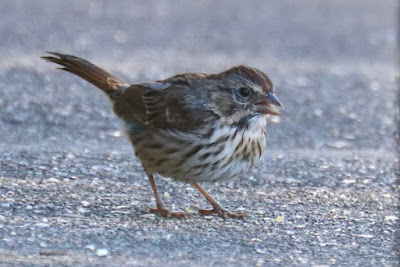
Just look at the size difference here. Baby's in front, but so much smaller and more delicate than hulking Ball. Also note the angle of her tail--she always carried it high.

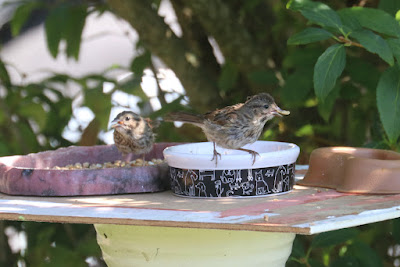
Baby and Ball were almost always together, as they had been in the cage and in the fledging tent. It was a comfort to see their bond persisting after release. 

                                                       Baby and Ball at the pedestal.

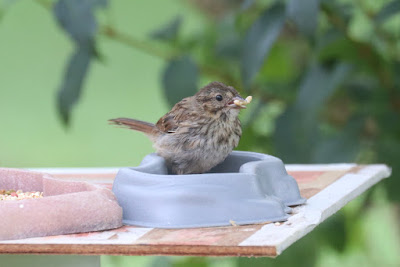
Ball was well-named. He was roundish, and he had finer streaking as a juvenile than Baby .


Ball, Sept. 25, '21


I stayed out with them all that first day. It is my habit to stay out with newly released birds, to give them a sense of continuity, so they know I will continue to provide for them. Toward dusk, Baby and Bob went to roost in the forsythia, while Bob, ever the loner, flew across to the prairie patch. He was to keep this pattern for the rest of the autumn. Alone among the three, though, Bob would spook around the front door, the studio hummingbird garden and the bird baths. It was always lovely to look down and see him as I worked. I often wondered if his willingness to come into my spaces was because he had spent time on my shoulder as a brand new fledgling. He sought me out.


20 Sept. Bob tries his first sunflower heart under the feeder! He also stripped crabgrass seeds as though he'd been doing it all his life. My mother bird's heart almost burst with pride!


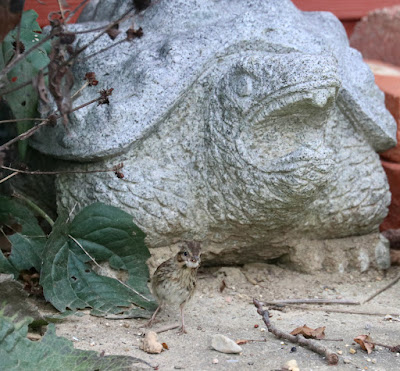
And that same day, I snapped his portrait by my granite snapping turtle. How cute is he? 


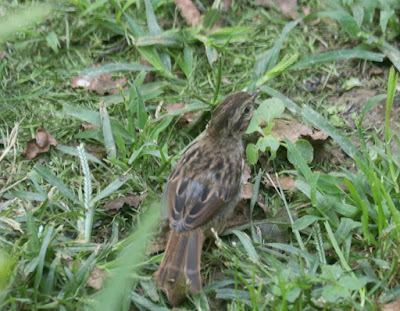
Bob, in the grass Liam calls "Witch's Hair" on Sept. 23, 2021


He was 33 days old. Such a handsome little guy.


Ball eats a moth, Sept. 28

Ball, Oct. 1, '21. This photo makes me smile. He was such a round little fella as a youngster.


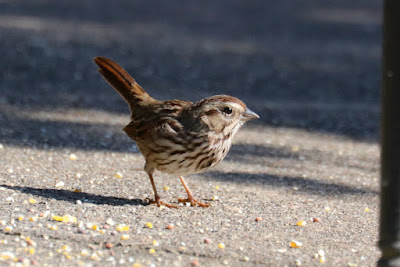
Baby, Oct. 17, '21. Baby carries herself low, and often cocks her tail upward. Always has. 


I fell into a pattern of taking my camera and binoculars out each morning when I filled the feeders on the pedestal. I'd sit in a lawn chair, taking my tea, watching for the babies, and I'd shoot as many photos as I could. It was lovely, like a morning meditation. My chair was perennially wet from the morning dew, so I took a towel out with me to spread before I sat down.  


I like to think it gave them a sense of peace and comfort to have a large anthropoid ape, one they knew, watching over them as they fed. 
They were also completely comfortable with Curtis, who made it his job to keep the chipmunks away from the seed I spread on the sidewalk.


Still, we couldn't protect them every minute. 


On this shot from Sept. 19, you can see the pale fault bar band across Bob's tail. All three babies showed this band, which was formed when they suffered a day of deprivation when their nest was destroyed, before I took them in on August 30. The feather growth was interrupted, and manifests as a pale line.


Bob fills up at the pedestal feeder, Sept. 24, '21

On Sept. 29, Bob turned up tailless! I blame the chipmunks who were always lurking in the rudbeckia/rose hedge along the sidewalk. Not a fan of the striped ones.


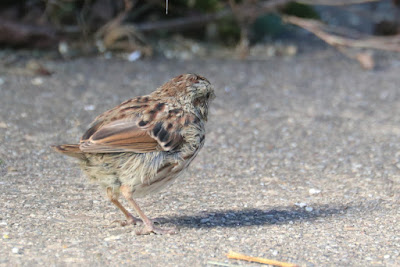
Oct. 1, 2021--Bob is already showing the start of a new tail! Four days of growth and he's already showing a stub! I knew he'd grow it back, and sure enough, within three weeks you'd never know he'd been without. The only thing that wasn't great about this was that I'd lost the key marker--the fault bar across his baby tail feathers--that I'd been relying on to distinguish him from the wild song sparrows. As they got sleek and beautiful, I had to rely on the fact that all three of my babies were still undergoing face and head molt in mid October, while any visiting song sparrow would have long since finished molting. There were still a few pinfeathers on Bob's face when I snapped him with his beautiful new red tail on Oct. 17.


Bob at the bonsai pool by the front door, Oct. 21, 2021


Bob loved to bathe! Maybe that's why he was always sleeker than his siblings. He probably thought they were gross, so he kept to himself. 

One of the really cool things that happened during this lovely September/October idyll was that two wild male song sparrows showed up and hung out with the babies. This is one I called  Chops, for his big muttonchop markings.


Chops can hardly believe the fare my three orphans were getting


 and helps himself! 


The bird below I called Wilder.
 Both sang around the yard, which is why I knew they were males.


Wilder, October 3, 2021

Because the babies weren't afraid of me, these two wild song sparrows decided I must be all right. 
They were so crisp and beautifully smooth, in contrast to the scruffy juveniles. I enjoyed getting to know the wild ones, who fed among the three babies, unconcerned about me sitting just a dozen feet away.


I remember that period as one of peace and contentment, watching my sparrows go a little wilder each morning, before their mama's eyes.


Who Pooped on the Dingus?

Sunday, January 29, 2017

17 comments
Most of the time, all you find is clues. Found this pellet atop a haybale. It's what a cardinal looks like when it's snatched in the night, swallowed and pulverized, thoroughly digested. This is what's left. 

Screech-owls like cardinals. 


I've had some screech-owls in my care, with varying rates of success. Some of them make it, and some of them don't. Nothing good happens when a screech-owl meets a car headlight or grille.


But the thing is to keep trying. I was worried about this one, but with expert care at the Ohio Wildlife Center, he got his eyesight back and I got to release him on a peeper-loud spring night, got to watch him beat his beautiful wings and fly to the top of a tree, then look around fiercely at the very place he'd been found hit. He was home, and he was good to go.


That was the best. 


Then there was this little character, who thought it would be a good idea to roost in a load of steel pipe somewhere on an oilfield lot in Texas, and woke up in a parking lot in Marietta two days later, dehydrated, freezing cold and hungry. Fed him up on white-footed mice and let him go on our sanctuary. Best I could do, since I didn't know where he'd come from.  All these owls have made cameos on this blog over the years. I'm just too busy to go hunt up the links. That's what the search box is for!


There have been a couple of lost babies, which thanks to summer festival travel commitments, I had to pawn off on OWC. But I got to feed them in between. 


Yep, that's a big blob of owl poop on my stomach. Perc of the job. 


 I think my favorite of them all was the wild red-morph that Phoebe spotted, perched just off our driveway one winter night, and took me out to see. She led me through the dark yard by my hand. Turned on the flashlight. There he was!! I brought my big rig and got exactly two shots as she held the flashlight on him. He never budged. One was blurry, and one was this. THIS.


All of which is an amusing way to say I knows screech-owl poop when I sees it. 


I was unpacking my Subaru of tons of original art, books, road snacks and clothes on December 11, having just returned from a superfun book tour in CT, MA and RI. Down by the back door, there stands this adorable, odd little lawn sculpture. I call it the Dingus. It was made by our friend, Lower Salem artist, jeweler and sculptor Mike Trembly.  It was an impulse buy, and I'm so glad I bought it. It makes me smile. Today, it made me gasp.

I did a double-take when I spotted the puddle of whitewash on its base. I knew right then that there had been a screech-owl a settin' on the finial.

By Dec. 26, he'd been back several times.  Who pooped on the Dingus? 


I chortled with joy each time I found a new sploot. He was making a real mess of the Dingus! I could just see him sitting up there, hoping a mouse would run underneath, never suspecting there might be an owl atop the dingus. No one expects an owl atop the Dingus!! Boom!

Except the Science Chimp, and Corey and Phoebe. We wuz gonna find out, because we are all card-carrying Science Chimps. Phoebe and Corey, headed for Silverback status. Corey got here Dec. 28, only two days after this splootfest, and he had that trailcam set up practically before he got out of the car. He set it to Video, let it run for a night, and brought the card in, all excited, only to find that we couldn't open the videos on any of our Macs, new or old. Incompatible format. D'oh!!!

Phoebe was undaunted. She took it to the Bird Watcher's Digest office and uploaded the videos onto her aunt's PC, then did some kind of hocus pocus to get them onto her Macbook Air. And she brought that laptop home and plopped it in front of me. And being a master of short film, she made a little video of what happened next. 


This is what I saw. Which will help explain my extreme excitement, captured in Zick Reaction, just below. I put a little of Corey and Bill's KitchenMusic in the background just for fun. It seems to capture the joy.


This is another video of him just a settin' there. At one point he turns his head, and those eyes light up the night. And I scream again.


 You're going to have to forgive me, and, as always when dealing with an excitable Science Chimp, turn your sound down. Because I am definitely NSFW (not safe for work).

Her Daughter Sets a Laptop in Front of Her. You Won't Believe What This Mom Does Next!


And it just doesn't get any better than that. Thank you once again, Corey, for the music and the videos.  Thank you, Phoebe and Liam, for lighting up my life and switchboard, every day. And thank you, Owl, for poopin' on the Dingus.
[Back to Top]