Background Switcher (Hidden)

Showing posts with label Science Chimp. Show all posts

What Killed My Frog?

Thursday, August 8, 2019

26 comments

I hadn't gotten too attached to this frog; we'd just made friends, and it had just connected me with good things like mealworms. But it still was a punch to the gut when I saw it suspended, little fingers splayed, eyes hooded, halfway down in the 3' deep pond. I knew right away it was dead. I've seen that float before.

I didn't have my phone with me, and it seemed disrespectful to shoot a photo of the frog like that anyway, when it couldn't say no. Besides, I had to fish it out quickly and see if there was any life in it at all, because helping creatures is what I always try to do first.

Nope, it was stiff and still. Ahhh how sad. I noted immediately that it was very fresh. No bloating, no odor; eyes still perfectly clear. But why and how had it died? I'd fed it two Superworms on July 29. And this was August 4. Could they have chewed a hole somewhere in its gut and killed it slowly, by  infection of peritonitis? Seemed unlikely. But then again...maybe the timing was right for a death that. Being the Science Chimp, and easily consumed by guilt, I had to know if I'd had an inadvertent hand in the frog's death.

I'm gonna ease you into this now with a little dissertation on the frog's tongue. From here, it gets more graphic, but it isn't gross. It's interesting. The more sensitive among you might want to stop here. You've been alerted. 

I opened the frog's mouth, to see if it might have choked on something, and was arrested by its amazing tongue. I'd seen that tongue deployed as it swiftly unfurled and blapped onto the mealworms I'd tossed. But I never realized that it is actually turned back on itself, and its side flaps are folded under, as it rests in the frog's mouth.


Freaking fabulous!! I thought about the extra velocity that sticky tongue would have as it snapped out and simultaneously unfolded. Fwab-adap!


It's like the distal half of a heron's neck, which, when it strikes, whips out from a sort of hinge halfway up the neck. That hinge is the "kink" in the neck that we notice when the bird is at rest.


 Shot this fledgling green heron as it hunted dragonflies in a floating mat of vegetation in St. Mary's WV. You know how fast you have to be to grab a dragonfly? 

 The one that got away.


Throwing the neck (or the tongue) out from a short distance is the difference between a roundhouse punch from the shoulder and a quick jab thrown from the elbow.  The jab isn't as powerful, but it's much quicker, and quick is what you have to be to catch insects (or fish). Already, I was enjoying my foray into this frog's secrets.

But I knew it wasn't going to be all fun and games, playing with a frog tongue.

There was only one way to really determine whether a Superworm had killed this poor creature.
 It was time to open the frog. The skin was like the finest thin latex, and the whitish abdominal muscles had to be cut with a scissors, as did the breastbone, so I could completely retract the abdominal walls. And there were its organs, pretty much just like a person's, with less intestine.


I saw two blackish granular structures that looked like caviar, one on each side, and knew I'd found the frog's ovaries. Ahhh, damn. It had been a female.

Kinda surprised me, because the tympanum (round external ear membrane) was pretty large.  Males have larger tympanae than females. 
Gotta listen for those spring choruses, you know, to get in on the action.


OK. Time to haul out the stomach and intestines, and see if there was a giant mealworm in there, or at least a hole somewhere. The stomach was fine, pink, unperforated (to the left of the pliers). The duodenum looked discolored right below the stomach. I thought I might have found something incriminating.
But when I opened it up, there were no holes, and it appeared that what I was seeing was the color of recently digested food, through the translucent wall of the duodenum (small intestine). It was an orange-red paste that for all I know might once have been a baby comet. So much for that.


Everything else inside the frog looked fine. I opened the stomach and examined its contents. Not a trace of a Superworm. Duodenum had checked out fine. Opened the caecum and examined its contents. Just normal looking frog poo, loaded up to launch. Small insect bits discernible in the fecal material. No hard chitin from a Superworm, at all. That had already passed through. This animal had been eating and digesting normally right up to its death. Nothing was bloated, nothing perforated, no internal bleeding and nothing amiss that I could see.  I had to conclude that perforation by Superworm was not the cause of its death. Not to say it can't ever happen, but I'm confident it didn't happen to this frog.

But there was something amiss on the frog, and I wanted to think about that.

The animal's left leg was bruised, with a hemorrhage running down the calf. Its foot was pretty swollen and discolored, too.


On the dorsal side, there were two very fresh wounds. One, a jagged tear in the skin. It would have taken something quite sharp, dragging across the frog's thigh, to make that.


There was also a puncture wound, from which some muscle protruded. See the tip of the pliers here, pointing at it.  Hmmmm. I couldn't see how either of those wounds, though, would kill the frog. But they were so fresh, they had to have something to do with her death. 

I have to thank Liam for taking these photos. I couldn't take any shots while doing the dissection. It was worse than trying to make movies while feeding bats (something I got pretty good at, thanks to a small gift tripod and a nimble tongue).

This isn't a flattering shot, but it is 100% Science Chimp Zick. Completely absorbed in the pursuit of knowledge. And for that, I love it. It's me, and I like who I am, because being normal is boring, and glamor ceased to be part of my world a long time ago.

 As Liam commented when I asked him if I should publish this photo:  "Of all the photos of me tearing apart a dead animal, this is the worst!" Which sent me into gales of laughter. This kid. He's made me laugh all summer long. God, I'll miss him when he goes back to school.


 Nah, it's not a glamour shot, and I look like a gnome, like something that lives in a tower. Oh, wait...

Hi Bacon! Thanks for stopping into this post. I love you.


I was left stumped. I decided to wrap up the autopsy and mull on it for awhile. I'd found out what I could find out from this poor frog, so I wrapped her in wet newspaper and set her in a cool place until nightfall, when I could put her body out for the possum who visits our compost. What a nice surprise it would be for him! Nothing gets wasted around here. And everybody eats.

I excavated the rider mower from its tangle of lawn chairs and bikes, replaced the front wheel whose tire I'd flattened and given to Marcy to get fixed (thanks, Marcy!!) Started it up, and began the hypnotic round and round the house and plantings. I was about five rounds into the mow when it hit me. A cut and a puncture wound wouldn't kill a frog...would it...

unless there was venom in what cut and punctured it.


Which explains the swelling and discoloration very nicely. That's what my finger looked like once upon a time, when I reached under a lavender bush for a weed and felt a hot lance to my hand. THAT good, old story is here: Committed to the Country


Durn copperheads. I build you a nice patio to live in, and you thank me by killing my frog. You struck; she jumped; you raked her with one fang, but you hit pay dirt, and punctured her leg with the other. Still, she got away, and plopped into the pond, already dying, a foot down, where you couldn't recover her. Wasted. Unless you consider that it was all a nice mental workout for a curious Science Chimp, and some fairly graphic entertainment for a few thousand people. 

And maybe a nice solid bit of debunking on a factoid that ain't necessarily true. That said, I'm not feeding any more Superworms to frogs. Better safe than sorry.
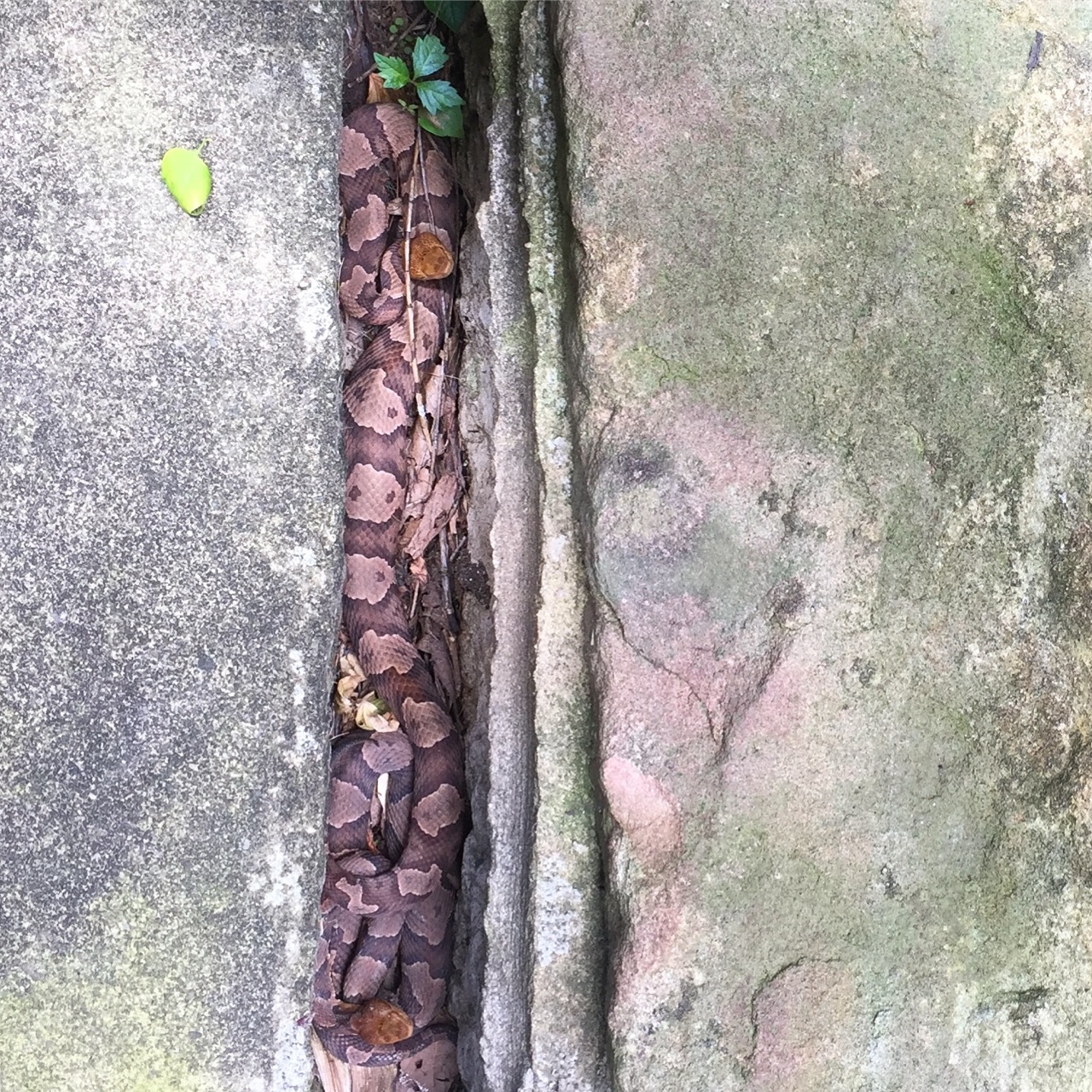
This year's fine brace of copperheads. Mr. and Mrs. Fak. I'm sure their banded babes will turn up very soon. I just hope none are in the basement.

Still, I suspect one of you Faks also killed the two bullfrogs who moved in this spring. The hummingbirds and warblers and chipping sparrows and I thank you for that. 

Circle of life, baby. Like my John Deere and my mind, it goes around and around.

Before the crape myrtle got killed back to the ground. When Chet, my tractor,  the crape myrtle and I were newer, and still shiny.

Who Pooped on the Dingus?

Sunday, January 29, 2017

17 comments
Most of the time, all you find is clues. Found this pellet atop a haybale. It's what a cardinal looks like when it's snatched in the night, swallowed and pulverized, thoroughly digested. This is what's left. 

Screech-owls like cardinals. 


I've had some screech-owls in my care, with varying rates of success. Some of them make it, and some of them don't. Nothing good happens when a screech-owl meets a car headlight or grille.


But the thing is to keep trying. I was worried about this one, but with expert care at the Ohio Wildlife Center, he got his eyesight back and I got to release him on a peeper-loud spring night, got to watch him beat his beautiful wings and fly to the top of a tree, then look around fiercely at the very place he'd been found hit. He was home, and he was good to go.


That was the best. 


Then there was this little character, who thought it would be a good idea to roost in a load of steel pipe somewhere on an oilfield lot in Texas, and woke up in a parking lot in Marietta two days later, dehydrated, freezing cold and hungry. Fed him up on white-footed mice and let him go on our sanctuary. Best I could do, since I didn't know where he'd come from.  All these owls have made cameos on this blog over the years. I'm just too busy to go hunt up the links. That's what the search box is for!


There have been a couple of lost babies, which thanks to summer festival travel commitments, I had to pawn off on OWC. But I got to feed them in between. 


Yep, that's a big blob of owl poop on my stomach. Perc of the job. 


 I think my favorite of them all was the wild red-morph that Phoebe spotted, perched just off our driveway one winter night, and took me out to see. She led me through the dark yard by my hand. Turned on the flashlight. There he was!! I brought my big rig and got exactly two shots as she held the flashlight on him. He never budged. One was blurry, and one was this. THIS.


All of which is an amusing way to say I knows screech-owl poop when I sees it. 


I was unpacking my Subaru of tons of original art, books, road snacks and clothes on December 11, having just returned from a superfun book tour in CT, MA and RI. Down by the back door, there stands this adorable, odd little lawn sculpture. I call it the Dingus. It was made by our friend, Lower Salem artist, jeweler and sculptor Mike Trembly.  It was an impulse buy, and I'm so glad I bought it. It makes me smile. Today, it made me gasp.

I did a double-take when I spotted the puddle of whitewash on its base. I knew right then that there had been a screech-owl a settin' on the finial.

By Dec. 26, he'd been back several times.  Who pooped on the Dingus? 


I chortled with joy each time I found a new sploot. He was making a real mess of the Dingus! I could just see him sitting up there, hoping a mouse would run underneath, never suspecting there might be an owl atop the dingus. No one expects an owl atop the Dingus!! Boom!

Except the Science Chimp, and Corey and Phoebe. We wuz gonna find out, because we are all card-carrying Science Chimps. Phoebe and Corey, headed for Silverback status. Corey got here Dec. 28, only two days after this splootfest, and he had that trailcam set up practically before he got out of the car. He set it to Video, let it run for a night, and brought the card in, all excited, only to find that we couldn't open the videos on any of our Macs, new or old. Incompatible format. D'oh!!!

Phoebe was undaunted. She took it to the Bird Watcher's Digest office and uploaded the videos onto her aunt's PC, then did some kind of hocus pocus to get them onto her Macbook Air. And she brought that laptop home and plopped it in front of me. And being a master of short film, she made a little video of what happened next. 


This is what I saw. Which will help explain my extreme excitement, captured in Zick Reaction, just below. I put a little of Corey and Bill's KitchenMusic in the background just for fun. It seems to capture the joy.


This is another video of him just a settin' there. At one point he turns his head, and those eyes light up the night. And I scream again.


 You're going to have to forgive me, and, as always when dealing with an excitable Science Chimp, turn your sound down. Because I am definitely NSFW (not safe for work).

Her Daughter Sets a Laptop in Front of Her. You Won't Believe What This Mom Does Next!


And it just doesn't get any better than that. Thank you once again, Corey, for the music and the videos.  Thank you, Phoebe and Liam, for lighting up my life and switchboard, every day. And thank you, Owl, for poopin' on the Dingus.

How to Save a (Bluebird's) Life

Thursday, June 23, 2016

14 comments
I'm a bit erratic of late, but trying hard to bring the blog back up to at least twice weekly. There's so much living to do. In nesting season interesting, time-consuming things get thrown in my lap on a daily basis, things I can't ignore, things that need to be done. And then there's the momentous fledging of Phoebe, and that's been an energetic investment of its own. I've little energy or time left over for telling stories, and I have so many stories to tell. They're stacked to the ceiling. And I can only tell them one at a time, when I'm not rushing to or from somewhere or buried deep into a project.

A Carolina wren who fledged 4.5 young out of our copper bucket under the front eave on June 4 is now incubating five more full-term eggs in a Gilbertson PVC box in the backyard! Cheepy's Mom has got it goin' on.


The peach, named Defiance, weeps gelatinous tears over its encounter with periodical cicadas, who have slit its bark and laid eggs in every branch. Damn. That peach had had it already with the freeze May 10. And yet cicadas bet that the tree they lay eggs in will still be alive in 17 years. That's why they go for young ones, in the middle of open spaces. Like fruit trees. Like me, trying to get from the house to the car. You've got all this open space, and you aim directly for my face. But they're dying now, and a part of me kind of misses the hubbub. Like 1% of me.


A dogbane beetle, my first of the year, chews the edge of a milk-sapped leaf, deadly poison to any but he. If his chrome Jacob's coat doesn't yell DO NOT EAT ME, nothing does. Admire me. Eat at your peril. I'm sad that goldenrod has choked almost all the dogbane out of our prairie patch. Nothing stays the same. I love dogbane and so do silver-spotted skippers, fritillaries, and hairstreaks, who sip its nectar. But serving as fodder for dogbane beetles is clearly its highest use.


A friend came to visit, to see the place and meet me and the family, and I saved my yard bluebird box check for when she was here. As soon as I opened the garden box I saw something that brought me up short. Do you see it?


When you've been tending bluebird boxes for 34 years, you know enough to say "Uh-oh" when you see a runt like the one at the top of the heap there. It's at least three days behind its siblings. They're six days old, and this little thing is barely three days old, developmentally. It may have hatched soon after they did, but it's not getting enough food and is only going to fall farther and farther behind.

I closed the box and thought about it. The instant I saw this chick, I could see its future rolling out. Experience has shown me this: Starting smaller than the res, it would be the most vigorous begger in the brood, and ironically enough it would get the least food. Come fledging time, about two weeks  from now, it would still be largely unfeathered, while its fully-feathered siblings would be crowding the entry hole, taking all the food. And when they fledged, flying strongly, if this bird was even still alive, it would be left sitting in the box, calling and calling in that lonely nasal Ne-nu! Ne-nu! of baby bluebirds. The parents would return occasionally to look at it, but they probably wouldn't waste time and resources feeding it. If it jumped out of the box from sheer desperation, it would be reduced to hopping across the yard, easy prey for anything walking or flying by. And then it would become my problem. If I know anything after all these years, I know my heart. It is strong, and weak, too.


Unless...That evening, a solution presented itself to me. I'd go out first thing in the morning, and I knew that when I'd open the box, that chick would be standing up with hunger. I'd be ready with my tweezers, and I'd pop some tender mealworm pupae in its little gob, and when it was full I'd drive it a half mile to a box of bluebirds that hatched only yesterday. I'd slip it into that brood and then, and only then, would it have a snowball's chance of becoming a bird.

Overnight a huge storm front came through, with 2.65" of blessed rain. The lawn, concrete-hard for weeks, now gives a little when I walk on it. It's not soggy by any means, but THAT was exactly what we needed. I felt every cell in my body rejoice for the hen box turtles who've been plodding around for a couple of weeks, holding their eggs in because they couldn't dig in the concrete-hard soil. 

And when Liam and I went out this morning to fetch the chick, it all rolled out just as I'd envisioned. 


That tiny runt was standing up with hunger. It didn't care that I wasn't a bluebird. I fed it the first pupa (you can see a white bulge in its craw) and it voided the tiniest of fecal sacs.  You can see that dropping right behind its head. Oh my. You are starving indeed, my love.


Three pupae later it was finally quiet. Its fat little siblings didn't need to beg; their parents had filled them with rain-fresh insects. Bluebirds don't waste food on those who aren't thriving. It's the wisdom of wild things. It can seem dispassionate, even cruel, but it makes sense for survival. Bluebirds are a lot smarter than I am. They don't let emotion rule. They look at that bird and say, "You're not going to catch up no matter what.  Here's the deal. I'll feed you if and only if I have a surplus."

So the runt overcompensates by begging at the slightest stimulus. It's trying so hard to overcome its lousy lotto number and survive.


I took the babe, now full and sleepy and wondering what the heck was happening, and installed it in a temporary nest.


My handsome son, driving Ms. Crazy and her dashing sidekick to our destination a half-mile away, a bluebird box on the edge of a huge hayfield.


Tender solicitude from a sweetly frosted gemmun.


I peeked in the box: four two-day old chicks. They could surely handle a fifth.


The foster child, slipped in to the left side. A far more harmonious sight than when viewed in its own nest. You'd hardly notice the anomaly. Yes, it's bigger than its new siblings, but given its slow start in life, I have a feeling you won't be able to tell it from them in a couple of days.  Now it has a chance to grow up, a flying chance to be a bluebird. 


I want to say, as a not-so-poetic but vital postscript, that none of this slick cross-fostering stuff would have been possible had I not been checking my 26 bluebird boxes once or twice weekly, and writing down what I found.  Had I not been looking closely, comparing each chick to the other, and informed enough by years of working with bluebirds to be able to see the anomaly at a glance, the chick would almost certainly have died. Again and again, I see people observing nature, watching nest boxes, say, and never bothering to make a simple written note when eggs are laid, when chicks hatch; when they fledge. It makes life ever so much more interesting when you keep notes. It's the very stuff of educating oneself. And it makes interventions like this possible when you know without a doubt what you've got in every box. See a robin starting to incubate? Write it down! Then you can look up incubation and nestling periods, and you'll know when to expect hatchlings; when to expect fledglings. You'll be acting like a naturalist, not just a passive observer. You'll be participating in it all. And actively participating, not just watching, is how we learn.

 I'll keep you in the loop. If you're already keeping nature notes, hooray! If you're not, consider this your kick in the pants toward your Science Chimp badge.


Heronarama and a Science Chimp Mystery

Sunday, August 3, 2014

3 comments
Oh did I have fun with the herons of North Bend on my late July canoe trip. Great blues are everywhere, croaking and flapping prehistorically off when disturbed. This one is in some pretty impressive molt. Look how the fresh new dark slate feathers are replacing the worn and tired pale gray flight feathers. I'm not sure, but this may be an immature bird. Anyone?


But the real star of the show was this adult green heron, in glorious plumage and condition, who was hunting hard, probably to feed a hungry brood. Green herons breed much, much later in the season than do great blues, who start nesting in March and April in Ohio. 


The deep chestnut neck, the glossy dark-green back, the lanceolate(rather than rounded) lesser wing coverts, bright orange-yellow legs and clean white double streak on the neck underside all point to this being an adult bird. 


Lesser wing coverts lift up, functioning as flaps as the bird brakes to a landing.


It steps quietly along through the shallows, looking for minnows, dragonflies and bluegills. Toward the end of its photoshoot, it stabbed a 3" bluegill and gulped it right down.


I keep watching green herons whenever I can, hoping one will use bait to fish with. There's a video of a bait-fishing green heron that a lot of people have sent me on Facebook. Yep, they do it! At fish farms, they learn to get fish food pellets from dispensers, drop them in the water and wait for lunch to rise up to get them.  In the wild, they'll use a small twig or leaf, drop it in the water, and wait for curious fish to come.

This bird was getting food the old-fashioned way, though, by hunting. The water was so scummy and covered with algae that he couldn't have used bait anyway.


I would hate to be a minnow under that gaze.


It was divine to be ignored by this gorgeous little heron, to watch it going about its business and fishing successfully. I love love love birding and photographing from my Wee Lassie canoe, Lois.


I love it because everyone ignores me and goes about their birdy bidness. In this case, processing a large cicada.

Browsing in the underbrush--a second buck in velvet.


Or just lighting up the shore with beauty: swamp rose mallow. Native, lovely, showy, ahhhh.


It wouldn't be a North Bend outing without at least one myskery. David saw this object high in a broken snag. "Is that an EGG?"

I paddled closer, burning with curiosity. "Yes! It's an egg!"


Now, there's only one kind of egg that could be, being almost the size of a hen's egg, and that would be a wood duck. I figured out what was going on by noting that it looked like the snag had cracked in half, exposing the heretofore closed cavity. Unhatched, broken or addled eggs are often left in the bottom when the ducklings depart. And the black mulch? Well, having examined a number of cavity nests in downed snags, I'd say that mulch is made up of organic matter, including but not limited to sawdust, feces, other unhatched eggs (see the one a few inches below the top one?), and dead birds. See the bird bone sticking  out of the mulch? Eeew! and EEEEE!! Science Chimp heaven!


We're looking at years, maybe a decade or more, of accumulation of organic matter. I wanted to get in there and tear through that mulch lookin' for other clues, but it was too high for me to reach, even with overarm brachiation.


Image shamelessly nicked off randalrauser.com, who, the Net being what it is, could have stolen it too.

If canoeing North Bend  with me, trying to figure out what's in dead duck mulch sounds like something you'd like to do, there are still some spaces left in the Bird Watcher's Digest Reader Rendezvous coming up August 22-24, 2014.

Check it out here: Birding Valhalla With Julie Zickefoose

[Back to Top]