Background Switcher (Hidden)

Showing posts with label beaver. Show all posts

Into the Arms of Dean's Fork

Wednesday, July 1, 2020

7 comments
On this June morning, I woke before light, as I usually do, and lay in bed planning my day. I decided that the best thing I could do would be to walk down Dean's Fork with Curtis and celebrate the return of the beavers. Maybe I'd get some photos for this post! I hung the big rig over my shoulder and grabbed my binoculars, harnessed the cur to a belt around my waist, and off we went. 
The feeling I get when I walk down Dean's Fork is much like the one many do when passing through the doors of a church. I feel as though I am delivering myself and all my cares to a greater power. I feel it working on me the entire time I'm there. Discoveries await me, each time, and I can never anticipate what they might be. That's the deliciousness of being attuned to nature. It's subtle stuff. You have to look for it and be open to it. You can't go barging along talking or listening to music. You must let the only input be that of nature. That's when the magic happens.

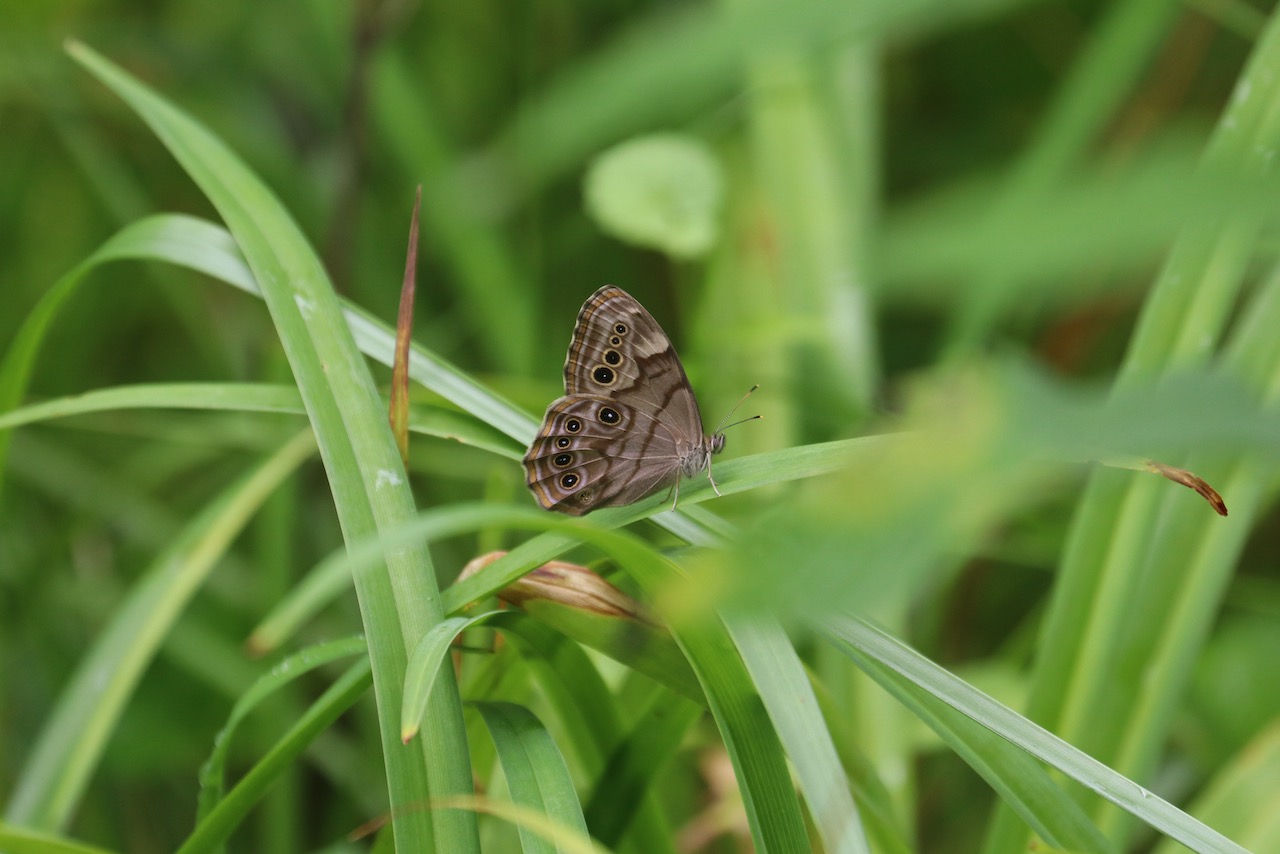
Northern pearly-eye, my first of the season, June 15

I think of my visits there as "delivering myself into the arms of Dean's Fork." Because that's how it feels. Like I'm being wrapped up in something much bigger than me. Look at this beaver dam, in a sinuous Z, perfectly and powerfully engineered to hold back who knows how many hundreds or thousands of tons of rainwater. The dam itself is easily 20' high. It was made by two rodents only of the materials they could transport in their teeth and arms. Think about that. The intelligence, the design of it all. It takes my breath away. It is as precious to me as any architectural work of man, because what work of man creates habitat for so many other creatures?  Humans transform habitat, but rarely for the benefit of other life forms than humans. Concrete and glass are notoriously unkind to winged ones. Here, in this perfect construction site, the waters teem with life, and they're a magnet for wildlife you'd never find otherwise. 


I didn't see a heron on this joyful trip, but I saw where the shitepoke sat.


And shat.

I smiled so big, picturing a great blue heron, all angles and spikes, delivering the evidence of its visit to the road below. 

That evidence, transient and nourishing, going back into the earth without a hitch. Unlike the evidence of human passage. What LOSER would dump his (losing) lottery tickets and beer cans in this sacred space? A loser, that's who. Only someone insensate to beauty could defile this place. 


In the muddy road just alongside the pond, some opossum tracks...


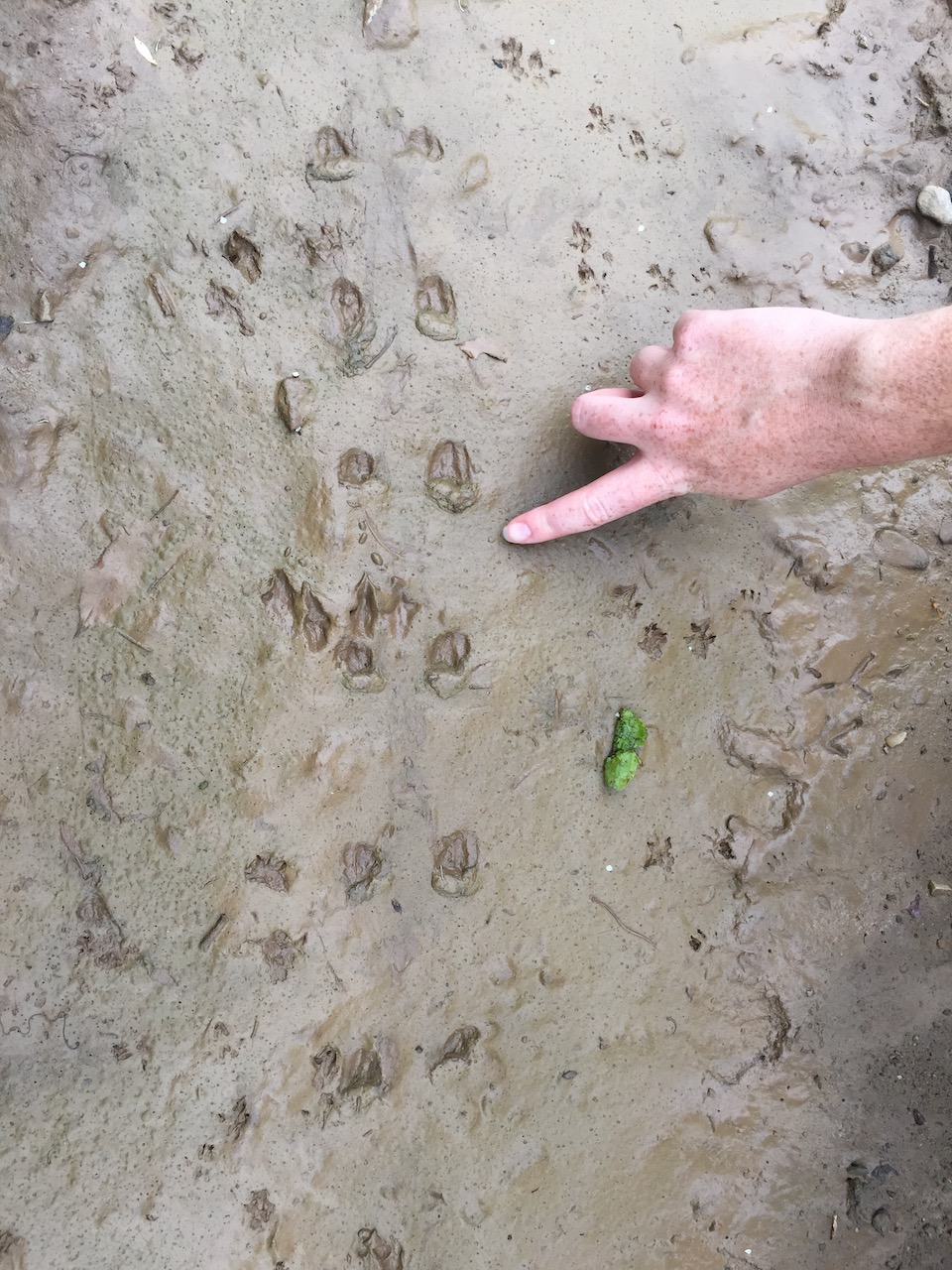
and the greater prize, some good clear river otter tracks. For now, they might be eating crayfish, but oh, when the fish come in! I thrill to think of fish rising to the surface in the evening.


And the greatest prize of all, my lottery win: a sighting of the engineers! I have to go pretty early in the morning or late in the evening to catch them. They're crepuscular. I was delighted to see the two interacting when I got there. They were grooming each other with tooth and claw. But so gently, no red. 
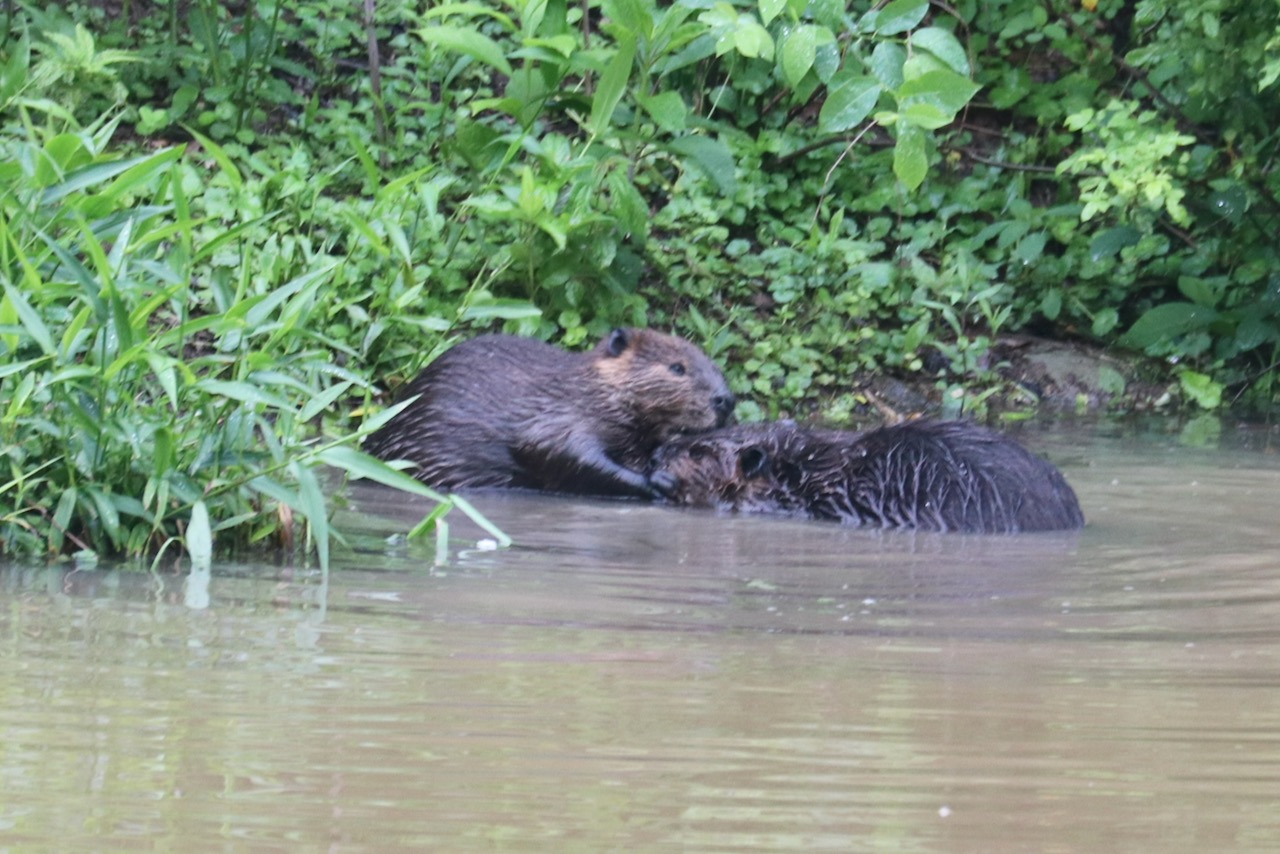

I have to think that the smaller animal (on shore) is a female, while the enormous dirigible is a male.


He gave me a direct stare, surely unaware that I had advocated on his behalf.


Eased into the water and swam as close as he dared.


And then, with a hugely satisfying kerPLOOOP, he clapped his flat tail against the water and dove deep.
I love that sound! It's like throwing a pumpkin in a pool! 

Though we'd had 3/4" of hard rain the night before, the stream crossings on the road were all absolutely fine. When the dam has been destroyed, they become impassable to foot traffic, unless you either want to wade barefoot or have the water come over your boot tops. But now, the dam holds back the flood, and that makes life easier for those who live on the road. I wonder if anyone else has noticed this but me?


Puddles on the road were another matter. We got through, but only just. Yes, that one is heart shaped. I love it because it's a frog factory, and because it keeps cars and many trucks from getting through. Less traffic is better, always. 


Curtis and I reached the Ironweed Festival grounds and looked back, having walked facing the light the whole way down. 


How beautiful it all is. I know that, now that the cattle are gone, it won't be open for very long. Already, groves of sycamores have started up, and they're taller than me. We must be ready for the change that inexorably comes. We have all had so much change of late. 

Oh, how the sky reflects in the creek. 


I can envision the day when this young sycamore will take my breath away. I hope I'm still here when it's big enough to do that.


I found Moneywort, in the primrose family (Lysimachia nummularia), growing in a wet ditch. I looked at the plant and turned it over in my hand and mind, and decided it was either a loosetrife or a primrose. I was happy to find it was a primrose! Love that plant taxonomy, now practically innate, kicking in as I puzzle. Carroll Williams' Plant Taxonomy course at Harvard was one of the best, most fun, and most useful I ever took. Plus, we drew!!


Down toward the end of the Ironweed (or Corn Salad) Festival Grounds, I found at least five pairs of song sparrows. I have a new appreciation for these birds, having raised one up from nothing this summer. I saw some fledglings about 10 days younger than mine, and smiled. I knew what their parents were dealing with. I was amazed how many breeding pairs were packed into that one old field. I envisioned setting up a study to map their territories, then discarded the idea. I study birds all the time, but not in that way. No netting, no banding, no blood samples. 


If song sparrows have a heaven, this is it.


Can you spot the phoebe in his element? 
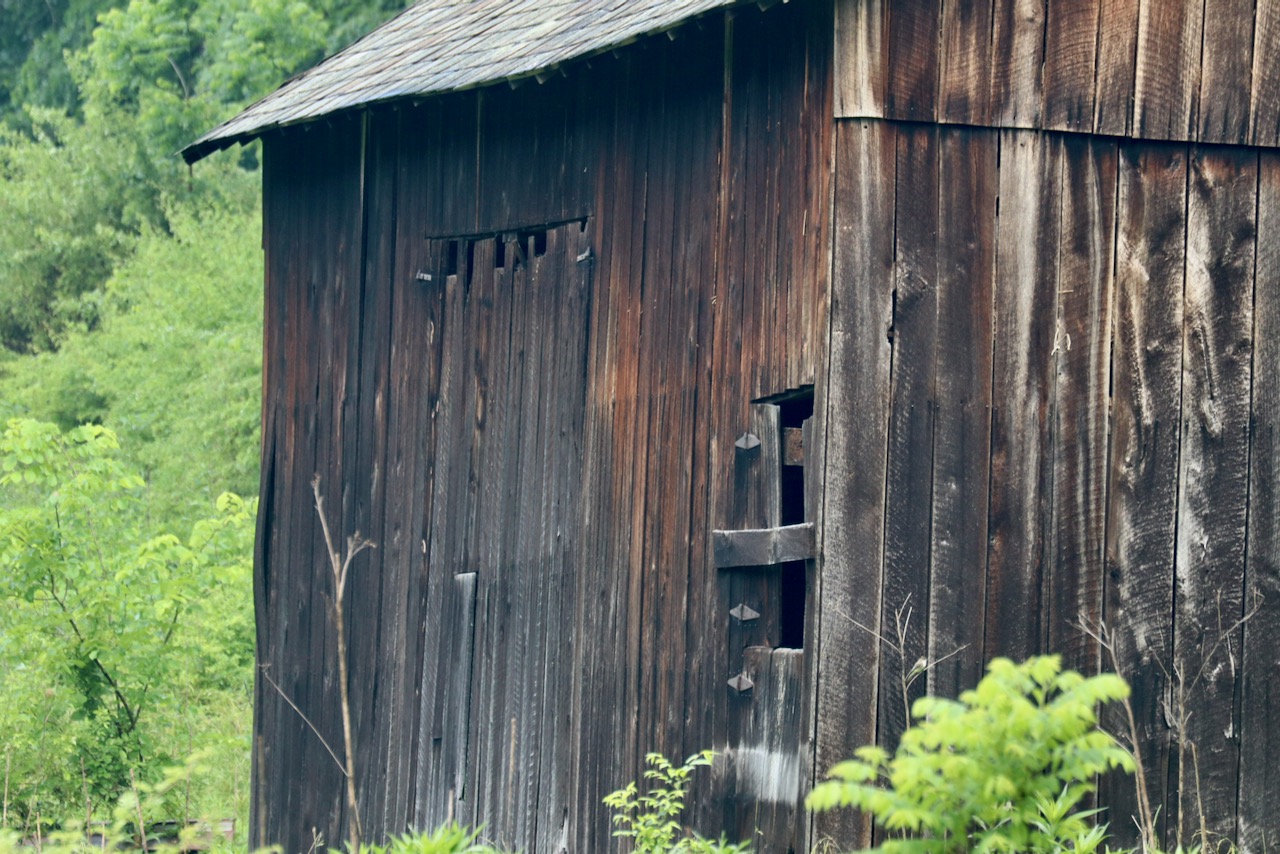

We got to the end of the line with a creek crossing my boots couldn't handle. This is the face Curtis gave me when I told him we had to turn back.
He'd have happily gone on for miles more.


As it is, it's a four-mile walk, round trip. I do it happily, though it's all downhill on the way down, and uphill going back. What helps is that the light is beautiful on the way back, because the sun is behind me.


It was a good day for large rodents.


Woodchucks, genus Marmota, are in the family Sciuridae, the squirrels. That makes sense. 

They are not so very different. Beavers (Castor canadensis) are in the family Castoridae, the rodent suborder Castorimorpha, along with gophers, kangaroo rats and pocket mice. That is one heck of a mouse.
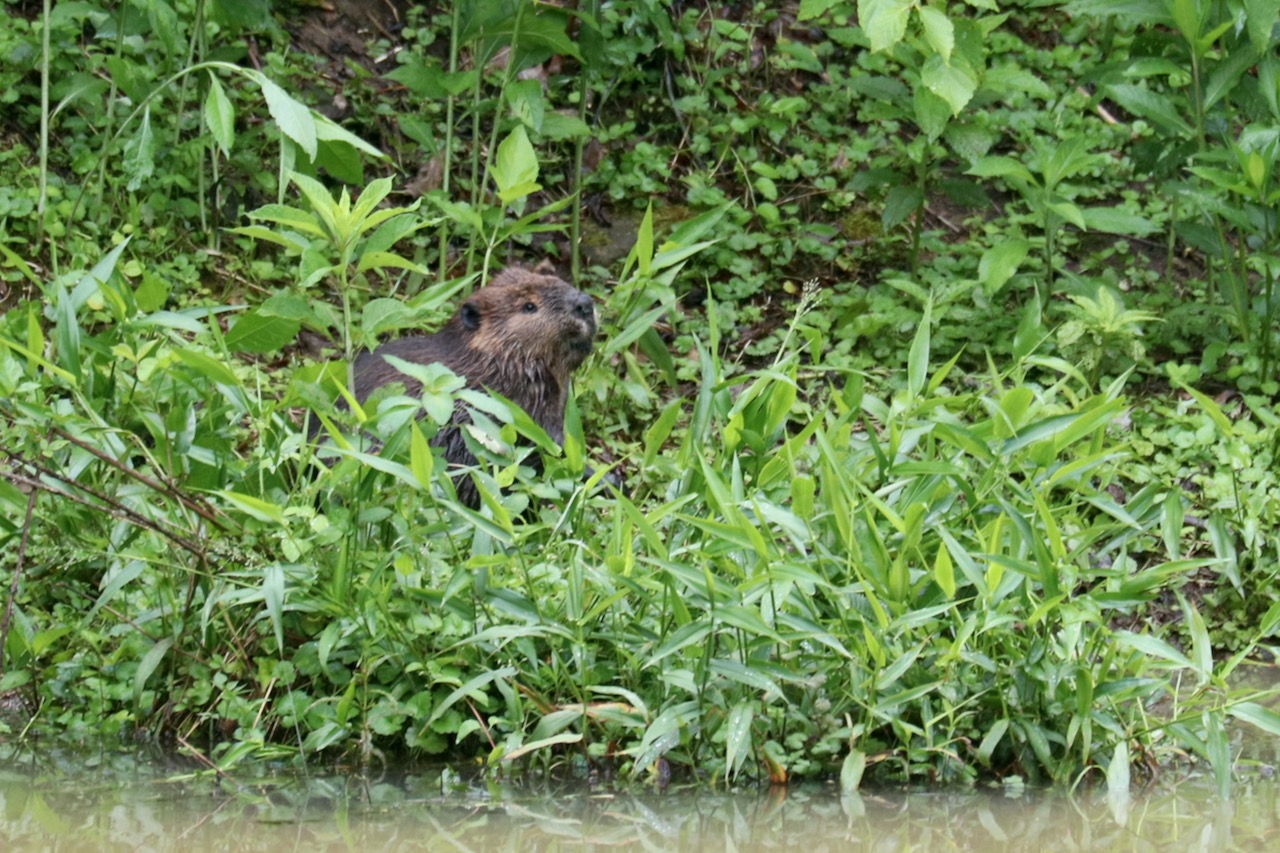

A mouse with skills. Here's its house, with an underwater entrance and chambers lined with fresh dry grass inside. 


Beavers, and the habitat they create, are miracles. I can't think of another animal that so profoundly impacts the surrounding habitat, in such delightful ways. Water is precious; water is life, and this pond bursts with both. I saw a newly-fledged belted kingfisher trying the waters on my next to last visit. Wood ducks almost always squeal and scurry away, taking a little piece of my anxious heart with them when they do. Into the arms of Dean's I go, and I come home changed for the better.


To Save a Beaver Pond

Sunday, June 21, 2020

33 comments
Sunday morning, June 14, 2020, as I rested in a chaise longue with a song sparrow on my shoulder and a fine cur-dog by my side, I got a call from the county wildlife officer, with whom I've been working to try to head off any more beaver killing or dam destruction. Through conversations with my area contacts, I had sleuthed the perpetrator's address and phone number, even gotten directions to his house. Wildlife Officer Donnelly used this information, stopping by the house and finding no one home, then following up with a call that morning. He told this man that he had taken a few calls concerning the beaver dam and his destruction of it. The gaswell tender admitted to hiring a backhoe contractor to take the dam out. This man claims to have a right of way to lay a gas pipeline through private property. He said that the first couple of times he destroyed the beaver dam (and the beavers, too), he failed to "get it dry enough" to lay the pipe. So he killed the beavers and ruined the habitat for nothing, but that didn't keep him from doing it twice.


His first assault in September 2014 reduced the proud beautiful pond to a stagnant mud puddle. I would see an enormous snapping turtle rising to breathe, then settling back down to the bottom. It was such a sickening, sad remnant of the glorious pond that once was there, and it broke my heart. Through that fall and winter I was disconsolate, and I didn't go down Dean's Fork as much as usual, because her crown jewel had been drained and the beavers shot, for no good reason I could understand. For nothing.

The next fall, beavers came back in and rebuilt. Here it is, gloriously refilling, in November 2015.


Then, by my contact's reports, the well operator used dynamite to blow up their work. In the fall of 2017, back this magnificent habitat went to a sad puddle. I can't express the dismay and anguish of coming upon such destruction, where once there was such beauty.

All of this was done against the landowner's express wishes. She wanted the beavers left in peace.  I was mad enough to spit bullets, on her behalf, on the behalf of all the creatures who depended on this lovely body of water in a place where water is precious. 


So you see why, when I found the pond refilled in the spring of 2020, in my view it was not if the beavers would be killed again, and their dam destroyed. It was merely a question of when. I was putting my money on September of 2020 for another attack, as much as I hated the thought. I'd seen and photographed this man's patterns.  I'd labeled and saved the photos, calling them up again for this post, in a bit of guerilla environmental journalism that I'm proud to be able to write. Documentation is important! Without these dates and photos, these destructive acts never happened.  

Over the years, I had raged and wept over this person's rampant disregard for the law and the landowner's rights. He was taking advantage of a person who couldn't police her own land.  But I'd never gotten anywhere trying to enlist the help of the county wildlife officer who preceded Ryan Donnelly.  Each time I broached the subject with him, I got the stock answer: "If I don't see him do it, I can't do anything about it."  This is the perennial law enforcement dodge for any crime that might happen in the future.  And for doing nothing at all to prevent it. You say this to make the complainant go away, to relieve you of the burden of having to bestir yourself. You say this, knowing that you'll never catch the person at it. He's free to do whatever he wants, and nobody can walk up to you and  make it your problem.

It was thoroughly frustrating. I would go away from those conversations feeling like some dumb bunny hugger who just loves beavers. I may love large wet rodents, but I am thoroughly invested not just in beavers, but in the habitat they create. Because it was never glaciated, the southeastern part of Ohio where I live has no natural bodies of water. Every lake or pond around here is man-made. Appalachian Ohio shares topography with West Virginia and Maryland, and neither of those have any natural lakes at all. In fact, in all of Ohio, there are but 100 natural lakes, and all of them are in the glaciated areas, mostly Summit, Portage and Geauga Counties.  Those of you from the Dakotas and Minnesota and upstate New York just stop and think about that for a moment. No natural ponds. No lakes without a cement dam. The artificial lakes we do have are ringed with houses and used up by recreation.  So we have very few places to go and see creatures like herons,  ducks, dragonflies, muskrats, turtles, or any of the myriad beautiful life forms that inhabit quiet ponds and lakes. Ours is a rich but aquatically impoverished biome. 
In Officer Donnelly, I had finally found an ally.  Here was someone who was willing to stick his neck out to try to protect this habitat. He listened to me, and made the pre-emptive strike that the beavers so desperately needed him to execute. My pounding on the well-tender's door would get me nowhere fast. Who am I? Some beaver-lovin' crackpot. Well. This beaver-hugger finally had the ear of someone with law enforcement authority.

In their conversation, Officer Donnelly reminded the well operator of something he surely knew but had chosen to ignore: that any activity conducted on someone else's land has to have express permission from the landowner. Having a pipeline right of way does not grant him tacit permission to  shoot or trap animals, much less destroy an entire wetland habitat. In a face-to-face conversation with the landowner, also facilitated by this beaver-lover, Officer Donnelly had established that the well operator never obtained permission to destroy the habitat in the two previous incidents. Now, it has become clear to the welltender that multiple people are watching and reporting his activity; law enforcement is watching; the landowner is upset, and the beavers are not to be killed nor their dam destroyed again. All that should make it a bit harder for him to just go ahead and do his thing come fall. He'll get a knock on his door if he does. He'd better hope it's not me. 

Now, he told Officer Donnelly,  he "doesn't have time to monkey with it"  and intends to leave it be. 


I cannot express how happy I was to hear this. I could hear the smile in Officer Donnelly's voice as he related their conversation. I was so happy I'd done the legwork, helped the wildlife officer do a pre-emptive strike, and finally had a county wildlife officer who cared enough to step in and do something about it. Finally, after agonizing over the fate of this habitat since 2014, I had some reassurance that, the next time I walk down Dean's Fork, there will be water, and wood ducks whistling, maybe a green heron or a kingfisher or two. And two beavers gliding back and forth across a big, deep pond of their own making. Perhaps it might have stayed that way without my asking, sleuthing, and making a pest of myself. But then again, perhaps not.  


Perhaps wasn't good enough for me. 

Opossum tracks in blessed water.


When You Don't Know

Monday, June 15, 2020

3 comments
We walked on down the Fork that evening and saw some really cool tracks in the fresh silt. Some were easy to identify, like these chipmunk prints, overlain by the small asterisks of white-footed mouse (to the left of the photo). 


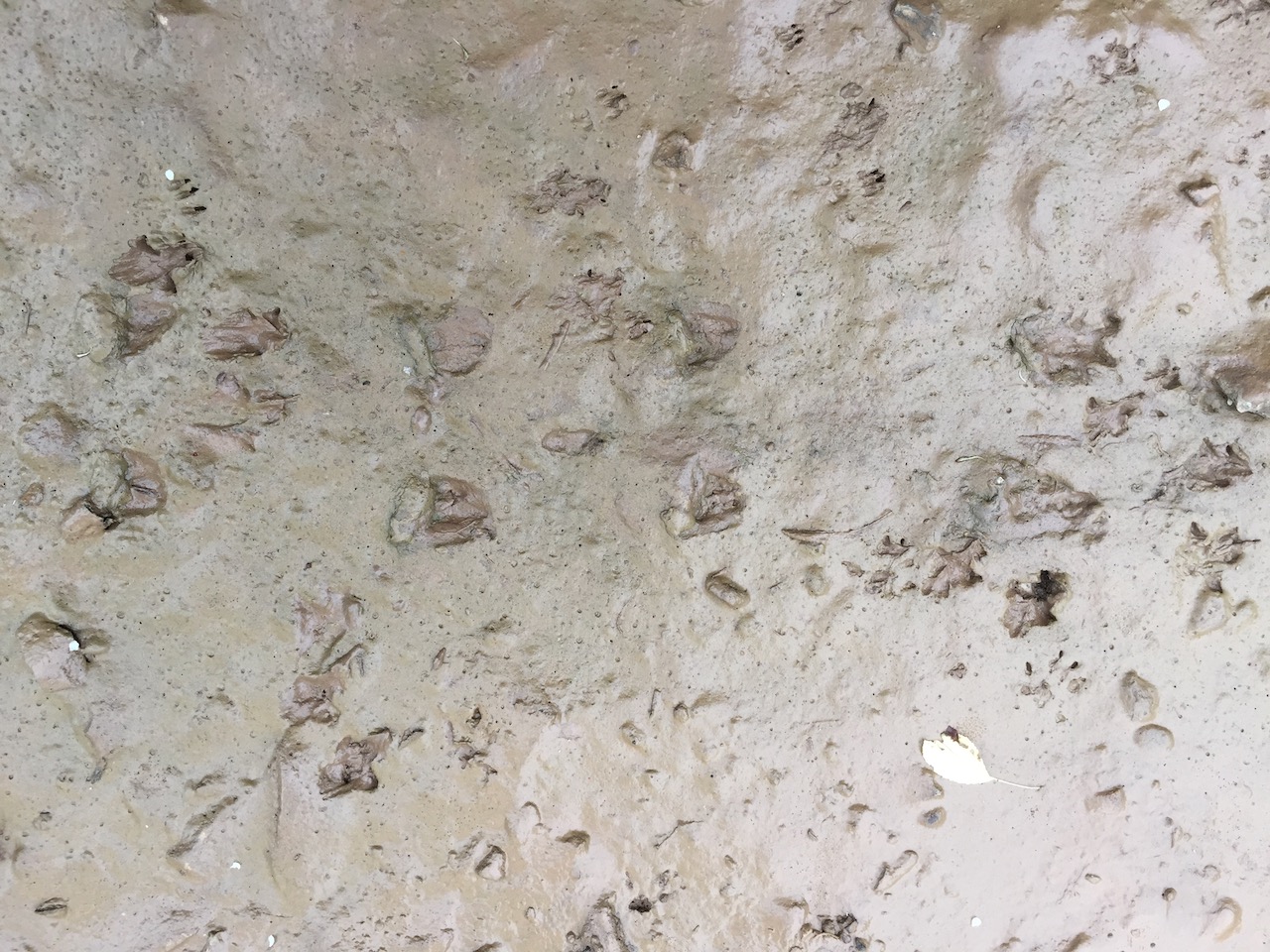
Some were just weird and I, who function as the Answer Chimp for so many people as regards natural history, had no idea what I was looking at. I thought this trail might have been made by a tiny whitetail fawn, because of the split in the foot, but it isn't quite perfect or right. Unless it was just born, and its feet were very soft and the hooves not hardened. I just don't know. It's not often that I don't know even a little something about a track. Hmm. Input welcome. The way they're in a double line bugs me, too. The creature has a little weight to it, from the ridge of mud at the back of the track. Just doesn't look like a box turtle...no claw punctures, no tail or shell drag. 


Closer:


For comparison, here are some for sure whitetail fawn prints, from June 2, 2018, right behind its mama's hoofprints. Maybe. Size is good. And if it was brand new, it was probably stumbling, which could account for the asymmetry of the track. So maybe I've got that one figured out. 


Then there was this amazing sinuous mark. The whole thing is about 3' long and 1 1/4" wide. 


The tiny marks along the side didn't look like feet to me. Thought it might be a baby turtle, but the "footprints" look too fine, too pointed, to me, and there isn't a tail drag mark. I decided it might have been made by a snake, navigating the puddle as it drank. (The imprint was about 1 1/4" wide).  Shila suggested that the fine marks might be the impressions made by the snake's ribs as it hitched through the silt, as that's how snakes move--by hitching along moving their ribs to walk their spine along their path. I loved that suggestion. 

But as always, I'm open to others.
 
Here's a closeup of the fine marks on either side. Halp.


These, I knew, were from a bird. By the size of the feet, the way it was walking, and where it was (smack in a LOWA territory), I thought it was probably a Louisiana waterthrush. 


This is a track I've never found on Dean's Fork. And there was only one! I'm virtually sure this is a river otter's front foot! I know you might be thinking raccoon, but coon fingers are much longer and thinner, with more prominent claws. Otter claws barely register, even in soft mud. They're just wee pinpricks here,  the toes are short, and the toe tips are kind of bulbous.


Alongside a deep rut full of water was this beautiful feather, from the breast or belly of a barred owl. I've found wing feathers, but I'd never found a barred owl body feather. That felt like a gift. The whole walk felt like a gift: the beaver pond, laboriously but seemingly magically restored; the beaver gliding in his watery realm. The tracks, known and unknown. Those beautiful kids walking ahead of me, because their legs are so much longer and they stop and kneel less than I do. The fact that they love taking these walks of discovery with their mama. 


Something I wanted to show them: the Corn Salad Festival. Astute blogfans will notice that this is taking place on the very grounds of the Ironweed Festival. You could have knocked me over with a barred owl belly feather, because the flowers of this weak-stemmed plant, rising over the grasstops, looked like snow in late May. 


Valerianella umbilicata, or Navel Corn Salad, likes the open moist meadow. The weird name comes from its fruit, which apparently resembles a navel. It is related to the popular salad green mache, but is a different (native) species. Need to check on the fruit as it develops. Here's a photo by Steven J. Baskauf from http://bioimages.vanderbilt.edu/baskauf/24344.htm


I guess it's kind of umbilical. Pretty cute. 


I've never seen it bloom in a blizzard like this, and I've been down here in late May a lot. Just goes to show you that one year is not like another. I brought Shila down two days later and the show was mostly all over. Talk about an ephemeral!


I love how it looks with the old bar gate and the black barn. Way back there, you can see just the roof of the chestnut gristmill that used to stand so proud.


It was all too beautiful. It looked like a Hudson River School painting, my beautiful kids lounging in this impossible landscape like the pastoral peasants. All it needed was a few cattle, but they haven't been in this pasture for several years. I miss them.


Dean's Fork is always changing, evolving, being changed by human activity. Nothing is the same on my walks, no matter how many times I walk it. Seasons change, plants come into and out of bloom, birds set up territory, breed and leave, and I am dazzled by it all, witness to something ancient and new, all at once. 


Return of the Peepers

Tuesday, April 25, 2017

10 comments
I have made my way down to Dean's Fork, tracking animals all the way. As I hit the dirt road I hear from upstream an enormous chorus of spring peepers, so many that I can hardly believe my ears. So instead of turning downstream, as I have for the last six months, I head up. 


I head toward the beaver pond, which had all but dried up when I saw it last fall. 

And what a sight met my wondering eyes. The pond was full. As full as I'd ever seen it. 


The dam had been completely rebuilt to its original 2009 height, with an interesting angle to it that I'd not seen before. I stood and gaped. 


I let my eyes run over that miraculous expanse of water. Sweet, deep, muddy water. 
And I heard a splash and gurgle.


And the architect of it all, the higher intelligence I so adore, swam slowly toward me. 


I stood behind some trees, trying to melt into them, but it was clear he saw me.  His head was high. His nose was searching for my scent.


And it was equally clear he did not fear me. Twice he made a circuit of the pond, passing close, looking right at me.


It was an honor I neither expected nor deserved, but I gave thanks just the same.


And whispered to him not to be so trusting of men.

The beaver was back. The beaver? I don't know. A beaver was back. And the dam had been completely restored. I could not believe it.

 How I wish I could impart just a molecule of the wonder and joy Dean's Fork brings me, to the soulless loser who destroyed that beaver dam.  But I know that there is no redemption for one so callous. You might as well appeal to a tornado to spare something in its path.  And, I'm told by our wildlife officer, there's no legal recourse when no law enforcement agent is present to witness his vandalism. To see it all come back despite his worst attempt has been a fragile, trembling victory. I will never again be able to visit without a preamble of anguish, for wondering whether he'd have gotten to it first.  Loving this place as deeply as I do, knowing that dreck-for-brains is bent on its destruction, is like living with a big old boot hanging by a frayed thread over your head, ready to drop at any time.

Extend that metaphor, now, to include the men in white pickups; the dump trucks and tankers and flatbeds strapped tight with pipe that now hurtle along our winding roads: the oil and gas development going on in our shale-rich region. Last summer, all Dean's Fork was strung with orange spaghetti--extension cords running to seismic testing instrumentation for its entire 3.5 mile length. For all I know, they've marked off some or all of it for destruction and drilling. I suppose I could find out, but I don't want to know. At this point, knowing might kill me. I just don't want to know. 

I've spent four solid days writing this series of posts. Along with "They're Drilling My Forest," they have been among the most difficult I've ever had to write.  But I have to write them. I won't get another deep breath if I don't. The story of the Dean's Fork beaver pond has become a song cycle for me. I feel I have to tell it all--the beautiful, the magical, the mystical and the horrible--to try to convey what this place means to me. What it means to live in tired old, lovely old, beat up old Appalachian Ohio at the height of its seventh oil exploration boom. What it means to be deeply invested in a place whose inestimable beauty and diversity might not survive the new and more avid attentions of the men in white trucks. Compared to the destructive power of Protege Energy, the creep who blew up this beaver dam is a mosquito.

Listen to those wood thrushes sing, and replace that with the roar of a drill rig. That's what we're up against.

 My complex relationship with this place has been an object lesson to cherish the moment and the setting and the people around me right now, for I can never know when all will be brought to nothing. I have no steadying constant in my life I can rely on to sustain me save the love of the land. One can only draw so much strength from within. There must be input, and I get that from the land.

Is it any wonder I sing out day after day, season after season, about all that is still here, alive, thriving, and good? 

I sing like a goddamned bird.

 Like a heavenly chorus of spring peepers. Who better to celebrate the return of light and life, leaf and love, and water, life-giving water, than these permeable beings** of water, mud and air?


**A poem given to me by my lovely and loving friend Donna. I've borrowed Ms. Tibbett's word, because it's perfect. As is this poem, perfect for this post, which is all about wonder at the fact that, despite humanity's best efforts to crush them, spring peepers and beavers are

Still Here Softened by a glass or two of Cabernet, I left my neighbors’ crowded table, our bursts of laughter, and dour conversation about man and his dangerous antics in our only world, and went to the kitchen for more bread. There, through the window, a sweep of damp air and wild spring calls of peepers and wood frogs rushed in like the Holy Ghost and made me pause. Their piercing chorus of voices mixed into such a deep soup of sound that one frog was indistinguishable from another. And for one long moment I was held there in the world’s big hands, and everything that mattered was evening with its early, scattered stars, the fragile smell of daffodils and boggy water, and the mating calls of a population of those finely-tuned, permeable animals (indicators of the Earth’s well-being) so much older than we are, that have survived ice ages and the shifting of continental plates, but are now disappearing — though still here thriving in woods beyond my neighbor’s lawn in this hollow where we are all clinging to the slippery edge of wildness, where I was allowed a rush of such sweetness and grief, those fraternal twins who are born in us again and again, though perhaps not forever, singing whether or not we listen. Elizabeth Tibbetts First published in the Beloit Poetry Journal As printed in Science and Conservation of Vernal Pools in Northeastern North America: Ecology and Conservation of Seasonal Wetlands in Northeastern North America, by Aram J. K. Calhoun, August 2007
[Back to Top]