Everybody loves a big dew-covered spiderweb, right? But does everyone love the artist who makes those? Here's Neoscona crucifera, the Arboreal or Spotted Orbweaver. I'd say they're one of my favorite spiders, but I have so many. Right now is a wonderful time to go out and find Neosconas. They hang like little plums from eaves and, in this case, sumac fruit clusters. This one cleverly hides in the sumac when she's not working in her web, which she does at night. By morning, she may eat the entire web and recycle the silk proteins to make another one this evening.
Those of you who follow me on Instagram and Facebook know that I'm mad for the sit and wait predators, the ones who hide in flowers waiting to ambush pollinators. Spiders have to eat, too! This white-banded crab spider Misumenoides formosipes has caught herself a nice fly.
I visited a pair of these crab spiders (well, both were females) on a tall thistle plant in the orchard this fall, for day after blissful day, and I loved to see where they were and what they were up to each morning. These patient predators wait hour after hour for pollinators to visit their flowers. When a flower would fade they'd move to a fresh one.
Look at those arms held wide to give a bee a big hug! Aww!
They also come in French vanilla. Not sure what this spider thought she was gonna catch on a spent thistle. Maybe a goldfinch?
If you look really closely at these (as in, click on the photo), you can see a ridge just below the eyes that looks like a Snidely Whiplash mustache. That's the white band that differentiates it from the goldenrod crab spider.
Who doesn't love a black and yellow argiope, or garden spider? Argiope aurantia is just a spectacular spider. I love the zigzag landing strip they weave in the web just below where they rest all day.
I don't see near enough of these spiders for all the habitat that's here.
Side view, very fetching as well. When you see a big spider like this, you can bet it's a female. Male garden spiders are minuscule by comparison. That's true of almost all spiders. The females are the ones who get your attention.
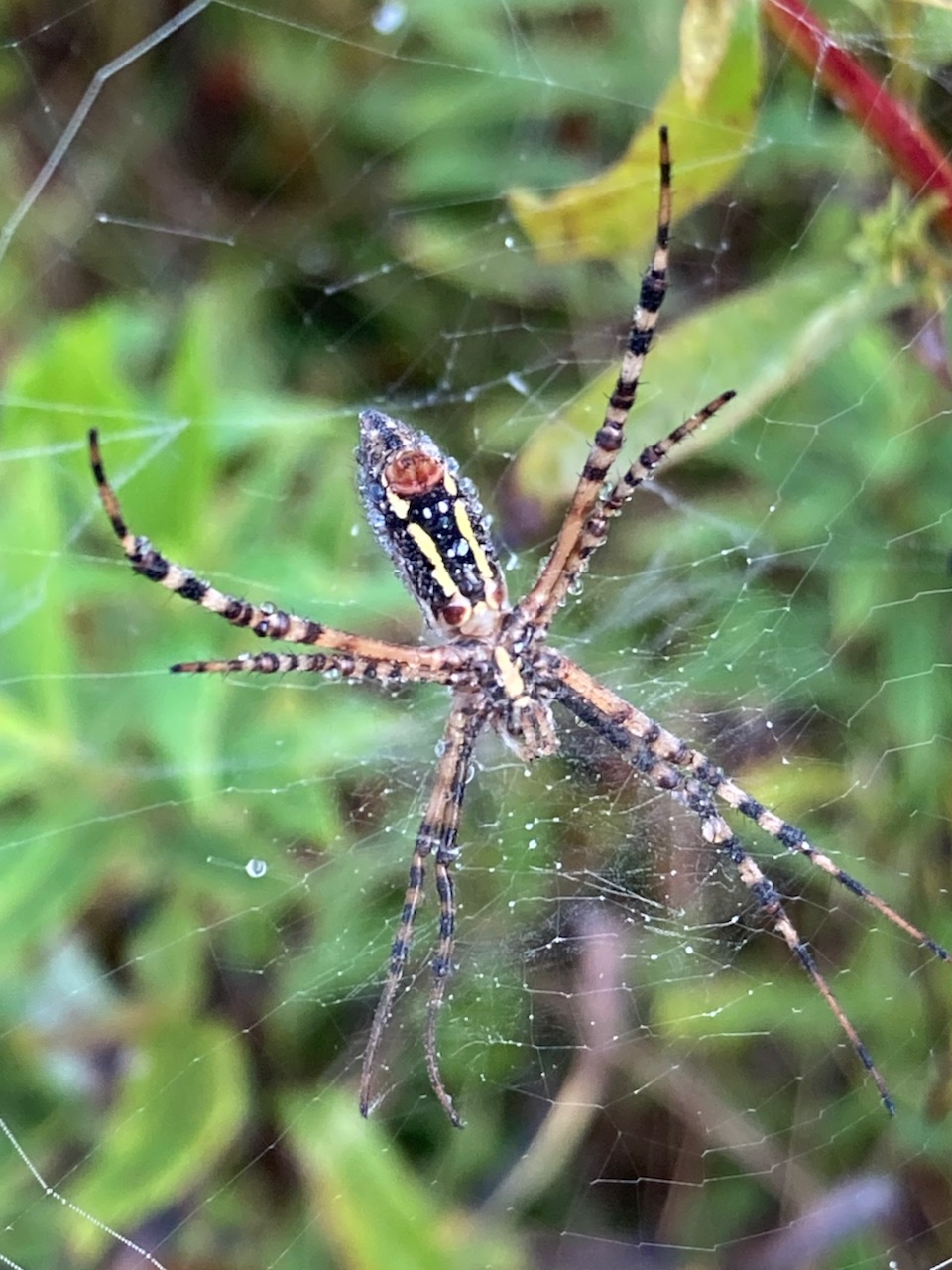
This was a lifer for me this year: the Banded Garden Spider, Argiope trifasciata.
It weaves a beautiful web, and is smaller, thinner and more silvery than the more common black and yellow argiope.
It has a very fancy reverse.
I was delighted to add this creature to my sanctuary list, and to my rapidly growing iNaturalist sightings board. Ooooh I love that app. It really encourages me to learn my spiders and insects. And having the list of them with their Latin names at the touch of a finger on my iPhone helps me learn those lovely names, too.
Of course, iNaturalist will crunch away at your photo and identify the subject, which seems too darned easy to me! I like my books! and still refer to them. But man, it's handy and such a thrill to look back over your sightings and have the date, your notes, and the exact location where you saw them. This app, geared as it is to iPhone photography, suits me to a T. And because so many people are feeding in their photos now, the identification algorithms have become infinitely more robust than they were when I first became a user three years ago. Durn thing can tell a fall bay-breasted warbler from a fall blackpoll! My first post was a road-killed porcupine I found, out of range, in extreme western Maryland. That was October 2, 2017. Three years and 226 posts later, I'm learning my bugs and spiders, and about to celebrate my third iNat anniversary. I believe this app could change the world, empowering everyone to identify and learn about the natural world around them.

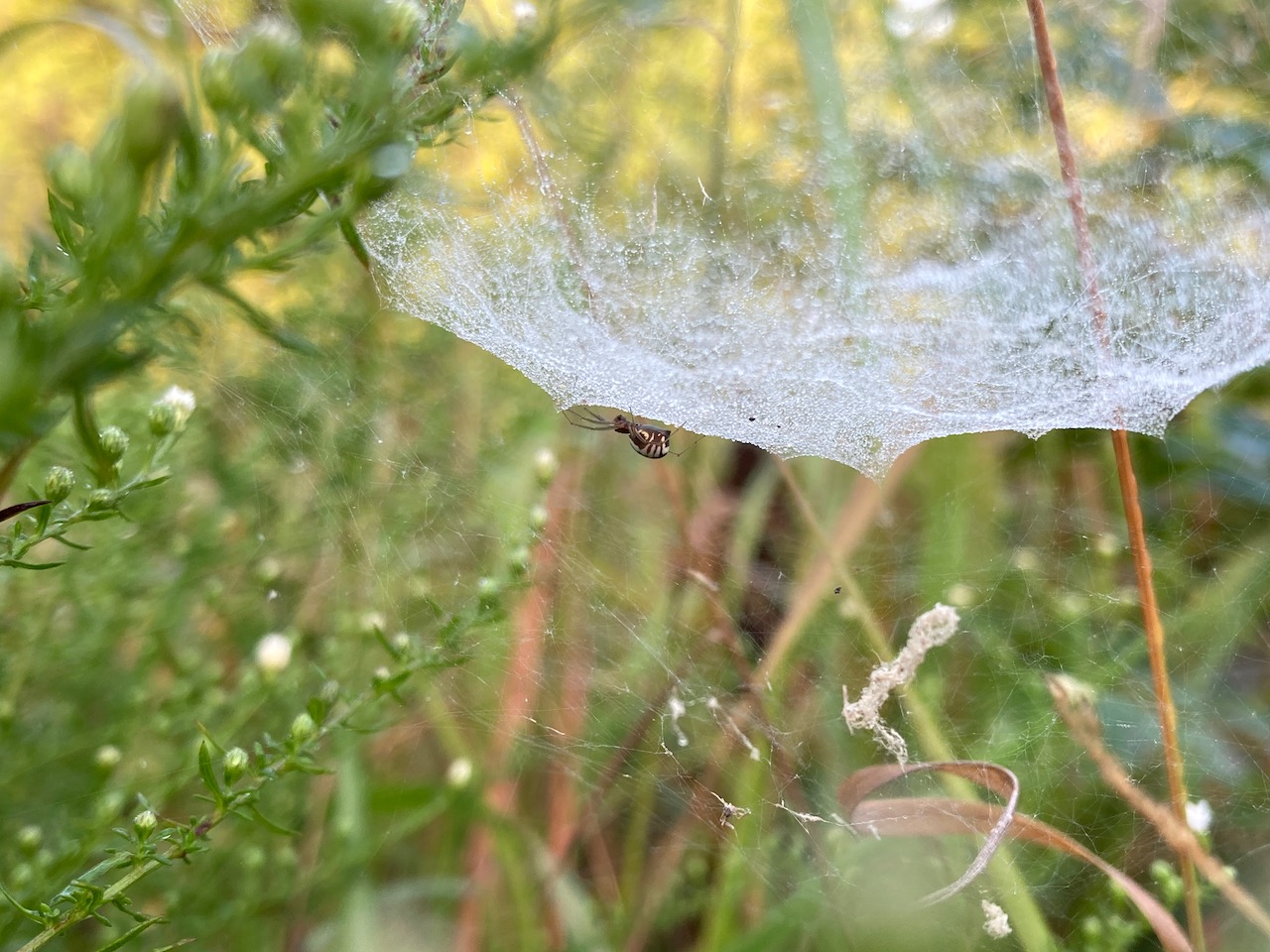
As delighted as I was to get those big orbweavers, this one eluded me for a long time. This is the work of the bowl-and-doily spider, Frontinella pyramitela. Isn't that the most gorgeous Latin name? You see these webs by the thousands in a good backlit morning field, frosted with dew, in mid-September. Usually there are two tiers, the bowl, and the diaphanous doily beneath it.
The spider is in this photo, just really hard to see. That's because it hides under the top bowl (above the doily), and BITES insects THROUGH THE WEB when they fall into the bowl! Isn't that cool? If you click on this photo and blow it up, you can see her clinging to the bottom of the bowl, left of center.
Here's one that's more easily visible, above the web, crawling up. Look at the sucked-out husks of little moths, caught in the doily! This spider is a bloodthirsty (well, hemolymph thirsty) killer!
I tried for days to get a better photo of the bowl and doily spider. It's just so tiny and so hard to shoot, because it hides under the gauzy web and swiftly climbs to a hiding place if you disturb it.
Finally, persistance was rewarded. I found a beautiful big female amidst the budding heath aster. Oh yes!
And with the fabulous telephoto option on the SE, I finally got an acceptable shot of the beautiful bowl-and-doily spider.
Death to tiny moths, and huzzah! This fierce little warrior leaves carcasses strewn in her wake.
Another new spider for me was the White Micrathena, Micrathena mitrata. I found this lovely female in my garage, so I moved her outdoors for a better life. Many spiders prefer to be in buildings; my sense was that this isn't one of them.
What a looker, what a little jewel. As I have learned more about and come to admire spiders so much, my fear of them has vanished. They are by and large harmless. I mean, I don't pick up black widows, and I'm glad I live (mostly) out of range of the brown recluse, but I'm not afraid to let a little thing like this hitch a ride on my finger to a better spot.
This is another one for which it's tough to get a decent photo. The Pennsylvania Grass Spider, Agelenopsis pennsylvanica, is a hulking beast that spreads a web of unsticky silk a foot or more across a meadow floor. It waits in a neat tunnel for the vibrations of an insect walking across the silk, then dashes out with lightning speed to snag it. For this species, iNaturalist got me to the grass spider genus, Agelenopsis, and I hit my beautiful Common Spiders of North America book by Rich Bradley to narrow in on the species. The plates in that book are to die for. Highly recommended.

I'll save one of the coolest looking spiders for last. I'm really happy with these photos of a Spined Micrathena Micrathena gracilis, which is a very common spider which is very hard to photograph. The problem is it hangs in the middle of paths, waiting to festoon me with a faceful of silk, and there is nothing for the iPhone SE to focus on! So I'm forced to put my finger there so the camera can see to focus, like this...
and then I move my finger out of the frame and praaaay it doesn't choose to refocus on the goldenrod behind...and once in a blue moon the focus holds and I get something like THIS which makes my heart swell, with the blue and gold bokeh bits behind
and then if I'm super lucky I can zoom the SE up and get an actual photo of the coolest lookin' little spidey in the hood. Big ol' silk factory in that spiny abdomen, the better to drape Zick with!
I hope you've enjoyed this foray down the webby paths of Indigo Hill, and I hope you'll seek out some spiders of your own, and try your hand at spidertography, and check out iNaturalist, which will teach you so much. And maybe then you can identify your own bugs and beasties! Yes! That was a hint! ha ha !!












Saturday, September 26, 2020
10 comments