Background Switcher (Hidden)

Showing posts with label Zickefoose art. Show all posts

It's an Honor to Be Here

Sunday, December 17, 2023

0 comments

 Last summer, I was invited to submit pieces for consideration for a show of natural history art by Ohioans
to be held at the Decorative Arts Center of Ohio in Lancaster. Although I very rarely show my work any more, I was more than happy to get together some favorites, old and new, to submit. To my surprise, all five were selected for the show by curators Maria Burke and Madeline Beaumier. Maria herself is a sculptor and exhibit preparer, and the artistry both curators brought to the exhibit was evident everywhere.


photo by Jessica Vaughan

I think it only sank in on me what an honor it was to be there when I walked in at the opening September 29 and saw the company my bird paintings were keeping. Such a big, beautiful, huge-hearted show! 

Artists were coming at natural history subjects from all directions and media: photography, painting and sculpture; interpretive and photorealistic. 


                                                 photo giclee of OSU specimens by Ardine Nelson


I met my friend and soon-to-be BWD cover artist Ann Geise, and was delighted to find our works displayed together. Two of Ann's lepidopteran works  hang above my white-breasted nuthatch developmental painting, which has neither been shown nor published before.


BWD Magazine Editor Jessica Vaughan and I perused the exhibit together. What a treat to see such talent coming our of our beloved home state!


The Decorative Arts Center of Ohio is a beautiful destination nestled in Lancaster's historic district.
You won't want to miss this beautifully curated and conceived show of Ohio artists, each interpreting nature in their own way. 


To top it off, DACO engaged John Luchin of Classic Interactions, Inc. to create a video of each artist's personal statement and vision. We artists sent him our images, videos and recorded narrative tracts, and John produced and tied them all together beautifully. The videos can be accessed on iPads stationed in each room of the show. Here's mine:


Here's what you need to know, but you'll have to get there before December ends! Show closes Dec. 31.


As I drove home from the opening, I felt very lucky to have been included in this review of some of Ohio's finest natural history artists. 


A full moon rose over Main Street as I drove home, feeling honored and thankful.


Cerulean Homemaker

Monday, May 30, 2022

9 comments


It seems I've just returned from a week in West Virginia, and yet I look at the calendar and it's been almost a month. Such is my life during Vegetation Time, when all that free time I fritter away doing things like editing, blogging, writing and painting gets sucked up in Vegetation Management. Oh, there's plenty of that all winter long, but it's more like upper body workouts, and not as horribly pressing. In southeast Ohio in May, you manage your vegetation or smother under it.

People have been asking me about No Mow May. "Is it bad to mow my lawn during No Mow May?"  The whole concept makes me laugh in a snorty way. Whoever came up with that doesn't live in southeast Ohio. Maybe doesn't even have a yard to maintain at all. I've thrown a belt and broken a pulley mowing my paths this spring. Yesterday I mowed a path that I had inadvertently skipped--it went about three weeks without mowing. Aaaack. I barely got through it; the rider mower was gagging and growling and burping on grass.  Then, just as I was finishing up three hours of path mowing, I threw a belt again. What fun. It takes my beloved neighbors Bill and Kathy and me to get the damn deck off, belt replaced, and back on the mower. Every time.  I'm all for not mowing. But around here, you'd better have a tractor and a brush hog ready if you quit for the month of May. Honestly, what could those No Mow May folks have been thinking? 


Kathy and Bill, saving my bacon again, and again, and again.
I am in the market for a new rider lawnmower. I need one that doesn't throw
belts like a Chippendale dancer, and doesn't give me PTSD
every dang time I climb on it.


Anyway, I'm not here primarily to kvetch about having to mow. I'm here to celebrate West Virginia, ancestral home of the Zickefooses, West Virginia University, ramps, and kick a-s birds. I celebrated my 20th year of involvement with the New River Birding and Nature Festival this spring by committing to an entire week of guiding. It wasn't nothing, getting up at 5 every morning, leading a 7-hour field trip, then getting up and doing it again the next morning, and the next...

But oh, the places we went, and the things we saw! 


I will now share some glorious things in a random way. 

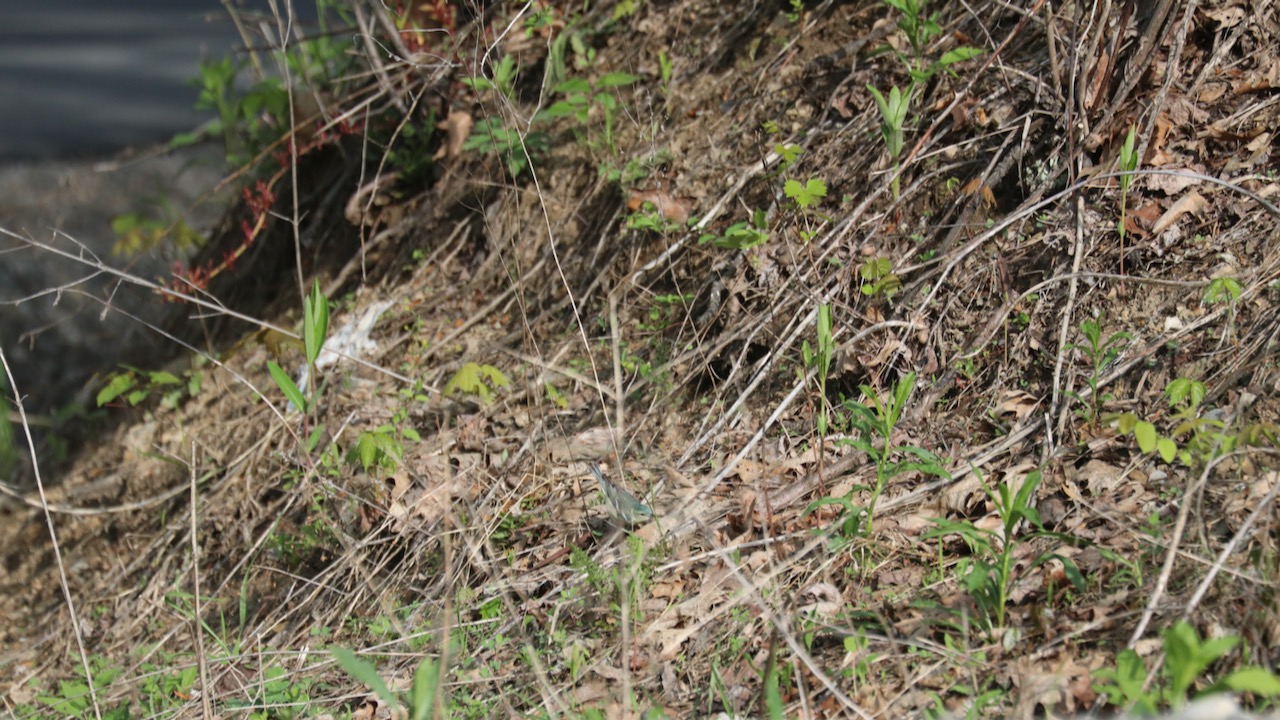
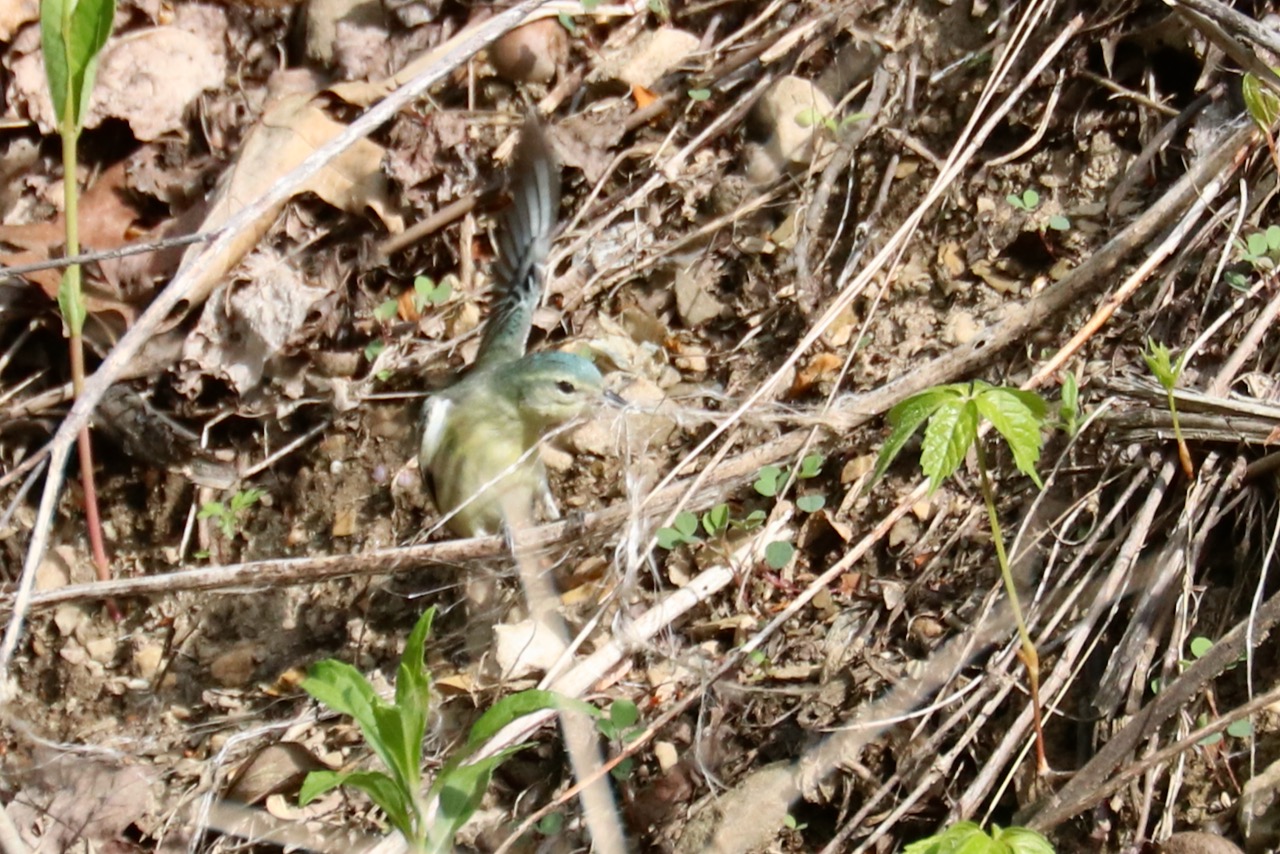
One of the things I love about our field trips is that they are entirely bird-driven. If we find a bird, or birds, we stop dead and hang out for an hour or more, just taking in what the birds give us. Such was this moment with a female cerulean warbler we found visiting a junky-looking pile of winter stems on a Fayetteville road bank. 

You'll want to click on the photos to see her.


Birds are natural botanists and artisans. Like me in an art store, they know what materials they're looking for, and when they find the right stuff, they'll keep coming back. This little beauty was stripping papery fibers, perhaps from a winter milkweed or goldenrod stem.


It took some effort, and she'd throw a wing out and flutter as she pulled, which is what drew our attention.


It didn't take her long to get a billful, and she'd bear that off into a tall maple where, unseen, she was weaving a masterpiece.


We were charmed beyond delirium.


The female cerulean warbler has a dusty aqua/cornsilk yellow/dove gray color combination you just don't see on any other bird. She owns that muted color scheme, wears it beautifully. Please see her crown. Heavenly blue!


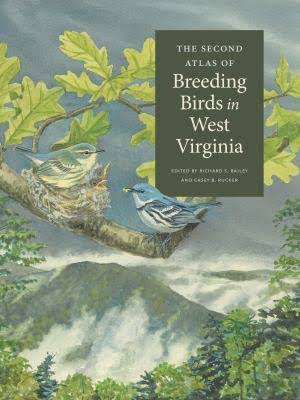
Seeing this little miracle taking place before our astonished eyes was such a full-circle moment for me. Years ago, I received a commission to paint nesting cerulean warblers in a West Virginia mountain setting for the WV Breeding Bird Atlas. I watched cerulean warblers and shot some landscapes for reference on this very same road, with my same WV friends. And the great big beautiful vastly informative and carefully researched book is out, and it's SO good, and I'm so proud to have decorated the cover. You can find out more at https://www.psupress.org/books/titles/978-0-271-08980-5.html


It almost always rains for part of the festival, and I really wanted to convey a sense of West Virginia's mist-shrouded mountains. 

Taken from the New River Gorge bridge early one morning during this year's festival...wonder where I got the inspiration for the painting?


The little cerulean warbler didn't know any of this stuff that was swirling around through my head. She had work to do. And so she kept tugging and pulling and gathering, and we kept smiling. 


All this on a trashy-looking mountain road bank, that just happened to have the right kind of bark for the nest of one of our most beautiful and imperiled warblers. 


My First Wild Penguins! Betty's Bay, South Africa

Sunday, January 3, 2016

8 comments
African black oystercatcher, Stony Point, Betty's Bay

Years ago, when I lived in Connecticut, I was commissioned to create a sketchbook of penguins for  the Mystic Aquarium in Mystic Seaport. My friend Ed Ricciuti, a writer, recommended me to an exhibit company that was contracted by the Aquariium. It was the perfect marriage of job and artist. I got to go to Mystic Aquarium and draw their flock of 28 beautiful African black-footed penguins from life. I researched their natural history and made drawings that illustrated aspects of their life, from behavior, breeding and feeding to the threats posed by offshore oil spills. Black-footed penguin populations have decreased 70% in the last ten years, thanks to habitat loss, oil spills, and baitfish collapses due to overfishing. Ack.

Far more than just displaying penguins, Mystic Aquarium helps the birds in South Africa, as well. Each year, its staff travels to South Africa to work with wild penguins and the South African Foundation for the Conservation of Coastal Birds. Mystic Aquarium staff rehabilitates abandoned penguin chicks, oiled birds and helps bolster wild chicks--taking in weak or sick chicks and saving each precious one for further breeding and/or repatriation to the wild.

I was so proud to contribute my artwork to this display, which includes underwater viewing ports and a big station where you can watch these merry little birds torpedoing around in streams of silver bubbles.


from Mystic Aquarium's website

from Mystic Aquarium's website

Photo by Karen Kemp. My sweet grand-nephews Will and Max for scale!

My drawings were blown up a zillion percent and baked onto a score of enamel panels that line the exhibit. This was in the late 1980's, and amazingly enough, the panels still stand and look great today, through 25 years of rain, snow and shine.

So it was with more than the ordinary amount of excitement that I approached a colony of black-footed penguins in the wild. I had had the privilege of spending many hours with them in captivity. I'd even held a few. It's like holding a live football or a small tuna; they're like India rubber, dense and hard and very, very strong.

The first thing I saw was not a penguin but a rock hyrax, or dassie, as they're called locally. OMGGG!!!


These rotundly adorable animals (about the size of a Scottie) live in rockpiles and feed on whatever vegetation they can find. I was NOT expecting hyraxes. Hyraces. Dassies. These.


Hyraxes find their closest living relatives not in rabbits or rodents but manatees and elephants. They are a miracle of evolution.


And this one reminded me of a certain dearly missed Side of Bacon, baking in the sun. I know. You don't go down and kiss the brisket of a wild hyrax. But oh, I could have.


Soon enough, the penguins materialized before us. I was so thrilled to see a thriving colony full of older juveniles, still begging from their parents. The steel-blue one is a juvenile; the black one its parent.


This juvenile is in the process of molting out of its first natal (baby) down, and into its first juvenal plumage. They look like fairy penguins at this stage, but they're much too large. And those are in Australia and New Zealand, anyhoo.


The black-footed penguins nest under rocks and vegetation and in burrows they dig with their feet and bills. This colony happens to be just outside a luxury housing development; it's in a band between the homes and the sea.

Whosoever lives amongst penguins needs to develop olfactory fatigue, and quickly, for they are the stankiest of birds. They are as stanky as they are adorable and endearing. That's pretty stanky.


And there are lots of people living amongst penguins here. I had to hand it to them for putting up with the neighbors. Not only do they stink to high heaven; they bray, too, which accounts for their common name of "jackass penguin." Perhaps the fact that they're not in residence year round helps. I'd love to think that the homeowners take pride in their diminutive endangered neighbors.

The gale of that morning was still raging; the cold ocean currents hitting warmer water make for some wild weather around the Cape. Even with fresh air racing through our lungs, the stench of fish emulsion was remarkable. We remarked on it, a lot.


Penguins radiate excess heat via these bare patches over their eyes. A pink penguin is either very excited or too hot, as this basking fellow was becoming. 

I couldn't believe I was finally seeing wild penguins. I never thought I'd make it to a penguin colony, but I was very glad that I didn't have to cross the ocean to get to Antarctica to accomplish it. A bit of a landlubber, I'll admit.

More on Stony Point Penguin Colony in the next installment!


Passenger Pigeon Print!

Thursday, September 11, 2014

5 comments

As an artist who enjoys bringing extinct species to life, I have a fossil bone to pick. What I want to know is this. Why do most reconstructions of extinct creatures wind up looking like this? From a recent USA Today article about what must've been a bitchin' toothed albatross:


I should qualify that question. I want to know why these paleontologists don't get ahold of someone who knows how to draw lively images of related living species. (Why don't they call me??)  I actually know why most reconstructions wind up looking spare and unimaginative, sterile and tentative. It's because many artists simply clutch when asked to draw something out of their imaginations, something they can't copy from a photo. I would wager a bet that this person had never drawn an albatross. Maybe they don't even know how to draw birds. In my opinion, freely and rashly given, there's nothing right about this drawing, from the bulbous, football-shaped body to the feet to the wing structure to the structure, insertion and feel of the head, neck and bill. The expression is blank. Its eye is dead. There's nothing believable going on here, artistically or biologically. I would have LOVED to have a chance to draw this bird. 

Unfortunately, you see the same sterile renderings and blank, boring backgrounds in reconstructions of many extinct taxa: mammals, dinosaurs. It's like they're all drawn by the same person. And I think it's because the artists are clutching. They're not relying on living creatures as their source of reference, aren't bothering to figure out what their habitat might have looked like, so they come up with these tentative, lifeless images.

Here's what you do when you're drawing an extinct bird. You go off what you know of its nearest living relatives. Granted, painting a passenger pigeon is a LOT easier than painting a Teratornis, because there exist some beautiful  photos of living passenger pigeons, and lots of mounted specimens.

Still and all, I wanted to create a scene that hadn't been painted before: a family with a half-grown nestling. I'd show the male's gorgeous coloration off to best advantage, in a classic three-quarters pose, but I'd paint Mom and baby in poses that I know mourning doves assume, that I've drawn many times from living birds. I'd give them dancing sunlit beech leaves as a backdrop, put some color and pizzaz in the picture.


Three of Billions: Passenger Pigeons at the Nest
by Julie Zickefoose
Image size: 9" x 12"
Fits standard 14" x 18" frame when matted.

 Though I'd drawn them, I'd never painted passenger pigeons until Editor/Co-Publisher Bill 
Thompson III asked me to do a Bird Watcher's Digest cover to commemorate the 100th anniversary of the passenger pigeon's extinction, September 1, 2014. It's a story that's been told again and again. Martha, the last remaining passenger pigeon, passed away at the Cincinnati Zoo that day. My dad was two years old. It was a sad, sad day for biodiversity; a sad period, during which man did everything in his power to exterminate a magnificent torpedo of a bird, a bird that operated as a many-celled organism in vast migratory flocks that blotted out the sun. 

 In reading essays and treatises on the passenger pigeon, written in observance of the 100th anniversary of its extirpation, I’m struck by the fact that almost all seem to dwell on the mechanism, the process of its extinction. Perhaps that’s because that’s all we really know of this singular bird. It’s as if we were collectively asleep until it hit us that the thundering flocks were suddenly no more. I wanted to paint a tribute to the passenger pigeon as it lived, not as it died. This is a portrait of its domestic life, the deep investment of a pair in their single squab. I have never seen a painting that depicts a nestling, and I wanted to do that, to draw on what I know of mourning doves to imbue this image with life and feeling. I've raised a few mourning doves, watched them with their parents at the nest, and I wanted to convey the affectionate nature of pigeons in the painting.

Could there have been two squabs in that nest, the story might have ended differently. But the passenger pigeon, like its single child, was one of a kind, with an ancient reproductive strategy. Swamping any potential predators with simultaneous colonial nesting worked fine for raccoons and hawks. But the master predator, ready and able to ship traincars full of pigeons to waiting markets, was nothing the passenger pigeon had faced in its evolutionary history. All these thoughts ran through my head as I mixed the gorgeous peach and slate colors of their feathers, and wished them back to life, if only on a sheet of watercolor paper.

Three of Billions: Passenger Pigeons at the Nest is a digital proof made right here in Marietta, Ohio, at Richardson Printing, using state-of-the-art equipment with UV inks on Strathmore Linen archival paper. I got to breathe over Printer Bob's shoulder as he tweaked the color, and though Richardson Printing knows I'm notoriously fussy about color, I'm really happy with the result. Such one-off digital proofs as Three of Billions are often referred to as “giclees,” which is a fancy French word for a print that’s made on demand. This saves a lot of money and a lot of trees. Instead of firing up a huge press and running an obligatory 3-500 prints, as was formerly done with my Bird Watcher’s Digest cover images, I can now have the image printed only as I receive orders.

Three of Billions is available as an unmatted giclee print directly from Julie Zickefoose.
 Image size is 9" x 12", and it mats up to 14" x 18" (standard sized frame).

 $50 includes shipping; you may send a personal check made payable to

Julie Zickefoose
 Indigo Hill Arts
 Whipple, OH 45788

 To order and pay by credit card, you may use the DONATE button on the right sidebar of this blog homepage. Be sure to include your address! Don't worry--it's not really a donation. You'll get a gorgeous giclee print, signed by the artist. That would be me!

As always, thank you for your support. I'm excited about the potential of giclee prints, and I'm already thinking of other popular paintings of mine that would lend themselves to such a treatment. It's all a big experiment, an adventure, trying to send two kids to college on a freelance artist's income. Every little bit helps.

Yes. This is the Art Gallery.

Sunday, September 2, 2012

12 comments
Always wanted an original Zickefoose watercolor? Read on.

Living out as far as we do, we don't get many knocks on the front door that we aren't already expecting. A scorching early August day. I'm still in my running clothes, still wearing the sweatband and the sweat, too. The doorbell rings. I peek through the beveled glass to see a woman in a bright blue blouse standing on the stoop. I reflexively open the door, instantly wishing I'd thought to throw a shirt over the sports bra. Oh well. Nothing she hasn't seen before, I expect. (Why don't I keep a shirt by the door? Duh!)

"Is this the art gallery?" She peered past me to the shoes in the foyer; the clutter of everyday life.

"Uhhhhm....well, my stuff is all over the walls, so I guess you could....umm, lemme get a shirt on..." My kids would have given the moment a 9.5 on the Awkward-o-Meter.

"Oh, I'm terribly sorry. I was just at Bird Watcher's Digest's office in Marietta, and I looked up your business listing on my phone and it gave me a map to your house. I thought it must be set up as a gallery. And this is your home. I'm so sorry!! You're Julie Zickefoose, right?"

"Yes! that's me. Please come inside. Don't feel bad. Maybe I can sign your book for you."

 I'd noted that she had a copy of The Bluebird Effect in her hands. I got her a glass of cold water and it wasn't long before we were laughing about the misunderstanding. I think I'd have abandoned the assumption that I'd find a retail art gallery after the first couple miles of winding country road and distinct paucity of retail businesses (Yes! We're right next to the Starbuck's and across from Curves! Or...turn right at the hayfield where the old Morgenstern place got torn down...) The whole episode was instructive. First, I hadn't realized that my business was listed online with full contact information and a Google map. I never did that! So who did?? Eeek. Ack. This Information Age, it can be scarily intrusive (says the blogger who's been telling you everything for almost seven years...)

She asked to see some limited edition prints and, being a nice person, bought a couple, as well a copy of Letters from Eden. I took her up to the tower and we stood and looked out at the hills and the gardens down below. I was glad she came, and I think she was too.

The whole thing got me thinking. My house is an art gallery, really, if you don't count the shoes in the foyer and the dishes in the sink or the usual attire of the proprietor (No stilettos or little black Chanel dresses to my name). And there are stacks of paintings that won't fit on the walls, stored neatly in two huge flat files that dominate the studio floor space. Downstairs, boxes of framed paintings. Upstairs in a storage room, carrels of paintings. What am I saving them for? I don't know. But they're not doing us any good sitting around in boxes.

I was asked to be Executrix for the estate of Louis and Lois Darling in 1991-2. Both amazing natural history artists, their house looked something like my house: paintings on every possible wall, and stacks of 'em in flat files and boxes. Lois asked me to donate the lot to the University of Minnesota's Kerlan Collection of Children's Literature, and I did. As I sorted and stacked, I shook my head at how sad it all was, that nobody got to see this incredible work but me, and here I am wrapping and boxing it up to ship off to be stored somewhere else. And with that experience behind me, I find myself wondering if all this art I've got here might be better appreciated in the homes of people who know me and like my stuff.

I've not had much experience with gallery transactions, and what I've had I didn't much like. There's something about a gallery marking things up then taking 50% of the price just for hanging it that rubs me the wrong way. Having to call to see if they've sold your paintings, finding out they sold months earlier, then having to ask for your check again and again...nuhhhhh.  Even if people wanted to pay that much for bird paintings, which by all accounts they don't.

So. The tower is peeling; the boards are rotting. Windows and roof vents are leaking into my art storage room. Ack. That's not where you want leaks. We'd hoped to make some repairs on our slowly deliquescing house, had hoped to hire someone to paint it; even bought all the paint last fall. And then in January 2012 we made an album (The Rain Crows' "Looks Like Rain")  and making it the absolute best it could be, we cleaned ourselves completely out and have yet to recover from that. We don't regret making the CD for a moment, but we have yet to have anything to show for it other than a few people saying, "Hey! Great stuff!"  I don't kid myself that selling a few bird paintings can paint the tower for us, but it might help make the wait between book payments go a little easier, might make that next stack of bills, that next mortgage payment a little less frightening.

What I thought I'd try is posting a photo of a painting I'd like to offer, with a minimum suggested bid.  Giving it a week, letting people bid on it, then closing the bidding and sending the painting off to the highest bidder. It might work. It might not.**see update, below. I guess if it doesn't work, the worst that can happen is that it's embarrassing for me.  Nothing ventured, nothing gained. And if you don't try something new, nothing ever changes. Make like Nike and just do it. I sound intrepid, but I'm pumping myself up because I'm tired of pondering, wondering if being my own sales rep for original art could work. I'm ready to do it.

So here's the first piece. So many people have expressed their admiration for the book's cover, and asked if I have prints of it, that I thought I'd offer an original watercolor that looks just like it. It's a study for the cover of my book, The Bluebird Effect: Uncommon Bonds with Common Birds.  11" x 13", transparent watercolor on Winsor-Newton paper.  Minimum bid: $550.   Bidding closes next Sunday, September 9, 2012.

You can leave a comment with a bid in the Comments section, or if that seems too public, just email me:
julieATjuliezickefooseDOTcom. I'll let people know where the bidding's going in the comments section and here on this post, but will absolutely respect your privacy if you'd prefer to bid via email.

OK. Deep breath. Here we go!

11 AM 9/2/12: Minimum bid met.
11 AM 9/9/12: Closed.

Update 9/9/12: I found out in the  meantime via a concerned reader and a wise mentor that there are all kinds of regulations in Ohio regarding auctions, involving applying for a permit, and awesome fines for trying to conduct one without sanction from the Ohio Dept. of Agriculture. Which is not exactly what I need at this point. Fines. So I was relieved that this turned out to be a direct sale instead. And am delighted to send the painting off to the first and only bidder. A win-win, to find that out, to avoid being fined for striking out in a new entrepreneurial direction; to find a home for a painting I love with a person I love, too. In the future I'll offer art for a fixed price. And probably, based on your comments, keep the pieces smaller and more affordable. Thanks for your feedback and encouragement.


Hamster Loaf, Zickefoose Underwear

Friday, December 4, 2009

21 comments

These social networking sites, I dunno. You can get kinda wrapped up in 'em. Like last night, I posted a photo of my HamLoaf, which is a meatloaf shaped like a hamster. Before cooking, it has a distinctly fetal quality, which several of my Facebook friends pointed out. I can assure you that it is much more appetizing when nicely browned. My little family can demolish an entire HamLoaf in a sitting, with only a little fighting over the crispy feet and tail. 40 comments came in about HamLoaf, including requests for the recipe (there is none; I just throw stuff together). Yeah, Facebook can be fun.

Social networking aside, I ask you: Why not sculpt your meatloaf? It's right up there with stopping to smell the flowers or to notice the dropping on the trail, in my book. Everything is there, waiting to be sculpted, smelt, identified, and it's all good, all free for the taking.

Moving along that train of thought, we all wear underwear, so why not have amusing underwear? Even better, why not own amusing underwear sporting anatomically accurate Zickefoose art?

In my career as a freelance illustrator, I've painted band logos on drumheads, Jersey cows on milk cans, bird feeders on packaging. I've done dozens of wildlife t-shirt designs, horse portraits, dog portraits, cat portraits; I've even done art for two marble headstones. I've done several kickin' tattoos which are walking around on live human beings. Nothing is off limits when you're trying to feed your family and pay the mortgage with art. And, like the flowers and the meatloaf and the dropping, all those experiences were good for me, all grist for the mill. I've enjoyed every minute of it, although the headstone gig did get a little weird.

So when Bill of the Birds asked me to help make real his idea, which had aged for about 15 years, of designing bird boxers, I jumped on that like butter on a pancake. Behold:


Need help with the joke? I thought you might.

They're kind of subtle.


This is my husband's humor, what makes living with him special, each and every day. (Thanks to Anne Taussig for invaluable design and production guidance.)

Christmas is roaring up. These boxers would make the perfect surprise gift for your husband or boyfriend, who lurks on my blog but never comments. Lurky lurk lurk.

Or for you. Yes, you! (I know this is primarily a chickblog; I'm not kidding myself.)

I like to wear boxers while gardening on really hot days. They're like super-comfy short shorts. And it's easy to sprint for the side door when you hear the Fed-Ex truck rumbling up the driveway.

So. They come in M, L, XL and XXL. And you can order them HERE.

I know I cannot have the hamsters, but I fervently hope they will give me a piece of HamLoaf. I know the difference. I cannot eat hamsters, but I can eat HamLoaf. Right, Mether?

Right, Chet Baker. But not too much, because there are onions in it.
[Back to Top]