Background Switcher (Hidden)

Showing posts with label Window strikes. Show all posts

A Cuckoo's Farewell

Tuesday, July 19, 2016

26 comments

The window-hit black-billed cuckoo and I got into a routine. She'd spend quiet days in the glassed-in aviary off my studio, and I'd peek in on her, change her papers several times a day so she wouldn't get too dirty, and take her out to the kitchen for her feedings every couple of hours. I was sure she was self-feeding when she collided with the window; she was traveling with a sibling, not a parent, and she is fully grown. I guess she just didn't like the food I was offering enough to try eating it out of a dish.

Before I continue, a couple of clarifications. I've gathered from a couple of comments that some might have a vision of me wiping bleary eyes as I get up to nurse this cuckoo all night long. Uhhh, nope. Birds sleep at night, even baby birds. You want a saint?  That would be a wildlife rehabilitator who works with baby mammals, who DO need to be fed all night long, and all day, too. Homey don't do mammals, nuhhh nuh nuh.  Love my sleep too much. Second, let's all remember why this cuckoo's in a bad way. Because of the big glass window in my big cool house, that's why. I am not a hero here. I'm the problem. All I'm trying to do is right a wrong that's been wrong for way too long. More on that below.

Cuckoos are incredibly cool birds. But they also have a very high weird quotient. Quirky. I've only had one in rehab before, an egg-bound adult female yellow-billed, and luckily she fed herself from a dish. When I figured out what was wrong with her, I oiled her vent and that same afternoon out came the biggest dang blue egg I'd ever seen come out of a bird that size.  In fact, these two cuckoos (black-billed and yellow-billed) lay the biggest eggs relative to their body size of any North American bird. There's a whole chapter of my book devoted to the strangeness of cuckoos. I highly recommend reading it! because cuckoos are too weird and too cool to begin to capture in a post like this.

 July 9, around noon. Looking good!


Feeding time. That's an EZ-Feeder syringe, meant for hand-feeding baby parrots, but it works great for everything else, too. It's full of Mazuri nestling formula, mixed up fresh twice a day. There's also my dentist's cotton pliers, a bent tweezers that's my best friend for hand-feeding insects to birds. 


July 10: I have her in a bander's grip, her head coming through my first two fingers. She was the calmest, most compliant bird I've ever handled. I was waiting for her to get obstreperous and feisty, because that's usually the sign that they're ready to go. She got stronger with every feeding, but she never got feisty, and she never once tried to bite me. Never seen a bird act like this one. Just nice, she was. Nice to the bone.


By July 11, there finally came that magic point where she began agitating to get out. She spent all morning at the side of the cage nearest the window, bouncing around, poking her bill through the bars. She struggled a bit when captured for feedings. It was time. I love it when I know beyond doubt that it's time to release a bird.

I thought long and hard about whether to flight-test her. The only place I could think of to do it was our windowless upstairs hallway, but the more I pondered it, the less I liked the idea of a cuckoo, whose long tapered wings give it a lightning fast, arrowlike, swooping flight style, trying to maneuver in that cramped space.  What if she crashed into a wall and concussed herself again!? Nooo!! I definitely didn't want to set up the nylon flight tent (a good hour's work) just to ascertain that yep, she could fly! I knew she would be able to fly. I felt she was ready. So I took the risk of simply taking her outside and opening my hands. (The risk being that she wouldn't be strong enough to survive, but that she'd fly well enough to get away from me, oops!) Nah, she was ready. I washed her soiled tail with Baby Magic and warm water and patted it dry. I keep my rehab birds, be they babies or adults, strictly clean, for soiled feathers don't insulate or function well in flight.
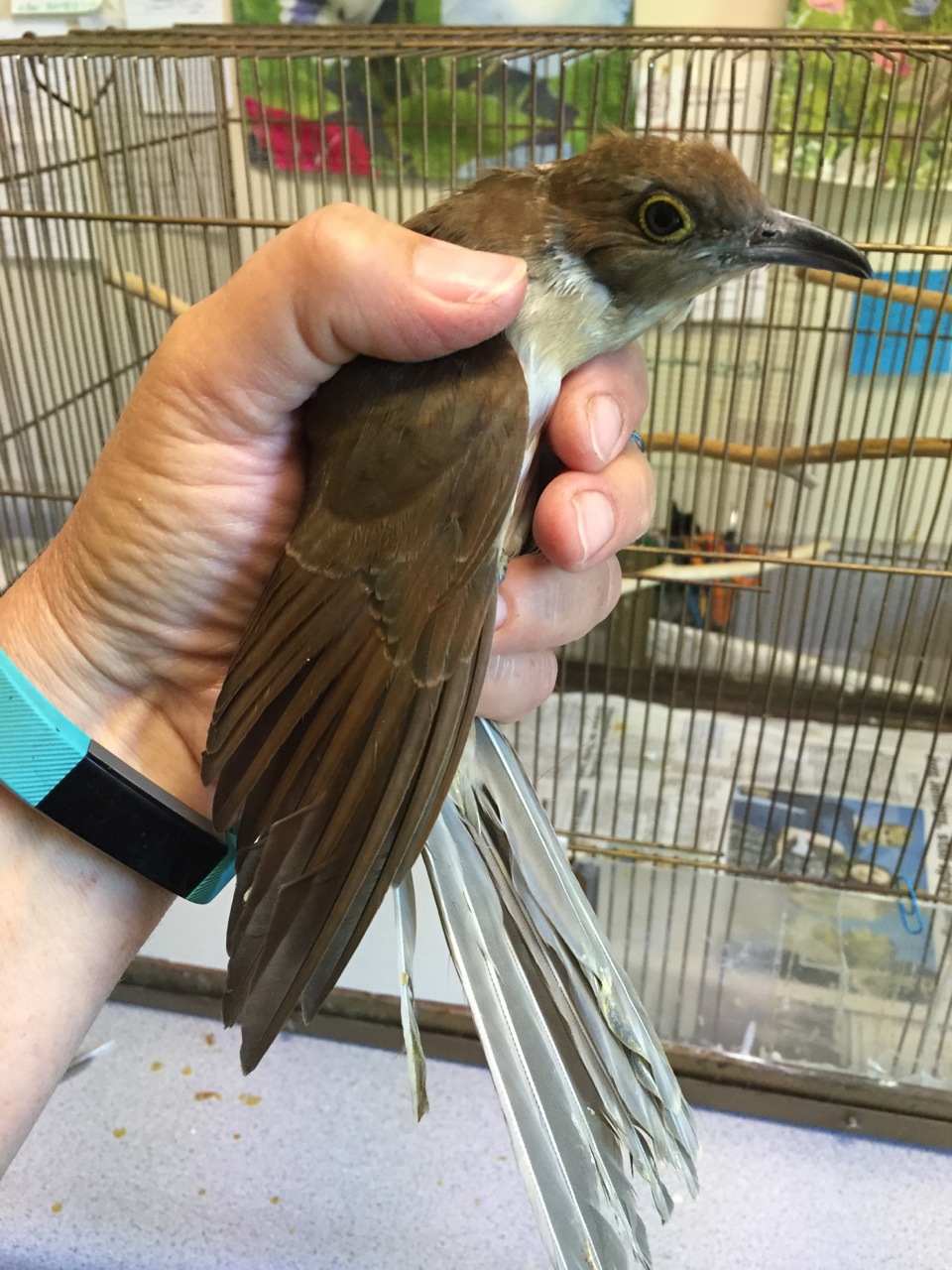

 July 11. Time for release! Her keel (breastbone) was nicely rounded with muscle and fat; she'd been a bit thin when she came in. 

I gave my iPhone to my expert videographer, Liam, who did a marvelous job of capturing the action. I couldn't be happier with this video, for all kinds of reasons. Look what this bird does when she's released!


I cannot begin to describe the thrill of having that cuckoo just hang out with me, ON me, of her own free will, for a golden 32 seconds.  Aw, you can see it on my face, hear it in my voice. It was incredible. It was a benediction. It lit me through and through with joy, and some of that is still lingering. I think about it, about the feel of her long soft toes on my hand, the slight weight of her, not even two ounces, but packed with pounds of sweetness and light and forgiveness for all I'd put her through.


And then to see her fly, that lightning fast low swoop, to stick a perfect landing in the dead pine. So glad I didn't try to flight test her in the hall. I was so glad I'd listened to that little voice, that one that makes itself heard over all the self-doubt and second-guessing.

In the video, you see me going into action, capturing our last looks at the bird with my 70-300 telephoto lens.


It was uncanny how she kept looking back at me.


Even after she bounced into the woods, she kept her eye on me.


                                                             I will remember you.


To keep birds from hitting your window ever again, see my Ultimate Solution to Window Strikes at this link. Well worth reading, for finding out what doesn't work, as well as what absolutely does. Which is crop netting, stretched over your window. In 2008, I had screens made for my big, deadly north-facing studio windows, and in the eight years since then, I've lost only one mourning dove, the only bird big and fast enough to deform the crop netting and bonk itself dead.

Through the magic of Facebook, I was alerted to conservation biologist Andrew Mack's 2012 blog, The View from Love Hollow, in which he came up with the same solution, with easier and cheaper installation. 

Cheaper and easier yet: National Aviary ornithologist Bob Mulvihill's idea of tacking white string at 4" intervals, vertically across the offending window.

To get this window treated toot sweet, Bill (who climbed the big shaky ladder) and I  (who fearlessly handed him the tape before he went up) used American Bird Conservancy tape designed for windows. We have solid reports that it works. It's a comfort to know the birds are duly alerted, but we're still trying to get used to the new look. Ultimately, crop netting, which truly disappears, will likely be the best fit for us, who, when we're indoors, are always, always looking out.


I hope you've enjoyed this bird's journey as much as I enjoyed having her with me. I miss having bird energy in the house, and she brought a very, very special sweetness to my life for the few days she was recuperating. She was released on July 11, Phoebe's 20th birthday, and something about that rings a bell, too.  On July 13th, a mysterious brown bird launched out of one of the birches and flew right at the (crop-netted) studio window toward my preoccupied face, veering at the last moment and heading into the backyard. It wasn't a dove, and it wasn't a flicker. It might have been a black-billed cuckoo, saying thank you once again.


Zick photos and videos by Liam Thompson

Window-Strike Part II: Hand-Feeding a Cuckoo

Sunday, July 17, 2016

10 comments
In my last post, I introduced you to a black-billed cuckoo who hit our kitchen window. Here she is!
People who work a lot with window-stricken birds and have veterinarians they can work with give injectible drugs that help minimize brain swelling. These are best given in the first few minutes and hours after a strike, and they can definitely save lives and improve prognosis. I've got no veterinarian closer than two hours away who will see wild birds, and nothing like that at my disposal. All I've got is sympathy, some basic housing, good food, and the ability to get that food down the throat of whatever needs to be fed.


That would be you, Miss Black-bill.


By that first night, I'd decided the bird had feminine energy, and it's easier for me to empathize with it as a he or a she, so she it was. Doesn't matter anyway; I could see that this cuckoo's brain was doing some mighty swelling. Her pupils weren't responding well to light. She was slow and dopey and had no interest in being active or eating. I was quite heartened that she managed to attain a low perch for her first night with me, but she was still quite a ways from being viable in the wild.


July 9, mid-day. She's on the high perch! Gaah what a gorgeous beast she is. A foot long, and half of that tail. That bronzy green, that wash of unexpected rufous in the wing. So, so lovely. She was looking good, more alert at 24 hours out from the accident. Still spending a lot of time with eyes closed. That's OK. I've got nothing but time. Just look at the proportions of that bird. Elegance in feathers.


A look at that eye ring. When she's mature, it will be brilliant carmine-red, which lends her the species name Coccyzus erythropthalmus. This yellow eye-ring is a little visual signal to other cuckoos that she's still learning to be a cuckoo. Take it easy on her.


By now in her rehab, though, she should have shown interest in picking up food. Nothing I offered: live mealworms, including freshly molted pupae; chopped raspberries, blueberries, cherries, even a couple of corn borers from dinner's local sweet corn--appealed to her at all. C'mon. Corn borers? Soft green caterpillars hung enticingly over your perch: you're just going to cock your eye briefly and then ignore them? That's what you'd be eating in the wild, Cuckoo.

All right then. You don't like captivity. I don't blame you. But I'll be damned if you're going to starve yourself. You're going to be force-fed every two hours until you either start eating or get strong enough to be released. My staple was Mazuri Nestling Formula. , augmented with increasing numbers of mealworms as she got stronger.

Liam made this video of me, the classic Jewish mother to a cuckoo. I love this video, because the cuckoo doesn't look at all upset about being force-fed. She's like, "Yum. Thank you. Waitress, more water please?"


The next installment is the best.  I know, I'm giving away the outcome in this video. But you just wait to see what this sweet cuckoo does in the next video!!

Thanks and props to Liam Thompson for expertly handling the iPhone to make this video. The kid has skills.



Window-Strike: Please, Not a Black-billed Cuckoo!

Thursday, July 14, 2016

9 comments
I was in the kitchen when it hit the window. It was one of those sickening BONK's with an added CRACK from the strike of the bird's bill on glass. My neck snapped around just in time to allow me to see a pair of long brown wings flash up into a helpless vee. And the bird dropped like a stone, two stories down. 

My birdwatcher's brain went into high rev, processing what little information it had received in the split second after the bird's impact. Brown. Large, wingspan approaching 20".  Either mourning dove or cuckoo.  Mourning dove vastly more likely. But wing shape and color wrong, not grayish, the flight feathers too warm and brown for a dove. Bill went crack on window glass. Mourning doves have a soft, rubbery bill. That kind of bill doesn't make a cracking noise. DAMN IT!!! Cuckoo. DAMN IT!! ARRRGH!!

I was already tearing down the basement steps on the shortest route to the backyard. I was swearing, wailing, chanting. Please, please, please don't let it be a cuckoo. Not again. No no no no no.
Not a cuckoo, not a cuckoo, not a... 


No. No. No. Not just a cuckoo, but a black-billed cuckoo,  rarer of the two that occur here, and the second black-billed to hit this summer. The first, an adult, had died. No. 

I had grabbed my phone as I hurtled out of the kitchen, because I always want a camera with me when I go outside, when I'm investigating. I felt like a horrible creep for photographing a bird in its death throes, but oh God it was so, so beautiful, head thrown back in its anguish, a modern Archaeopteryx.  It was an unforgettable moment, an indelible image. It had landed on concrete. No.

I could see by the yellow eye-ring that this was a recently-fledged juvenile, which made its chances of surviving the impact all the more slim. Such a young bird would have a paper-thin skull, the double layers still forming in a process called ossification, which builds honey-comb struts of porous bone between two solid plates of bone, strengthening it immeasurably. This one hadn't had time to make an ossified skull.

A poor candidate for rehab, or even survival. No, no, no. 

Another bonk, this one light, without a cracking sound. I looked up quickly, unbelieving, to see a second black-billed cuckoo striking the exact spot on the window that stopped its friend. It flew back to a birch and perched in plain sight as I knelt beside its fallen friend. A juvenile, with a yellow eye ring, exactly the same plumage and age as this one. This cuckoo gave a scolding rattle and cocked its head at me. Its message was plain. 

"That's my sister! She hit the window. Take care of her." 

I will do my best, sweetheart. I'm so, so sorry. I'm going to get some netting up over this window, too.  You be careful. I've got to take her inside for awhile.

July 8, 2016


I picked it up, away from the ravenous chipmunks and gray squirrels that constantly patrol our foundation for just such treats. I couldn't believe it was still breathing. It was a patchwork of molt, grayish-brown juvenile plumage, fringed with white, being replaced by brighter, warmer russet feathers of adulthood. I was surprised by the amount of rufous in the primaries, and for a moment doubted my initial ID as a black-billed cuckoo. But a yellow-billed this age would have a bright yellow mandible. Note how the impact has misaligned its bill--you can see the mandible tip sticking out to the bird's right. Not good.


For these two cuckoos, the tail is the clincher. Yellow-billeds have quarter-sized white spots at the end of each tail feather. And black-billeds have tiny white spots, especially at this age.  Note also the grayish-buff underparts. Yellow-billeds are much whiter and cleaner. At this point, I'm figuring this bird is going to be another specimen for the freezer, and eventual donation to the Cleveland Museum of Natural History. Might as well take some ID shots. 

I brought it inside and put it in a small Critter Keeper on a soft towel. I plumped up the towel to support its head and put it in a corner of the studio where I could keep an eye on it. It lay, not moving a muscle, for three hours. 

I put a peanut butter jar lid of mealworms and one of water in with it. It ignored the food, lying with its eyes closed, breathing. Another hour passed. Clearly, this wasn't one that was destined to revive and "fly away." 

Better feed it, or it's going to use up what reserves it has, just trying to survive the impact. I mixed up some Mazuri Nestling Hand-feeding Formula #5S90 (for insectivores). This stuff, available in a 1KG bag from mazuri.com,  is my new favorite formula--a finely ground vitamin-fortified meal that mixes up velvety-smooth, perfect for syringe-feeding nestlings and compromised adults, too.  Nestlings fed this formula make the most beautiful fecal sacs, and adult droppings are gorgeous, too. Do I sound like a mom? Well, you can judge the health of a bird (or a baby!) by the consistency and color of its droppings. So there. The brilliant Virginia bird rehabilitator Connie Sale, who expertly raises everything from hummingbirds to jays to wrens to woodpeckers and back again, turned me onto Mazuri. The thing that convinced me to take the plunge were her photos of fecal sacs from wrens fed Mazuri. Ha! Rehabber to rehabber, it's all about the poop. I'll never grind kitten chow again! and I've got a beautiful one-kilogram bag of Mazuri #5S90 in my fridge, ready to be deployed at a moment's notice.


By nightfall, the cuckoo was able to raise its head and look around a little. There's no doubt in my mind it would still have been lying under the kitchen window, though; it couldn't move at all, nor did it seem to be with it enough to pick up mealworms or even drink. I force-fed it every couple of hours until bedtime. 

It seemed a bit stronger, and I didn't want it to suddenly come to in the small Critter Keeper, so I installed it on the floor of a spacious cage, one that had housed Vanna, the World's Longest-lived Savannah Sparrow, for 17 1/2 years.  I put the cage in Charlie's glassed-in aviary, now my mailroom and sometime rehab room. 

When I peeked in the same night, July 8, just before I went to bed, the sweetest sight greeted my eyes.
Somebody's able to PERCH!! Good night, sweet angel. Now I think I can safely say,


"See you in the morning!" 


Bonk!

Wednesday, September 5, 2007

0 comments
My studio has a rack of three fixed-pane windows, facing north. To them I owe countless Bird Spa pictures, constant bird sightings, endless hours of gazing and wondering, and a pure north light on my palette and paper. On those windows are six FeatherGuards, designed by a Bird Watcher's Digest subscriber (and marketed by my husband) to deter collisions. They're lines of monofilament, strung with colored chicken feathers. Usually, they work. In the height of migration, with a bunch of crazy juvenile birds bouncing around, we still get some strikes.

Bill was out in the blind and I was at the drawing table inside when we heard that sickening BONK that means something has brained itself on the glass. We're so attuned to it after 7 years that we can tell which window it's hit by where the bonk comes from, and the pitch of it. A big window makes a deeper BONK. I always jump up and go digging in the flower beds for the poor thing, to see if I can help, or at least take it out of the way of predatory chipmunks (like Bob.)

You never know what the bird is going to be. You always hope it's not badly hurt.

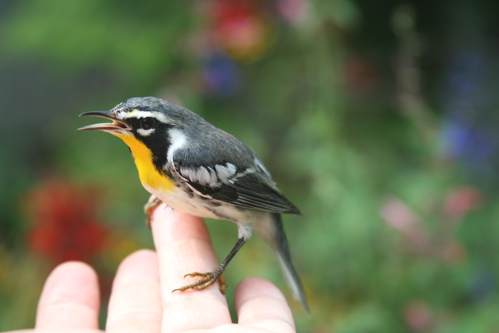
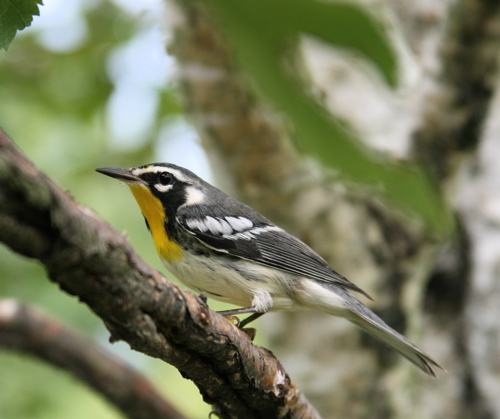
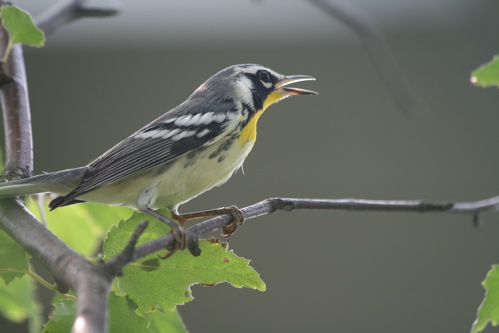
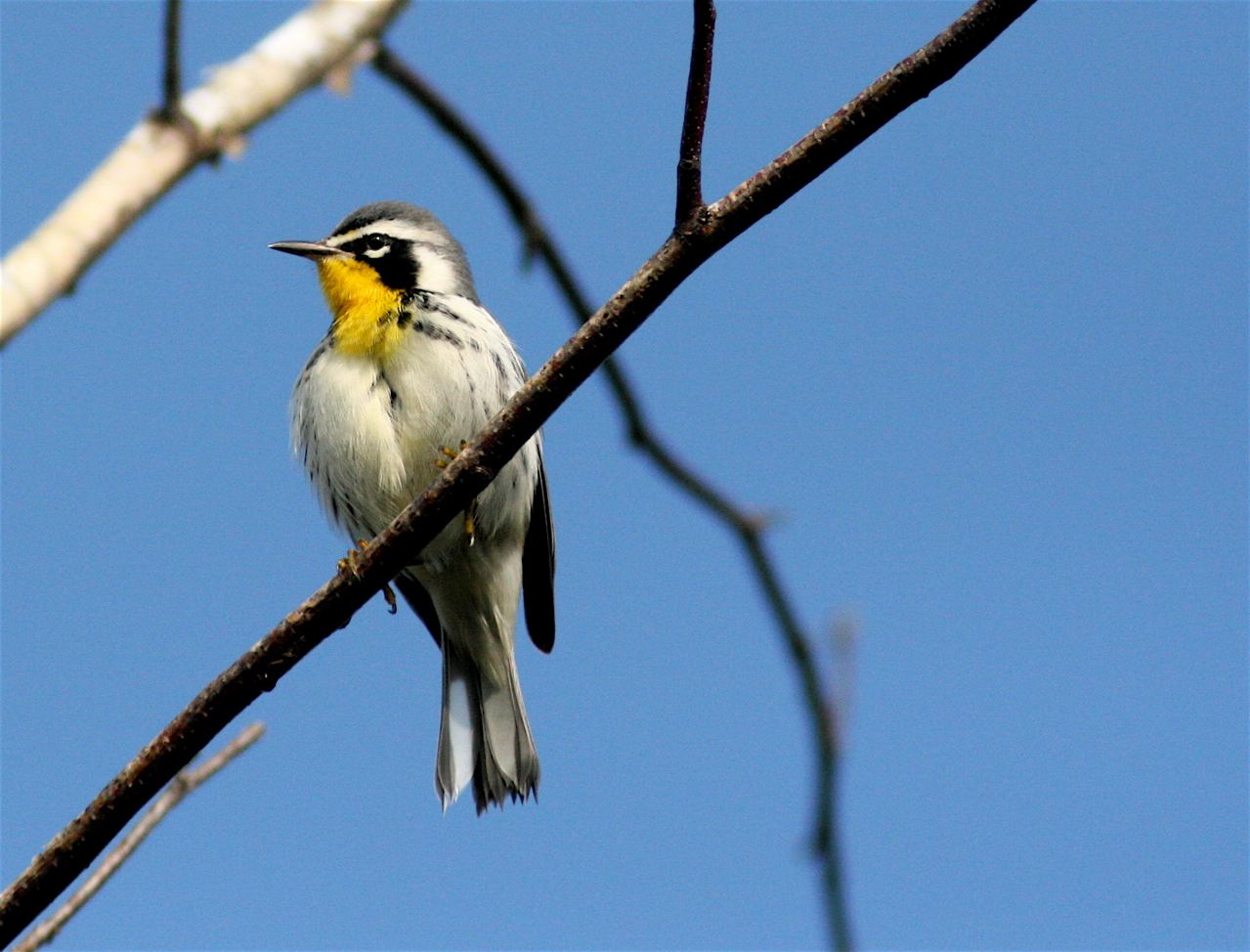
Sometimes, what you find takes your breath away. Oh.We get one or two yellow-throated warblers here every year. This is a big, robust warbler with a long, slightly decurved bill, large clinging feet, and strong legs. It hitches around on the trunks and limbs of sycamores like a black-and-white warbler, and nests in natural cavities. (One of only a couple of warblers that do nest in cavities; the other being the prothonotary.) They nest sparingly right in the center of Marietta, which, as a river town, has lots of huge holey sycamores. They nest all up and down the hollers and runs near us, the low-lying ones with sycamores. I wish this bird were still called the sycamore warbler. It's so hard to keep from confusing it with the common yellowthroat, in name at least. All apologies to Geothlypis trichas, this bird has it outclassed six ways to Sunday in the beauty realm, don't you think?

Usually, we see them in fall, and they are almost always in a weird place--in the bird bath, on the deck railing, climbing up the beige stone chimney (which I think looks like a sycamore trunk to them), and once inspecting the LEG OF A TRIPOD we were using!!

This one was in a pile beneath the studio window. Rats, rats, rats, rats. Please be OK.

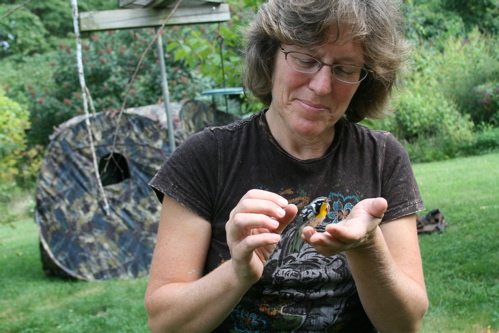
Might as well give you a good preen and fluff while you're down for the count. I have a feeling we'll be taking some pictures of you. There's Bill's doghouse blind behind me. He was trying for some bathing beauties, but never dreamt he'd see this.photo by Bill Thompson III

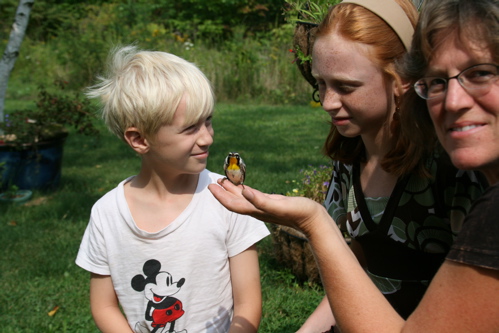
Of course the first call that went out was for the kids to come see what the window had wrought. Ohhhhhh! What a pretty bird! Is he going to be OK?photo by BT3

Gradually, he began to come around, and realized that Zick's fingers were not where he wanted to be. He moved up into one of the birches, higher and higher. You would have to be the most beautiful warbler on the planet, wouldn't you? Do you like butter?

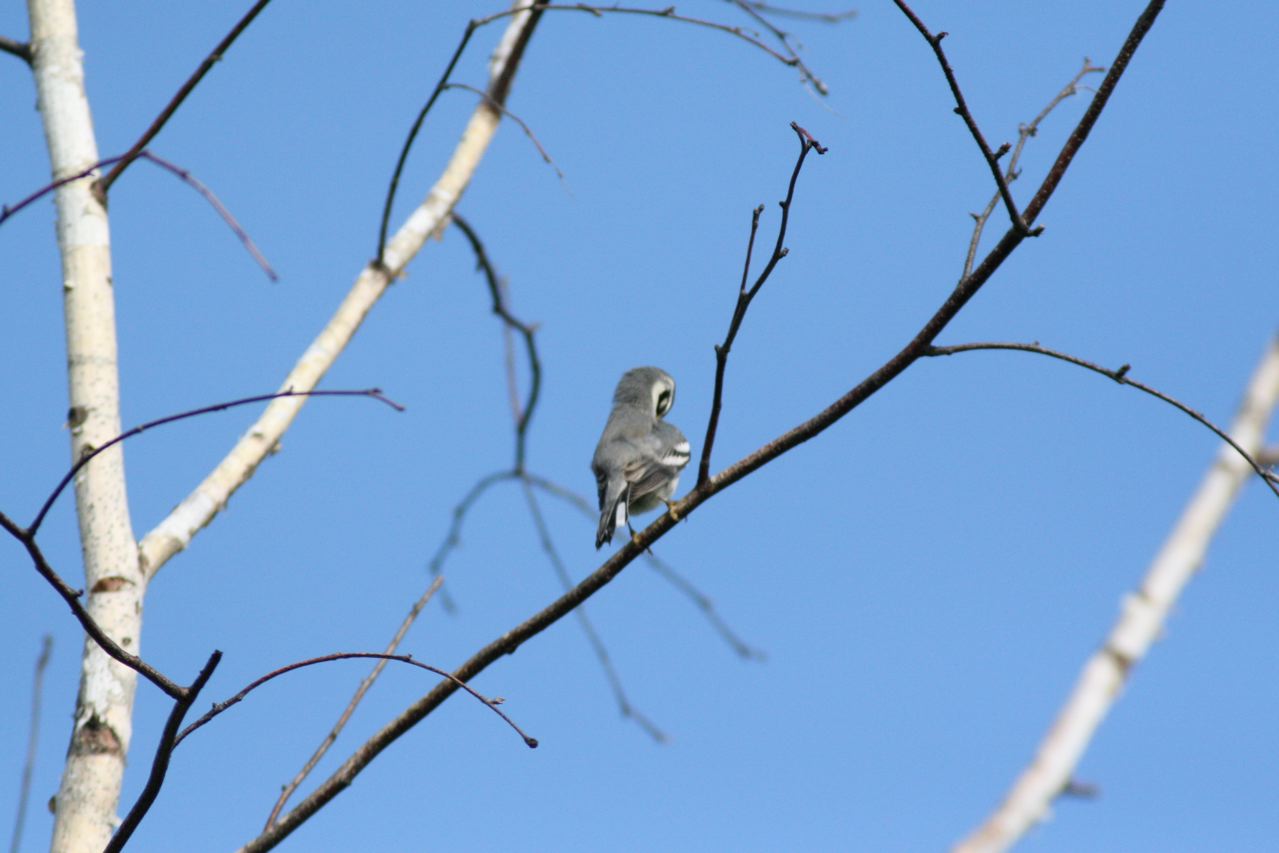
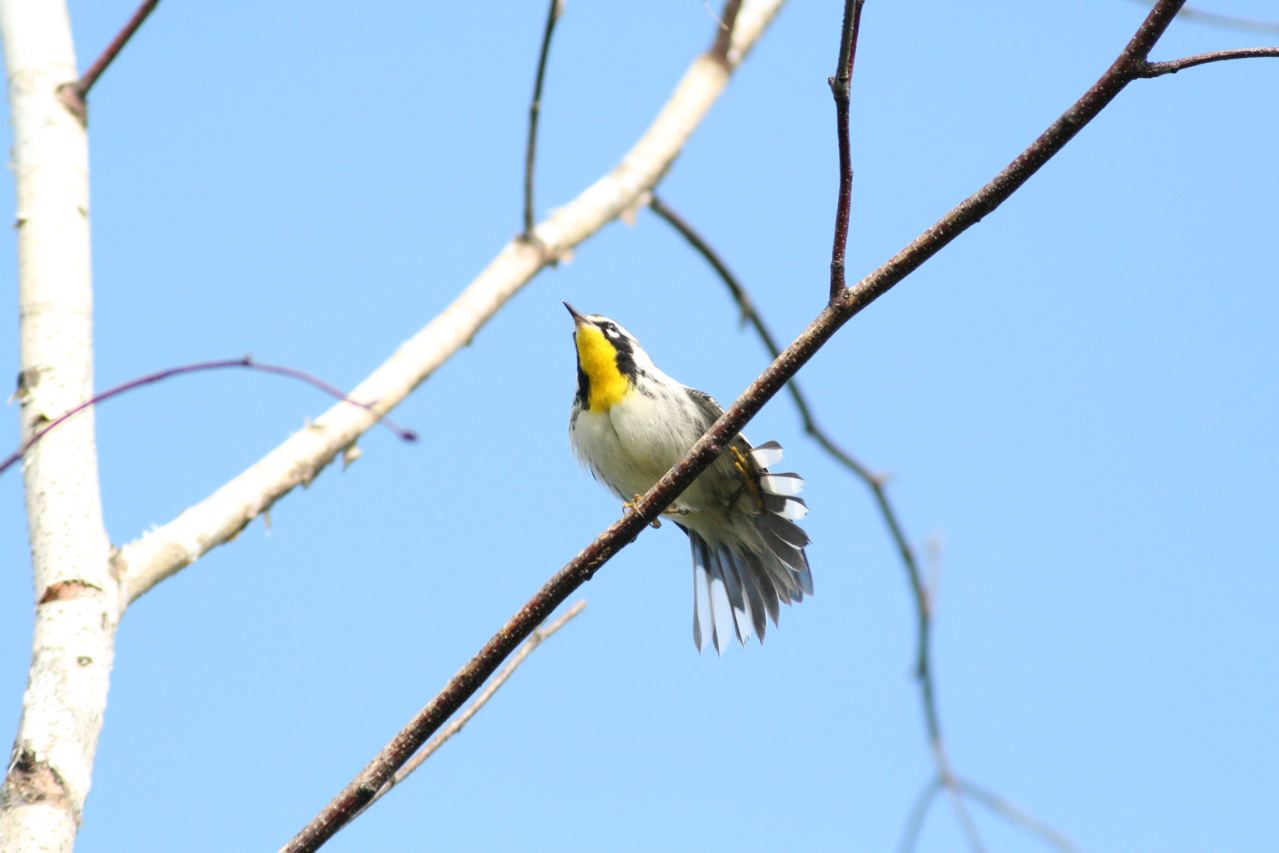
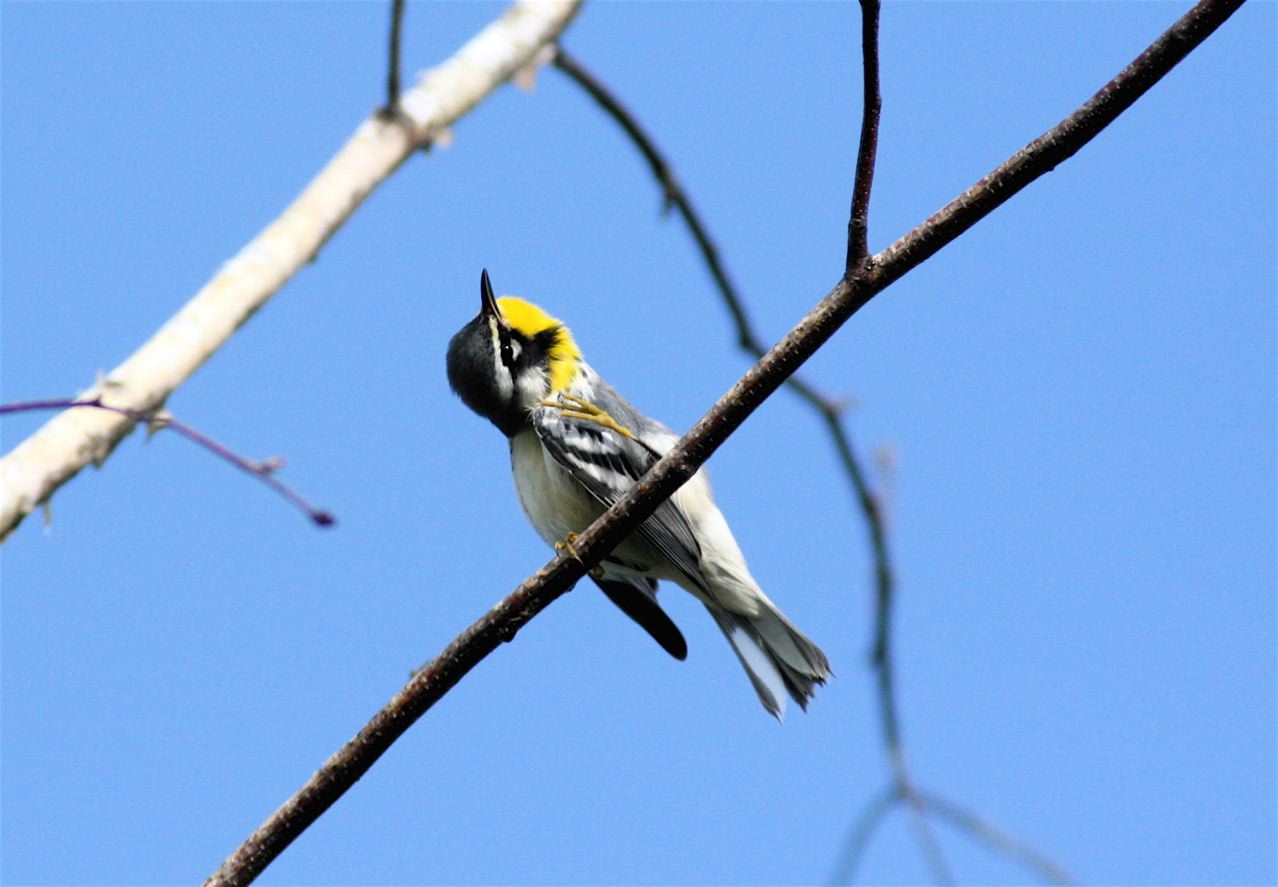
The next morning, we saw a yellow-throated warbler preening calmly in the top of that same birch. It was a strong coincidence, if coincidence it be. He was fine, healthy, with it, but unconcerned about us standing just below him, snapping pictures. Singing a few bars in between rearranging his feathers. I pray it was the same bird, ready to continue his migration south. Given the paucity of YTWA sightings here, it seems likely. In my experience, if a bird can grip with his toes and open his eyes immediately after impact, the foreseeable prognosis is better than if he can't. He's not singing here. He's still panting.Compare these photos with those taken of the bird we saw the next morning in the same birch tree. Pretty darn similar. But so delightful to see this bird preening,
stretching his wing and tail
scratching his throat with his little yellow-soled foot (note that the feet match the window-stunned bird's!)
and being devastatingly lovely.
I'm going to think it's the same little fellow. Chances are. It's two visitations from heaven, that's for sure. Take care and stay away from windows, little scrap of beauty.
Thanks to B. for letting me borrow your camera for the preening shots. I love that gargantuan fixed 300 mm. lens. I just don't love carrying it around.
[Back to Top]