Background Switcher (Hidden)

Showing posts with label West Virginia. Show all posts

The Ancestral Home

Friday, July 28, 2017

20 comments

Lots of people ask me what my name means. Zickefoose is a corruption of the German name Ziegenfuss, which means goat foot. It's not derogatory, not based on our looks. It refers to a nimble way of walking. Much better! I have had only two bad falls in my life, and both were when I was hugely pregnant. Amniotic fluid is a great cushion. Just ask my kids. As for the falls, I'm sure I can arrange more as I get old and doddery. But for now, I'm getting around pretty good. That was always what my grandparents said when asked how they were. It was all about mobility. I never understood why they emphasized how they were "getting around" then, when I was a little kid, and I moved as easily as I breathed. I get it now. Oh boy do I get it. 

Zickefoose is quirky enough that, when I got married and the pressure was on to change my name, I didn't. Wouldn't. Couldn't. I am a Zickefoose and will always be. Actually the decision had been made when I was very young. I loved my name, even though I was last in every line. I loved being my father's daughter, of being identified in some tangible way as his. He was a very cool man. My mom knew we'd have a special bond, with me being the last of six kids. She wanted my middle name to be Dale, to honor him. My dad voted it down. So my middle name defaulted to Sue. Which honors no one. A placeholder. Damn, and oh well. Why DOD, why?? Well, you know now that it would have been the right thing to do.

 Once I started doing freelance art as a freshman in college, I figured if I was going to hang out my shingle, I might as well have a memorable last name, one that, once learned, isn't forgotten.

What follows here is a small and shallow exploration of Zickefoose roots in America. I'm doing it mostly so my kids and family and I have a record of the things I've been told about our line. I don't expect it to be particularly interesting to anyone who isn't a Zickefoose, but I'm glad to know these things. Some people, like my brother Bob and especially our first cousin Brad Braga, have an aptitude for genealogy. Brad has an entire climate-controlled room in his Marshalltown, Iowa basement devoted to family photos and original records. He can answer any question we throw at him about who's related to whom and how.  He is a meet keeper of the Zickefoose flame and records. I am thankful for Brad. We all are.  He can explain what a third cousin, once removed, actually is. I can have something like that explained to me a hundred times and still not get it. Genealogy is like math to me. Genealogy lore goes through me like a dose of salts. So I'm determined to record it so I have it.

In 1751, Johan Jacob Ziegenfuss came to America from Germany. It's thought he had a son named Peter, who settled near the little town of Blue Grass, Virginia, in Highland County. At that time, Blue Grass was called Crab Apple Bottom. I guess I can see why they changed the name to Blue Grass.

  Peter had a son named George. George settled near Pipe Stem, West Virginia, with a land grant. At that time, Greenbriar County, WV, encompassed Pipe Stem. Larry Zickefoose, historian and genealogist for the West Virginia clan, says that during the time George was living there, you could be born, live and die in the same spot, but the county lines were changing such that you'd have lived in three different counties.

 So whether the Ziegenfuss/Zickefooses come from Virginia or West Virginia is a bit muddled. George's son, Benjamin, married his first cousin, Susannah Buzzard. DOD had told us this, and West Virginia genealogist Larry Zickefoose, who's written a book called From Zigenfuss to Zickefoose, confirms this. Marrying one's first cousin is forbidden in the Old Testament. 

This photo of Benjamin and Susannah entrances me. As I look at the pair, the set of their wide mouths and the shape of their heads, with prominent cheekbones and high foreheads, is very familiar to me. Susanna in particular looks like my dad's sisters, in a big way. 
The cheekbones alone belie their bloodlines. 


My father always said that he thought Ben and Susannah went west to escape the disapproval of their family. I'm glad they did.   They lived for a short while in Ohio (!) and Indiana, then settled in Henry County, Iowa, near Olds, around 1837. They had eight children. The first three were born in Virginia, the fourth in Ohio on the way to Iowa.  Their sixth was Western Summers Zickefoose, born near Olds, Iowa in 1842. That would make him just the right age to get caught up in the Civil War. He fought for the Union, with the 25th Iowa Regiment.


Western Summers was my great grandfather. 

He was at Vicksburg and other battles along the Mississippi, and was with Sherman around Atlanta and on his famous march. As they marched through the Carolinas Wes got malaria, and was sent north on a boat. He regretted missing the grand mustering in Washington D.C. Western's older brother, Clark, was killed at Arkansas Post and died in Wes's arms. He had been hit in the temple by a spent Minie ball. I remember DOD saying, "It never even broke the skin."  

Western was in Buell's Army of the Ohio, reinforcing Grant after the first day of fighting, when troops were being boated across the Tennessee River all night long. But Wes never got off the boat to join the fight at Shiloh. Good thing. 

My sister Micky has a tin plate and cup that had belonged to Western Summers, part of his mess kit. He lived through that terrible war and went on to live a full life. Missing Shiloh might have been the key there. Attaining the age of 83 is remarkable for a man, for those days. 


Western Summers' grave, Asbury Cemetery, Henry Co., Iowa


Western Summers Zickefoose, my great grandfather.


Martha Jane Yancey, my great grandmother.

Wes went on to marry Martha Yancey and have a son named Charles Summers Zickefoose. He was born in 1878, and remained unnamed for two years. Not sure what that's about. What do you call him until you decide what to name him? Hey You??  I remember Grampa Charlie Zickefoose being pretty crochety, but then he wasn't feeling well by the time I came along. My grandmother Elnora Zickefoose was the sweetest person you could imagine, so she more than made up for that. Whenever Nora would hear us Zickefoose kids singing in harmony, she would say, "They got that from the Yancey's." That's still a catch phrase in our family. It came from the Yancey's. Thank you, Martha, for giving us our musicality. It somehow escaped my dad. He loved music and could sing just fine, but had little sense of rhythm. Singing (or dancing, Ida said) with him was an adventure in compensation.


My DOD, Charles Dale Zickefoose
He may not have had much rhythm, but there was a lot he could do. Like, everything.

 I love the fact that my immediate family originated in Iowa, my grandparents and both my parents being born there, thanks to Ben and Susanna's moving west. When we moved from the Midwest to Richmond, Virginia in 1962, we were coming back to the homeland, though that fact was lost on me then. I remember missing terribly the big skies of the Great Plains. I was born in South Dakota and lived my early years in a suburb of Kansas City, Kansas. We were used to seeing the weather coming. In Richmond, we had to look straight up through the trees to see the sky, and storms always took us by surprise.

So you might imagine the feelings that coursed through me when my brother Bob gave me and Liam a route home from his place in Mt. Solon, Virginia, back to Ohio, that went right through the ancestral Zickefoose home along the Virginia/West Virginia line. (We were heading home from the wedding of Bob and Bonnie's daughter, Holly).


There are not many places in this world that I look at and say, "Yes. I could live here." But this was one of them. Rt. 250 went up, down and around through gorgeous healthy national forest with scattered agriculture and mountain vistas. 


Speeding car out the window photo. Near Blue Grass, Virginia. Ohhh yeah. It's sooo beautiful here.


Liam loved the ride so much he rolled down the window and hung his head out like a dog. He couldn't get over the views and the beauty of this place.


Before long the highway, which was all but deserted, rolled down into a valley where beavers had made a beautiful series of ponds, like beads on a big watery chain.


The clouds and reflections were perfect.


I've never seen Liam respond to a landscape the way he did to this one. We pulled over and got out to revel in it. 


I loved to think that our ancestors may have ridden or driven wagons along this route and loved this valley, too. I wondered if the beavers were there then.


I don't know if a landscape or a place can be so deep in your genes that you somehow know your ancestral place when you see it, but Liam and I knew something special was going on here.


I am grateful to have children with a sense of place, genetic or not. Who know beauty when they see it, and stop to wallow around in it.


Here's a little movie of Route 250 near the Virginia/ West Virginia line. I hope you've enjoyed this exploration of Zickefoose roots as much as I've enjoyed ferreting out the information and photos. Many thanks to Bob Zickefoose and Brad Braga for keeping the genealogical flame for know-nothings like me.


And because it was the song in my head the entire drive, here's Jonathan Edwards and the Seldom Scene with "Blue Ridge."

The Peregrine's Gift

Tuesday, May 5, 2015

9 comments
This is birding. 

You have some days when you have to beg for a freezing cold ovenbird in pea-soup fog. And you have fun anyhow, because you're with people who get that sometimes birds appear and sometimes they don't. And you're outside and who can have a bad time outside?

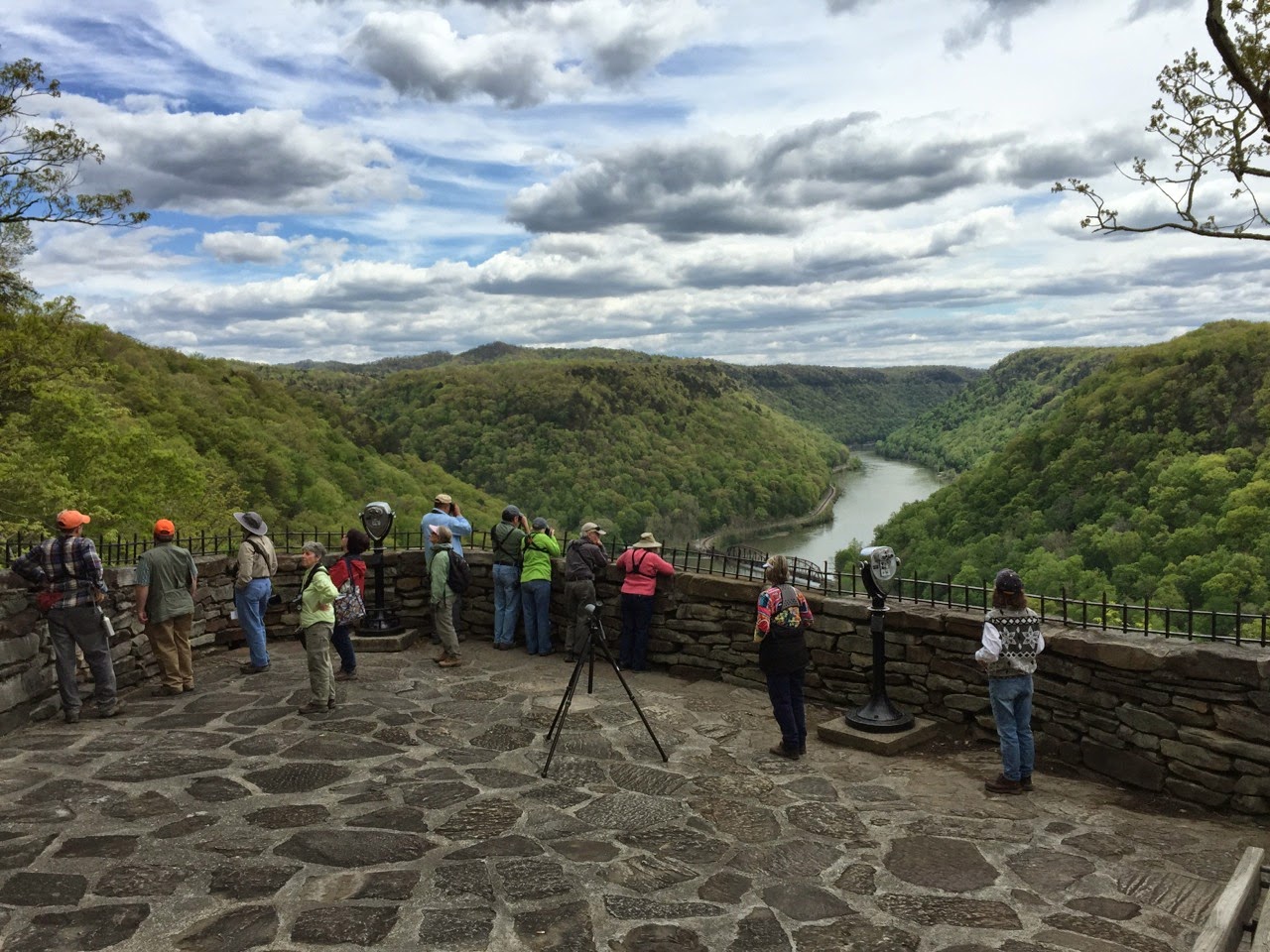
And then there are days like these, Saturday May 1, 2015. On the last day of the New River Birding and Nature Festival, we've been imbibing warblers and tanagers on a trip I'm co-leading all morning. After lunch we all tromp down to Hawks Nest Overlook and gasp at the beauty of the wild and savage New River Gorge. 


It's getting hot and we're peeling layers like crazy. Those of us who aren't wearing long underwear and can't. Heh.


I just can't believe I get to be here and look out at all this. I'm kind of overloading, so I look down at the stone steps and find a teeny tiny plant which, in my bookless botany, I determine by its four petals and whorled leaves to be related to bluets, in the Rubiaceae. I can't go any farther, and it takes Jim McCormac, summoned via electrons, to tell me this is Blue Field Madder, an exotic weed. But a cute one. 


How bad can it be, tiny as it is? I decide I love it anyway.


Birding friends have a stony chat.

And someone says, "There's a peregrine perched up in that tree!" 


We crane our necks and marvel and feel blessed. But the show hasn't even begun.

The peregrine launches out over the gorge and suddenly rolls over in flight and falls like a stone or a spear. Somehow I manage to follow it in my binoculars, though it's likely doing better than 120 mph in that stoop, and I see it hit a barn swallow which explodes in a puff of feathers, falls limp and disappears into the river.

The peregrine circles a couple of times, looking for the swallow, but it can't see it. Too bad, waste of a good bird, but that's hunting for you.


I am shooting and shooting as the falcon circles up from the water's surface without once moving its wings. It rises, using the updraft from the river and cliffs, rises like a thought or a dream.


The raw steel blue of his back, the muscularity of his shoulders, the bright buttery cere. 


I can't believe he's coming so close. I fall over the dopey giant swiveling binocular, the kind that takes up precious space at every overlook, the machine nobody ever uses, trying to keep him in my sights. I click and click.


I have to show this bird to you, cropped in closer.


It's a male, Paco and I agree, murmuring softly as we watch it circle and rise; something subtle about its build and size and big eyes and bright cere. We are rapt, enraptored. He makes me promise to send him these photos. Here you go, Paco. Here's that bird we saw. 

As exquisite as it is up close, this living missile is even more thrilling against the backdrop of man's attempt to tame the New River, the dam we put in its wild and rugged path.


The peregrine is a gift, snatched away when we couldn't stop spraying DDT everywhere, and now returning. In my lifetime, it's back. When I was 14, I never thought I'd see a peregrine, ever. And now I'm reaching out and catching this one and keeping him to look at forever. And he's nesting somewhere on these ledges, or under the bridge, making more peregrines. My friend Tiny worked several summers hacking baby peregrines out in the Gorge, and now it's all paying off. They're here. They're HERE. Killing barn swallows, somehow making it past the great horned owls who like to eat its chicks, and thrilling us all.


I didn't even see the people on the rocks until I got these photos on the computer. Epic!

Eventually the peregrine circles back to its branch, then leaves altogether, the branch wiggling in the empty air as I look longingly at where it was, wishing.


Thus endeth the Peregrine Show. A fine show it was. And a fine bird it is. A gift.


Eastern Kingbird Nests

Sunday, July 17, 2011

15 comments

 So I'm floating along with my camera, marveling at all I've seen in a few hours of doodling around in my lil' peapod canayak. I just can't get over the array of active nests I've found. Just goes to show you what birds can accomplish when mammalian and reptilian predation is controlled by oh, four or five feet of water.

This snag intrigued me, just because the Virginia creeper framed the cavity so beautifully. I didn't see a vine running up the tree, and because it was standing in several feet of water, any vine coming from the ground would be drowned. I figured the creeper had rooted in the cavity. I circled the tree, shooting, and it wasn't until I saw the photo on the camera screen and blew it up (trying to figure out where that vine was coming from) that I saw that the tree hid another treasure.          
There was a nice nest inside the cavity, which could have belonged to a robin, but I suspected it might have been built by an eastern kingbird, because there were gobs of them around. Would a kingbird build in a cavity like that?

Well, would you?

I might.


More discoveries: I saw some stuff sticking out of the top of a rotten stub, which resolved into nesting material, and a setting kingbird. Well!


Well, hello, Missy! I'll pass by--don't you worry or get up, OK?


Luckily for you, she did leave the nest for a moment. I say that because this gives me a chance to tell you how to sex a kingbird.  See the gray wash on her breast? That's a female. Males have a clean white breast. Nice of them to have a little dimorphism, just enough to make it fun for a birdwatcher.


But my favorite kingbird nest of the day (and this was more kingbird nests than I'd seen in my life, for goodness' sake!) was the last one. I saw a beautiful kingbird fetched up on a snag, and shot a photo of it.

We bird photographers can have tunnel vision--we're trying so hard to get the bird in focus and framed that we often overlook what's around the bird. See anything interesting in this photo?


Yeah, it took me awhile, too. Sweet! There were two little heads bobbing in the nest. 


 It was a beautiful end to an incredible day on the water. All I want to do is go back to West Virginia's North Bend State Park. You can lose yourself at a place like that.


On Quiet Waters

Tuesday, June 28, 2011

11 comments
One good outing in a boat can be absolute magic for the soul. Forget chicken soup. I need the sound of trickling water under a canoe hull, the gentle rock of a boat on calm water.

A couple weeks ago, we mounted an expotition to North Bend State Park, not far over the West Virginia International Boundary with Ohio. About nine years ago, a dam went in, making a long, meandering flooded lake with lots of fascinating elbows and appendices to explore.

David and Mary Jane, Chet Baker's West Virginia parents, alerted us to this place, and all the birds they'd found nesting there made us anxious to explore it. So they brought their huge aluminum canoe, and graciously took our kids in it, while Bill and I zooped around in our one-man canoes.

Get a load of these reflections.


It was immediately clear to us as birdwatchers that we were entering a gallery of cavity-nesting birds the likes of which we'd never experienced.

For the flooded trees all died at the same time, and this made for easy excavation by flickers, red-bellied, hairy and downy woodpeckers.

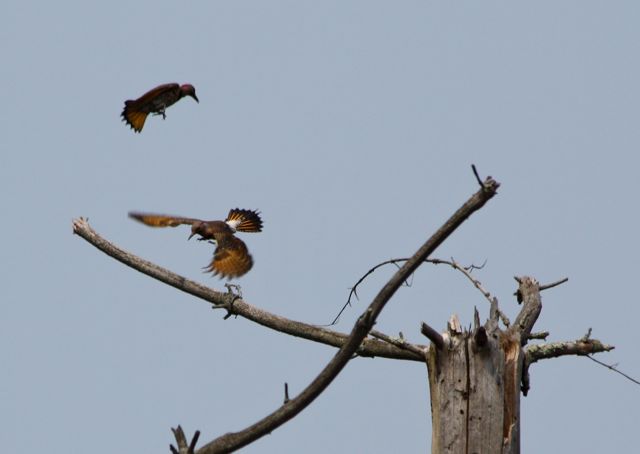
Flickers, in fact, were going nuts all around us, courting and fighting. These two males engaged in some terrific stunts and dances, vying for a single female. See their black malar marks, or "moustaches?" Those small black dashes on the side of their faces (not the breast crescent; both sexes sport that) mean they're boys.

The males kept engaging each other, approaching, posturing with bills erect. There was a whole lot of woika woika woika-ing going on.


The female flicker's the top bird in this photo. 


Very noisy and amusing, they were.  What a treat to see flickers breeding--outnumbering the starlings, which compete for the cavities the woodpeckers dig. This is one of North America's most ornate birds. All the spots and dashes of jet black on warm brown plumage--they wouldn't really need the golden underwings and tail, or the white rump, or the gray toupee, or the little vee of scarlet on the nape...but flickers have it all.


Sometimes when I see a flicker on the ground I'm reminded of Africa's beautiful hoopoe, which is why I sometimes call flickers the American hoopoe. But usually only to myself or to Bill, because most people have no idea why I'm calling a flicker a hoopoe.


Good grief, they were spectacular. I love this photo--it captures the crazy antics we witnessed as the three birds chased and swirled above the mirrored water. Yes, that's gold in the spread wing of the lower bird. Oh, for a bigger lens, better light, closer approach. But you get the idea.


But flickers weren't the only woodpeckers nesting in the flooded forest of North Bend State Park. There were red-bellied, hairy and downy, pileated too. And then there was the most beautiful woodpecker of all...Bill's totem bird. 

The place is absolutely lousy with red-headed woodpeckers. I hope you're swooning, because we sure were. Red-headed woodpeckers are durn rare any more. Why the loveliest woodpecker must be our rarest...sigh.


More of these red, white and jet beauties anon.


The Hubbub and the Healing

Thursday, October 22, 2009

16 comments
I've just returned from a road trip to West Liberty, West Virginia, just north of Wheeling. Three weeks ago, I visited a Zickblitz upon the campus of West Liberty University,

giving a library talk, a luncheon talk, a Hughes public lecture, and hanging 46 of my paintings from Letters from Eden in the school gallery. (Art professor Robert Villamagna and I hung them all in about two hours using a only a hammer, nails, a length of string and our eyeballs, the finest measuring device known.) There was a public opening, and there were a couple of dinners, too.

All this happened over a four-day span. It was really fun. I talked a lot, interacted with students and faculty, stayed in the fabulous alumni house on campus:

Yes, that'll do. Just fine, for a few nights.

I felt so honored to be invited, so delighted to share some stories and paintings with interested, like-minded people. I love being caught up in the current trend of honoring area artists and writers. It's smart; it makes sense, and I thank English professor and Hughes Lecture Chair Peter Staffel for thinking to invite me. Let's face it: it's more affordable than bringing someone in from another state or foreign country, and it sends a message to students that there are creative people worth engaging all around us. That sends a message that they have permission to grow up to be one of those people; that they don't have to flee their homes in order to make their mark. If nothing else, at least I can offer them a living, breathing example of someone who lives in Appalachia and writes and paints about that life.

I can function pretty well with a lot of hubbub, and I enjoy it, but there comes a point when it's time to recharge the batteries. I'm a textbook introvert. When called upon to be an extrovert, I can rise to the challenge, but my resting mode is introvert. I'd guess that most writers are introverts, and many, if not most, artists.

Although there's kind of a stigma associated with being an introvert, I don't believe that it's any better to be an extrovert. It's just different. As Murr points out, it's about from whence you draw your energy. Extroverts draw it from other people, from the hubbub. Introverts draw it from within, and they must flee the hubbub to recharge.** Extroverts accomplish a ton of good things, giving of themselves on boards and committees, gathering others around them, sharing their vision. But I think that a lot of good things come from people who like to work and create by themselves. If the world was composed of only extroverts, we'd all go crazy. If we were all introverts, it would be a really quiet, boring place. We balance each other, even if we don't always understand each other. Right, Dearest?

**thanks for this crystallization, Murr.

Along about the last morning of my stay, it was time to walk. I wished I had Chet Baker with me. I've found that being alone with him is better even than being alone. He fits perfectly into that special space where I'm delighted to finally be still and quiet and alone, but I'm just a tiny bit lonely, too. He doesn't analyze or criticize, go off on tangents or make any background noise. He just keeps me company.

I drove north up Route 88 toward Bethany and took the first right turn I found, which is Garrison Run Road. I had seen it on my first evening and made a mental note to check it out. Oh, was I glad I did.

To my eye, this looks like a place which has been strip mined and recovered. I may be wrong, but I think that's why it looks like it does. Which is pretty ironic, because I found it heartbreakingly beautiful with its forest dress taken off.
I don't know. Maybe it's just hayfield. Let's call it hayfield. That's a mighty old barn. Maybe it pre-dates strip mining.

There is actually a palm warbler in the middle of this shot. I didn't bring my telephoto lens, d'oh! because I didn't think I'd have a chance to sneak off and be in nature.
There were migrant meadowlarks singing their little hearts out, too. Oh, what a balm that was to my ears.

There was a big clump of foxtail growing up in the bend of the barn roof, catching the morning sun. I'd never seen that before!

In this landscape, you can see some of the taller buildings on campus, nestled in the forest. It's such a beautiful place to go to college. If I studied or worked there, I'd come to Garrison Run as much as I could. I wondered if any of the students knew to come here to get all fixed up again.

Soon I plunged down into the woods, leaving my car a couple of miles behind. It was so golden, so alluring in the morning light. I could have walked down that road all day.


Oh, pardon me! I didn't realize...

May I ask what exactly you two are doing?

They weren't talking, and I still haven't figured out what these two sugar maples, which appeared to be from separate root systems, were up to. Whatever it was, it was pretty sexy, so I left them in peace.

I walked awhile longer, having a conversation with a redtail and some song sparrows, and then it was time to go back to the surreal world.

As I came up out of the woods, the light played across the hayfields


and the chicory set its blue up against the sky and asked me to pick which I liked more


and neither of them won, really, because they were both beautiful in their own way, and I loved them both the same.

Heartfelt thanks to West Liberty University, and especially Peter Staffel and Robert Villamagna for making it all happen.
[Back to Top]