Showing posts with label Space Coast Birding and Wildlife Festival. Show all posts
Skimmerrama!!
Liam didn't really remember meeting Corey Finger of 10,000 Birds Blog at Midwest Birding Symposium a few years back. So he was wondering what it would be like to go birding with him in Florida.
I told him, "Corey's one of my favorite people. He's cool, he's funny, he has a sweet son named Desi, and the best thing about him is he gets as excited about seeing birds as I do. You'll like him."
They were thick as thieves within a few minutes.
Plus, we got to wear shorts in January. That worked for us.
Liam discovered that he and Corey shared a mutual love of boat-tailed grackles. Which appear to be eating some kind of breakfast cereal here. Saw a woman feeding disgusting sugary breakfast cereal to the gulls on Daytona Beach, too. What's with that? I don't believe in feeding wild birds food I wouldn't eat myself, with the possible exception of suet...I'd eat Zick Dough in a pinch.
We went to see the pack of black skimmers that hang out by a causeway near Historic Titusville.
I loves me some skimmers. Their weird asymmetrical bills are used as fish lures. The skimmer beats low over quiet waters, raking the surface with the tip of the mandible, its bill open wide. Fish rise to the line cut in the water. When the mandible hits a fish, the maxilla(upper bill) snaps downward, trapping the fish in a millisecond. The bird's head bends under and it comes up with a fish, which it often swallows in flight. I really don't understand how they do it, or how in the heck you catch a slippery little fish with two knives on edge, but they've got it down. It must work pretty well.
There always seems to be such a range of bill and body sizes in any skimmer flock. Males are about 1/4 bigger than females, and young skimmers take awhile to attain full size.
They're among the most graceful fliers of all. I love to watch them slice the air and water.
Black skimmers have spread up the East Coast, nesting in New York and Massachusetts now. Huzzah! I love it when cool birds expand their range.
I also love seeing that incredible bill head-on. Get a load of the left top male.
Well, that helps explain how he cuts the water without dragging himself under.
It's pretty unusual to see a black skimmer's eyes, so well-concealed they are in the black cap. I'm thinking the black cap functions to cut glare in the brilliant sun-on-water conditions the skimmer lives in, much like the black stuff football players wipe under their eyes.
I remember looking at a beautiful skimmer painting the terrific artist Don Eckelberry showed to a little group of us bird artists at his house on Long Island back in the 1980's. He hadn't painted their eyes. "Have you ever seen a black skimmer's eyes?" he asked. Nope. We hadn't. So Don didn't paint them in. And the skimmers looked fine.
I also remember his saying, "If a bird is black, get out your tube of black paint and paint it BLACK. Don't paint it blue or brown or anything else. Just paint it BLACK."
I love the breathless moment when they lift off. Oh, to fly with them.
We saw a handful of brown pelicans, and some white ones, too, flapping slowly over Canaveral Seashore. Birds a-poppin'.
|
Widget for blogger by Way2Blogging | Via Spice Up Your Blog Gadgets
|
Consider the Armadillo
Thursday, February 12, 2015
16 comments
The nine-banded armadillo is an oddity to me. I know nothing about them other than what I've read. My encounters have been limited to a few minutes each, near dusk, in Florida, or perhaps poring over my first roadkill in amazement.
So what I'm going to give you here you could get about anywhere, but it's interesting to me. The armadillo is a collection of bizarre characteristics rolled into leathery armor. It's not just a possum in a can.
The armadillo family (Dasypodidae) finds its richest expression in South America, where it originated. They belong to the superorder Xenarthra, along with the anteaters and sloths. Paraguay has 11 species of armadillo. By the early Pleistocene, nine-banded armadillos had used the Isthmus of Panama to invade North America, where they range as far north as central Indiana and Nebraska, and east to Florida and South Carolina. I had no idea there were Hoosier armadillos. Nebraska? They must be more cold-tolerant than they look. My gosh. Whatever do they do in the winter, when there are no ants and termites and beetle grubs to eat? I read that they retreat underground to escape the cold, but they are unable to hibernate, and die in freezing temperatures. Soooo....what are they doing in the Great Plains? Expanding their range, and dying out each winter at its northern terminus? Scratching my head here.
Stay in Florida, little armadillo. Though I'm sure there are many who'd like to export you.
So this little animal in a can is puttering alongside the car and I'm staring at it as if it time traveled in that can because we have nothing like this in Ohio. It's an edentate, an insectivore. It gives birth to four IDENTICAL young, same sex, from a single egg that splits into four parts. So it'll have identical quadruplets, all boys or all girls.
Because of this, and the fact that armadillos can contract leprosy, they've attracted attention of lab researchers. When you have four identical twins to work with, you can do all kinds of experiments on the animals without worrying about your results varying because of genetic differences between them.
The perfect lab animal. Lucky armadillos!
They look like they're walking on tiptoe all the time, on their heavy clawed toes. They can dig very fast, and disappear almost before your eyes in nice loamy loose soil.
photo by Liam Thompson
Their armor is so beautiful. I kept wondering what an armadillo skeleton might look like--what's under all that? The armor is a combination of dermal bone and horn. Amazing. The bands remind me of those rubbery accordion-folded connectors between subway cars. The design of the animal is quite amazing. I was thrilled to find this photo of an armadillo skeleton!
My God! I mean, just start with the ribs--widened, laterally flattened--and that crest of vertebral processes along the spine! Do you need very strong intracostal muscles to be able to breathe under all that armor? I wonder... You can see the crests on the scapula where enormous digging muscles insert. Those massive forearm and thigh bones, the bizarre tilted pelvis and the insanely cool skull, which is pretty much exactly what the armadillo's head looks like (eyes seem to be an afterthought when you dig for things you can smell). It all makes me want to pick up the next armadillo roadkill I find and somehow get that skull--heck, the whole skellington. Little peglike teeth for crunching down ants and termites. And the way the shell sits over it all. What an inspired mount. When I look at this skeleton all I see is raw power, from the massive nature of the bones.
Apparently a frightened nine-banded armadillo can jump straight up 3-4 feet in the air. Which is probably an elegant escape/startle strategy when it's surprised, say, by a bear. And which, as anyone who's hit one knows, is bad when you are trying to straddle an armadillo on the highway.
A tremendous BONK! and it's dead. Do not straddle the armadillo.
Imagine if these had walked up the Isthmus of Panama to central Indiana.
|
Widget for blogger by Way2Blogging | Via Spice Up Your Blog Gadgets
|
The Grateful Gull
Monday, February 9, 2015
11 comments
Liam and I, turned loose in Florida, when the Weather Gods decided to smile instead of crap on us. It was in the upper 60's and 70's for the duration of our visit, and only rained one night and the next morning. The reason I'm blogging this now is because it is unconscionably dreary here in them Mid-Ohio Valley right now. 40's and drizzly and gray. Not complaining, mind you, for all of you buried under yards of snowpack. Grateful. Just pinin' for the F'lords.
You never know when a walk on the beach is going to turn into a rescue mission. Liam and I saw this beautiful juvenile bluefish swimming wan figure eights in a tidepool. The tide was receding, and the lovely opalescent bluefish was clearly doomed to become gull food.
The problem was how to catch a very fast fish with sharp spiny fins and a good set of razor-sharp teeth with only one's bare hands. Which, by the way, one uses to make one's living. I studied on this little dilemma as I walked a short distance past the fish. I could have kept walking, which was what I wanted to do. But I couldn't leave it there to die.
Thought some more with my big brain, like the hunter-gatherer I was designed to be. Aha! Got it. I cornered the fish in the deepest part of its pool and with both hands swept a big wave of water, including the fish, out onto the flat sand.
photo by Liam Thompson, who accompanied me to release it just back of the breakers. Yay.
Better luck next tide, Fish.
We hadn't gone another ten minutes of breathing salt air, walking on perfect wet sand and listening to waves when I heard a willet give a sharp, urgent, keening call I'd never heard before. It was clearly sounding an alarm, but for what? I followed the bird's gaze
far down the beach to a woman with a fishing pole, and a small white gull, grounded, facing a man.
Oh, that's not good.
As I ran toward the scene I could see the man was afraid to approach the gull, and that it was tangled in his line and would only get more tangled the more it flapped. Well. We'll see about that.
I swooped in there like a big ol' bird and in one grab had the gull by the back of its neck with its wings tucked under my arm. It bit me a lot, but ordinary bird bites don't bother me in the least, because I was perforated for 23 years by the best biter that ever lived. She could crack a Brazil nut in one go. Enormous masseter muscles; tremendous crushing power; piercing tip and shearing mandible. By comparison, a nip from a laughing gull is a loving tickle.
I didn't bite you that much. I just bit you good.
Yes, you did, Charlie, like a good parrot should.
Back in my parrot-keeping days, I remember talking with a guy from whom I was buying a used cage. From the look of his hands, he'd handled a lot of parrots. Ever the reporter, I asked him about it. He said the bites didn't hurt him any more. "You get bit enough, the nerves die back." Niiice. Let's all handle parrots until our nerves die back. Then we wouldn't need to scoop bluefish out of tidepools like a wussy. We could just grab those runners with our nerveless hands.
I still have nerves in my hands, and want to keep them, so I secured the little laugher's pointy part, but not before he scored bigtime on my poor titty, whose nerves, despite baby Phoebe and Liam's best efforts, have clearly not died back. How do they know to stab humans where it hurts most? Not slow, these larids. Titty twisters.
I held the gull while the fisherman unwound his line, then Liam shot a commemorative photo of the happy bird-whisperer, and I joyfully hoisted the gull back into the air, to live and laugh again. That was sweet, to give it its freedom, with two still usable wings as a bonus. Monofilament is not kind to bird bones.
We'd been at the beach 20 minutes and already rescued two creatures. I guess we came at the perfect moment. Or we were the right people for the moment. Nobody else on the beach, I noticed, batted an eye or turned around when the willet started shrieking. To my ear, it might as well have been screaming,
"OH MY GOD THAT GULL'S GONNA BREAK HIS WINGS!!! SOMEBODY DO SOMETHING!!! ZICK!! ZICK!! ARE YOU SEEING THIS???"
It's all about tuning into what the birds are saying, all the time. Being more huntergathery.
We thought the gators looked very well-fed at Merritt Island NWR. They're not eating flapjacks for breakfast.
Little blue heron has that lean and hungry look I dig. An avian javelin, perfection in slate and mauve.
If you can't get a good photo of a little blue heron in Titusville, you're doin' it rong.
We saw more roseate spoonbills this trip than ever. What a treat! And this immature bird has yet to go bald, to show its slightly icky chewing-gum green scalp. I've always wondered why the white Eurasian spoonbill manages to keep its nice white hair, and ours goes bald.
Miraculous bird, the spoonbill. Another gift.
As was that evening's sunset on Biolab Road. A good day with my sweet boy in the rare, warm sun.
|
Widget for blogger by Way2Blogging | Via Spice Up Your Blog Gadgets
|
Butterfly Lightning
Sunday, February 8, 2015
5 comments
The best thing about being a generalist is that you can amuse yourself anywhere. If there isn't a bird to watch nearby, there are bound to be plants and insects.
And January butterflies are fabulous. January butterflies!! I'll take 'em!!
Here's an eastern pgymy-blue Brephidium isophthalma. This bug is the size of my ring fingernail. Pygmy is the word. But it's not blue, not even close. Brown and orangeish above. But oh what a train of tiny jewels on the hind underwing. I'm sure they'd be stunning if I could only see them closer.
I wish I knew what makes the hieroglyphs on a pygmy-blue's wing. Or whom.
A boffo big gator on Biolab Road. I love the name of the road. It reminds me of happy college days. Biolab Road runs behind the dune, through the marsh that backs the barrier beach of Canaveral National Seashore. It is chock fulla wading birds and gators.
There is one bend in the road that had a dozen gators this warm sunny day. We knew to look for them there, because the same was true even on a cold sunny day four years ago, the last time Liam and I beheld gators. Liam spotted every single gator we saw on this trip.
This one puzzled me. There are lots of yellows in the Deep South that we don't have up to home.
I had to look it up. Turns out to be a Barred Yellow, (winter form), Eurema daira.
This little beauty was flitting through longleaf pine forest at Tosohatchee NWR, a huge complex of wooded pine swamp and riverine forest and prairie that is crawling with great wildlife and birds.
I was lucky enough to lead a morning's trip there for the Space Coast Birding and Wildlife Festival.
You can see a peek of the clear sulfur-yellow of this barred yellow's forewing in this shot.
White peacock Anartia jatrophae. Hard to photograph and catch the subtle iridescent baby blue that suffuses its wings.
Still wondering about this skipper. Waiting to hear from Swarovski rep, photographer, birder and digiscoper extraordinaire Clay Taylor, who helped me with a lot of my ID's. Clay was one of the people who turned me on to butterflies back in the early 1980's, in Connecticut.
Salt marsh skipper, Panoquina panoquin (below). Distinguished by its elongated narrow wings, which make it a panoquin amongst the skippers. I need to find out the derivation of that word. I like it. Hang tight...dang it! Can't find the derivation. Kinda sounds Greek. Help, somebody?
And Wheatley kicks in with: "Panoquin was the name of a Narragansett who aided in the
attack on Lancaster in February, 1675, purchasing Mrs. Rowlandson of the Narragansett who captured her at that time.
Whaa? Don't know what all the people purchasing is about, but Wheats points out that several skippers are named for Native Americans: Sachem, Ocala, Hobomok, Delaware...except for those named for Greeks: Horace's, Juvenal's, genus Erynnis...Awesome. Thanks my friend.
Zebra longwing Heliconius charithonia. I will never forget seeing my first zebra longwing on a visit back to where I grew up in Richmond, Virginia, in the mid 1980's. It must've been a late fall stray northward, but I didn't know that. All I knew was that I saw a vision of tropical loveliness floating on shallow wingbeats through a powerline cut in a pine forest along the James River. I had no idea what it was or even how to find out, but it burned itself into my brain--how could it not? Now I know. I smile every time I see a heliconian, first because they're beautiful and second because when I see heliconians I am usually in the tropics, and I'm smiling nonstop anyway. But I also think back to that day, when a bolt of lepidopteran lightning struck me in the Virginia pinewoods.
I am so grateful for the Google. Now I can almost always find out what it is I've seen. I can put names to things. And that is the greatest luxury and most nourishing food for a curious Science Chimp. Even if it takes years to do it, the most delicious thing for me is to learn.
Common Buckeye Junonia coenia. I was looking for mangrove buckeyes but failed to find any. This butterfly makes this Buckeye feel at home. We have oodles of 'em in autumn. Florida's winter ones are much less colorful than ours.
Do you have oodles of us?
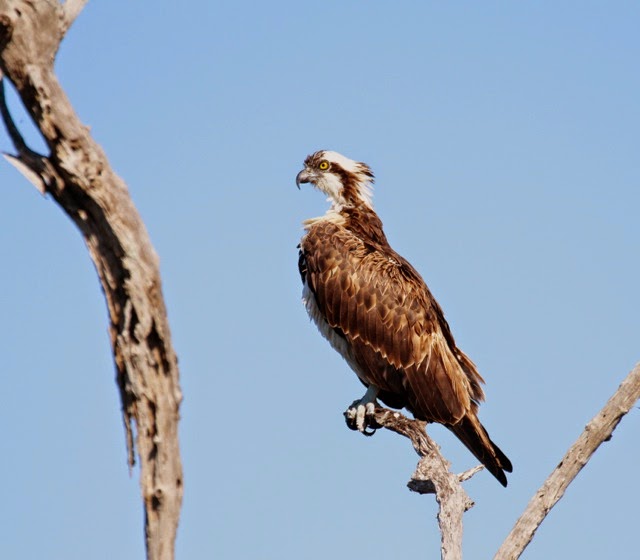
No, sir, we don't, and I'm very glad to see one of you on almost every lamppost on every bridge. Blown away, in fact, and reeling. It is a fine world we live in, where ospreys are as common as gulls. That speaks well for the fish, and for the bay, and for the people of Florida.
More Panoquinas, all salt marsh skippers:
That long white window on the hindwing is a great field mark.
I am so grateful for the Google. Now I can almost always find out what it is I've seen. I can put names to things. And that is the greatest luxury and most nourishing food for a curious Science Chimp. Even if it takes years to do it, the most delicious thing for me is to learn.
Lesser scaup, or bluebill. Liam asked me what the ducks with the blue bills were and I replied, "Bluebills."
Hunter names are often better than birder names.
I know it's a lesser scaup because of the purple sheen on its peaked head, the small size and the heavy vermiculation barring its grayish back and sides. Greater scaup have green-glossed rounded heads, a broader bill with larger black "nail" on the end, and almost pure white backs and sides. And they don't tend to hang out in these marshes back of dunes. I see a LOT more lesser scaup in my peregrinations than greaters.
Do you have oodles of us?
|
Widget for blogger by Way2Blogging | Via Spice Up Your Blog Gadgets
|
Pink Flamingos, Happy Boy
Thursday, February 5, 2015
10 commentsThe first thing Liam and I did upon arriving at Merritt Island NWR near Titusville, FL, was to stop right on the road for a bald eagle who was hangin' out on a power pole. I have been there a bunch of times and I'd never seen that. Now, maybe I'm supposed to be blase about an enormous sea eagle 30' over my head. But I'm not. A truck honked at us and swerved, gunning its engine, and it was then I realized it was probably stupid of me to stop on the main road. But still. I was overwhelmed. And as it turned out, we never saw another eagle perched so close. I was glad we'd taken the time to ogle it. Liam took this photo! (I kept handing him my camera, as all the best wildlife was out the passenger side of the car. Wink, wink.)
Great big and itty bitty Florida cooters near the Merritt Island Visitor Center. I want to name a dog Cooter.
Another Liam shot of a majestic high-headed gator. Ahh. Such a grand reptile.
He scrounged a palm frond petiole and took to leaping and poking.
I always forget that roseate spoonbills have head skin the color of used chewing gum. Freaky greenish-blue. That's a winter American avocet exiting, stage left.
We were in Florida for a week and saw oodles of spoonbills, but I never once got used to seeing a large flaming pink bird. I'm glad of that. May I never get used to spoonbills.
I had a good (silent, inner) chuckle when a woman I was standing near on a viewing platform asked me if I'd seen the flamingo go over.
"I saw a roseate spoonbill go over just a bit ago, but no flamingo."
"This was a flamingo."
I chewed that over for awhile and decided the fate of the world didn't ride on whether she'd seen a flamingo or not. Flamingos may sometimes be found very sparingly in the Florida Keys. A day's drive south of Titusville.
I replied simply, "Cool!" and ambled off. About twenty minutes later I was peering intently into a shrub at a common yellowthroat. The same woman came up behind me. "What are you looking at?" she asked.
"Common yellowthroat, male, right at the water's edge."
"Really? Now who'd ever think to stop and look at something like that?" she exclaimed.
That took me by surprise. Huh?? I actually laughed out loud. What a bizarre thing to say!
I turned around and smiled at her, meeting her eyes.
"That pink bird you saw fly over? Roseate spoonbill. Flamingos are found only in the Keys, and they're super rare."
"Oh! OK."
Never can pass up a teaching moment, and she'd given me permission to correct her (kindly) by asking me what I was looking at, and making a comment that told me she didn't yet know a hawk from a handsaw. Seemed like the right thing to do, to tell her she'd seen a spoonbill, so she wouldn't go around calling them flamingos to everybody she ran into. Kind of like wiping a daub of ketchup off somebody's lapel.
Or shoulder...I never tire of trying to get a peek or a picture of a spoonbill's saffron tail. Not to mention the used-bubblegum head.
Binocular vision in a young tricolored heron. I like his tighty whities.
Really, what a lovely bird, all painted with rufous. Saw so many of them and never tired of the "Lady of the Lake," either. Pure elegance on the wing or on foot. I do miss the name "Lousiana heron."
When I was a teen, I was pretty sure I'd never get to see a wood stork in my lifetime. They were almost extinct then. I felt the same about brown pelicans and bald eagles. Imagine. I'm that old. But I'm not that old. They've recovered that quickly! There is so much to celebrate in conservation today. Forget the gloom. There are bald eagles on the power poles, and wood storks walking around on lawns and roadside ditches. And that, to me, is a miracle.
Liam liked this wood stork. He narrated its preening. I love birding with Liam.
A raft of northern pintails, hauled out. They have the right idea. Breed in the prairie potholes, winter along the Florida coast. I could dig that seasonal regime, if I had somebody to fly with.
Another Liam Thompson shot, of shovelers! Watch out world, he's got a telephoto!
He's not bad with an iPhone camera, either. Selfie by the pool... taken for his sister who was freezing her patootie off in a Maine snowstorm at that moment. He said it was so bright he couldn't see the palm tree until he got back in the room. Classic shot!
Yes, it's always worth yanking the kid out of school for a week in January. Never more emphatically so than this January. He told me today (Feb. 2) that he's finally caught up with schoolwork and back in the groove. And that the Florida vacation was worth every minute of grief since he got back.
Atta boy! Way to live.
|
Widget for blogger by Way2Blogging | Via Spice Up Your Blog Gadgets
|


_(cropped).jpg)


Sunday, February 15, 2015
10 comments