Background Switcher (Hidden)

Showing posts with label Lobelia cardinalis. Show all posts

Young Hummingbirds On the Loose!

Wednesday, August 4, 2021

6 comments

Summer. I love it. But I really, really love August, a month that doesn't get much respect because people remember it as too hot, too humid, too something or other. Here's how I see August. Everything is still growing and blooming as hard as it can. Baby birds have fledged, by and large, and are absolutely everywhere, at least on my ridgetop in southeast Ohio. Wherever I walk, I'm scolded by parent birds, who are telling me they have young ones hidden nearby. I hear a strange continuous rustling in pine needles and follow the sound to a male hooded warbler, puffed up, tail dragging, skittering slowly over the forest floor as he leads my eyes inexorably away from his nest. It is SO cool. To enjoy August, all you have to do is stop complaining and show up.


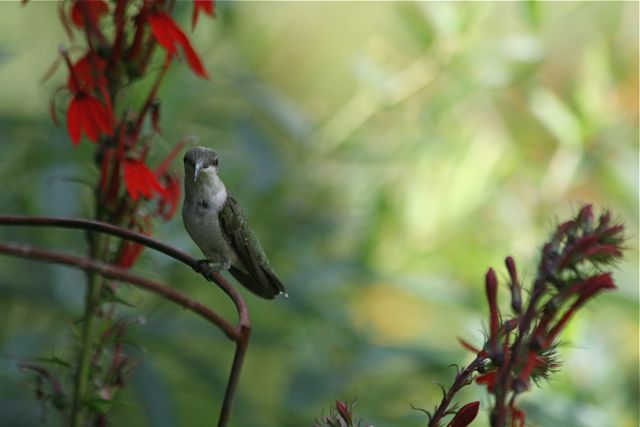
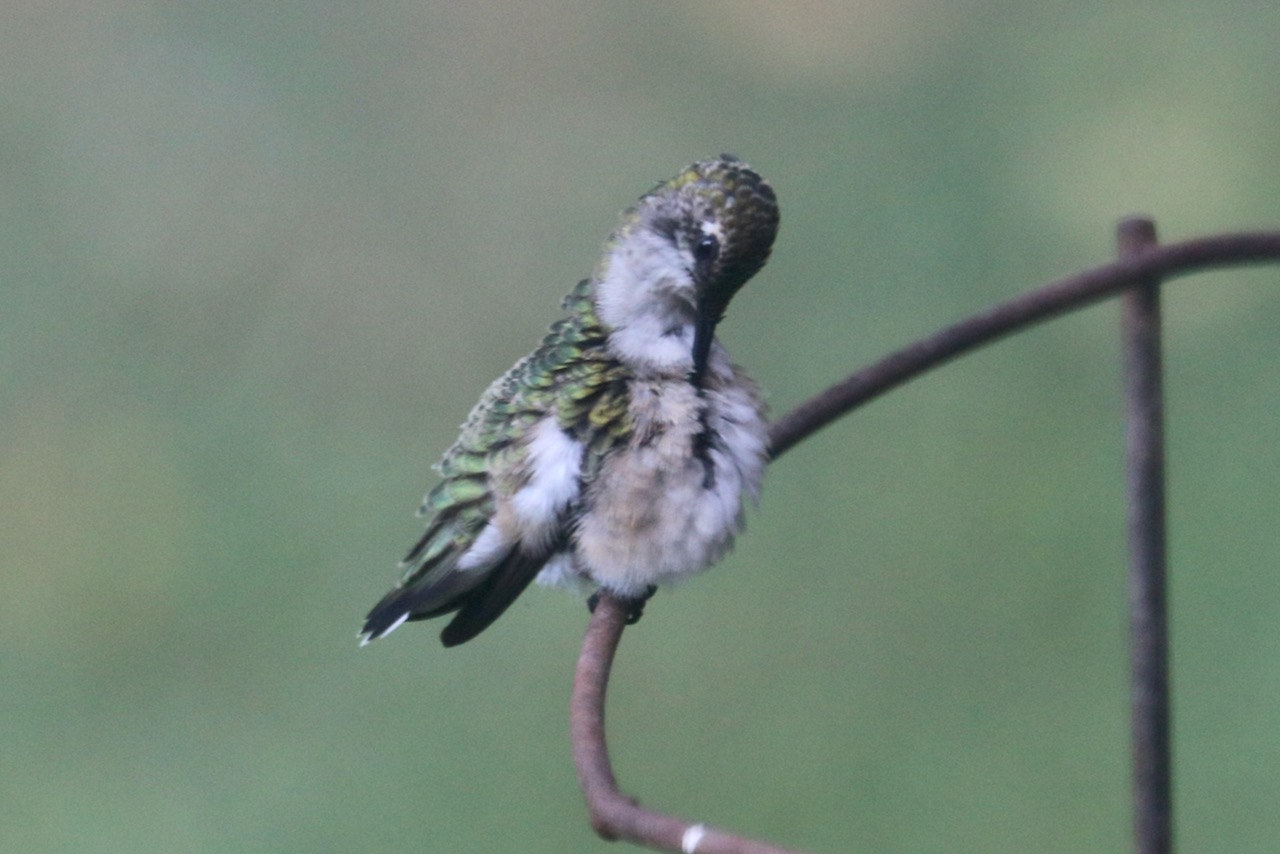
This is a typical move by a juvenile ruby-throated hummingbird. Young flight muscles tire easily, so they're always looking for a place to stand while learning to ply the flowers for nectar. You will not see an adult rubythroat busting a move like this.

They vie for privileges at the crocosmia blossoms with spicebush swallowtails. Crocosmia "Lucifer" is native to Africa, and is naturalized in places like Costa Rica and Scotland, my goodness. While it spreads in my beds, I haven't seen it popping up in other places in my yard or in southern Ohio. It grows from a bulb, but you don't have to lift it in the winter. Just leave it right where it is! For whatever reason, mine just went NUTS this summer of 2021. It was a gift from my friend Bonnie many years ago, but this year it took center stage, delighting the hummingbirds and swallowtails and me.

The young hummingbirds stop frequently to rest and preen.


I love being in on the intimate moments when they're acting like birds instead of insect helicopters.
Sometimes, when the sunlight is bright and clear and striking the flowers just below my studio window, I get some acceptable photos. Like this one:

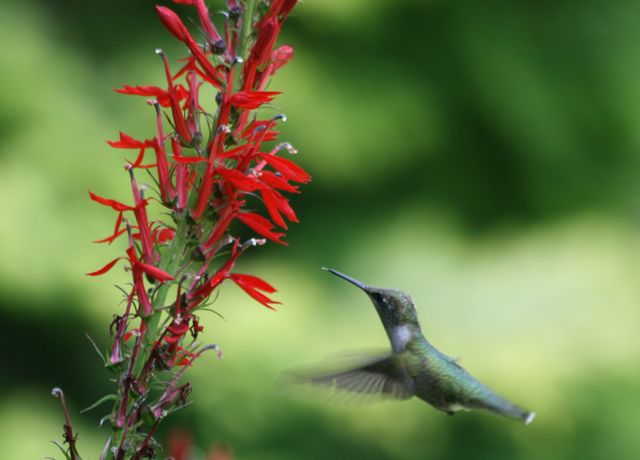
And this one, which is one of the better hummingbird photos I've taken. The trick is having sufficient light and fast enough shutter speed to freeze those wings.The brighter it is out there, the more likely you are to be happy with your shot.

I absolutely love the video game thrill of keeping my lens on a rapidly moving hummingbird. Or warbler, for that matter.
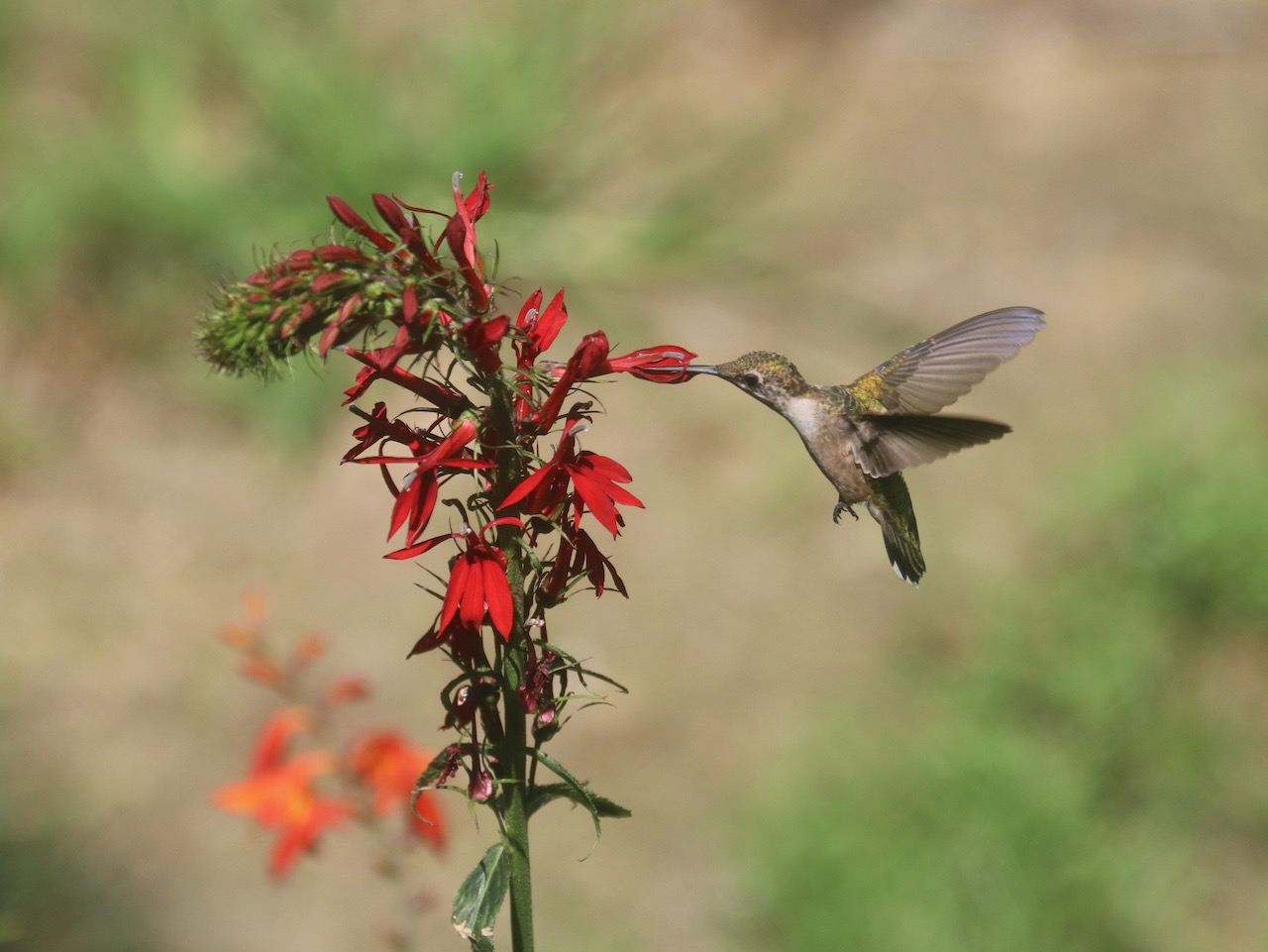
Pretty little glittering scrap of life, lighting up my world.

 I'm very grateful that the stem borers that attacked and killed my cardinalflowers last summer are nowhere to be seen this summer. This hardy native has thrown seed children all over the bed where it first started, and marched up along the north side of the house. I've aided the dispersal, transplanting many seedlings up into the front yard beds, which is now aflame with crimson blossoms and the little green sprites who feed on them. It is most satisfying. I've also given lots of cardinalflower seedlings to local friends, who very much appreciate these Ohio-tested natives adapted to our conditions. The trick in growing and propagating cardinalflower is not to deadhead it. Let it go to seed and disperse, then lay the ripe seedheads on bare soil where you want it to come up. Don't mulch a cardinalflower bed! you'll inhibit recruitment of seedlings. Do keep it moist. Be generous with water, especially in dry spells. 
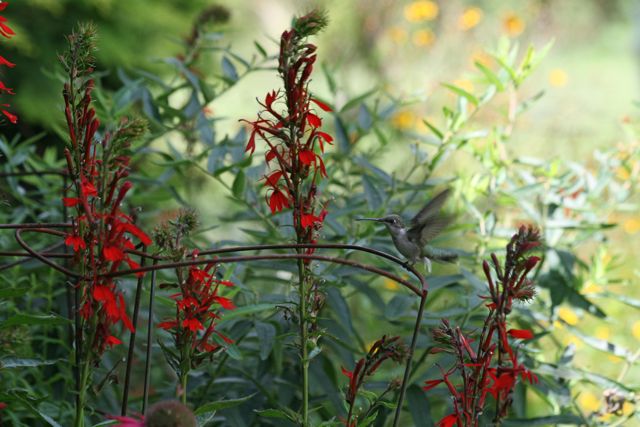
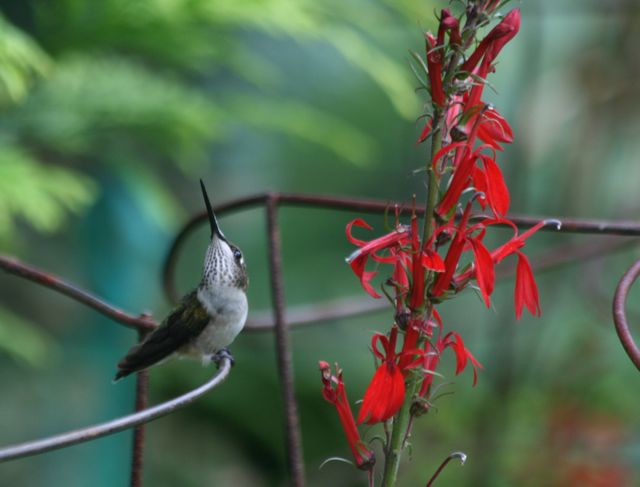
Super tall stalks appreciate support, and hummingbirds love to perch on the rungs of tomato cages, too. Win-win. 
 
This is how the original bed, which I've had going for at least 20 years, looked in 2017. Borers killed these plants, but new ones have spring up and will soon be as tall and beautiful as the originals. In the meantime, the crocosmia has spread like mad, and I'll have to take some of it out to make room for more cardinalflower. A great problem to have!
 

Feeders are fine, as long as you keep them absolutely spotless and free of mold and bacteria. But there's nothing like watching hummingbirds feed the way they were designed to, at the plants they evolved with. Plant it and they will come!

JZ


Hummingbird Gardening

Sunday, August 24, 2008

21 comments


It had to happen, sooner or later. The hummingbirds are leaving us. I had been running two "World's Largest" Perky Pet feeders, which hold about a gallon apiece. I was making nectar about every three days, which tells you that I had a whole mess o' hummers here, maybe 10 or 15 at one time. By the timeworn formula, multiplying the number I could count times six, I had from 60-90 birds using my feeder. But they all started to depart on August 22, and I'm down to one feeder, and I fill it about 1/10 full...sigh. I already miss the humming masses.

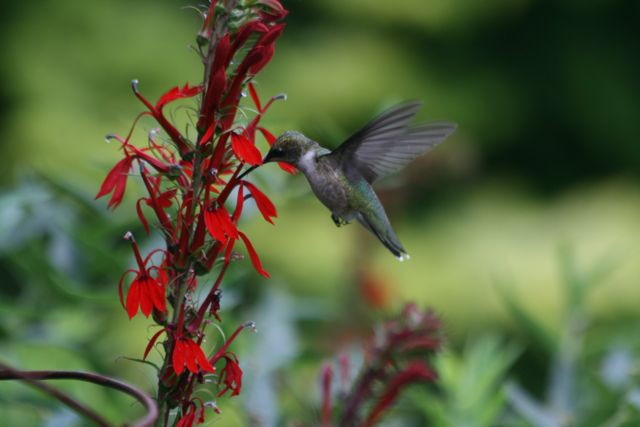
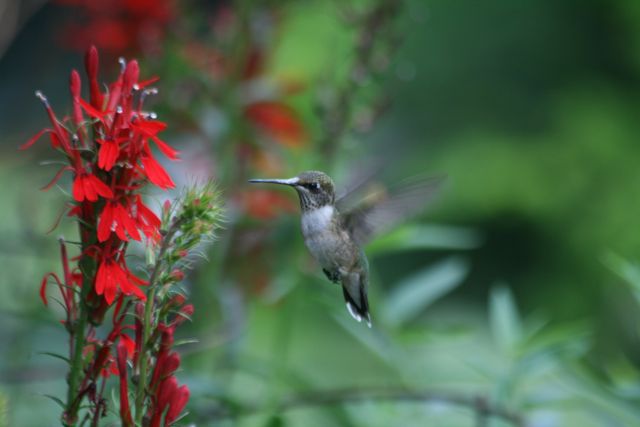
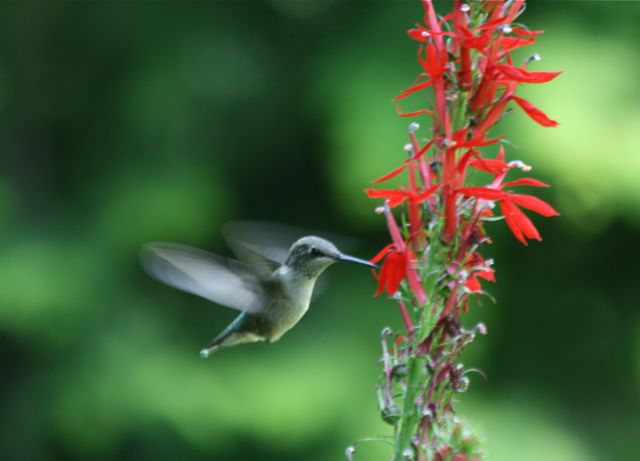
While the hummer numbers were at their height, I took a lawnchair out to the cardinalflower beds one sunny morning, and fired away. The beds were in shade, with bright sunny background behind, so there was bounce light, but nothing direct. I liked the moody result--different from most hummingbird photos, which tend to be bathed in sun or (worse) flash strobe. Blaaa. I think a hummingbird's wings should blur, because that's how we see them in real life.

But I played with exposures and ISO and managed to freeze the bird's wings for one shot:
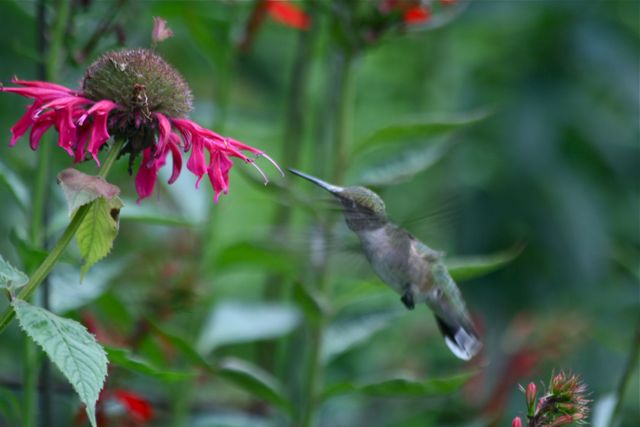
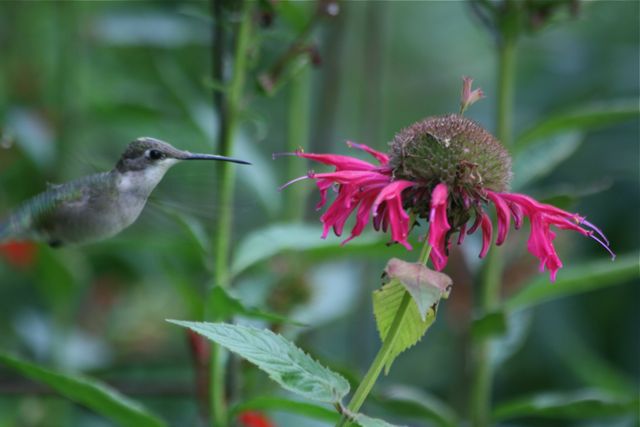
and then I relaxed and let them blur as they should. This is a young male, evidenced by his heavy throat streaking. Catch those green streaks in sunlight, and you may see a ruby glinting at you. I absolutely love this shot, of a bird feeding from my bee balm:
It's a gauzy fairy, suspended in air as if by magic. I was mercilessly baking my bee balm in a full-sun bed when I conferred with my garden landscaping friend Tim, oracle of all things planty. "You're cooking it. That's why its leaves turn yellow in mid-summer." So I dug it all up and put it in the north-facing moist cardinalflower bed in the shade of my heirloom lilac. It's the first time I've ever transplanted anything and not had it wilt. It was as if the bee balm had come home at last. I can't wait until next year. It ought to come roaring back. Monarda is a top fab fave of hummingbirds.
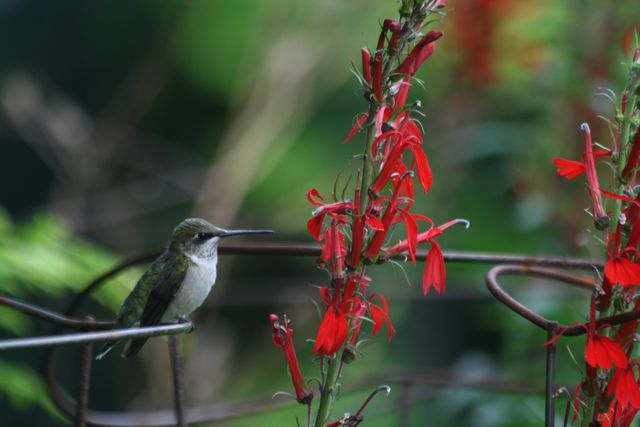
A lot of people are surprised to find that ruby-throats like to perch rather than hover when they're feeding. You have to hang around and watch them for awhile to get that simple truth.
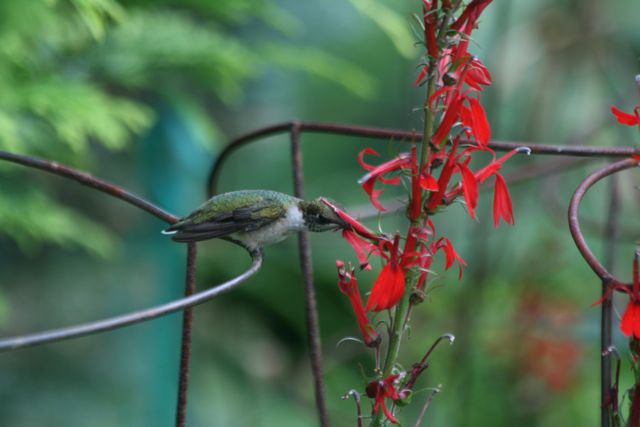
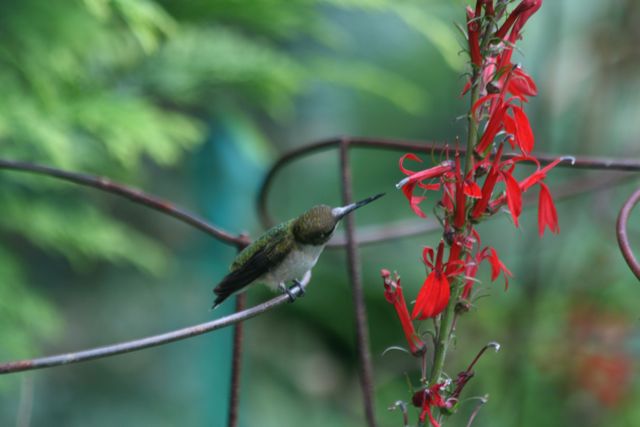
Would you run in place while eating if you had a choice to run or sit down? Would you stand at the sink and gobble something down if there were a table and chair nearby? (Mothers are disqualified from answering). No, a normal person wouldn't, and neither would a hummingbird. Witness this:
and this:
See the white cardinalflower pollen on his snoot? He's been making seeds for the plants.

I keep these little wire cages around my cardinalflower, even though they're pretty much self-supporting, because the hummers love to perch on them. They're great for watching for rivals
below and above.
The Lobelia cardinalis that I've got here are all seed children from a couple of plants from Land Reformers Nursery here in southern Ohio. They specialize in Ohio-grown native plants. I've bought lots of cardinalflower over the years, but the only ones that have survived and prospered and made babies are the native ones from Land Reformers. Hint: When they go to seed and the capsules ripen, I break them off and lay them where I want more cardinalflower. Keep them watered and the soil open, and you should have more next year. They bloom in their second year of life. What a marvelous plant.
They are beautiful, and they attract the beautiful, and they bloom when everything else (of a cultivated sort) is gasping its last in the garden, when all the wildflowers go crazy in the meadows and streambanks.
Ahh, the gift of hummingbirds and cardinalflower. I savor them while I may.
[Back to Top]