Background Switcher (Hidden)

Showing posts with label American goldfinch. Show all posts

About that Goldfinch

Friday, March 28, 2025

0 comments

On February 27, a sick goldfinch I'd been watching for a week or more finally became blind enough to catch. Her eyes had sealed all but shut. I walked up on her blind side, and caught her in my hand as she sat on the platform feeder.  Here's how she looked from above, her eyes so swollen by Mycoplasma  infection that her entire head looked weird and big. This is called house finch disease, because house finches are the primary vector. They first caught it in the early 1990's from our domestic chickens, and have little resistance to it. And now house finches have spread it to more than 35 species of wild birds. I like house finches. Nice little birds. I hate house finch disease. 

It's a painful thing, as you can see from her swollen red eyelids. 


She sat, quiet and still and mute. The first thing to do was mix up some tylosin tartrate (Tylan), an antibiotic effective against Mycoplasma spp. , which I get from my veterinarian. I held her in my hand as I administered that solution, drop by drop. Birds with house finch disease are very thirsty, and spend lots of time sitting on bird baths, which of course allows them to infect lots of other birds. I wanted to get this bird out of the mix at my feeder, so I caught her and put her in a small plastic Critter Keeper with a couple of small crocks of hulled sunflower seed and medicated water. By that evening, her eyes had opened enough so she could see me! It always feels like a miracle that Tylan works that fast. But she had a long way to go. To clear her system of the germ, I'd have to medicate her for three weeks. 


But here's the good part. Once she could see, I could move her into a large cage. Then, all I had to do was keep her in fresh Tylan-medicated water and food, and leave her the heck alone. The healing was up to her. 


Here she was only a week later. Understand: she wasn't always this agitated. This behavior is elicited by my entering the room and making a video. She was perfectly calm until she saw me! I was the monster who caught her and made her drink medicine.


By March 12, she was looking and acting ever so much better.


She'd had two weeks of treatment when I had to leave to speak at the Michigan Bluebird Festival. I left her in the loving care of my neighbor, Martha J., who is a bird whisperer. When I saw her last, canary babies had just hatched in two nests in her bird room! Martha kept my goldfinch isolated in a back room for almost a week, until I got back with Phoebe in tow. I felt confident leaving the wild bird with Martha, because she'd been medicated for two weeks and was asymptomatic, and Martha was careful about containment. I'm very grateful she could step in. Thank you SO much, Martha!!  It's really hard to do wildlife rehab when you travel for work.

Only one day to go until release time! I put her in the basement because Liam came home for a few days to see us, and I couldn't use his bedroom as a finch sanctuary any more. She's sharing space with an enormous geranium called Frank Headley, one of three huge mother plants I have kept over the winter. Ain't it gorgeous? A semi-dwarf zonal geranium developed in the U.K. in 1957. I adore it and plan to propagate it very soon. 


Finally, March 20 came. I love this little release video Phoebe made. Goldfinches don't stop to say thanks and goodbye. They just GO. 


May this bird be the only sick one I treat this spring. There's an element of luck to it, but more to the point, I'm not using tube feeders--only port-free mesh cylinders and small platform feeders. Everything is covered by hanging acrylic domes that keep droppings from falling into the food. 

I'm feeding sunflower hearts, safflower, and peanuts both in and out of shell in a small gray hanging platform feeder (behind the cylindrical peanut feeder), and suet and black oil sunflower hang from the other two hooks.


I just ran outside to shoot these photos. Brrr!! It's 56 and incredibly blustery. Gusts up to 39 mph make it feel like about 40 degrees out there! This is a somewhat better look at the small platform feeder in the foreground. I love this one because the birds tend to perch on the rim to feed, butts over the ground, and don't crap into their food. Good feeder hygiene is all about controlling poop.  And I don't use tube feeders because goopy sick bird eyes rub against the ports. So think about that. If you've got disease at your feeders, your first best step is to discontinue using tube feeders. Next, stop feeding when the weather is reliably warm. If you feed all summer long, you'll probably wind up feeding familes of house finches, who will happily breed nearby, producing multiple broods. Yay! you'll have even more disease vectors for your feeding program. See the connection?


My hanging system is the Denali Squirrel Stopper with four hooks, made by JCS Wildlife.
I save SO much money on seed now that the squirrels can't make it up the pole! The sliding baffle is very effective, as long as they can't leap from a nearby tree--which they sometimes manage to do.

Thought you'd appreciate some birdfeeding tips from someone who's been at it since she was about 10. Hard-won experience has led me to the conclusions I state here. Farewell, little goldfinch, and try to stay out of trouble now.


Florence Nightingale, Meet Elmer Fudd: Still Helping Goldfinches

Tuesday, March 30, 2021

7 comments


Well, folks, I'm still at it, doctoring, feeding, and cleaning up after --would you believe it--a total of 17 American goldfinches, installed in five different cages around my house. Capacity is at an all-time high as of this writing on March 26, and I'm actually blogging about it now so I don't forget in the excitement of the coming week, when I get to release a bunch of them at long, long last! My "morning practice" of heading out to see the sun rise has, since February 20 when I caught my first sick goldfinch, been replaced by janitorial duties. That's OK. I just postpone the hike with Curtis until they've been fed, medicated and watered. 

Since I wrote "Caught in the Whirlpool," admissions have slowed but not entirely halted. In the last three days, I've caught two more, and I have my eye on a little female who can still see well enough to evade me.

The huge flock of goldfinches--60  or more--that deposited these waifs at my doorstep is long gone. The tube feeders that attracted them are, too, likely never to be used again. I really want out of this loop, but I'm much more sanguine about it now that I have some releases coming up and recruitment of patients has slowed to a trickle. This is a typical scenario for me in the past month or so...

I make a delicious lunch of cranberry pecan chicken salad over tower-grown lettuce and head down to the new patio with a happy sigh to consume it in the spring sunshine. Self-care, yep! I'm doing it today!


And while I am sitting there, before I even get to take the first bite, the unbelievable occurs again...
a blinded goldfinch flutters down to the patio. This is the second time this has happened. 
How is a bird rehabber to get anything to eat? 

I put my salad on the terrace wall and advance.


 Can I document the hand-capture of a wild American goldfinch two times in a row?  It really helps when they're finally and totally blind. But I have to say, I am mystified and enchanted by the fact that two blinded birds--both females-- have raised the white flag and come to me when I least expected it. 


I got the bulk of my patients by creeping up on the tube feeders and snatching them off their perches. It was pretty easy to block their dim view of me using the feeder posts. After I took the tube feeders down, having made the connection between the feeder ports and disease transmission,  I had to get craftier.

I took to using my koi net, which has a long, telescoping handle. This is a really groovy way to catch the birds, since you don't have to get right up on top of them to nab them. I owe this Elmer Fudd video tribute to Shila Wilson, who, unbeknownst to me, was standing in the studio and ready with her iPhone when I grabbed the opportunity to try to catch an extremely elusive bird. Shh. Be vewwy, vewwy quiet. I'm hunting Gowdfinches!


Don't know about you, but I find this video unintentionawwy hiwawious. Something about the way there's nothing happening, and then this black net just cweeps in from stage left...and then you have me, so totawwy focused on the stalk...it's just hiwawious. And perfect that I didn't catch the little blighter after all that trouble.

Another bird who gave me the swip again and again is this one. I kept cweeping up on him with my Fuddnet, and he kept swipping out from under it wike quicksiwver. When I finawwy got him I was ewated! 

I named this bird Mr. Netinyahoo, because he was so hard to catch.


I'm sure Mr. Netinyahoo is a career criminal. Just look at that shifty face. He's plotting even as I grip him in my Gentle Cobra grasp. I'd only had him for a day when I opened his Pet Taxi to re-up his food and water and he flipped right out the door. Straight up to the clerestory windows he went, well above the reach of hand or net. 


That meant only one thing. I would have to bring the dreaded 17' extension ladder into the living room. 


This ladder is very heavy and unwieldy, and getting it in the front door is an adventure in cussing and trying not to not break something (window; Hoosier cabinet, mirror, lamp...) Luckily, once a goldfinch picks a window to flutter against, they tend to stay there.  Unlike hummingbirds, which rapidly switch windows, making you set the ladder up several times before you finally are able to nab them. You can see the tiny dark blip of Mr. Netinyahoo's head in the middle clerestory. Obviously this isn't my first rodeo, catching birds in the clerestory windows. 


I tried a bunch of times to extend the ladder but it kept collapsing. No way was I going to extend that thing only to have it suddenly retract and send me to the floor. So I said a prayer that I'd be able to reach him with the ladder unextended, called Shila to tell her I was about to do something dumb, and climbed up. At least somebody a half hour away by car would know I'd fallen... I caught him handily and started my descent. I couldn't see the underslung last step as I came down and missed it. Tumbled into a straw ottoman which nicely broke my fall. I rolled a bit, holding my precious cargo high in my right hand. He was unharmed, and so was I! But his little eyes were both screwed shut, which I found very touching. He probably thought he was toast when I went down.

And there may be yet a third way to catch a goldfinch. I'm getting cwaftier and cwaftier! I recently installed a New and Improved Secret Studio Feeder, which avid readers and social media followers will remember from 2017, when Jemima visited it for chicken breast, basmati rice, pecans, sugar snap peas, raspberries and the like. I went looking for a nice narrow plexi drawer organizer that I could wire up under my crank-out studio window, installed some plastic cups, and now I have a steady stream of awesome birds right up close to enjoy. My idea was to be able to offer some special foods like Zick dough and sunflower hearts to my beloved regulars without attracting big flocks of house and gold finches who would carry disease.

And wouldn't you know, a little female goldfinch with one squinty eye figured out how to get in there and eat. Bless her little heart! Needless to say, I'll be ready when she's finally robbed of her sight. I'm so touched that she spotted the sunflower hearts and had the courage to come in for food. That's a stretch for a goldfinch. They are sweet birds, but they are not innovators, the way titmice, Carolina wrens, blue jays and even chipping sparrows, to name a few, can be.


I am delighted to report that on March 29, this bird's good eye finally closed and I heard her toenails on the plexi of my new feeding station. Oh my gosh, there she was. BUT the screen was in, and the window was closed. Well, it was worth a try. Stealthily, I removed the screen. Still she sat and ate. Even more stealthily, I cranked the window out. The bottom of the window brushed the top of her head as it oh-so-slowly opened. Still she sat! One pounce of the Gentle Cobra and she was mine--the last of the last of the last sick goldfinches, I pray! I was beyond delighted to finally have her in my mitt.


So the saga continues. I sincerely hope to be able to stop running a goldfinch hospital in the nearish future. As is, with the birds I've got, I'll be caring for birds into the third week of April. Good thing I've done my taxes.

And speaking of taxing, I humbly thank you all for reading, and staying with me on this bizarre journey. Special thanks to those of you who have chosen to support my madness with blog donations. You don't have to! I got this! but you are very kind and I am grateful. I keep doing it because I feel terrible that goldfinches seem to be succumbing to the disease, usually mostly the province of house finches, in such alarming numbers this spring. I don't know why that is, or what has changed--has the bacterium mutated? But it's clear that their resistance to this awful disease is poor. 

I keep doing it because I love goldfinches, and if I have had any part in making them ill, I want to make them whole again.

I keep doing it because there's nothing quite like helping a blind bird see again. The only thing that's better than that is seeing a caged bird fly again. To my dear friend Donna I owe this poem excerpt, which she sent me on hearing my caged goldfinch singing. 

Everyone suddenly burst out singing; And I was filled with such delight As prisoned birds must find in freedom Winging wildly across the white Orchards and dark green fields; on; on; and out of sight. Everyone's voice was suddenly lifted, And beauty came like the setting sun. My heart was shaken with tears and horror Drifted away ... O but every one Was a bird; and the song was wordless; the singing will never be done.

Sigfried Sassoon


The best little singer of the bunch really tuned up in the four days before his release. Since his cage was in the foyer, I got to enjoy it all day long from the adjacent studio.


And now, watch that beautiful singer and his female friend go free!


A Song for No One

Wednesday, June 27, 2018

7 comments
 I've been running daily, and it feels so right. It helps to have Phoebe in the house; she's my inspiration and personal fitness advocate. We don't run together, because we'd be running together a half mile apart, ha! But we do bike together, and there is not much that's more fun than zooming down these hills and toiling up them with my kids. Proud to be a beast, schooled by the endless Appalachian foothills.

I usually run on my road, but I need a change of scenery now and then. Because I make lists of all the birds I hear and see on each run, it's fun to change it up and see what's singing elsewhere. I can get 50 species on my two-mile stretch of road in a single run in mid-June. The number I can hear drops steadily throughout June and July, not because there are fewer birds, but because they're too busy making more of them to sing. Boy, do I know the feeling. Busy launching my fledglings and painting pictures. It kind of rules out spending a lot of time behind the keyboard.

So I took a different road, and I found some beautiful things. If I didn't already love chicory for its inimitable blue, it's even more ravishing when punctuated by goldfinches.


 You can't crop off the guardrail or the road. They're part of the story, and beautiful too, for the way they curl through the composition.


A decrepit fenceline only adds to the charm.


It was on this road that I heard a song that stopped me in my tracks. It was coming from deep in the woods, that sloped steeply away from the road.
It was a hermit thrush.
Hermit thrushes are usually denizens of cool boreal forest. In Ohio, they seek out pockets of hemlock, with the refrigerated microclimates that go along with deep rock chasms.  The closest hermit thrushes nest in the Hocking Hills, a two-hour drive west of here.

Hermit thrushes aren't supposed to be here. My county, Washington, is the big one, five up from the bottom, on the right, the one with the notch in it. Where hermits are concerned, it's blank, for Not Reported. And as you can see, there are precious few hermit thrush breeding records statewide. That's because there's precious little hemlock habitat in Ohio, and what we have is suffering badly from the hemlock wooly adelgid, a nasty gummy white sap-sucking insect from Asia. I watched in horror as it wiped out Connecticut's hemlocks in the late 1980's, and now it's happening here. I can think of only two places in Washington Co. that have any hemlock, and I'm afraid to go look at them, afraid of what I'll find.


I borrowed this map from the Second Atlas of Breeding Birds in Ohio, the one with the Zick cover. I still get a big grin on my face every time I pull this book out for reference.  It came out in April 2016, the same spring that Baby Birds did. I was so durn proud to paint the cover for my beloved state's atlas, I can't even tell you. I sure hope they ask me to paint the Third Atlas of Breeding Birds cover, whenever that comes out! I hope I can still see to paint then!


Here's what it says inside. Author Paul Rodewald goes on to prognosticate that the hermit thrush may decline even more in Ohio, with the death of our hemlocks. The state has designated hermit thrush as a Species of Special Interest. 


No kidding. I was taking a special interest in this songster, hearing him on June 23, 2018, when he "should" have been far, far to the north or west, in our special pocket of HETH habitat in the Hocking Hills. 


And yet he was here. And he was lighting up the forest with his song. I'd never heard a hermit sing in Ohio in June. I made some recordings, which increased in quality over the next few days. I'll subject you only to the good ones. I could listen to them all day.


It is instantly addicting to spend a sunrise in this forest with that bird sending out silver spirals of notes, to no one. Or to someone. I have been there three times now, and I want to go there every morning.

I've never been in a woodland precisely like this one. The reason it is unique is, I'm afraid, anthropogenic. Which is to say the hand of man is heavy on this land.

There is no understory vegetation in this forest. And this is the chewed-upon pelvis bone of the reason why. 


People in this part of Ohio will fence and run cattle in the damnedest places. Well, they do it out West, too, put cattle in our national forests, our "multi-use" land. I won't pontificate on the propriety of that, but it isn't right ecologically to put cattle in a forest, either for the cattle or the forest. Cattle are descended from African ancestors. They belong on savannah; they belong on grasslands. Cattle eat grass. But, when forced by necessity, they will also eat anything that might try to come up in the understory of a forest. Which does not include grass.


So what you get when you've had cattle on a piece of land for decades, maybe hundreds of years, is topography like this. Deeply cut and eroded and trampled. And you can see for hundreds of yards. Now, that makes it pleasant to walk through, to be sure, but it is practically devoid of birds and wildflowers. I found some striped wintergreen, but most everything else trying to grow there was nonnative. Like the cattle.


Tromp and graze and cut it for enough decades, and the land becomes deeply eroded, with rivulets, most of them seasonal, running between artificial pillowed ridges. This landform was made by overgrazing. By people, and the cattle they put here. It happened when the forest was cut, grew back, was cut, grew back...and they never gave it a rest from grazing.


The Virginia pines, I'm thinking, dominate here because the cattle wouldn't eat them. Yes, it's a wholly artificial situation, atypical of the mixed deciduous forest in our area. There are a few beeches and red maples, but most of the cover is pine.

And pine, it seems, is close enough to hemlock for this hermit thrush. The missing understory, oddly, mimics that of hemlock forests. (Hemlocks poison plants that try to grow beneath them, and the ones that don't die get shaded out). This forest is cool and very dark, and there's lots of water. It must have felt like home to this wintering hermit thrush, enough so that he decided to stay.

 The forest is practically devoid of birds. Except This Bird. 

I kept visiting, hoping to see him singing. It was funny, being a pretty good lifelong birder, to keep coming home empty-handed. But he was singing high in the canopy first thing in the morning, and I just couldn't pick him up. 

So I lay down and made videos, imagining which treetop he might be in, while the silvery streamers of his song floated down and landed gently around me. I let hearing him be enough for me, and it was more than enough. 

 On June 26, I lay there so long--over an hour--that I zeroed in on the exact pine where I thought he might be. And then I got up and circled around, staring hard at the pine top, hoping. 

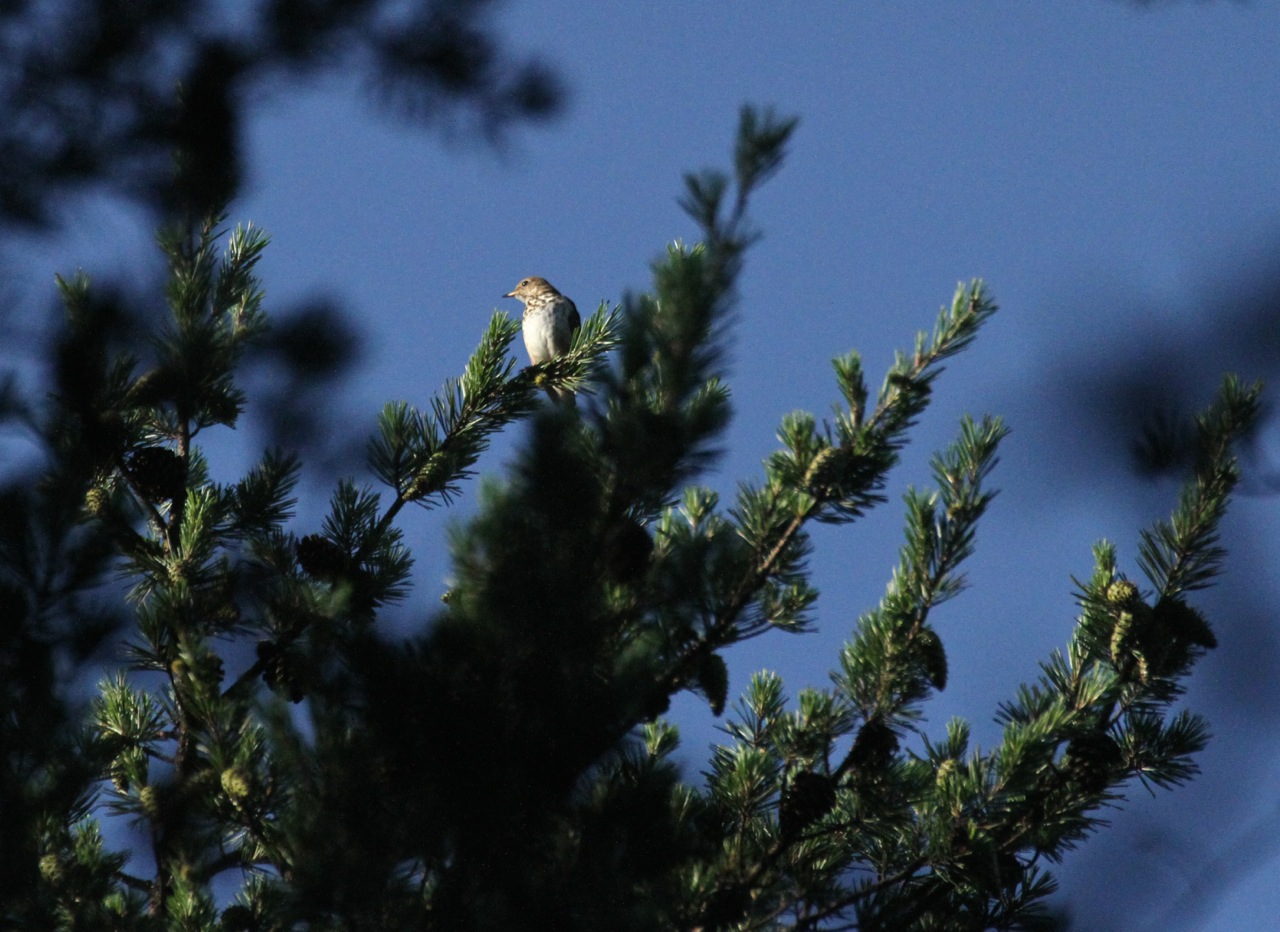
And I saw him. He was lit by the warm morning sun, a little white angel topping my best Christmas tree ever.


And he saw me. Hrrnh? A human?


But he didn't stop singing. He noted me and took me in and paused a few moments and then went right on with his homily.


And for that I was grateful. To see that song come out of his little yellow maw, well, it was a sweet reward for days of patient waiting. But it got better. I was positioning myself for a better shot, using a dead limb as a stabilizer, and he suddenly disappeared. After singing for at least an hour in one spot, he was gone. 

I saw something falling down through the canopy like a big brown leaf. It was him. He came down to have a closer look at me. 


It was so, so dark down where I was, but he paused just long enough for me to get a blurry shot that showed his rusty tail--the best mark for a hermit. 


He kept singing. And I saw another big brown leaf come up from the forest floor and land near him. It looked to me like another hermit thrush.

I left then, so as not to disturb them any further. I climbed out of the ravine, exalted by my brush with this finest of singers, thrilled that I hadn't frightened him; that instead of flying away, he'd chosen to come down to have a look at me. 


The light came through the windshield of an old junked truck, and I thought about all the crap humans leave behind on the land. Not just our junk, but our misuse and abuse of the land. We turn a bunch of animals that weigh a ton apiece loose in a forest and expect them to thrive. We never even give a thought to what our huge animals destroy; to the trails and ruts they carve in the land. We throw old cars and cans and bottles full of God knows what there, because it's a place to put junk where we won't have to look at it.


And the earth thanks us in a song like this, in a hymn for undeserving ears.


I work to deserve a song like this. I figure if I share it with you, and it brings you peace and wonder, the hermit thrush will like that. There's no way he could sing a song so beautiful without caring who hears it.


[Back to Top]