Background Switcher (Hidden)

Cur Love is Pure Love

Wednesday, November 6, 2019

6 comments
Remember Resusci-Annie? that big supercreepy close-eyed rubber mannequin we used to have to try to resuscitate in health class (after first wiping her lips with rubbing alcohol?) Was there anything grosser than that? Or more difficult? I could never, ever get a chest rise out of Annie, no matter how hard I blew. (yes, I've put a link there, and it's a heck of a tale, but please, read this post and then come back to it...)

Have a major life crisis or two, then leave your blog untended for a month and a half at a time, and you've got a Resusci-Annie on your hands. Flatlining. Dang. I blasted y'all with penguins and hyraxes, no... BABY penguins and hyraxes, and fully 384 of you (picture Dr. Evil, pinky to lips) partook! Come on. Penguins. Hyrax toes. Still no takers? Three hundred eighty-four hits...

I found an "article" in USA Today about "side hustles" that will add to your income. And one of the suggestions was Start a Blog. "Build your readership to a few hundred or thousands, and you can start selling advertising!" I took the red pen I keep on the kitchen table for just such inanities and circled the offending paragraph. Then I did one of my trademark HA. Ha. HAAAA's beneath it. In an increasingly inane publication, that was as inane as anything I've ever read. Blogging for fun and profit.

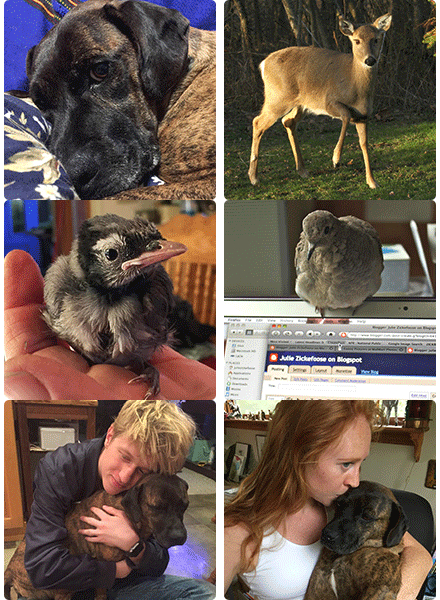
So this is a test. If pengins and hyraxes don't move you, will dogs? What about a little dome-head curdoggie? One whose tail never stops wagging?


 Still wagging. Tail always blurred. Oh, how this dog lights up my days. Just the joy he takes in being outside with me makes every hike special. To be able to lean down and throw my arms around this little creature...it keeps me going.


And then there is the daytime snorgling... he's too sexy for his bedspread.


Those of you who follow me on Facebook and Instagram are aware that I've been campaigning heavily on behalf of a certain Treeing Tennessee Brindle who is in very bad straits in West Virginia.
I was alerted to her existence by my friend Katie Fallon, who tagged me in a post back in late October, with a photo of a dog who could be Curtis' stunt double, or sister!

It turns out that this little cur was found collarless and lost in a park near Morgantown by a veterinarian named Nikki. Nikki brought her home, only to find that Ladycur, as we've been calling her, took exception to Nikki's dog. And others.

This is something you see every now and then, especially in female dogs...they just don't like being around other dogs.

In every other respect, she's a tail-wagging, supersweet brindle cur-ry dream. Good on a lead, and wonderful with people.


Ladycur is slender and well-muscled (though she looks a bit thin to me, having taken Curtis from 38 to 45 lb).


She's spayed and up to date on her shots. Nikki thinks she's around four years old (the gray muzzle is a cur thing and not indicative of advanced age). Her teeth are shiny white and perfect, which Curtis' are NOT.  Curtis is a known four and his whole chin is gray.

Little Ladycur has spent way too much time in cages lately, but Nikki has had no choice but to confine her while she's at work. And now she's keeping her at home, because the office environs were just too much, and there was no room for her there. Nikki would take her in a heartbeat if she'd just get along with the homedoggie, but it is not to be.


 Nikki's colleague has also joined the search for a one-dog household for this beautiful, sweet dog. Everyone who meets her falls in love with her.


Are you lonesome tonight? Would you consider opening your one-pet heart and home to Ladycur?


How I would love to help find her a forever home. And I would love for someone else to experience the kind of love a cur can give. Cur love is pure love.

Right, Curtis?


Ladycur says RIGHT. And Please?
and thank you. Share this far and wide, please. Let's find a home for this wonderful, somewhat persnickety dog.

If you're interested, email nbecichATgmailDOTcom

(wrote it that way to foil the scammers and bots)



Penguin Vs. Hyrax: Who Will Win the Battle for Cute Supremacy?

Sunday, November 3, 2019

5 comments

Boulders Beach in Cape Town, South Africa, hosts a thriving colony of African black-footed penguins, with a housing development and a bustling town just behind. It's a marvel of co-existence, a well-managed strip of coastal dune that's been preserved for the penguins. There's a thriving tourist industry, too, with a sort of turnstile setup to charge people to walk a boardwalk and see the birds at close range. 

 
 Most of the birds nest in tunnels in the shrubbery, though there are artificial nest boxes provided as well. When the chicks are old enough they come out and stand around on the sand. 


This penguin is guarding its chicks right at the edge of the parking lot--a good distance from the colony proper. They look fat and healthy. Two rangers who arrived while we were watching them were debating about moving them closer to the water, but decided to let well enough be. I can't imagine this adorable penguin would be fun to handle if it thought its chicks were being threatened. That beak is razor-sharp, and penguins are tremendously strong and fast little customers. 

Everywhere we looked, penguin life was going on apace. A youngster begs from its parent, and is soon rewarded with some fish slurry. Just look at the workboots on that baby.


When penguins go into molt, they can't go fishing, because their old feathers, which are being pushed out by the sleek new plumage, would soak up water. So they get really fat before they go into molt, and just fast for the time it takes to replace their plumage. It really looks quite miserable to have to molt and fast.


A blacksmith plover tiptoes through the colony. Just passing through, nothing to see here.


It was SO GREAT to see penguins with Raymond and Ann! Raymond and I were co-leading the Bird Watcher's Digest group, with the help of our Rockjumper guides.
Being able to share this incredible experience with such awesome friends was wonderful.


But penguins weren't the only thing to watch on this beach. There were rock hyraxes trundling through, too.


Not a guinea pig, though its shape might suggest that. Not a rodent!! Far from it. The rock hyrax's closest living relatives are manatees, dugongs and elephants. We know this bizarre thing primarily by comparing their dentition and their toes. Oh, the animal kingdom is a wonderful place to live!

This young hyrax was taking a dust bath in the sand. And it wound up almost killing me and Raymond with a concentrated dose of cute.  You should click on these photos to see the toesies.


He rolled around like a little butterball, toes up.


Stop. You're killing me! I wanted to squeeze him.


There you go. Hyrax toesies. And toofs. If you can't see the toofs, click on the picture.


Raymond and I were clickety clicking away as people trooped right past, as if rock hyraxes booble around in the sand every day! Well, they don't do that where we come from. Stop to watch, and you see the most marvelous things! We are both stop-to-watchers. It's the most fun thing to be.


I was so absorbed with penguin daily life and rock hyrax pulchritude that I almost forgot the incredible show that awaited at the end of the boardwalk. There, you can watch penguins come in from their fishing trips.


They swim like little bicolored torpedos. I did not succeed in capturing a photo of them porpoising through the waves, breaking the surface at great speed, airborne for a few moments, then diving right back beneath the surface. It is the most incredible sight. You aren't even sure what you're seeing, but when they slide onto the beach, you realize that those were not torpedos. They were birds. And penguins in the sea are a whole 'nother thing from penguins on the beach. On land, they are slow and a little awkward. In the sea, they are super-efficient fishing bullets.


They slide in on their stomachs and then haul themselves upright and walk up onto dry sand. There, they preen their freshly washed plumage, and it is the most beautiful symphony of black and white, circles and ovals, with the kelp ropes behind them echoing those patterns. 


Because I'm obsessed with telling one creature from another, I have to think these beautifully placed dots on their fronts are a code that essentially identifies each bird. 


What a treasure Boulders Beach is. What a privilege it is to live and walk amongst penguins, if only for an afternoon. And hyraxes. Let's not forget the hyraxes.


South Africa Bound!

Thursday, October 31, 2019

9 comments
Egad! Has it really been six weeks since my last post? Eek! That's scary enough for Halloween. I'm out of shape for this, and instead of blogging here, I'm spending way too much time throwing out content on Facebook and Instagram. I note my "captions" turning into paragraphs, turning into essays, and realize that I'm misusing these media; that I really should get those flying fingers back to their real home on this blog. Besides, I've got way more photos than anyone should try to share there. I'm making a nuisance of myself. This blog is where I should be putting my energy, getting those writing muscles back in shape after the big push of Saving Jemima.

Bla bla bla bla. Here's where I write and then delete a big self-confessional paragraph about all the stuff I've been dealing with as some kind of screwy rationale/apology for not blogging more often. Thank you, Phoebe, for helping me see this pattern and step around the pile of run-on writer's poo.  As my keenly self-observant daughter writes:
 
"Literally every time I've tried to start a post, I write one mega-paragraph about the swirling cocktail of emotions and thoughts in my head and why it's so damn hard for me to write about them, and then I get tired and/or distracted, and step away for long enough that the cycle begins again."

Elephant dreaming. Look at the tiny calf, and the sharp-angled forehead of its mama.

However. I have seen elephants. I've experienced hyenas.  And I've spent the last two weeks doing almost nothing but editing photos from the Bird Watcher's Digest Reader Rendezvous I accompanied, Oct. 1-11, 2019. I was asked to co-lead this trip because Bill had been lined up to do it, and at first it looked like he'd be too sick to go, and then it rapidly became clear he wouldn't even be here in October 2019, so I was tapped for the honor. Big sigh. Bill had been to South Africa once, but he never made it to The Kruger.

  This is how South Africans refer to their gigantic national park, where everything still lives and thrives despite the worst efforts of humanity to overcrowd and poach the wild things all away. Oh, is there living and wildlife and cool timeless awesome stuff going on there. So I did it for Bill, and for the subscribers who had signed up, and I did it for me, too, because I was pining for Africa. People say Africa gets into your blood, and it's true. It does. And one morning you wake up and say, "I need to go back." And I realize how incredibly fortunate I am to be in a position, whether by being asked to go, or by arranging my own group safaris through Holbrook Travel, to make that happen now and then. I don't take it for granted. And, like all my trips, this would be a working trip.

Scene along the Lower Sabie River, with Burchell's zebra and blue wildebeest coming to drink.

This was not a solo pilgrimage. Not by a long shot. We had 21 BWD subscribers signed up; two BWD guides (me and my dear friend Raymond Van Buskirk wheeee!!); two guides from Rockjumper Tailor-made Tours (Doug McCulloch and Rynart Bezuidenhout); an incredible bus driver for the Cape portion (Jacques Snyman); and three ridiculously good guides for the Kruger Park portion (Neil Watt, Heyn Neethling and Dirk Neethling).  That's a LOT of people to take on safari--25, not counting drivers, yeeoww! That means three packed safari vehicles and walkie-talkies between guides.  But Rynart Bezuidenhout planned and executed it incredibly well, and it was the trip of a lifetime. 

Leftmost guide: Doug McCulloch. Front row: Dirk Neethling, Neil Watt, Rynart Bezuidenhout, JZ, Raymond Van Buskirk, Heyn Neethling. Refraining from naming subscribers because some might prefer I not. Taken on Oct. 11, 2019, at Skukuza Camp, Kruger National Park, South Africa.

I was asked to write the trip up (in short form, which for Zick works out to almost 4,000 words) for the Bird Watcher's Digest Reader Rendezvous web page. I was glad to do this, because otherwise it could have just faded into memory, and this was a trip to remember forever. So I'll be relying on my trip report, painstakingly reconstructed, and embroidering where I feel like it, because blogging is embroidered writing. Illuminated, freeform. Like the birds and plants of Kirstenbosch Botanical Gardens.

Kirstenbosch Botanical Gardens is traditionally where weary travelers arriving in the Cape go, in the peculiar haze of having flown for perhaps 17 hours in one (usually hellish) flight. Kirstenbosch’s psychedelic botanical wonders, spectacular mountain backdrops, and gaily colored birds make for a fever dream when one is sleepless and bone-tired, and a pure delight after a night’s sleep. Endemic Cape sugarbirds and southern double-collared sunbirds were easy to photograph as they clambered among the big proteas. 

Scale is deceptive here. The king protea is the size of a dinnerplate, and the Cape sugarbird is the size of a brown thrasher, with a super-long tail, too. Sugarbirds are adapted to and dependent on the Proteaceae for nectar. Imagine such a huge bird living on nectar! They eat other things, too, but still.


Here's a southern double-collared sunbird. That's what I mean by "fever dream." Sunbirds are the Old World equivalent (sorta) of our hummingbirds, but they're too big and heavy to hover a lot, so they clamber. Still, they feed on nectar and small insects, and there are lots of plants designed (in an evolutionary sense) for their decurved bills.

 Cape white-eye on an I-have-no-idea-what. There's a lot of that going on botanically at Kirstenbosch. I did my best at identifying the plants, and my best wasn't very good.


A spotted eagle owl winked at us from over the rim of a hanging planter as she incubated her eggs. It's that kind of place. Magical.
 
I thank the gods and the early planners of these gardens that Kirstenbosch exists, educating and enlightening people about the incredible native plants of South Africa. Truly, this country is the cradle of so many fabulous ornamental plants, grown worldwide.
 
This bird-of-paradise (Strelitzia) is one of them! Who knew it was native to South Africa? Not me...I had thought they were Neotropical. Just goes to show you what you can learn at a botanic garden. I like the way the honeybee  is buzzing it.

Some of the birds were hard to miss, like this Cape francolin, strutting in the sun on a well-groomed lawn. Do click on the photo to enlarge it, and see its elegant tweed herringbone pattern! Click on all of them.

This Egyptian goose was also hard to miss. Unfortunately, I determined he had an injury, which is what made his left wing kind of hang out. But oh, the glory of it, with that neon green patch of secondary feathers! And he'll do just fine here, because he really doesn't need to fly to get what he needs.


But when they do fly, there's a neat central breast spot, as if all the other stuff weren't enough. Egyptian geese (Gyppos, after you've seen a few hundred of them) are extremely common all over South Africa, wherever there's some water to be had. Nice bird to be abundant!


 We had to work a lot harder for the elusive Cape batis. Batises are adorable, quick, cobby little birds who don't let you contemplate them for long. Taxonomically, they're sort of near the bushshrikes. There are many, many shrike-like birds in South Africa.


 Two notoriously skulky and hard-to-see species—forest canary and swee waxbill—foraged calmly at our feet, starting a run of lucky sightings that was to persist throughout this trip.


Forest canary, taking a leap. A pair was finding insects on the brick sidewalk, and schlepping them to their young.

You never see either forest canaries or swee waxbills like this! But we did, we did! and there was so much more delight to come!


and next would be...PENGUINS!! This one carrying a little stick, because that was his schtick.


[Back to Top]