Background Switcher (Hidden)

Showing posts with label rock hyrax. Show all posts

Penguin Vs. Hyrax: Who Will Win the Battle for Cute Supremacy?

Sunday, November 3, 2019

5 comments

Boulders Beach in Cape Town, South Africa, hosts a thriving colony of African black-footed penguins, with a housing development and a bustling town just behind. It's a marvel of co-existence, a well-managed strip of coastal dune that's been preserved for the penguins. There's a thriving tourist industry, too, with a sort of turnstile setup to charge people to walk a boardwalk and see the birds at close range. 

 
 Most of the birds nest in tunnels in the shrubbery, though there are artificial nest boxes provided as well. When the chicks are old enough they come out and stand around on the sand. 


This penguin is guarding its chicks right at the edge of the parking lot--a good distance from the colony proper. They look fat and healthy. Two rangers who arrived while we were watching them were debating about moving them closer to the water, but decided to let well enough be. I can't imagine this adorable penguin would be fun to handle if it thought its chicks were being threatened. That beak is razor-sharp, and penguins are tremendously strong and fast little customers. 

Everywhere we looked, penguin life was going on apace. A youngster begs from its parent, and is soon rewarded with some fish slurry. Just look at the workboots on that baby.


When penguins go into molt, they can't go fishing, because their old feathers, which are being pushed out by the sleek new plumage, would soak up water. So they get really fat before they go into molt, and just fast for the time it takes to replace their plumage. It really looks quite miserable to have to molt and fast.


A blacksmith plover tiptoes through the colony. Just passing through, nothing to see here.


It was SO GREAT to see penguins with Raymond and Ann! Raymond and I were co-leading the Bird Watcher's Digest group, with the help of our Rockjumper guides.
Being able to share this incredible experience with such awesome friends was wonderful.


But penguins weren't the only thing to watch on this beach. There were rock hyraxes trundling through, too.


Not a guinea pig, though its shape might suggest that. Not a rodent!! Far from it. The rock hyrax's closest living relatives are manatees, dugongs and elephants. We know this bizarre thing primarily by comparing their dentition and their toes. Oh, the animal kingdom is a wonderful place to live!

This young hyrax was taking a dust bath in the sand. And it wound up almost killing me and Raymond with a concentrated dose of cute.  You should click on these photos to see the toesies.


He rolled around like a little butterball, toes up.


Stop. You're killing me! I wanted to squeeze him.


There you go. Hyrax toesies. And toofs. If you can't see the toofs, click on the picture.


Raymond and I were clickety clicking away as people trooped right past, as if rock hyraxes booble around in the sand every day! Well, they don't do that where we come from. Stop to watch, and you see the most marvelous things! We are both stop-to-watchers. It's the most fun thing to be.


I was so absorbed with penguin daily life and rock hyrax pulchritude that I almost forgot the incredible show that awaited at the end of the boardwalk. There, you can watch penguins come in from their fishing trips.


They swim like little bicolored torpedos. I did not succeed in capturing a photo of them porpoising through the waves, breaking the surface at great speed, airborne for a few moments, then diving right back beneath the surface. It is the most incredible sight. You aren't even sure what you're seeing, but when they slide onto the beach, you realize that those were not torpedos. They were birds. And penguins in the sea are a whole 'nother thing from penguins on the beach. On land, they are slow and a little awkward. In the sea, they are super-efficient fishing bullets.


They slide in on their stomachs and then haul themselves upright and walk up onto dry sand. There, they preen their freshly washed plumage, and it is the most beautiful symphony of black and white, circles and ovals, with the kelp ropes behind them echoing those patterns. 


Because I'm obsessed with telling one creature from another, I have to think these beautifully placed dots on their fronts are a code that essentially identifies each bird. 


What a treasure Boulders Beach is. What a privilege it is to live and walk amongst penguins, if only for an afternoon. And hyraxes. Let's not forget the hyraxes.


The Dassie Man

Thursday, January 28, 2016

4 comments

It was only right, in a place as magical as Hermanus, South Africa, that something strange and wonderful should happen.  After all, there were ice plants glowing magenta, surf crashing, and southern right whales lolling peacefully just offshore. Any place you can watch whales from solid ground is a very special place.


 There were turrets and fairy castles of stone making a city for hyraxes.


Hold that pose, little one. It's the perfect postcard. This shot made me laugh, reminded me of the rock squirrel who welcomed me to the Grand Canyon last July. 


Same concept, different continent and order of animal...


And the hyraxes, or dassies as they're called, scampered back and forth between grazing grounds and rock fastnesses, making tourists pause and smile.


Yes, there was magic on the salty breeze.


I'd never seen a hyrax before this trip, but it was my first to the Cape Region. Taxonomists don't really know what to do with this little package of weird. By its dentition and skeletal structure, we've figured out that its closest living relatives are elephants and manatees. That alone is enough to fold me in a pretzel upon first seeing one. And the rock hyrax more than lived up to its advance billing. 


Put a trunk on him. Or flippers. Just imagine. Look how he's grazed the crap out of everything that isn't taken over by ice plant. It looks like he got a bit of leaf, ptoo!! Ice plant tastes pretty bitter, being a halophilic, or salt-loving, plant. There. There's your botany nerd Word of the Day.

So I'm watching the hyraxes when this colorfully dressed man picks his way out into the city of dassies. I'm taken by how wonderful he looks in his bright colors in that surreal landscape when he 
pulls out a bag of carrots and sits down on the rock next to the communal dassie latrine. All that pale tan stuff is dassie pellets. Yow.


 The dassies know him, and it's clear they are happy to see him.


Before long he has a good crowd. He's calling them kind of the way you'd call chickens, with a repetitive sound. The dassies are scampering from all over their little rock metropolis. For some reason he's tossing the carrots right into the latrine. Not something I would do, but the dung being sun-dried, perhaps it's innocuous. The dassies look fat and healthy, and they're herbivores, after all...their droppings aren't so noxious.


I am consumed with curiosity about this man, and his relationship with the hyraxes. I consider for a long time whether to approach him. I want the story so badly...how long has he been feeding them? Does he know them individually? Does he come here every day?  How come you throw the carrots right in their poop? I can't help it...I always want more story.

So I climb down until I'm within earshot and do the old super-awkward,  hesitant, "Excuse me, sir. May I ask you a question?"

And get no response. Hmm. Maybe he doesn't hear well. I try again, a bit louder. Awkward!

Still no response. He doesn't even register being spoken to.

At this point I have to consider three distinct possibilities.

1. He's deaf.

2. He speaks only Afrikaans and doesn't want to engage me in English.

3. This is his church, and he's just here to commune with animals. He doesn't come here to talk to curious tourists.



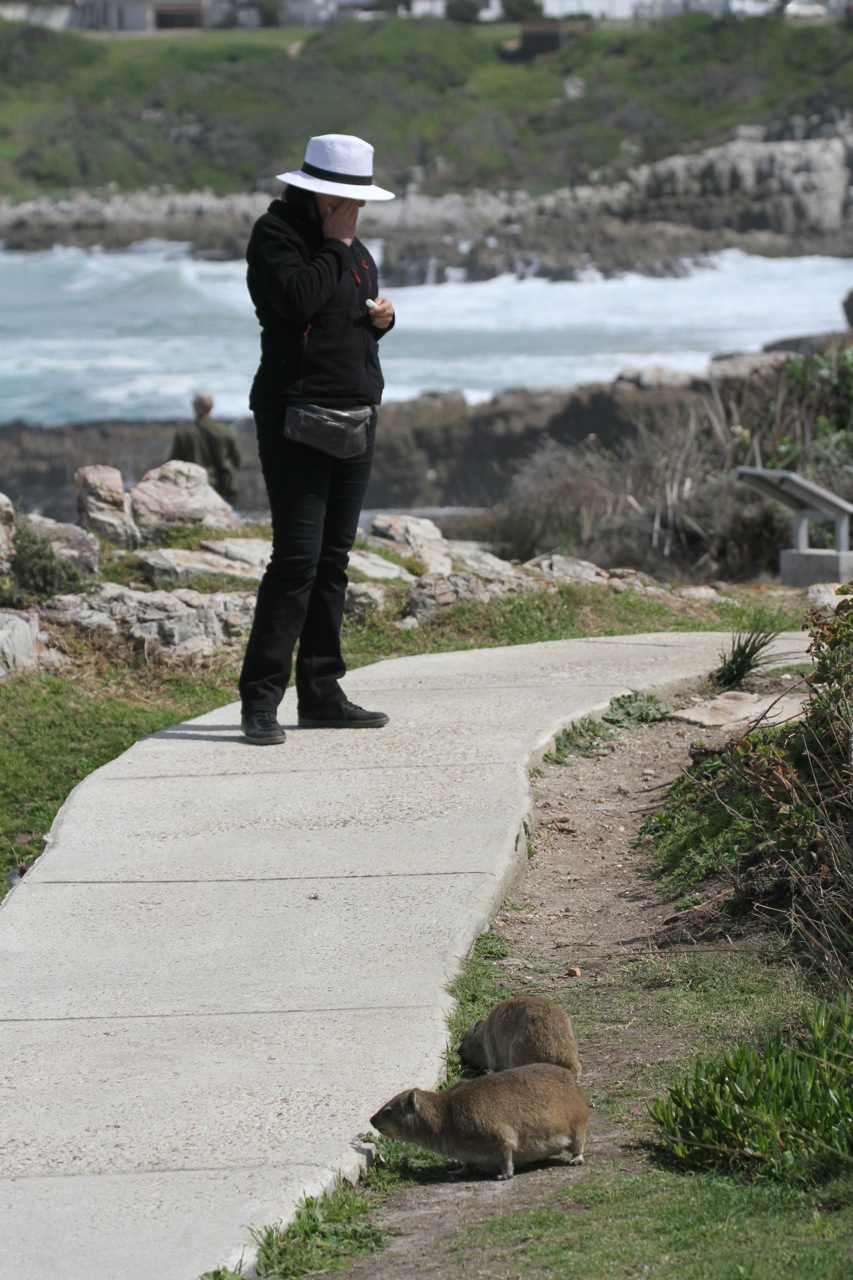
I know when to fold 'em. I shut the hell up, back off, and capture one of my favorite images of the whole trip. 


Just a guy and his friends. Perhaps his best friends. It's not mine to know. At peace, in this magical place of turrets,  real-life gnomes, and landgoing manatees. 

                      And who am I to disturb this communion of souls? Leave him alone, Zick. 
                                                               Leave room for mystery.


I'm going back to South Africa in September 2016. Wanna come along? Click here for details.

Hyrax Heaven: Hermanus, South Africa

Saturday, January 23, 2016

5 comments


Another Carpobrotus. What a lovely thing, and each flower three inches or more across! They're really best photographed from a near-prone position. I was happy to get the blue mountain in the background. It wasn't long before my friends on the trip started getting on the down-lo to photograph flowers, too. 


Rock hyrax takes a break.


If this doesn't look like vacation, nothing does. We were in Hermanus, South Africa, world famous for having some of the best whale watching in the world--from shore! 
Not being much for big seas, I was extremely grateful to be ogling lolling (oglalling?) southern right whales and Bryde's whales from the security of seaside cliffs and highways. I kept having to pinch myself, because I have come to associate whalewatching with wondering when (not if) I'm going to puke.

Just fine with me, not to be on a pitching deck while training my binocs on blowholes.  And to have these adorable mammalian proto-sirenians lollygagging on the cliffs within arm's length. 


Please notice softpaddy toebeans. I wanted to scoop up a hyrax and blow a raspberry on its tummy. I'd been away from Chet Baker too long. I probably would have gotten beaten to pieces, if I'd been able to catch one. But man. These little butterbeans are dang cute. 


I do believe I'd come out the worse for it if I grabbed aholt of one. When I look at this photo it's not that hard to imagine that they're related to elephants. Just elongate that snoot, give him some flappy ears, and upsize him about 1,000 times.

This looked very much like the lemon crispum scented geraniums I used to grow.  It was so cool to see old friends and acquaintances in the wildflowers.  Something had to be familiar here!


  In addition to grazing on the daisies, the hyraxes, or dassies as they're called locally, clamber over the cliffs, sampling tastes of the smorgasbord of flowers and plants South Africa lays out before them. 


At Hermanus, they're quite acclimated to the crowds who come to ogle the whales.


They quickly scamper to the safety of their rock outcrops if anything seems fishy.


Drinking from a rainwater pool. I like how dassies take life: slowly and with evident relish.  With lots of extreme lounging. 


I loved this surprise group of preening larids!


You might need to click on the photo to embiggen it. 

In this assemblage, from left, are Hartlaub's gulls (white heads); Sandwich terns; a gray-headed gull (center); greater crested or swift terns; and a few common terns. Nice! especially since larids can be a bit scarce along the South African coast. 

I never quite got used to speckled pigeons. They are just too snazzy with their red Amelia Earhart aviatrix goggles. 


 These two visions of loveliness repaired to the communal hyrax latrine to pick about for seeds amidst the dung. Pigeons will be pigeons, no matter how lovely.


That latrine, oddly enough, was soon to become a nexus of cool...stay tuned!

I'm going back to South Africa in September 2016. Wanna come along? Click here for details.


Penguins and People

Monday, January 4, 2016

4 comments
African black-footed penguin colonies have historically been found on islands, thanks to a plethora of predators on the mainland. Mainland colonies such as Stony Point and Boulder's Beach near Simon's Town have become established only recently, when these areas were settled and predators like mongoose, genet, serval and leopard were displaced. Boulder's Beach's penguin colony, in fact, still suffers occasional leopard attacks from this most adaptable and secretive cat. The numbingly ubiquitous feral domestic cat is very bad news in a penguin colony, as well. (Where is it good news?)

To view a penguin colony is to see vulnerability on stubby legs. The birds are, of course, flightless; their wings reduced to stiff paddles for swimming. And their locomotion on land is heart-touchingly slow and awkward. They shuffle along with an endearing waddle that could outdistance only a tortoise. And they are much smaller than you'd expect, maybe 15" tall. 


The birds dig nesting burrows in guano or soil; in colonies of long standing, the "soil" is actually years upon years' accumulation of droppings, called guano. Guano "harvesting" for fertilizer harms penguins, for it removes the substrate into which they burrow, leaving their young and eggs vulnerable to predation by kelp gulls. In managed colonies like this, artificial shelters in the form of small brushpiles, PVC pipes, or boxes may be provided for the birds, greatly boosting their productivity simply by giving them a place to hide their nests, eggs and chicks. You can see the little Quonset-style huts and piles of brush, which are soon grown over by vines, that give the birds much-needed options for nesting. YAY for active management of such precious resources.


For Spheniscus demersus is vanishing, and quickly. It's estimated that at the beginning of the 1800's, there were four million African penguins. By 1910, three quarters had vanished, with populations estimated at 1.5 million. It gets worse. 200,000 in the year 2000 had crashed to 55,000 only ten years later. Projections have this species reaching extinction by 2025. Hey. Wait a minute. That's ten years from now.

Why should this be so? Well, penguins lay an obligate clutch of only two eggs, and the chicks take a very long time to become independent, so their replacement rate is very low to start with.  Incubation takes 40 days, and is done by both members of the pair. It can take as long as 130 days for a chick to become independent and fledge. All these natural history parameters aside, the big reason for the massive longterm, noncyclic penguin crash is us.  Homo sapiens in all his wisdom has not figured out, or more correctly, hasn't figure out how to care, that when we overexploit species low on the food chain (in this case the small baitfish called pilchard), we cause earthquakes all the way up the chain, in those species that depend on smaller fish for their very existence. Not for fertilizer; not for fish emulsion, but for life itself. Overfishing caused a collapse of the commercial pilchard fishery in 1960, with disastrous results for penguin colonies. Chicks starved in the burrows (something we also see with our Atlantic puffins thanks to overfishing for capelin, their staple.) This is something we are also seeing in the North American red knot population since we decided that the highest use for horseshoe crabs, upon whose eggs the knots depend for food, was to be ground up for fertilizer. We hope that we've reversed that idiotic exploitation in time.

Finding no pilchard, African penguins were forced to switch to anchovies as their primary food, a fish which meets their basic needs, but is not ideal for rearing chicks, being lower in nutrients than the rich oily pilchard.  So chick survival has declined, and chicks fledge thinner when fed on anchovies than on pilchard. The fledging period is highly variable, from 60 days to 130 days, depending on the quality of forage parents are able to find.

I'll briefly mention the massive oil spill on June 23, 2000, when the tanker MV Treasure sank between Robben and Dassen Islands, fouling the waters and 19,000 adult penguins at the height of the most successful breeding season on record. A massive rescue effort brought wildlife workers from all over the world to South Africa to wash, feed, and release the oiled birds, and (unbelievably) capture an additional 19,500 clean birds before the oil could reach their colonies. These birds were taken 800 km. east of Cape Town and released to swim back to their homes, giving workers time to clean the waters and shores before they got back in 1-3 weeks. An astounding 91% of the oiled birds survived, making this the largest animal rescue event in history, and a global effort at that.

The penguins would be in sorry enough straits without the constant threat of oil spills. We are witnessing an overall collapse of the penguin population, and as always, humans are the root cause of it. People are doing what they can to rescue oiled birds and encourage mainland breeding, protecting the colonies and offering shelters to nesting birds, but if we've taken their prey base out from under them, forcing the birds to swim longer distances for lower-quality fare, and negatively impacting chick survival pre-and-post-fledging, no amount of land-based management is going to correct the decline. Still, we try. We have to try.

I watched the penguins entering and returning from the sea. They're different birds in the water; it's the difference between seeing a seal galumphing clumsily on land and shooting like a torpedo through the water.

They're bullet projectiles as they swim; long lean periscoping submarines when they surface.


And on land, little gemmun in tuxedoes, I'm told; though I don't see people in the least when I look at penguins.

I see birds, probably the most miraculous birds of all, right up there with hummingbirds and swifts and ostriches for the bizarre array of their adaptations. Wingbones fused into paddles; blubber for insulation in frigid seas; barbule-free feathers that form a silky water-repellent sheath; a prodigious oil gland; feet way at the back of the boat like rudders, forcing an upright posture on land. What we see on land is not the whole story by a long shot.


It can take 12 to 22 months for a penguin to attain its adult plumage. This is done in a series of molts that take them from fuzzy brown natal down to the first juvenal plumage of steel-blue and white, and thence into the banded, pied tuxedo of adulthood. During the actual molt periods, which take about 20 days, the penguins are unable to enter the water, since their old feathers would become waterlogged and the new ones aren't waterproof yet. So they stay ashore and fast the entire time. And yes, they look about like we would if we were fasting for 20 days while our hair replaced itself. Which is to say:

Miserable.

Everywhere, the penguins were loafing, sunning, preening. Chicks were older; perhaps they didn't need such frequent feedings now. But it seemed to me that the colony was taking a breather on this late September day.


The lone bird would stride by, on business.


And looking out the colony, I saw cormorants coming into their nests, and, despite the fishy gag in the air, I wanted to witness that.


So I pressed on out the boardwalk, leaning into the fetid wind, to see more.


This little video will take you there better than my words can. I get the name wrong--it's Stony Point, not Rocky Point. But it's still Betty's Bay, and we're still in South Africa. Listen at the very beginning of the video, and you can hear the soft whistled whew whew whew of the begging baby penguins (the two blue and brown ones on either side of the black and white adult). 


Nothing takes you there like a video! Just sorry I can't bring you Smell-o-Vision, which is probably why Leon Marais got a unanimous "No, we're good!" when he asked if we'd like to visit Boulder's Beach's colony as well. Ha! We were ready for some less odiferous birds by then.

Smell aside, I felt intensely privileged to have visited a mainland penguin colony, to witness just a tiny fraction of their population and a few hours of their doings. I left hoping, but not feeling at all sure, that my children would be able to see them someday, too. That somehow the same humans who have pushed them to the brink of extinction could ensure they remain among the living, for good.
[Back to Top]