Background Switcher (Hidden)

Showing posts with label hunting dog. Show all posts

All On a Summer's Morning

Monday, June 28, 2021

7 comments


Every morning, Curtis Loew and I tromp out the meadow to see what we can see. June 12 was his seventh day of nursing a deeply gashed hind pawpad, and I have been pleased to see him using the foot a little more each day. This morning, he'd even done a short, frisky run on all fours as we embarked. He was coming back. You can't suture a pawpad; you just have to let it heal from within, and I could tell the process was extremely painful, as he held that foot up for nearly two weeks as he three-legged around the place. He spent most of the week sleeping indoors, which I thought was great timing, given the presence of a wobbly new fawn on the place. I try to see the bright side in every misfortune. Maybe Curtis' loss would be that beautiful doe's gain. 


First stop was the right meadow box, where my favorite pair of bluebirds, the ones who had a clutch by April 1 (!!) are well on their way with a second brood. Listen to how they peep as they hear me scratching at the door, but shut up instantly when they realize it's Big Mama, and not their real mom. Consciousness is creeping into the heads of these five-day-old babies. 


Finding all well there on this foggy morning with an indigo bunting singing and Curtis finishing his morning ablutions, I move on. 

Next we check a box with unhatched eggs. Then it's on to the lower path, where ten-day-old house wrens, six of them! await a check. It's always a kick in the pants to have bright shiny eyes looking back at me. 
My heart races as I think about how soon they will be fledging. Yikes! They've got two, maybe three more days in the nest and then boom! out they'll go. Hence my little woooo at the end of the video.


Curtis trots ahead of me, and I spot a surprise just as he gets wind of it. What a beautiful little turtle, her beak all sludged up with slug. I love to see them feasting on escargot --this is probably Arion subfuscus--on a nice foggy good-for-slugs-and-turtles morning. Her markings look like Chinese characters to me. Shiny-smooth, black and beautiful she is. It's a bit early for laying eggs, but the females spend wet mornings prospecting for open soil, testing it with a tentative dig.


A great spangled fritillary struggles up out of the grass as I approach. It's hard for butterflies to fly when it's coolish and wet, but it manages.The cardinal, indigo bunting and peewee cheer it on. How beautiful it is, blundering in the wet grass. And how high and thick the meadow has grown in a short month and a half! Lush! with habitat and hiding places for all.
It's going to be absolutely amazing by August.


I note with great satisfaction that the ragged fringed orchid Platanthera lacera that I found as it emerged this spring and immediately caged against herbivores is finally in bloom. I saw a rolled lance-shaped fleshy leaf and thought, "That looks like it's gonna be an orchid!" My next move was to walk to the garage for three old rusty tomato cages to stack over it, to keep deer and rabbits from nipping it off. As they do.


Isn't that cool? It's a life orchid for me! I've seen the purple fringed and the yellow-fringed (which is actually the color of a Dreamsicle, no joke), but this is my first ragged-fringed. Whoot! And it's in my orchard!


Update: The count is now up to 16, all in the orchard's deep shade but one. And that one?

It came up on an unmown patch right at the head of Bill's grave. I was absolutely thunderstruck to see it. Hundreds of yards away from any other, baking out in the hot sun...what was it doing there, other than saying, Hey Zick! I love you!


Curtis turns off the trail and heads into the meadow, a move that always makes me nervous. The hair on his spine is standing up; that usually signifies that he smells coyotes, or that he's otherwise unpleasantly alarmed. The way he circles and circles a big patch of higher vegetation makes me think he has a largeish animal in there. Uh-oh. I'm thinking fox. Coon. Skunk. Sandworm. I don't know. 

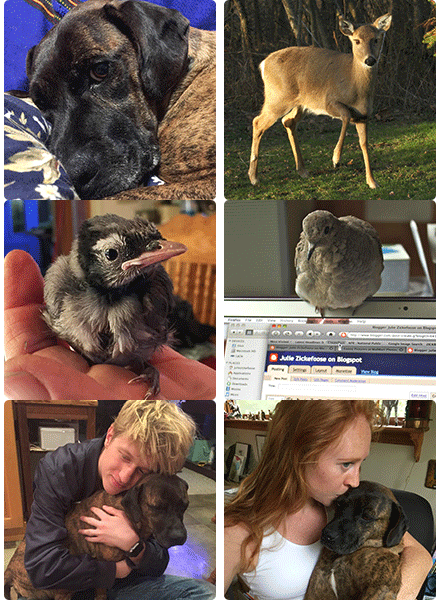
He makes a little stomp-lunge and a little whitetail fawn stands up, unable to hold its stance any longer.
I immediately collar Curtis and pull him away. I also immediately pick up that there's something wrong.
If you click on the photo you can see that the poor sweet thing has been injured already. Such a short life, and already something has had it. There's a puncture wound on its forehead, and blood in front of its left ear. 
I know it can't be Curtis who did that, because he's been indoors for a week--this is his first real outing.


Trailcam photo from early this morning shows the coyote is still out and about, hunting this wee baby.


Honestly, how do any of them survive? And how did this one get to the point of being grabbed by its head, and SOMEHOW escape? Did Mama pummel the coyote away from her fawn? Or was it something smaller, maybe a bobcat? I can only imagine. But what a rough and merciless entry into its world this fawn has had.

Oh, the night holds such terror for deer. I comforted myself by studying the photo and noting that it appeared the fawn's wounds had been licked clean by the doe. She licked them until they stopped bleeding. Undoubtedly it was she who saved it, and she who cleaned it up, and she who calmed it  and laid it down in the meadow. Had she not, it would be in a coyote's belly by now. I can only shake my head in wonder.

I snapped the photo and immediately walked a reluctant Curtis to the house. As we walked away, I watched the fawn slowly sink, like a grebe, back into the vegetation. Only days old, and already showing such wisdom.  Like a child at a bus stop, it has to wait for its mother. If it leaves, she might not find it.

Later, Curtis and I went back outside. I did my morning routine, keeping a close eye on Curtis. Not once, but three times over the course of the next hour, that dog watched me out of the corner of his eye, and when I seemed sufficiently involved in a pursuit, he tiptoed out toward the meadow. Three times I stopped him dead as he set foot on the meadow path with an AH-AH-AH!! --his least favorite sound in the world besides running bathwater. So much for those who think dogs can't plan ahead, or remember past goals. This one is a plot- hound.

He is sneaky, and he is a hunter to the core. He would not hesistate to kill this fawn, I know. 

So I stepped my surveillance up a notch.

I set his Marco Polo tracking unit, which keeps a connection to an electronic tag on his collar, to CLOSE, and turned the alarm on for the first time ever. If Curtis went outside a boundary considered close to the house, an alarm would sound until he returned. There is no shocking involved whatsoever--just tracking. 
When he's lying in his chaise longue under the Japanese maple, there's a 55% signal in the kitchen, where the base unit stays. 


Let him leave that circle, let the signal fade to 25%, and the alarm shrills. It works!

My job was to keep him under surveillance all day, until the doe could feed and move her fawn tonight. She would doubtless stay with it all night. 

Curtis Loew, you are being watched. 


He spent the afternoon either at my side outdoors or inside as I wrote. 
I was once again grateful, in an odd way, for his hurt paw. He was less likely to strike out on his own with a sore paw.

For out in that meadow, a wee fawn lies,


 waiting for its mother to return.


What's a Cur For?

Monday, February 8, 2021

7 comments


I will admit that when I brought Curtis home from Columbus Humane Society’s Animal Shelter, I did not know what I was getting into. I knew he was smart, intuitive, handsome and kind. I didn’t yet know what he was, and I didn’t know what he was made for. 


Literally one of the first of 10 million photos I have taken of this dog.


It’s important to know what a breed was made for. I had lived in the lap of luxury with Chet Baker, Boston Terrier, for almost 12 years. Because Boston terriers are made for lovin’,  keeping people company, and making them laugh. They weren't bred to kill anything, herd anything, guard anything...they were just bred as fun little pals. Chet hung on my every word and move, and he believed his highest purpose in life was to keep me company. (here, he's helping me sign books at a show). Boy, did I need that then. He was the perfect dog for me, a busy mom trying to keep my career afloat while caring for three other people. Chet never wore a collar because he never strayed far enough from me to need one. The only time he was ever on lead was in town, and that wasn’t very often.


Photo by Jenny Bowman at the Midwest Birding Symposium, 
Lakeside, OH, 2013. Bandana by Jen Sauter!


Because I hadn’t yet figured out Curtis’ breed, or if he even was anything other than mixed, I didn’t know how to work him. Work, as in David Byrne, asking, “Well, how do I work this?” I decided to trust him, and I let him out of the car without a leash on his first approach to his new home, and he peed on the forsythia bush, where he pees to this day, and walked up the sidewalk to the front door as if he understood perfectly that here he would live for the rest of his life. That night, I took him out for a pee before bedtime, and he perked up his ears and headed into the backyard, me close behind with a flashlight. And he was gone, running pell mell through the ruined orchard, crashing and leaping. And that, as Lyle sings, was when I made my first mistake.


I called and yelled and hollered and he didn’t come back. Oh boy. I’ve done it now, stuck my foot in it bigtime. He eventually appeared, eyes glowing in the flashlight’s beam, a wide grin on his face. 


Runs After Things in the Night. Check.


Ignores Frantic Calling When Running After Things in the Night. Check.


Needs to be Leashed After Dark. Check.


By the next afternoon, I’d done some thinking about how to work this animal. I had to know what he was made for. I decided he was far too delicate in structure to be a pitbull mix. I thought he looked like some kind of southern cur-dog, so I started by Googling Catahoula Leopard Dog, then “brindle cur.” Bingo!  I had a Mountain Cur, more specifically Treeing Tennessee Brindle. I had never even heard of the breed, but it seems I had rescued a hunting dog! Well, dip me in chocolate. Wonder what that'll be like?


Being a hunting dog means a lot of things. First, he’s a fine companion, and he seems to be able to read my mind. He loves to go out into the woods with me, but he doesn’t  stick close by my side, the way Chet did. He leads! He has a job, and that is to find edible things. Things made of meat.  Curtis might have written the line: “If God didn’t want me to eat animals, why did He make them out of meat?”


Now, this strike-out-on-your-own tendency Curtis has normally manifests with a lot of chasing and very little eating; high, excited yelps; crashing through briars; stripping himself of collar attachments such as tags, bells and trackers; and a resultant need to wear said tracker at all times. As I look back, I have been remarkably sanguine about the possibility of losing this dog. Something in me has known from the very start that he’s too smart to run willy-nilly, in a straight line, headed for the next county. That’s not who he is or what he's made for. He does, however, run after meaty things. If they can climb, he trees them, and tells me with excited barks just what he has and where it is.  Being human, I have been slow to awaken to the part he wants me to have in all this, which is to come join him, raise a gun and shoot the coon, possum, squirrel or what-have-you that he’s found for me. Then, in Curtis’ ideal world, we feast.


It is said that this is the breed that helped settle America; part hound, part Staffordshire terrier--which is where the brindling comes from--, part Indian village dog--which is where the brains come from. The mountain cur was bred to track and hunt anything, his highest mission to put food on the table for his family. And so when he trees a squirrel, he circles the tree, harassing and herding it around to my side, to give me the best shot. And still I don’t shoot. Poor Curtis must think I am either very stupid or very well-fed, because he keeps trying; it’s in his DNA to try. He wants to work with me, wants to be a team, but I just walk along with my head in the clouds, binoculars on my chest, and a trek stick in my hand, when I should be packing a thunder-stick.


I like to think I hold up my end of the pact pretty well, even if I don’t dispatch his quarry. I do take him out every morning without fail, and we are rarely gone less than three hours, rarely roaming less than three miles, either. He, of course, traverses far more ground than I do. I will linger in certain places, gazing around, and that’s when my wonderful companion invariably takes off. But only yesterday did I figure out why this happens again and again. I think that in stopping to gaze, I'm inadvertantly sending him the signal to go find me something to shoot.


I was standing at the overlook, the mile-long trail to which I have laboriously cleared this winter, enjoying the shifting light as it broke through high clouds and started raking the snowfields. I was peering, looking for the castle my neighbors are building to the east. It was vanishing in and out of the morning mist. Curtis, of course, had just ditched me, gone on a toot. Suddenly, the wooden fireworks of a startled flock of wild turkeys exploded deep in the valley to the east. Three, four, five, seven, they flapped noisily and then planed out over the holler. It was a stunning sight. For maybe ten seconds I simply stared at the silvery sunlight hitting off their bronze backs. They were too far away and I had only my phone, but I dug it out of my pocket and hit Video anyway. And so it was that I had my iPhone SE out of my pocket, turned on, and horizontal, even! when THIS happened.  


Of all the videos I've taken recently (and ask my laptop and it'll respond with a small, choked sound that means "a lot"), this is my favorite. It's perfect, perfectly focused, and perfectly unrepeatable. And I have Curtis to thank. Because it was NOT an accident that those five wild turkeys flew right the hell past my face. It was Curtis' plan. His design. This is how this dog works, and I have been too dumb, to asleep, to even know that.


Here he came, immediately on the spurred heels of those turkeys.


Had I had a gun on my shoulder, or even a goshawk on my fist, we would have eaten for a couple of weeks. 


Curtis tries, again and again. It's what he was made to do, and he is damned good at it. He emerged from the brush, glanced at me, knowing I would have blown this PERFECT SETUP AGAIN, WILD TURKEYS FIVE OF THEM MY GOD WOMAN WHY DON'T YOU SHOOT?? then shook off his disappointment and came to join me. Imperfect, clueless me, who he somehow manages to love anyway, because I love him so much. 


I'm no Annie Oakley, but we're a pair. 


Small Skunk, Big Victory

Sunday, March 22, 2020

9 comments
       
It had been ten days since I first saw the skunk, since Curtis first charged it and was stopped in his tracks by the horror in my voice. Each afternoon at 5 sharp, the little animal had trundled into the yard (usually from a different direction each time, telling me she had us on a route) and happily eaten a small bowl of Fromm's kibble. I'd kept Curtis inside at that hour, because who needs to tempt fate? I had no idea if the lesson of that memorable day had taken in his brain. I'm still getting to know him, and I have enormous respect for the power of his prey drive, the instinct bred into him to go for the kill.

The skunk and I had fallen into a routine. She responded to my voice by advancing toward me, not retreating. I could walk right past her and set her bowl down and she'd bumble like a stumbly kitten to the goods.  Charmingly myopic, she followed the scent of the food and seemed unperturbed by my watching and photographing her as she ate.


She was moving better, but she still had to hop with that broken hind leg. She would never win a race. A skunk doesn't have to be fast. All it really has to be is black and white, and armed.


It's funny how fast I can get attached to something like a crippled skunk. All I have to feel is that I'm somehow helping it, and I'm gone, all in. 


To be fair to me, she is absolutely adorable. Not the fanciest, by any means, but the cutest for sure.

After ten days of this, I felt I knew how she'd react, and finally felt comfortable doing another experiment with Curtis. I put his leash on and walked quietly out into the yard while the skunk was about. Watch what happened next!


I think you can hear how pleased I am that our dog has finally had a change of heart and mind about skunks. Because his hunting instinct is so powerful, I honestly never thought I'd see the day. That makes the gift of his cooperation all the more wonderful. I have the feeling this lesson will hold, on or off the lead. I think he's put it all together that Ma wants him to stay away from skunks. What a good boy!

As I write, it's March 20, and she's been here a solid two weeks. I hurried to set her kibble out this evening at 5 pm, as always. For the first time, she didn't show up. Aww, heck. Doggone it. Now what? Was she in a burrow somewhere, giving birth to tiny kits, broken leg and all? Had a great horned owl grabbed her? I hadn't smelled a struggle... Had she just changed her route, or found a carcass somewhere to feast on?

With wild friends, this time may be the last you'll ever see them, but each one I come to know, no matter how inconvenient or smelly they may be, is a gift. This little skunk stayed long enough to teach Curtis how to live with his neighbors. She was kind and patient and grateful, and those are good things to have in a friend. Here's hoping we see her again, farther on down the line.


Wait. There's more. 

Update: The compost area was heavily anointed with skunk aroma around 11 Friday night.  And the skunk was back at 3:45 pm on Saturday, March 21, hinting broadly that it was time for her kibble.  Being well-trained, I obliged. 


Sunday, March 22: She spent a couple hours in the compost pit from 3 pm on, sorting through some meat scraps that found their way in. Ignored her kibble. 


 This is her I-don't-want-to-talk-to-you-right-now glare. My kids, who are both in residence with me, eating like kings and sucking down every drop of bandwidth until such time as the world stops ending, are making fun of me as per usual.  Now, because of how obsessed I am with "that crippled skunk." 

Her name is SugarBean.

 That is all from Indigo Hill. 

But What IS Curtis, Anyway?

Tuesday, February 26, 2019

37 comments
Anyone who reads my blog regularly must be finding it a trifle odd that I have yet to speculate on Curtis' breed makeup. My first impression of him as I studied the only photo I had was that he might be a pit bull mix. I was going on his brindle coloration, which shows up pretty frequently in pit bulls, and his wide, spatulate tongue, and what appeared to me to be a deep-chested, wide-headed build.


But when I saw Curtis in person, all that changed. He was much lighter in build than he looked in that photo, and his head especially was almost delicate.  I looked beyond his coloration to his build, and what I saw was an archetype, a classic village dog body plan. At only 35 pounds, the idea that he might be part pit vanished with a poof. He looked like a cur to me.

 
 Like most of you, I grew up with the word "cur" being pejorative. There was a medium sized yellow dog down the street from us when I was growing up in Virginia that looked a whole lot like Curtis. Pete was rather low-slung, had a straight tail, a slightly boxy head with pronounced stop, and small folded ears. My dad always referred to him as "that cur, Pete." Well, since our dachshund was always picking fights with Pete and coming home torn up, I didn't think much of Pete.  I thought DOD was just saying a bad dog word when he called him a "cur-dog." So "cur" held negative connotations for me. I didn't realize then (but now understand) that my father knew a cur when he saw one!

And I think I did, too. The evening I brought Curtis home, I sat down to start Googling. I knew he was no Heinz 57. I sensed he was a purebred, and set out to find out which.  I started with "Catahoula Leopard Dog," since that was a southern mountain breed I knew about. A couple more clicks got me into brindle curs, and photos of Curtis' breed popped up everywhere. There he was! Over and over! I love the Information Age!!


It turns out that a cur is an historic American dog, and a recognized breed. According to one source, the Mountain Cur was originally derived from settlers' English pointers, plus some kind of (undoubtedly British) terrier, both interbred with Native American village dogs, a breed now extinct.  It's been assigned to the Hound group, but it has been in AKC's Foundation Stock Service only since May 2017.

From the American Kennel Club website: (lightly edited)

"Mountain Curs are the true all-American pioneer dog. They were a necessity to the frontier family and it is likely that the southern mountains could not have been settled without them. They were one of the biggest assets that the settlers had in the rough and unforgiving country of the mountains. They guarded the family and livestock against wild animals or intruders.
They were used to catch, tree, or hole wild game for the family’s food. Until the 1940s, these dogs were part of the way of life for the frontiersmen. They used money from sold furs that their dogs hunted to provide for their families. The exact origins of this breed are undocumented, as there was no need for an official pedigree among the pioneers.
The Mountain Cur was declared a breed in 1957 with the organization of the Original Mountain Cur Breeders of America (OMCBA). The most common strains of Mountain Cur included the McConnell, Stephens, Ledbetter, Arline and York strains, the categories being named after the owners of the dogs."

A BACKGROUND SKETCH OF THE MOUNTAIN CUR DOG
AND THE ORIGINAL MOUNTAIN CUR BREEDERS ASSOCIATION

It had been established through family history and research that Spanish Explorers brought the brindle, bob-tailed Curs to the South.  Hernando de Soto brought the brindle Curs to drive the hogs and provide protection against wild animals, while he explored the South and discovered the Mississippi River.  Hunters and settlers found the brindles when they came South.  
interbreiplusTe
From Original Mountain Cur Breeders' Association website: 

"The colors of Mountain Curs of early days are dominant today.  Brindle, yellow, black and blue.  Some have white markings... All these dogs have the same general traits, such as strong treeing instinct on all game, courageous fighters and intelligence.  The Mountain Cur today is still a varmint dog!  Hunting whatever game his master wants.  He is also a guard dog, farm dog and family protector.  This dog is put down and ridiculed by some uninformed people because of the word "Cur".  In Mountain Cur the word "Cur" is used idiomatically and has NO meaning of "low" or "worthless".

Low or worthless? Perish the thought! He's noble!


Now, as I understand it, there are three varieties of Mountain Cur, bred for coloration and conformation. One of the smaller ones is the Treeing Tennessee Brindle. 

Aww, it's Curtis! Look at all those Curtii!!


Again from AKC's website:

"In the words of Treeing Tennessee Brindle Breeders founder, Rev. Earl Phillips: “Our original breeding stock came from outstanding brindle tree dogs from every part of the country.” Many came from the Appalachian Mountains, Ozark Mountains and the places in between.
In the early 1960s, Rev. Earl Phillips wrote a column for a national hunting dog magazine. By way of his magazine column, Rev. Phillips gathered a wealth of information about these brindle-colored Cur dogs and the people that had or knew about them. Those people who corresponded with Rev. Phillips commended these brindle Cur dogs on their hunting and treeing abilities. There was a group that were trying to promote Cur dogs of different colors but none were trying to exclusively find, preserve and promote the brindle Cur dogs.

"Early in 1967, Rev. Phillips contacted many of the people that he had corresponded with about brindle Cur dogs. He suggested the formation of an organization to preserve and promote these dogs. On March 21, 1967 the Treeing Tennessee Brindle Breeders Association was formed and recognized as a legal organization by the State of Illinois. The purpose of this Association is to breed a dog brindle in color, smaller in size, with a shorter ear and different in conformation than the Plott. The dog may have dew claws and white feet and breast. By selective breeding, this dog can have great scenting power, be an open trailer with good voice, and retain the great uncanny ability of the Old Brindle Cur dog to tree all kinds of game."

You coming along, Ma?

From Puppydogweb.com:

"The Treeing Tennessee Brindle is another variation of the coonhounds of America. They are smaller than other coonhounds, however, and only range from around 16 to 24 inches. They have catlike paws, and a choppy bawl for a bark. With small ears and a brindle body, this breed is discouraged from changing size, ear length, tail, or colors so that it doesn't also change category. Treeing Tennessee Brindles are good at open trailing and locating prey. Courageous hunters and companions, the Treeing Tennessee Brindle is said to have an abundance of "heart and try." They are a sensitive breed, however, and owners warn never to mistreat the breed. This breed can be more sensitive than normal toward neglect or abuse, and it is thought that once you mistreat them they will never treat you the same again. They are good natured and friendly dogs, getting along with anyone and everyone. This breed is intelligent, alert, and vocal. They love to bark because it is usually their job. The Treeing Tennessee Brindle is a an American breed with a strong work drive and friendly demeanor."

ORIGINAL MOUNTAIN CUR BREEDERS ASSOCIATION


AND THANKS FOR VISITING THE
OUR CLUBHOUSE LOCATED  7 MILES SOUTH OF JAMESTOWN,           TENNESSEE OFF HWY 127.   PICTURE HERE DURING THE 2000 FALL HUNT  
GPS USE:  3241 Coon Hunters Lodge Road, Jamestown, TN  38556   
I boldfaced the passage that really spoke to me of Curtis' nature. 
He loves everyone, but is very sensitive to tone of voice, and you don't have to correct him over and over. He remembers, he listens, and he wears his feelings on his sleeve.

So those of you who have suspected Curtis to be a Plott hound were close. But Plotts are bigger, much longer eared and deeper-muzzled than Treeing Tennessee Brindles. He's not really a hound. He's a Mountain Cur, more specifically a Treeing Tennessee Brindle. And isn't that cool?


At least that's what I think. See if you agree. I'm not going to drop $200 on a cheek swab DNA test. I pretty much know what I'm looking at.  Lil' ol' good for nothin' cur.


[Back to Top]