I'm an artist and writer who lives in the Appalachian foothills of Ohio. With this blog, I hope to show what happens when you make room in your life, every day, for the things that bring you joy. Strange...most of them are free.
Thurs. Feb. 27, 2020, 7 PM: "Saving Jemima: Life and Love with a Hard-luck Jay" at
Mt. St. Joseph University Theater, 5701 Delhi Rd., Cincinnati, OH 45233. Doors open 6:30 pm.
For info call Colleen McSwiggin (513) 244-4864
Mar. 11-15, 2020: Bird Friendly Backyard workshop and Saving Jemima talk at Joint Conference, N. Am.
Bluebird Society/Bluebirds Across Nebraska, Holiday Inn Convention Center, Kearney, NE. Right in the middle of
sandhill crane migration! Call (308) 237-5971 for reservations.
Mon. Mar. 23, 2020, 6 PM: "Saving Jemima: Life and Love with a Hard-luck Jay" at Morgan Co. Master Gardeners Event, Twin City Opera House, 15 W. Main St., McConnelsville, OH. Free and open to the public. Call (740) 962-4854 for information.
Sun. Mar. 29, 2020, 3 PM: "Saving Jemima: Life and Love with a Hard-luck Jay" at
Sunday With Friends,, Washington Co. Public Library, 205 Oak Hill St. NE, Abingdon, VA 24210. For more information, call (276) 676-6390
Apr. 30-May 2, 2020: Julie Zickefoose at New River Birding Festival, Opossum Creek Retreat, Fayetteville, WV. Friday night keynote: Saving Jemima. Curtis Loew, miracle curdoggie, presiding.
May 7, 2020, 7 pm: "Saving Jemima: Life and Love with a Hard-luck Jay" at Campus Martius Museum, Washington and Third Streets, Marietta, OH. Booksigning after. If you missed the Esbenshade lecture/ People's Bank talk in November 2019, this is your event!
Weds. May 13 2020, 5:30 PM: "Saving Jemima: Life and Love with a Hard-luck Jay" at Roger Tory Peterson Estuary Center's event at Essex Meadows, 30 Bokum Rd., Essex, CT 06426
This event is open to the public.
Thurs. May 14 2020, 6 PM: "Saving Jemima: Life and Love with a Hard-luck Jay" at New Haven Bird Club's Annual Banquet, Amarante's Restaurant, 62 Cove St., New Haven, CT 06512. This event is open to the public!
Sat. May 16, 2020: "Saving Jemima: Life and Love with a Hard-luck Jay" for Bergen Co. Audubon Society at
Meadowlands Environment Center, 2 DeKorte Park Plz, Lyndhurst, NJ 07071
Time to be announced. Call (201) 460-1700 for more info.
Sun. May 17, 2020, 2 PM: "Saving Jemima: Life and Love with a Hard-luck Jay" at White Memorial Conservation Center, 80 Whitehall Rd., Litchfield, CT 06759. Call (860) 567-0857 for information.
Tues. May 19, 2020, 7 PM: Good Reads on Earth Author Series, by PRI's Living On Earth with Julie Zickefoose and Saving Jemima at Mass Audubon's Drumlin Farm Wildlife Sanctuary, 208 South Great Rd., Lincoln MA 01773. Includes audience participation, and will be taped for airing on public radio! Get the book first, read up and call (781) 259-2200 for information.
Thurs. May 21, 2020 6 pm: Julie Zickefoose, "Saving Jemima: Life and Love with a Hard-luck Jay" at
Bigelow Chapel, Mount Auburn Cemetery, 580 Mt. Auburn St. Cambridge MA 02138. Call (617) 547-7105 for more info.
Although I've been taking bats in for 13 years, I still consider myself a newcomer to them. There are people who know ever so much more than I do. Amanda Lollar is one of them. She wrote this amazing book which should be required reading for anyone wanting to care for bats. It's so well-written and thorough, informative and clear.
I also follow a couple of great accounts on Instagram: pabatrescue and azbatrescue. I have immense respect for these women and their volunteers. They take in an awful lot of bats, and do vet care as well. Way beyond my level, but they've been kind and encouraging. As a result of what I've learned from this wonderful book and my Instapals, I knew I had to give my bat housing an overhaul. I've ditched the individual critter keepers lined with rubber drawer liner and toweling for a whole new system, one that is more in tune with bat needs for socialization and softness.
Behold the new bat habitats! They're soft nylon laundry hampers that I bought at Wal-Mart. I can access the interior through two large zippered doors.
The flooring is soft mattress foam, wrapped in a plastic garbage bag which is taped tightly, then put in a washable pillowcase. Any bat that falls is not going to be injured in the least.
Each hamper has two places to roost: the made-to-order black bat roosting pouch from batworld.org (Amanda Lollar's incredible bat conservation organization) and a double folded length of plushy fleece they can crawl up inside. I've got a little plastic water container zip-tied near the top of the enclosure, and a worm dish for self-feeding.
There is one hamper for Carmelo, and one for all the girls. Males must be separated or they will be males, and will molest the females all winter long. These two hampers should be able to accommodate as many bats as I get, boys with boys and girls with girls. There's plenty of room to scuttle around, climb, groom, socialize, and flap wings.
Their first hour in the hamper together, the females gathered under the pink fleece. Jolie Blonde wanted a little separation at first.
Fuchsia, Poppy and Laura cuddled right up. It made me so happy to see the bats able to do what they do in the wild, and to know they were cuddled in warm fleece (I have draped another double layer over the outside of the hamper, too, to protect them from drafts).
By the next morning, there were four in a neat row. Isn't that dear? One is hanging with her dark brown back to us; the rest are showing their paler bellies.
Keeping these bats at the proper temperature (between 35 and 55 degrees) is an interesting exercise. Most of the time, my unheated detached garage is ideal. But when temperatures dip into the 20's, I bring them into my basement and put them right next to a cold door, where temperatures hover in the 40's on a very cold night. I swaddle them to protect them from drafts but it does stay cold by that door.
Ideally, they sleep most of the winter. Initial intake involves getting them up to proper weight (17-22 gm for a big brown) with intensive feeding for each bat for a week or more, and making sure they were strong and well-hydrated. Then I put them to bed in cold temperatures on Jan. 25. I took them out and fed them for the first time on Feb. 9 and 10, after three weeks in cold storage. Now that all are in good weight, I plan to stretch that to 4 or even 6 weeks in hibernation. Not gonna lie--I miss them when they're tucked away! As I update this post, they've been asleep for five weeks. I check on them daily. Temperatures have settled down at night, and the garage maintains nearly ideal conditions. Lovely!
When you think about it, these animals in natural conditions probably have no opportunity to eat and drink all winter long, since they don't fly on nights below 50 degrees. And if they were to fly on the occasional balmy night, there aren't any insects out for them to catch, anyway. So I've little doubt that a winter in Zick's Bat Hostel is a fat winter for these bats. And it sure beats wasting away in a heated space with your metabolism all revved up, but without food or water. Or worse, being caught and put outside to die in freezing temperatures, which is what happens to most bats that are found inside a home. I don't know what people think they're doing when they do that. It's not "letting it go." It's a death sentence for the bat.
I make these posts so people will understand that bats are very much worth cherishing and caring for. When they get into homes, they need help. To find a bat rehabilitator near you, go to batworld.org and click on "I Found a Bat."
Chances are, it'll be someone a lot like me, who is willing to care for these incredible little animals in their home, because they are endearing and special creatures. Bottom line for me: Yes, it's a ton of work. But the alternative to offering these refugees a safe winter home is too sad to contemplate. If you find a bat in your home, do the right thing and call a bat rehabilitator. Put on leather gloves, pick it up gently with a hand towel around it, and put the bat in a box with the cloth. Make sure the box is SECURELY taped up with a couple small air holes, because bats can get out of the most amazingly tight spaces. Don't try what I'm doing--feeding and watering and handling-- without training and rabies vaccination. These are not pets--they're destined for release. They are going back to the sky!
Carmelo says thank you for the warm fleece and tasty worms.
Breathing a huge sigh of satisfaction and relief. I've just put the bats back to bed.
I've been feeding a big brown bat named Ambrose every night for the last two weeks. He was found by an Instagram pal of mine in a bathroom sink. Because of the weird and delicate web of Instagram, Leah knew I work with bats, knew to call on someone who'd know what to do for this wee foundling.
Bats that are found in heated homes in winter are in trouble, usually because their normal hibernacula (rhymes with Dracula!) have become too cold. People's pleas for help with bats they've found tend to come in when the Polar Express sweeps down from the Arctic with bitter temperatures. Bats that find themselves freezing to death, I surmise, somehow make their way from attics and sofits down into to warmer places, and that brings them into contact with people. That doesn't usually go well for the bat, unless someone like Leah is in the mix. She picked the little bat up with a hand towel, placed him in a box and taped it up securely. We met at a pet shop in town, where I was going to buy my third critter keeper so I could accommodate the new arrival (I've already got two bats in care).
Ambrose (named for one of Leah's adorable sons) came in weighing only ten grams. That's dangerously low for a big brown bat (low normal weight is 17 gm). They get as heavy as 22 gm., but after that, they're too fat to fly. I knew I had my hands full with this little guy. He was a lousy, reluctant eater, dehydrated and down. I sometimes had to coax him for ten minutes or more to take his first mealworm. Once he started eating, he'd down 7 or more at a go. I doggedly kept at it, and after two weeks, he was the bright-eyed, active little sprite you see in this video, weighing in at 16 gm. ( I weigh the bats before each feeding). I figured that was close enough to normal, and with a great sigh of relief, readied him for hibernation with a final big feeding.
Because we had three nights in a row in the 50's, I decided to wake up the other two bats, Lyle and Murcie, for a midwinter feeding. I let them sleep until nights get warm enough that, were they in the wild, they might go out looking for moths. So for three nights, I was feeding all three of them, and that took well over an hour each evening. I couldn't wait for it to get cold again so I could put them back to bed. By about 8 pm, I'm fried, and bats eat best after 9, I've found, so it was a struggle for me to stay up late enough to get them all taken care of.
I love this little unexpected flitter Ambrose executes, onto an old license plate in my bat room.
This is Lyle. He's also a refugee from a house.
And here's Murcie, the biggest and strongest of the three. Also the most opinionated.
What's involved in putting them back to sleep for a few weeks is cleaning their boxes and taking out their soiled linens (they sleep in hand towels, folded over and taped to the top of the boxes). I replace the paper toweling on the floor and put fresh clean linens in.
You see that the boxes are lined with nonskid drawer liner, extra thick. This is so they don't break their delicate finger bones on the plastic sides of the box, beating their wings.
Washing bat linens. It's pretty disgusting. Not going in my washing machine, nossir.
I keep the condos by a poorly-insulated door in the basement. It gets pretty darn cold down there on the floor, so I put the critter keepers up on a box.
I also cover their condos so they aren't drafty. The all-important thermometer gets checked frequently. It shouldn't drop below freezing. Ideally you keep them between 37-50 for torpor. I've learned to adjust the temperature by moving them closer to, or farther away, from the cold outside door.
And there they sleep, for three to four weeks at a time, until the next natural warmup comes. Then I'll wake them, weigh them and feed them for a couple of nights. I've little doubt my bats eat more in winter than wild bats do, but I feel a responsibility to keep them in tip top condition, and I worry about them getting dehydrated, too.
In order to qualify as a bat caretaker, I had to take a course in handling rabies vector species from the wonderful Barbara Ray of the Ohio Wildlife Center, and I've had two rabies inoculations--you have to provide proof that you've had the course and the shots before you can get a permit to keep bats. It is not for everyone, that's for sure. There is so very much to know about them, and they're teaching me more every single day. They are my best teachers.
I feel I'm getting better and better at handling, housing and understanding bats. I'm very fortunate to have a cold basement where they can be safely overwintered. I shudder at the thought of keeping them warm and having to feed them all winter long, especially with all I've got on my plate now. I've done that and it's a ton of work. More importantly, I think it's bad for the bats to be kept warm in winter. There's a considerable risk of overfeeding them and making them too fat to fly. I know, because I've done that. Sometimes I think learning is just doing everything wrong until you figure out how to do it better, how to do it right. Here's a post about my fat bats.
If you just can't get enough batitude, keep hitting Newer Post for the story of Bat Boot Camp. :)
I don't overfeed my bats any more. I keep them lean and sweet. Lyle again.
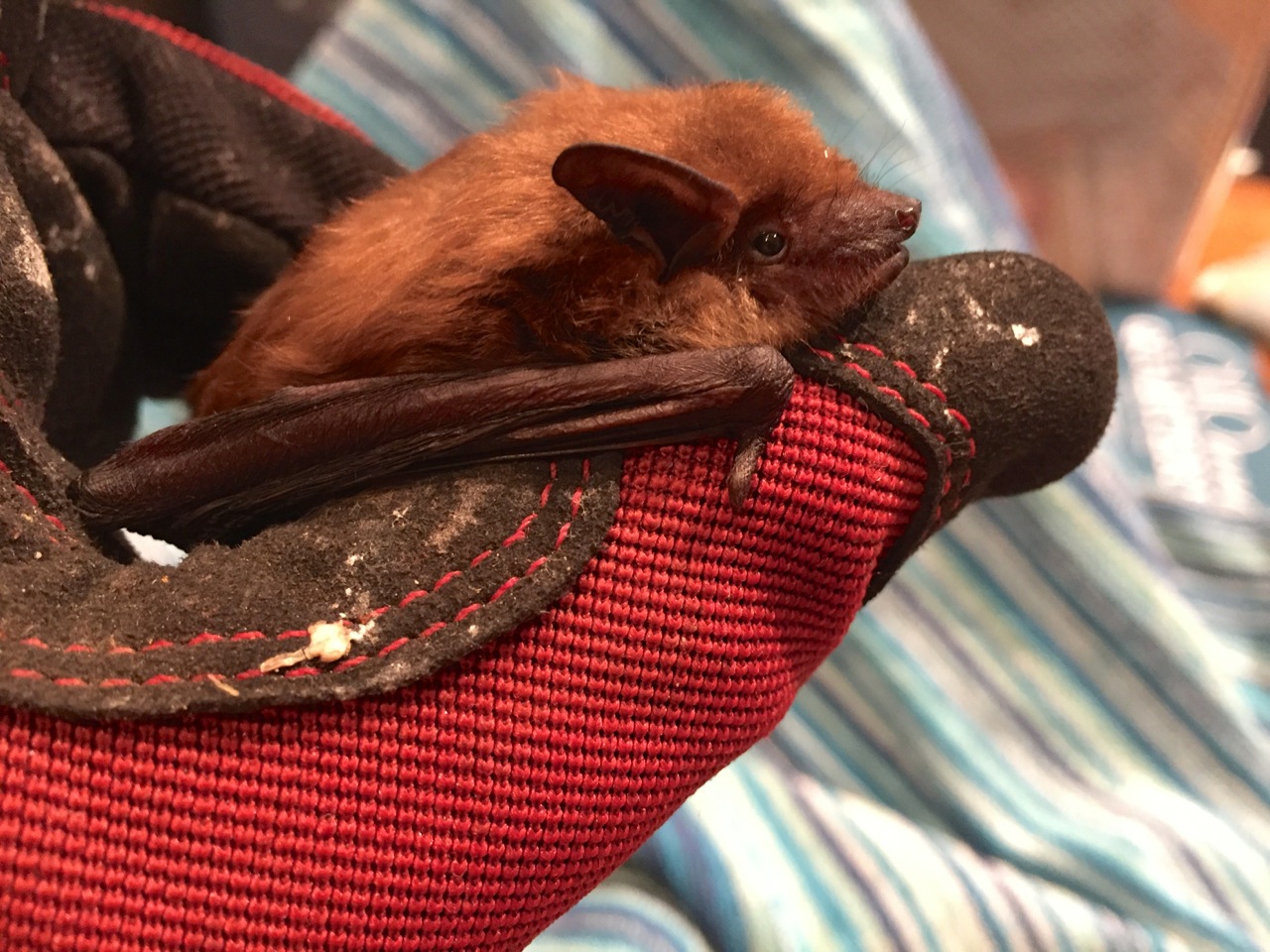
I find working with bats very rewarding, because gentle handling usually results in a tractable bat. They may start out terrified and chittering, but you can win them over with time, food and gentle hands. I've only had one bat (Drusilla) who came in horrid and remained horrid. I laugh just remembering her chewing away on my (double) glove. I loved her anyway. These three are total sweethearts by comparison.
Bats, for me, combine all the things that are most wonderful about birds and mammals. They're delicate and very beautiful, and they employ flapping flight like birds do. Yet they're possessed of the softest fur imaginable, and the most winsome faces, like very small puppies. What a combo! Add to that the ability to survive for months without food or water, and you have a very special animal indeed. Miracles, they are. Just miracles. And they help me every bit as much as I help them.
In this undated file footage, a big brown bat named Velma, who was rescued from the foyer of a library on a frigid February day, dines on mealworms. Bats (big browns around here) tend to show up in heated interior spaces when their hibernaculae, which tend to be dry unheated attics, get too cold for them. So I wait for bat calls when the temperature gets into the single digits, and they come in when the night temperatures get ridiculous. What the bats need then is a safe, 40-degreeish place to hibernate for the winter, with occasional feedings/waterings when nights get into the 50's, until they can be released right where they were found in the first week of May.
In this video, you will see an excellent example of what Phoebe calls "worm-mouth."
I find it endearing, Phoebe not so much.
Velma liked to eat unconfined, and she was able to pick the worms and pupae up by herself, though she never learned to use a bowl.
At about 0:43 in the video, you can see her raise her head, open her mouth and start emitting (almost inaudible) radar blasts. I hear them as sort of a low-frequency thrumming. She's going to go! and she does, hanging herself up neatly on the screen. You can hear me say, "Radar's on." She's fit as a fiddle here, and circled the room probably 30 times in one bout after this video was made. FYI, she always neatly avoided my hair and had no desire to get tangled up in it. That's what you want to see: strong sustained flight, precise maneuvering. That's a healthy, releasable bat.
Velma came in thin and remained so, at 17-18 gm. Better thin, I've learned, than too fat!
A highly entertaining post about my two obese bats, Stella and Mirabel, at this link.
I have learned to judge the condition of a bat by looking at its pelvic region. Just like you can look at a cow or horse and see what kind of shape it's in. Or hey, me.
An overweight bat will have a roll of fat there, and you can't even see its bones. Velma's a little thin, but that's OK. As you can see in the video, she was flightworthy!
Beautiful Velma, overall.
While I'm at it, as many of you know, I'm on Facebook. I had to disallow posting from my friends on my Wall, because my Wall had turned into a solid stream of photos and videos of adorable flying foxes (a huge tropical fruit bat) drinking from doll bottles, being swaddled in baby blankets, being stroked and chucked under the chin etc. etc. Flying foxes have the distinct advantage of being big enough for people to be able to see their faces, and those faces look more like puppies' than bats'. Lucky flying foxes. They're hoplessly charismatic.
While I enjoy watching such videos, I never repost them, because I have a problem with them. It's the same problem I have with the Tubes of the Internet in general. And that's that there is almost never any useful (or in this case, vital) information accompanying the adorable photos and videos. They are meant for people to merely swoon over, but not learn from. But these cuddly baby bat videos could prove dangerous, even lethal, in a "don't try this at home" way.
I don't handle any bat without heavy gardening gloves and a dental hygienist's plastic face guard. Nor should those Australian rescuers, in my opinion. Sometimes, as in the case of my hard-chompin' little nest of vipers, Drusilla, I used two layers of latex gloves underneath those Gore-tex and leather gloves. You do NOT want to be bitten by ANY bat, flying fox or big brown, adorable baby or grown-up, or anything in between. All bats have the potential of carrying viruses that kill humans. We know what the big one is. Although Australia, where most of the flying fox videos are coming from, doesn't have rabies, it has something similarly deadly called lyssavirus. It's rare, but probably more common in flying foxes than we suspect. There have been three human cases, all transmitted by flying foxes, in Australia since it was first identified in 1996, and all three were fatal. Read more here.
So. I can't pass up a teaching moment, and if you watch the video of adorable (peaceful) little Velma eating, then flying, you will see me reflected in the window, wearing long sleeves, a thick jacket, heavy gloves and a face shield (thank you Dr. Starship!) because that's how I roll. Even though Velma was perfectly healthy and I've had two series of rabies vaccinations. That said, enjoy the worm mouth! And keepa you hands off da bats!
There's some kind of golden rule on videos. You keep them under three minutes. You honor the increasingly brief attention span of the average reader. Well. I'm ignoring that today. Animal rehabilitation takes patience and time, and immersing oneself in a bat's world is worth it. So I present a seven minute video (Ack! Seven minutes??) of Ryan the Bat, eating. I like it because you get to see how he moves and how a bat acts when it's relaxed and unconfined. Ryan doesn't mind nestling in my hand, but he also likes perching on the back of my glove. He's got a cool tentlike posture in this video, which is typical of him.
I figure that anyone who takes the time to read my blog in a herky-jerky Facebook world is going to dig watching Ryan as much as I do. So there, Golden Rule of Internet Videos. Whatever.
I'm very thankful that of the two bats I'm caring for, nasty little Drusilla is the one who self-feeds from a bowl. All I have to do for her is drop five mealworms in her bowl and minutes later, day or night, she crawls down and wolfs them down, drinks from her water dish, and goes back up into her towels to sleep away the early spring. The only time I handle her is when I mistake her for Ryan. She lets me know right away I've got the wrong bat. She chomps my glove and vents an ultrasonic string of oaths. That's my girl!
This is Drusilla, showing the wing-spreading defensive behavior of a torpid bat. They'll flip over on their backs and spread their wings while making an eerie, otherworldly squeal. Naturally, I asked Phoebe to take some shots of her spread wings and tail membranes, because they are so beautiful. No, I'm not torturing her. She's just being Dru.
Ryan has never gotten the hang of self-feeding. Perhaps if he were kept singly he eventually would. Keeping him with Dru, though, virtually eliminates any chance that he'd get to the worms first.
But I like keeping them together, because they cuddle, and bats should be with bats. I don't mind feeding Ryan. I feed the bats only on nights above 50 degrees. As spring comes on, there are more and more of those. Hooray. Let's hear it for warm nights and heady days. They've been a long time coming.
It's tempting to think about releasing them in the current warm spell. And then I look at the ten-day forecast and see a couple of nights dipping back into the 30's, and I'm glad I resist the temptation. Soon I'll set up the flight tent and see how my little darlings do, get them conditioned for release. It's a happy thing to contemplate. Ryan's still holding at 15 gm., and Dru has gained two grams, up to 19. Which, if you'll remember, is the flying weight down to which I finally worked Stella and Mirabel, my overweight little Battista Sisters of 2012. Sofa pillows! I look at pictures of them before their diet regimen and laugh out loud. I'm limiting these bats' intake to five worms each, nightly, and soon they'll get a chance to exercise in the flight tent.
This video was made November 3, when I'd just gotten Drusilla and thought she might turn into a nice bat, given gentle handling and time.
Wrong. Drusilla is not a nice bat, as you'll see in the rather funny end of this bad, blurry video. Her true nature comes out. I can't blame her. She doesn't want to be around me. She wants to be hanging up with other bats. But still. She is a pill among pills.
And what also comes out is the true nature of Chet Baker, Boston Terrier, the gentlest, smartest, wisest little doggeh ever to walk the earth. Watch how he manages his feelings upon finding out that Mether has a new love. Restraint, thou art named Chet.
Do not worry, Chet Baker. I'm a long way from loving Drusilla the way I love you. Never gonna happen. Spring will come and we'll turn her loose and I'll be all yours again. Until the next time the phone rings with a baby bird on the other end of the line.
I think she's this year's pup. She's the smallest big brown bat I've ever seen.
She was found on Halloween, hanging on a curtain high up inside the Marietta (OH) Riverside Artist's Cooperative gallery by a member named Todd.
Todd picked her up in a washcloth and brought her home in a coffee can. He tried to feed her but she wasn't interested. He posted about her on Facebook and a bunch of people jumped on him and told him to get in touch with me. I made sure Todd knew that you have to wear gloves when handling a bat. Not just washcloths. I wanted to get that bat away from him. In retrospect, I'm glad I did.
So I drove into town and picked her up. From the start she was different. First, she was tiny, and I was sure she was this year's baby. Second, she never stopped cussing while being handled.
She even cussed the whole time she ate. And third, she bit. She bit my glove. A lot. And now, as of late November as I'm writing this, she's biting even more, and she's decidedly un-fun to handle. She's about got me bamboozled. She's a real pill. But she doesn't self-feed, so she needs to be handled just long enough to be fed a few worms, then put away again.
So I named her Drusilla, which matches her witchy personality well. And I decided that she would spend as much of her winter as possible in the cold garage, hibernating between towels in a covered tank.
Don't get me wrong, I'd love to let her go. But since Halloween there has not been a single night above 50 degrees, and bats can't summon the energy to fly until it's consistently 55 and above at night. So releasing a young bat on a cold night when it couldn't fly to find a suitable roost would be contraindicated.
Chewing on a worm. Drusilla weighs 17.5 gm, which is on the light side, and I mean to keep her lean and, I guess, mean. She hung nicely in the cold garage for two straight weeks when we went to Texas, not eating. Then ate well for a day or two when we came home. She's hanging up now for a spell, until the next warmish night when I see moths flying. I'll take her out, feed and water and weigh her, and hang her out again. It's as close to nature as I can get. I don't intend to let her get fat like Stella and Mirabel did. Bless their sweet little hearts.
Next: A Drusilla video, featuring the ever-gentlemanly Chet Baker.
Don't you want me back in your bedroom? How about your attic? I don't poop that much.
I’d already made contact with the owners of the house where Stella was captured, asking them if there were a quiet nook on a porch where I might tape up the bats’ roosting towel, with the girls bundled inside, for the afternoon. As fate would have it, the stately old house was under renovation, every square inch of it being scraped and prepped for painting. It was a forest of ladders and scaffolds and exactly the wrong place to hang up a couple of sensitive bats. It is ever thus with bats, and chimney swifts, too...the places where they can live are always being screened or boarded up, or in this case, scraped and painted. Uh-oh.
I thought hard. Bill’s mom lived only two blocks away, and her house looks out on Camp Tupper, a beautiful Revolutionary War encampment that’s now a tree-studded park.
The mound you see is an ancient Hopewell burial mound made in the shape of a turtle. The turtle's head is facing you with a willow oak planted about where its beak would be. Its legs splay out to the sides. Bill and I had our first kiss on the head of that turtle. There's something nice about that. The park is also great bat foraging habitat.
On the wall of her board-fenced back courtyard is a wooden cabinet that houses a garden hose—the perfect sheltered spot to hang a couple of bats for the day.
I taped up the folded towel inside the cabinet, put food and water beneath just as I did at home, then peeled it back for one last look at the girls. Their eyes glittered in the bright light and they huddled smaller as bats will when they’re suddenly exposed. I stroked their backs gently with a bare finger. The last couple of days, I’d allowed myself to feel their fur without a glove. I ran my finger over the surprisingly cool, translucent membranes of their tails. As daytime bats will, they stayed perfectly still. Good bye, sweet bats. Good luck, Godspeed.
I propped the cabinet door open so it couldn’t blow shut, giving them easy egress from their hiding place, and placed a bowl of mealworms and one of water just below the towel where they’d be sure to find it before they launched into the free night air.
Three months later, I’d done wrong by them and then somehow managed to make it right again. They’d taught me what I’d need to know to truly be of help to other bats going forward. And they would live to fly again, maybe even have their babies.
A check of the cabinet a week later showed that they'd been in such a hurry to get out and wheel among the trees and old houses surrounding Camp Tupper that they didn't even stop to eat. They were probably tired of mealworms, anyway, probably lusting for the feel of mothwing powder on their tongues.
A last look at the cabinet where my girls were waiting for nightfall.
What a joy they'd been. So much more than flying mice; they were more like tiny flying Chihuahuas in their intelligence and sensitivity.
I like insectivores.
You can redefine "soft" just touching their fur. It's so soft you can barely feel it.
From Barb Stewart: My husband John just said, "One phone call to Julie, and the illustrated chapters on natural wonders we could never have know about or even imagined just keep on rolling into our lives."
Barb and John, how Stella enriched my life I can't begin to tell. What some might view as a mere nuisance (a bat circling a bedroom, ack!) was to me a gift beyond price or measure. I loved that bat, fiercely, for the short few months she was given to me to care for. Most of all she was a teacher. Everything she did gave me a glimmer of insight as to how to care for her. The final goal here is to do right by bats that come to me in the future. My instinct tells me that it is not right to keep them at room temperature in the winter; my instinct tells me that it's not right to feed them all winter. What I'm looking for is a protocol that will be the closest imitation of what nature would provide them. And that will probably be quickly integrating foundling bats into an existing winter colony where they can sleep and commune with others as nature intended. I don't know whether I can find an accessible colony, or even whether that will work, but it's got to be better than what I'm doing here.
Thank you, Barb and John, for my impetuous blonde, who is even now probably hanging back in your attic, and flittering over Camp Tupper in the evening. I miss her and Mirabel so!!
May 14, 2012. My to-do list for that day said, "Pack for Alaska. Pack Liam for Camp Hervida. Liam orthodontist 4:15. Check on chewed turtle at Campus Martius. Release bats. Depart for Columbus PM." Two of these things are not like the others...
May 7 was a turning point for the batgirls. I had noticed that Stella was flying ever so much better since being delivered, as I'm sure I would. It was a wonderfully warm day, and a warm evening. Bill and I had been out all day doing a Washington County (Ohio) Big Day, seeing as many birds as we could, trying to break our record of 109. I think we got 105. I peeled out early to do some stuff and came home, and everyone else kept birding. They came back after dark to celebrate a record broken. I asked them if they'd like to see the bats fly, and Shila and Steve and Marcy stepped into the garage.
Stella
The girls were hawt. They were flying when I walked into the garage! I got the sneaky feeling that they were only just getting warmed up for the spring. They flew, they gained altitude, they stuck their landings, and it was so sweet to have Shila and the Whipple Bird Club there to witness it. Shila especially, since she'd seen me work them when they could barely flutter to the floor. "Wow!" she said. "They're flying SO much better!" I knew what she meant. They were better, but they weren't ready for prime time. Not yet.
Still, it was wonderful to see how spunky they were. Maybe I hadn't messed them up after all.
The kids smiled to see them flit around my head. I'm the only one who gets to handle the animals or go in the bat tent, as I'm the only one vaccinated against rabies. Truthfully, I had stopped worrying about rabies pretty early on. I had been vaccinated in 2010 and these bats had been in quarantine since the first week of February. They were perfectly healthy, if temporarily obese, and showing no symptoms of any disease. Still, no one in my family would come near them; they viewed them through the tent’s nylon walls. That was as it should be, for rabies is nothing to be trifled with, even if the risk of contracting it is vanishingly small.
That didn't mean I handled them bare handed. In the three months I kept them, the bats only bit twice, and since I always wore sturdy gardening gloves, no damage was done. Stella would gnaw a little at the gloved hand she rested on when, on the rare occasions that I hand fed her, I wasn’t dishing up the mealworms fast enough. Once when I went to get her out of her roost she chattered angrily and bit down hard on the thumb of my glove, which I’d thoughtlessly stuck right in her face. I felt the power of her jaws squeezing my thumb and thanked goodness I had always worn gloves when handling them. Figures that the impetuous blonde would be the nipper. Still, she was anything but aggressive--just protecting herself.
What an incredible privilege it was to be able to handle them, to see how their delicate finger bones ran through the cool smooth membranes of their wings, to see how their legs and wings and tail were all connected by crenulated skin that, when unfolded, would help bear them aloft.
All in good time, my pretties.
ZICK ALERT: Come see me and Bill and get your copy of The Bluebird Effect and Bill's brand-new The Young Birder's Guide to North America signed and personalized at Sugden Bookstore, 282 Front Street, Marietta, Ohio, Friday, June 8, from 4-9 pm as part of our beautiful town's fabulous Merchants and Artists Walk on summer Fridays. Free ice cream (and extraneous minutiae).
The walls of time kept closing in. I had speaking engagements on May 9, then another at Presque Isle Festival of the Birds near Erie, Pennsylvania on May 11-13. One day home on the 14th, and on the evening of the 15th we were headed for a full week in Alaska. What to do with the bats? Because I was hardly to be home for the next two weeks, I’d been planning to take them up to Columbus to the Ohio Wildlife Center for safekeeping on May 9, and pick them up on our way back from Alaska on May 21. But something in me stopped dead at the thought. Stella had already aborted her baby. What if Mirabel delivered in that span, which was squarely in the time when big brown bats give birth? What if the bats stopped eating and slid backward, traumatized by the upheaval? What if they were handled by someone who didn’t appreciate just how sensitive they were? What if they could actually be ready for release before I had to leave? The morning of May 9 came, and I made a snap decision not to take them to Columbus, but to leave them in their tent, and see how they were doing when I landed briefly at home on the 13th. Maybe four more days would do it. I was listening hard to my little voice, hoping it was right.
When I came home on the 10th, it was cold, dipping into the 40’s, and I knew they’d be unable to fly. I weighed them. Good—right around 19 gm. each. Keep eating, keep losing weight, batgirls. I had faith that they’d be OK.
I forged on to the festival in Presque Isle, PA, giving it my all for the weekend. When I got back on May 13, it’d be do or die—release them, or leave them for another risky week in the tent, with Phoebe, who was staying home to finish out her last week of school, sneaking in during the day to replenish their mealworms and water. I didn’t like the idea at all. Wearily, I unpacked the car, lugged my suitcase into the bedroom and left most of it untouched as I began to repack for a week in Alaska starting the 15th. I’d have tonight and tomorrow home, and then I’d take off again. I wasn't happy about that. I felt my life had gotten away from me, and I didn't want the bats to suffer for it.
A bat illusion. Mirabel's on the tent wall; Liam's outside!
I looked up from my work with a start, glancing at the clock. It was 9:10 pm and my girls would be out of the roost and looking for their evening meal. Rats! I ran out to the garage through a misty rain, the crickets, frogs and toads singing all around in the cool night air. I flipped the switch and the garage fluorescents buzzed to life. And both bats were hanging high in the flight tent, and both instantly took flight. I couldn’t tell luggy Mirabel from agile Stella. Both circled the tent one, two, three, five, eight times, flew as I’d never seen them fly. I stood transfixed, laughing with delight. Stepped into the tent. They dove at my head, like bats are supposed to do, swooped low and threatened to tangle themselves in my hair. Go ahead! I’d love that! Twice, Mirabel landed on my back and I laughed aloud. Then she took off again, circling and circling.
I zipped myself back out of the tent and ran to the house. “FAMILY MEETING IN THE GARAGE!!” I ran up and downstairs, gathering Bill and Phoebe and Liam. They filed out. “THIS IS BIG!! “I chortled. “Did Mirabel have her baby?” Phoebe asked. “No no no, much better!” The bats were hanging up again, looking around quietly with swiveling ears. I stepped into the tent and extended my arm like a circus ringmaster. “Presenting the Flying Battista Sisters!” The bats clung resolutely. I tickled their tail membranes and finally Mirabel and then Stella launched back into the air. Once again they circled, dipping and diving. Mirabel landed on the ground, then sprang back up, rising to the top of the tent. On the last possible day they could have chosen, the bats were ready to go. Oh, hallelujah!
Here's the fatroll of a 25 gm. bat.
Compare with the slender Stella below.
I gave them a big bowl of mealworms. They’d earned it. The next afternoon, in between packing for Alaska and doing the ten thousand things a mother has to do to leave her human kids in the care of someone else, I wrote a note for the babysitter, watered all the plants, then tenderly gathered up their blue roosting towel with them inside and drove the Battista sisters into Marietta for release. They’d come from town and back to town they’d go. You don’t release town bats in the country. They’d need to find a nice old house with a snug hot attic for their maternity roost.
This photo is from Stella's last day with me. She was flying so fast and so frequently it was all I could do to get a photo of her. Mirabel, only slightly less zippy. Both making five to ten circuits of the tent at one go. Both aloft for 20 minutes continuously. It was like a miracle, one I didn't want to question.
My spring obligations began to close in, and I was trying to see into the future and predict when the batgirls might be ready for release. I understood from Rob Mies and Lisa Fosco that bats should be able to fly continuously for ten minutes in an enclosed space to be considered releasable. I watched my girls flutter languidly from one perch to the next and wondered if they’d ever get there. But they still had weight to lose, so I worked them and kept their rations slim (12 mealworms each day) and kept hope alive. What I didn’t want to do was to have to send them to the Ohio Wildlife Center for safekeeping while we were in Alaska from May 14-21. I desperately wanted to release them before I left. I knew from past experience that the stress of transport and of being in a new environment, which would likely be much less bat-friendly than our quiet garage with its spacious flight tent, might throw them off their feed and cause them to go back into torpor. These bats knew me and were comfortable with being handled by me. Heck, sometimes I had a hard time getting them to fly--they liked hanging out on my gloved hand. I liked it, too. But oh, I wanted them to go free.
The other wall facing me was the possibility that one or both of these girls was pregnant. Big brown bats mate in the fall and delay implantation of the fertilized egg until conditions are right. They deliver their young—one or sometimes twins—from mid-May through June in Ohio. What I did not want was more bats to worry about.
Lisa Fosco learned that through hard experience, when bats would deliver babies while still in captivity. She said she released a female bat with a young baby clinging to her only to see the baby fall to the ground, its newly released mother vanishing into the sky. Ack ack ack. The only alternative to prevent such a boondoggle, she said, is to keep the mother and baby together in confinement until the baby is flying and completely independent. My mind boggled at the prospect. How many more months would that be? How could I provide adequate nutrition for a lactating mother bat, and how could the baby bat learn to forage in a flight tent? No, no, no, no. These bats had to go and find a maternity roost before they delivered their young. I felt like Indiana Jones in the vault with all four walls closing in.
On the evening of May 1 I went out to fly the girls and found a small red wad on the towel beneath the bats’ roost. I knew what it had to be before I picked it up. It wasn’t a wad, it was a being: a fetus, about half developed, its tiny wings wrapped around it, each minuscule toe perfectly formed, its face dished like that of a puppy, its eyes just dark spots between the clear fetal skin.
I turned it over and over, unfolded its wings and worked its tiny feet. It would have been a boy. I studied the quiet bats. Stella hung alone in the corner, not cuddled up to Mirabel as usual. Gently I picked her up and found the birth blood on her. I fed her all the mealworms she wanted and gave her a dropper of water, apologizing to her for failing to get her out to a maternity roost where she could deliver in safety. I didn’t fly her for the next two days. By the next morning she’d passed the afterbirth.
Looking at her baby's perfect spine reminded me of the early sonograms of our kids, just notions in the womb, but already adorned with a string of vertebral pearls.
Oh, so very sad to know this one would never fly.
There was a bright spot in the sadness. Both bats, by May 2, were down to 20 gm, which was finally in the normal range. Yet they were still not showing sustained flight. My hands were tied. I felt the pressure of time once again. My heart ached to see the girls fly free.
Most of all, I ached for Stella and her lost baby. I wept for him and for her. I hoped that I could do better by Mirabel, hoped that part of her stubborn weight was a little fetus hanging in there, waiting for her to find the right old attic in Marietta where it could come into the world as nature intended.
I knew we were on the road to release, knew all these bats needed was a little more time. And time was the one thing I didn't have.
















Sunday, March 12, 2023
5 comments