Background Switcher (Hidden)

Mantisfly and Wolf Spider-A Terrible Tango

Thursday, August 18, 2011

13 comments

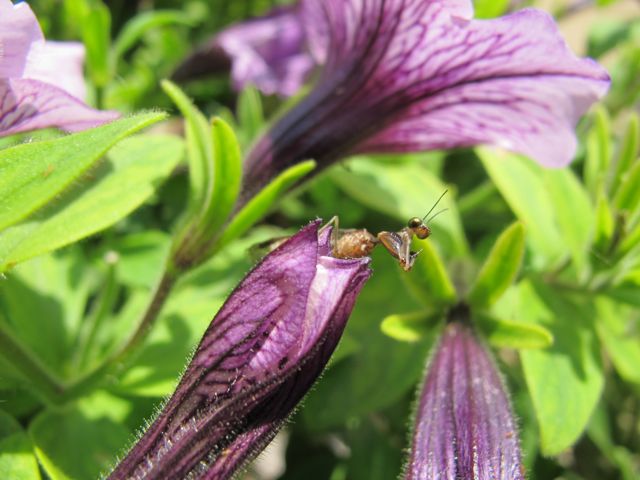
Mantisfly - Dicromantispa sayi

Another treasure of the garden--a mantisfly. These little gems are not terribly common, and I'm glad to find one every few years. I found this one floundering in my little water garden and saved it by putting it on some petunias to dry out. Predatory, as its spined and grasping front legs would suggest, the mantisfly is a neuropteran, related to the predatory lacewings, and like them it flies reluctantly and weakly. Actually, it prefers to wait around on flowers for something to blunder by to be grabbed and eaten. Me too. But usually I wind up cooking instead.


Such a charming bug--tiny but outfitted with everything it needs to grab smaller insects, process and consume them. I'm amazed at the convergent evolution that gives this insect the same bug-eyed countenance and miraculous forelimbs of the big praying mantis. Just a real good preying apparatus, and it works for both mantids and the unrelated mantisflies.
 
There, the similarities end. And the story gets weirder, as it usually does with insects.   Larval mantisflies, which are speedy and flattened and look something like beetle larvae, parasitize spiders and their eggs. They hitch a ride on a female spider, like a wolf spider, and get into the egg sac while it's under construction. They suck the eggs dry with tubular mouthparts, then pupate in the nice strong silk egg sac. When they pupate, the adult emerges by chewing its way out of the egg sac. Wow.

Dicromantispa sayi, one of six North American species in its subfamily Mantispinae, has a wide range, from southern Ontario west to SD, Utah, NE and AZ, and south to FL, Mexico and Panama, the Bahamas and Cuba.Worldwide, there are about 400 species of mantisfly. Think about that for a moment. It's a little crazy when you think about it, and compare insect diversity to, say, mammalian or avian diversity. That's like saying there are 400 species of oh, say, gnatcatcher worldwide.

So when you see a big scary spider, know that there's something much scarier haunting it, and cut it a break. This, according to Eric Eaton of BugEric on Blogspot, is a fishing spider, genus Dolomedes, family Pisauridae. What it's doing on a dry ridge with two nearly-dry, fishless streams on either side is anybody's guess. Headed for my goldfish pond, hoping to snag a half-pound snack?

                             
I posted the photo above thinking I had a wolf spider. Below is a real wolf spider. And this is the one I hope you'll cut some slack. Because if the wolf spider had been able to hatch all its eggs in its carefully tended silken sac, which the female spider hauls around beneath her abdomen, you'd have seen something like this:


which we at first thought was a very fluffy wolf spider but which, upon closer inspection, resolved into THIS
 which I'm sure many people consider a Fear Factor moment, being covered in your own squirmy seething chillun'. I found it charming. So as much as I love finding mantisflies around, I'm thankful on the wolf spiders' behalf that there aren't a lot more of them.

Thanks to my friend Eric Eaton and the folks at Bugguide.net for helping me narrow down the choices of mantisfly. And for helping me tell a fishing spider from a wolf spider!

Tiny Golden Jumping Spider, Who Are You?

Tuesday, August 16, 2011

14 comments
Let's find out.

 I just flippin' love living in the Information Age. It is the perfect place and time for a Science Chimp to flourish and thrive. Even five years ago, if I had put my hand on the garden gate and seen a tiny iridescent golden jumping spider leap to the next post, I would have bent down, studied it, run inside to my woefully inadequate shelf of invertebrate field guides (well, they're great for big flashy butterflies, and the Kaufman Insect Guide has delighted me again and again, but I didn't have that five years ago), and I would have sadly concluded that it was a really neat little golden jumping spider and wished hard that I knew its true name.                                                     
  This thing was tiny and very shy and I had a devil of a time getting pictures of it.  They don't begin to capture its mystery and elegance. It looked like it was made of molten gold with a pinkish-lilac sheen that changed depending on how the light hit it.

I kept herding it around with my fingers and sticking the Canon G-11 right down on top of it and finally got some acceptable pictures before it disappeared into the marjoram, thoroughly disgusted at my presumption.

I stored the photos away until a golden Tuesday evening with the scissorgrinder cicadas competing lustily with lawnmowers and children laughing in the town green. An evening after a week of houseguests and cooking and wild wonderful music and pure fun. An evening when I could finally think about tiny gold jumping spiders and wonder what they might be.

I went to bugguide.net.  I typed "golden jumping spider" in the search box. And up popped matching photos of the gold jumping spider Tutelina elegans.  And I marveled that this could work. And marveled that I, an armchair Linnaeus, had already named it the same thing, minus the Latin. But the Latin is the key; the Latin is what will give me more. I have found out that they eat carpenter ants, but not a lot more. But that, at least, is a start.

My Webby peregrinations led me to a wonderful site tended by an old friend named Dick Walton.  Well, imagine that. I haven't seen him since the late '80's, at an Association of Field Ornithologists meeting where I was showing some very early paintings. He's making amazing videos of all manner of small creatures on his web site, Natural History Services. Here's his video of Tutelina elegans doing its thing. Watching it, you can appreciate the wonder of finding a tiny, shining golden-purple spider on a garden gate. Watching it, you can feel the enormity of knowing there's this huge, huge web of people pumping information out into the universe for no other reason than the love of knowing. Thank you, Dick. Thank you, Bugguide biologists. Thank you, Web. Thank you, Universe.


My Unseen Friends

Sunday, August 14, 2011

22 comments
My unseen friends leave me messages, often in the little cemetery on my running route. 

The red-shouldered hawk I sometimes see left me a beautiful tail feather not long ago. I stuck it in a crevice in the trunk of a dying red cedar as a hello to anyone who might see it.


One day when I was lying on the grass under this tree, the red-shoulder landed on a dead branch very close by. She didn't know I was there. The branch broke under her weight and that hawk sprang straight up in the air flapping like mad. I laughed 'til my stomach hurt. It's fun to see such commandeering, graceful, powerful creatures look silly sometimes.


I would love to see the owl who left this whitewash on an old stone. I can only imagine the creatures who people the cemetery at night.


I saw the first tiny fawn prints, along with its mother's tracks, in early July. The pockmarks are raindrops. This photo doesn't look like much, until you see how tiny they are next to my hand.


Yes. That's a fawn the size of Chet Baker, maybe smaller. I imagined it tottering through the mud behind its mama.


One morning I found the most perfect pile of bobcat droppings in the middle of the road, past the cemetery. I was so excited that I ran straight home to get my camera. The droppings were full of turkey feathers--poult feathers, to be exact, and I wanted to document that. 

All the way home I dreamt of the photo I would take of the turkey-stuffed bobcat poo. I climbed in the car with my camera and by the time I got back someone had run over my poo pile. 

RATS!

I moped for a little while and then decided to get up before light the next morning in hopes the bobcat had come back and pooped there again.

I ran with my camera in my hand the whole way, more than two miles. And when I got there, the angels smiled and there was another perfect turkey-feather-stuffed bobcat ca ca, put right atop the old pile.

And I got my photo.


 So don't go around saying you don't know anyone who gets up early to photograph bobcat crap, because you do. One of the good things about living this far out is you don't really have to worry about anyone seeing you crouching next to a pile of poop, getting the perfect shot.


I wouldn't care if they saw me anyhow. It's probably more interesting than what they're up to, which would be smoking and driving a car. You can see the feather quill in the squashed poo, and then the fresh stuff, put right atop the smashed pile. How kind of the cat. Must've smelt my disappointment when the first pile was run over.

These photos conjure up an image of a beautiful bobcat leaping high into the air to snag a football-sized wild turkey poult. Good eatin'!


Just because I found it online, here is a photo of a melanistic bobcat taken in Scioto County, Ohio, several years ago by a trail camera. I've seen three Ohio bobcats, but none of them have been midnight black. What an unutterably cool animal. I might not recover if I saw something like this.


No, mostly what I get to see is what my unseen friends leave behind. That's where the imagination kicks in.

[Back to Top]