Background Switcher (Hidden)

The Art of Bonsai

Wednesday, August 21, 2019

12 comments

 It is a humbling thing, to start a tree from seed, put it in a small pot, and care for it for 37 years. This is not something that you can accomplish by wishing you could do it, by talking about doing it, or by having the good intention to keep it alive and thriving. You have to BE there for the tree. You have to remember to water it; you have to knock it out of the pot and make a safe place to overwinter it for 37 Novembers to Aprils. You have to dig it back out and repot it in the spring, trim the roots and top back just so, get it through the dog days of summer, sometimes watering twice a day. You can't wink out on your watch or it will die.

And so a bonsai tree 37 years in the pot speaks of commitment, it speaks of constancy and good care. I used to look at pictures of elderly Japanese people, wrapped in kimonos as they watered their bonsai, and read how the trees are passed from generation to generation, because they outlive their caretakers. All this I started, when I started some tiny two-leaved seedlings I dug from under some trees 37 years ago, when I was fresh out of college. My 40th reunion is 2020. These trees have seen me through two relationships; they pre-date my marriage to Bill; they've been with me since I was 24, moving from Connecticut to Maryland to Ohio, and staying for good with me in Ohio.

I asked Liam to sit next to them for a photo on his sixth birthday, November 8, 2005. He was into trains and pumpkins. Ahh, he melts my heart, with his fingers laced tightly together, the yellow "fantana" he picked out to wear so he'd look like a real conductor. That sweet boy.

 Now look at the biggest tree, in the middle. It's been in the pot for 23 years. It's in peak fall color. It's already a specimen. I also notice that the mandevilla clinging to the house has escaped the frost. The columnar blue juniper to the right has long since died and been replaced with a golden chamaecyparis, but the bonsais, and Liam, go on.


I wish I'd thought to take this shot every year, but opportunities go by every minute of every day. I did decide to recreate it on Liam's 17th birthday in November 2016, and I'm so glad I did.  Same trees in the same arrangement. Everyone has grown. There's Chet Baker, 11, hoping for a piece of maple cake. There's the cake, decorated with leaves from the same tree, now 34 years in the pot. There's beautiful Liam with his happy smile and the world stretched out in front of him. A morning glory has replaced the mandevilla. He carved the pumpkin. Mom just stood back and watched.

  
You'll notice that this tree has a split trunk. That happened in 1993, right after our wedding. A raccoon knocked it off the porch railing. It was dumb of me to keep it on the railing, in a beautiful midnight blue round that also broke in the accident. When I picked it up the next morning the trunk was split in two.

I called my dad. I still had a dad then. I could ask him what to do. He and I had stood on that porch at my wedding, looking at the young bonsais, only 11 years in their pots. He had been so thrilled to see them, so impressed that I could keep them going through all my life changes, all my moves. He loved trees so very much, and he'd been my guide and mentor in growing things since I was in kindergarten, and I brought home my first purple petunia in a paper cup.

"Tape it together. Keep it watered. It'll live." And I did. I slathered it with white artist's tape and I think I dripped some candle wax on the wound, to keep the bugs out.  The trunk was cleanly bifurcated, and after it healed and the tape came off, it was more beautiful for the coon's careless act.  Man, it was beautiful. I love to think that I have something my father saw and touched. I love to think of the times when I could still call him for advice. He died April 10, 1994.  The tree went on.

 Here it is when Liam was just nine, and the house was grayish-green, and Baker was a shiny wasp-waisted masterpiece.

2008

2008

Liam was helping me put the bonsais to bed, when they still fit in a little cinderblock-lined pit I'd dug under the back deck. Jeez, I look like a kid, too.
 
2008


 This was always our largest tree, and it was awesome even in 2008. Imagine it now, 11 years hence. Imagine us all.


2008
2008


Our subject in 2013, in its prime, in best fall color.
 Snow caught me before I was able to put it to bed in 2013. The bifurcated trunk, neatly highlighted in white.
2013

2016. It's the one in the blue pot. See how leggy it's gotten? 


 I bumped it up into the red-brown pot in 2017. It's lost most of its leaves, and you can see it's way outgrown that pot, at least by my standards, and it's time to give it more foot room.


2017


4/19/18


Spring of 2018,  above, with the bluebells from my sweet friend Jen a-blooming. Our tree is the center one, silhouetted against the boxwoods. It's got no lower branches coming at all. It's just going for broke, heading up and out.  I've given it a bigger pot, and that's helped with its general health, but it still has a lanky shape and, short of totally beheading it, I can't figure out how to reshape it so the top is in proportion to the roots and trunk. I don't want to behead it.What to do? This tree was becoming No Longer an Asset. This is my coded phrase for house plants that have outgrown their beauty and usefulness. But this is no houseplant. This is a tree, a spirit, a thing I revere, a thing of permanence. After so many years being bumped from tiny, to small, to medium, to large pots, it was tired of confinement. When a tree is just DONE with being subjected to the art of bonsai, it lets you know. 


I had begun to think about planting this Japanese maple out in 2015.  By "planting out," I mean setting it free. Letting it be the tree it is trying to be. I had no idea where I’d put it. There were already two liberated bonsai in the yard, and they offer delightful deep maple shade now, being tall enough to allow us to set up lawn chairs beneath their splendid tiny leaves and fine, fine branches. So we do. It’s lovely to take a cool drink and your laptop or the phone or a good book and go outside and sit under what was once a potted bonsai. It’s like having a room of your own, outdoors. Sitting under a liberated bonsai makes you think about growth and constancy, time and the power of trees.


 And the fall color is still incredible.


When Bill died, I knew what I wanted to do. I now had a new place and a  perfect spot to turn this fretful tree loose. I'd plant it near his grave, where it would eventually give us shade to sit under when we visited him. It took me a good while to get around to it, though, because it isn’t a trivial thing, planting a tree that stands waist-high. I decided to start schooling it for release in April, moving it from its usual partly shaded spot to full sun, because it was going to have to get used to baking out in the open meadow. 

I’ve had a heck of a time keeping all my trees adequately watered in the brutal heat waves this summer. When their trunks get as big around as your arm, they drink a lot! Here's the bifurcated trunk of this tiny but massive tree in 2018. Thank you, Long-dead Raccoon.


 Truth be told, I was happy to contemplate letting Mother Nature and its considerable root system take care of this largest of my bonsais going forward. I’ve been watering this tree for more than half my life! 

To be continued... 

Sorry about the antic type sizes in this post. I've been beating my head against Blogger's wall for an hour, trying to get everything to a readable size. I think I've effected a change, and it reverts back to caption size text when I publish. Pbbbbbt!


What Killed My Frog?

Thursday, August 8, 2019

26 comments

I hadn't gotten too attached to this frog; we'd just made friends, and it had just connected me with good things like mealworms. But it still was a punch to the gut when I saw it suspended, little fingers splayed, eyes hooded, halfway down in the 3' deep pond. I knew right away it was dead. I've seen that float before.

I didn't have my phone with me, and it seemed disrespectful to shoot a photo of the frog like that anyway, when it couldn't say no. Besides, I had to fish it out quickly and see if there was any life in it at all, because helping creatures is what I always try to do first.

Nope, it was stiff and still. Ahhh how sad. I noted immediately that it was very fresh. No bloating, no odor; eyes still perfectly clear. But why and how had it died? I'd fed it two Superworms on July 29. And this was August 4. Could they have chewed a hole somewhere in its gut and killed it slowly, by  infection of peritonitis? Seemed unlikely. But then again...maybe the timing was right for a death that. Being the Science Chimp, and easily consumed by guilt, I had to know if I'd had an inadvertent hand in the frog's death.

I'm gonna ease you into this now with a little dissertation on the frog's tongue. From here, it gets more graphic, but it isn't gross. It's interesting. The more sensitive among you might want to stop here. You've been alerted. 

I opened the frog's mouth, to see if it might have choked on something, and was arrested by its amazing tongue. I'd seen that tongue deployed as it swiftly unfurled and blapped onto the mealworms I'd tossed. But I never realized that it is actually turned back on itself, and its side flaps are folded under, as it rests in the frog's mouth.


Freaking fabulous!! I thought about the extra velocity that sticky tongue would have as it snapped out and simultaneously unfolded. Fwab-adap!


It's like the distal half of a heron's neck, which, when it strikes, whips out from a sort of hinge halfway up the neck. That hinge is the "kink" in the neck that we notice when the bird is at rest.


 Shot this fledgling green heron as it hunted dragonflies in a floating mat of vegetation in St. Mary's WV. You know how fast you have to be to grab a dragonfly? 

 The one that got away.


Throwing the neck (or the tongue) out from a short distance is the difference between a roundhouse punch from the shoulder and a quick jab thrown from the elbow.  The jab isn't as powerful, but it's much quicker, and quick is what you have to be to catch insects (or fish). Already, I was enjoying my foray into this frog's secrets.

But I knew it wasn't going to be all fun and games, playing with a frog tongue.

There was only one way to really determine whether a Superworm had killed this poor creature.
 It was time to open the frog. The skin was like the finest thin latex, and the whitish abdominal muscles had to be cut with a scissors, as did the breastbone, so I could completely retract the abdominal walls. And there were its organs, pretty much just like a person's, with less intestine.


I saw two blackish granular structures that looked like caviar, one on each side, and knew I'd found the frog's ovaries. Ahhh, damn. It had been a female.

Kinda surprised me, because the tympanum (round external ear membrane) was pretty large.  Males have larger tympanae than females. 
Gotta listen for those spring choruses, you know, to get in on the action.


OK. Time to haul out the stomach and intestines, and see if there was a giant mealworm in there, or at least a hole somewhere. The stomach was fine, pink, unperforated (to the left of the pliers). The duodenum looked discolored right below the stomach. I thought I might have found something incriminating.
But when I opened it up, there were no holes, and it appeared that what I was seeing was the color of recently digested food, through the translucent wall of the duodenum (small intestine). It was an orange-red paste that for all I know might once have been a baby comet. So much for that.


Everything else inside the frog looked fine. I opened the stomach and examined its contents. Not a trace of a Superworm. Duodenum had checked out fine. Opened the caecum and examined its contents. Just normal looking frog poo, loaded up to launch. Small insect bits discernible in the fecal material. No hard chitin from a Superworm, at all. That had already passed through. This animal had been eating and digesting normally right up to its death. Nothing was bloated, nothing perforated, no internal bleeding and nothing amiss that I could see.  I had to conclude that perforation by Superworm was not the cause of its death. Not to say it can't ever happen, but I'm confident it didn't happen to this frog.

But there was something amiss on the frog, and I wanted to think about that.

The animal's left leg was bruised, with a hemorrhage running down the calf. Its foot was pretty swollen and discolored, too.


On the dorsal side, there were two very fresh wounds. One, a jagged tear in the skin. It would have taken something quite sharp, dragging across the frog's thigh, to make that.


There was also a puncture wound, from which some muscle protruded. See the tip of the pliers here, pointing at it.  Hmmmm. I couldn't see how either of those wounds, though, would kill the frog. But they were so fresh, they had to have something to do with her death. 

I have to thank Liam for taking these photos. I couldn't take any shots while doing the dissection. It was worse than trying to make movies while feeding bats (something I got pretty good at, thanks to a small gift tripod and a nimble tongue).

This isn't a flattering shot, but it is 100% Science Chimp Zick. Completely absorbed in the pursuit of knowledge. And for that, I love it. It's me, and I like who I am, because being normal is boring, and glamor ceased to be part of my world a long time ago.

 As Liam commented when I asked him if I should publish this photo:  "Of all the photos of me tearing apart a dead animal, this is the worst!" Which sent me into gales of laughter. This kid. He's made me laugh all summer long. God, I'll miss him when he goes back to school.


 Nah, it's not a glamour shot, and I look like a gnome, like something that lives in a tower. Oh, wait...

Hi Bacon! Thanks for stopping into this post. I love you.


I was left stumped. I decided to wrap up the autopsy and mull on it for awhile. I'd found out what I could find out from this poor frog, so I wrapped her in wet newspaper and set her in a cool place until nightfall, when I could put her body out for the possum who visits our compost. What a nice surprise it would be for him! Nothing gets wasted around here. And everybody eats.

I excavated the rider mower from its tangle of lawn chairs and bikes, replaced the front wheel whose tire I'd flattened and given to Marcy to get fixed (thanks, Marcy!!) Started it up, and began the hypnotic round and round the house and plantings. I was about five rounds into the mow when it hit me. A cut and a puncture wound wouldn't kill a frog...would it...

unless there was venom in what cut and punctured it.


Which explains the swelling and discoloration very nicely. That's what my finger looked like once upon a time, when I reached under a lavender bush for a weed and felt a hot lance to my hand. THAT good, old story is here: Committed to the Country


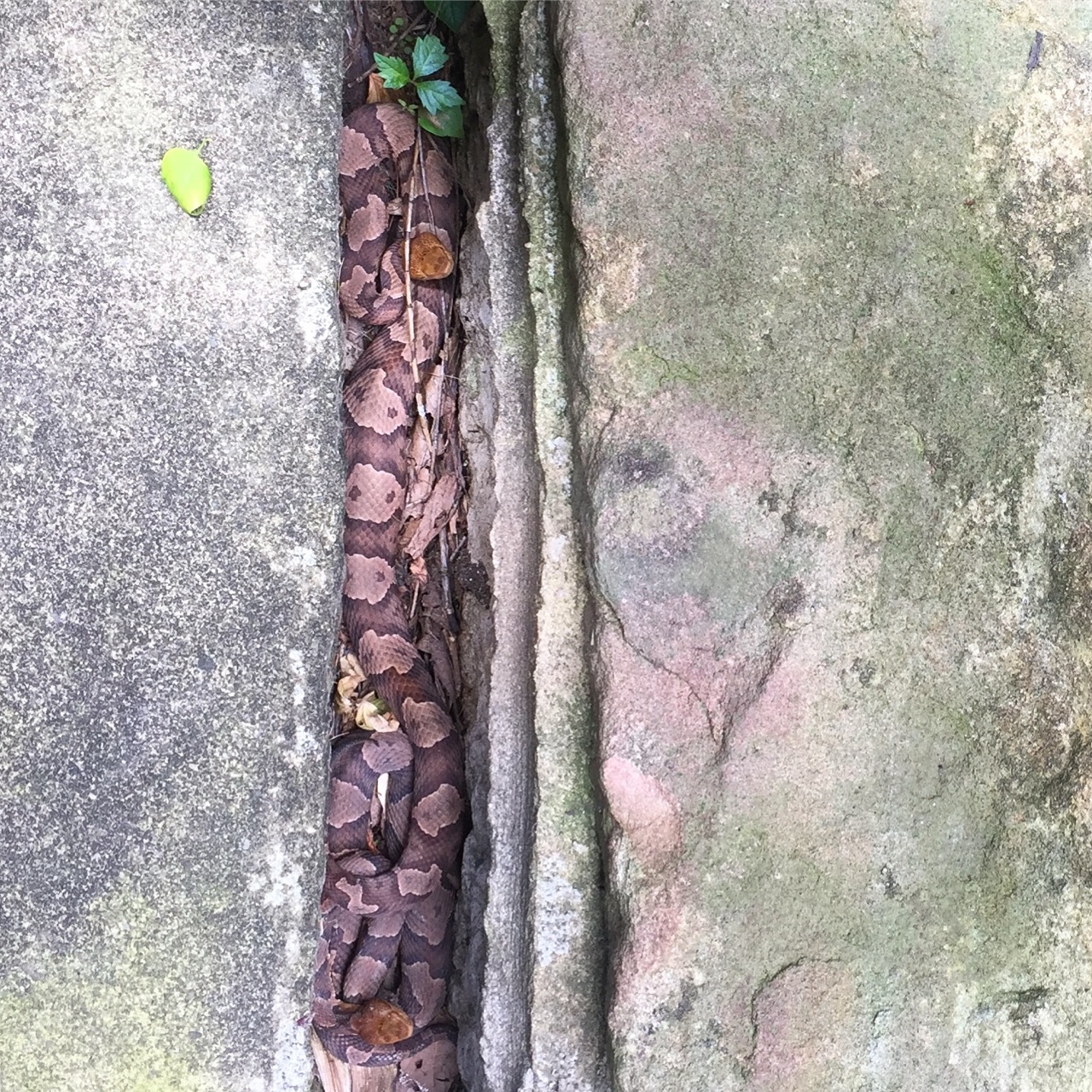
Durn copperheads. I build you a nice patio to live in, and you thank me by killing my frog. You struck; she jumped; you raked her with one fang, but you hit pay dirt, and punctured her leg with the other. Still, she got away, and plopped into the pond, already dying, a foot down, where you couldn't recover her. Wasted. Unless you consider that it was all a nice mental workout for a curious Science Chimp, and some fairly graphic entertainment for a few thousand people. 

And maybe a nice solid bit of debunking on a factoid that ain't necessarily true. That said, I'm not feeding any more Superworms to frogs. Better safe than sorry.

This year's fine brace of copperheads. Mr. and Mrs. Fak. I'm sure their banded babes will turn up very soon. I just hope none are in the basement.

Still, I suspect one of you Faks also killed the two bullfrogs who moved in this spring. The hummingbirds and warblers and chipping sparrows and I thank you for that. 

Circle of life, baby. Like my John Deere and my mind, it goes around and around.

Before the crape myrtle got killed back to the ground. When Chet, my tractor,  the crape myrtle and I were newer, and still shiny.

Feeding the Frog

Tuesday, August 6, 2019

7 comments

I like my pond. Bill and I dug it in 1993, dropped some old carpet and a vinyl pond liner in the hole, filled it with the hose, put some fish and plants in it, and it's been going strong ever since. The original four shubunkin goldfish lived and reproduced for a couple decades, making babies that were all black, that you could hardly see in the dark water, until they all up and croaked of some disease. Well OK. That was that. I'd never wanted 70 fish in my pond, anyway.  I cleaned it out, waited awhile, and put some Comets in, and they've been hardy and friendly and most of all colorful! They have bred well but not explosively. I appreciate that.


  Twice a year, the pond's a huge pain in the butt to clean. However I have figured out how to do it without killing myself, as I was doing in this 2012 photo. I note with some satisfaction that I still don the same lime-green Columbia nylon shorts to clean it in 2019. Frugal to a fault. However now, instead of painstakingly siphoning muck off the bottom, stopping every 30 seconds to clear the clogs from the tubing, I do it ever so much more quickly and easily. I just get a square-sided Tupperware and scoop the sludge off the bottom, dump it in a bucket, and I'm done! Fabulous. Fast. Works better than siphoning. Plus, I can fertilize my roses and peonies with the sludge. BONUS.

Really, the pond is just an excuse to plant lots of flowers, drifts of color that ring it all summer long.  


Sometimes it's crape myrtle, sage and coreopsis; sometimes it's buddleia, Rudbeckia and zinnias.


One of my other favorite things about having a water garden is the frogs it attracts. There have been several summers when it was overrun with bullfrogs, and they can be a problem, especially if you're a chipping sparrow, warbler or hummingbird. But usually what I get is medium-sized green frogs who quietly take up residence, plop into the water with a little Yikes! when they see a human, then decide we are no threat after all and sit quietly and let us admire their beautiful gold-flecked eyes; their sweet froggy anatomy; their green lips.  

I had one live here for 18 years. I called him Raoul. Maybe he was a she. I'm not sure. But there's a post from 2013 about him here. 

This 2019 model was one such frog. Tame as all get out. I could lift the filter out, right next to it, and it wouldn't bat an eye.

  
Maybe it's because I fed it a couple of times.


I love this video. Frogs don't really seem to be looking at anything, until zoop! they nab it. And they don't seem to notice anything, except that they notice everything. Don't be fooled by their impassive golden eyes. They're watching your every move. And if you toss a worm to them, they know it was you who did it, and they hope you'll do it again. Same goes for lizards. Lizards NOTICE.

I posted this video on Facebook, and one of my friends who does wildlife rehab left a comment warning me that Superworms (the giant mealworm offered in the video) are dangerous to frogs! Well, who knew that? She said they can chew their way out of the frog's stomach! OMG! Huh? That sounded weird to me, so I asked The Google about that. Like many things I learn on the Intertubes, whether that's true or not depends to whom you're talking. I found some herp keepers' forums that emphatically pooh-poohed such claims. The story apparently originated with Petsmart, whose employees claim this to be true, and who warn people not to feed Superworms to amphibians or reptiles. Oh.

Superworms, for those who don't know, are normal mealworms (Tenebrio molitor) that have been given hormones that keep them from going through their normal instars. Basically they are arrested in development, staying in the larval stage, and they just get bigger and bigger instead of pupating and turning into beetles.  These Superworms I have now date from summer 2018. I'm curious to see how long they will live! They're handy to have on hand if you have a bird that needs a big meal.

Me, I trust a frog to know what it can handle and what it can't. This frog didn't have the slightest hesitation glupping up my superworms. (It only ate two). Having had a frog (Big Fergus) who ate BIRDS, with their pointy beaks and sharp claws, I had my doubts as to whether a large mealworm could kill its captor by chewing through its stomach before the mealworm died. Mealworms, super or not, give up pretty easily when you get them wet, not to mention, I'd think, when they drown in stomach acid. 

But. 

I didn't see our sweet green frog again after it ate those mealworms. As the days went by, I began to wonder...had I killed our frog with kindness?


Evil cackle. Another cliffhanger. You know how I love 'em. I'll be back. 
Heads up. Next installment is graphic. Not gross, in my opinion; more cool, but graphic. 
Hang on for that ride.

[Back to Top]