Background Switcher (Hidden)

Goldfinch Down!

Wednesday, October 4, 2017

9 comments
I was away giving a talk to some master gardeners in Hocking County, Ohio, September 9 and 10. My gosh, that's nearly a month ago. It's all flown so fast. Probably a good thing.  I had the great privilege of staying overnight with my friends Jen and John at their gorgeous country retreat in the famed Hocking Hills of Ohio. How lucky can you get?


I got a nice dogfix from their Australian shepherds Winston and Jake, who were so happy to hike with us. They respond to voice commands. It has been so long since I've been around a dog who can hear, that this seemed like an extravagant luxury to me--calling a dog. Not having to run up to him and tap him on the shoulder so he'd look at you and have to guess what you were trying to tell him. It made me think of the old days, when a quiet word was all it took to bring Chet to my side. Heavy sigh.

I gazed for a long time out at their gorgeous meadow. In my appreciation was a keen sense of how much work it is to have and maintain a meadow like this. A view like this is a privilege, an obligation, and a hell of a lot of work. I just love the serpentine path John and Jen cut through it, inviting the eye and the boots to traverse it. And as someone with land to tend, who lacks the requisite heavy equipment skills to keep it open, I see it with a far more appraising eye than I would were I not in this situation. I look at this view and am awestruck. This view is about beauty, yes, but it also speaks of great vigilance and dedication. Those meadows don't stay open by themselves. It's a pitched battle between woody vegetation and the brush hog. Relax for a few months or a year, and the vegetation wins every time.


Too soon, my little escape ended, and I headed home. On the morning of September 10, I was filling the feeders when a wee bird fluttered out from under my feet. It was a goldfinch, and it was completely grounded, reduced to hopping around under the feeders, scrounging for its existence.

Uh-oh. Here I go again, thinking about entering a pact with an injured bird, one with unknown consequences for us both. I knew one thing: if I did nothing and "let nature take its course," as the wildlife officer likes to say, this baby goldfinch would end up in a chipmunk's burrow, being carved up like a Thanksgiving turkey. If I did something, its chances for survival improved dramatically. If what I did didn't work, and the bird wasn't releasable, well, I guess I'd deal with that on down the road. Maybe somebody would take it on. But who? That's the fine print I have to read on any such contract with a broken wild thing.

I mentally shuffled through the weeks ahead. When was my next big trip? Well, I had the Ohio Pawpaw festival in a week, but that was a day trip. I'd be speaking and showing my work at the American Birding Expo in Philadelphia (birdingexpo.com) Sept. 29-Oct. 1. My brain does a pirouette when I stand back to observe a hurt bird. All those things twirl around in there and then my brain spits out a ticket that says "Do it." And I lean down and close my hand around the bird, and our fates are intermingled from that moment on. And as I looked at the still-black bill of the bird, it hit me that it was probably still being fed by its parents. Oh, Lord. Please, please be able to pick up your own food. I can't force-feed a finch, can't get that slippery little conical bill open if you won't open it yourself. Ack!! What was I thinking?? Welp, too late to worry about that. I've entered the pact.


I picked up the little creature as easily as I'd pluck a candy wrapper out of the grass. I took her inside and held her by the window, stretching her wings out, looking for breaks and bruises. I could find nothing. She could move her wings in a normal way if she had to, but she could get no lift. She'd flutter through the grass, but couldn't get any altitude. All I could conclude was that she had a broken coracoid. This break, of a bone that's embedded in the pectoral muscle, can really only be guessed at, not seen on examination, but it will ground the bird as surely as a broken humerus will. It most frequently occurs in windowstrikes. I had little doubt this poor bird had hit one of our unprotected windows.

From shearwater.nl, here is a photo of a fulmar's pectoral assemblage. They're a lot heavier than the bones of a goldfinch, but the structure is the same.  You'll recognize the furcula as the V-shaped "wishbone." The coracoid is #2, running from the shoulder girdle down to the great big blade-shaped breastbone #1 (sternum). The coracoid serves as a strut for those big pectoral muscles that power flight and are anchored on the sternum, or keel, as it's often called. Mammals don't have coracoids, so calling it a "collarbone" is descriptive, but not really apt. You can see, looking at this structure, that if there's a break in the coracoid, the whole system of flapping breaks down, because the supporting strut has broken. Everything's moving around in there, and the bird can't get any power to its wings. Ow. Gotta hurt, too.

1. Sternum / breastbone
2. Coracoid
3. Clavicles / furcula
4. Scapula
5. Joint with the wing
6. Foramen trioceum
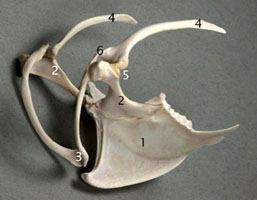
Coracoid: #2. That's probably what's broken here--the supporting strut for the wing. 

The good thing about a broken coracoid is that, given time, it can heal on its own. Like, two weeks' time. The coracoid is basically supported by surrounding muscles, so it's not flopping around loose. It can heal and the bird can regain flight functionality. But the bird needs a couple weeks' worth of rest in a small cage, and it needs to be in a quiet situation where it isn't tempted to flutter a lot.

All this I simply have to deduce, based on how the bird's acting and moving. It's an inexact science. Jumping in the car and driving a goldfinch 2.5 hours to the Ohio Wildlife Center and back kills a day, and it simply ain't gonna happen in my busy life. Down here in the most wildlife-rich counties in Ohio, where there's an immense need for wildlife rehabilitators, there are no rehab facilities, no veterinary backup. There are no options other than to take the hurt thing to Columbus, or to try to help it yourself. Anyone who opened a clinic down here in the southeast corner of Ohio would be swamped with patients from Day One.

 People around here care greatly for our wildlife--the constant phone calls I get attest to that. But the income base that could support such a facility through generous donations simply doesn't exist. See, the pile of money generated through oil and gas drilling doesn't stay here, and for the most part it isn't pumped back into the community. You in the big white trucks, we've invited you in.  We've fallen all over ourselves to take your bribe to drill our land. Bring in your tankers, your haulers, your rigs. Take our oil, take the money and run. All of you truckers come on. You drive too fast, smack down the middle of our little country roads and you run over some more of our wildlife while you're at it. Please, if you could be so generous, swerve back into your lane for just a second, and let my son in his little green Subaru make it to school, and home.

Hmm. It must be the growl of heavy equipment, floating in the window well before light, that inspired that last paragraph. There's heavy logging going on down in the holler, and I don't want to know what comes after that.

Her right wing doesn't look so good here, I know. She spent a lot of time resting it on the perch, which was exactly what she needed to do.  But I was willing to keep her in the studio for a couple of weeks, in the hope that one day she might fly again. And my brain was working, figuring out a way to perhaps help the healing process. Next: Goldfinch in a Turtleneck.


Red Bat Release: To the MOON, Alice!

Wednesday, September 20, 2017

16 comments
Cards and letters keep rolling in. I do appreciate the outpouring, and the beautiful sentiments that let me know how much Chet Baker meant to those of you who have written. I'm saving them. I won't lie: it's hard for me to read them, when I spend much of each day trying so damn hard to forget and get on with things. Lots of times I have to refrain from opening the mail until I'm in the right frame of mind, feeling bulletproof. My speaking schedule is packed, and while I don't much feel like being in public, the travel has been a blessing.  I'm trying to get back to my running routes, but I usually end up in a puddle of tears as I remember him so vividly, running in front of me, nosing at that log, jumping that ditch, eyeing those cattle. I remember all the places where he used to cross the road so he could keep an eye on oncoming cars. He was so smart about cars. I even remember the spots where he liked to stop for a poop. With all that's going on right now, running helps keep me grounded, centered and sane, but there's a fresh dart to the heart every time I go out. Maybe I need to find some new routes, ones that aren't haunted by sweet apparitions.

They say the Universe sends us what we need. When the timing's right, it's magic. I couldn't have received a better gift on the Very Bad Day of September 1 than a red bat in need of love, comfort and wasp larvae. On this, our third installment, the bat is being fed for the last time, in preparation for release.

This isn't a great photo, as it was taken in very low light, but look at the gorgeous lines of this little animal as she investigates the padded Critter Keeper that would be her home for three days and two nights. I purposely keep short-term rehab bats in small plastic containers with toweling or nonskid drawer liner as padding, to keep them from breaking their delicate finger bones should they beat their wings against the sides. This bat was a model guest. Every time I checked on her, day or night, she was either sleeping or preening--she wasted no time or energy that I saw, trying to find a way out.


I just love the long slender forearm, the hand part of the wing being folded along it, the jet-black webbing crinkled up between hand and forearm. Her hind leg is extended, joined by a membrane to the tail and the other hind leg. Her head is up, and she's taking in information with eyes and nose. Once you get used to bat architecture you can begin to appreciate what a beauty she is.

She looks deceptively big and blimpy here. Most of what you're seeing is fur and membrane. Her little body is slender, and if you squint you can see her sides--quite vole-like, with a little waist, even--and the outline of her tail. The big furry areas along her sides are her coat--the heavily furred patagium, or wing membrane, that, along with the furry tail membrane, allows this little marvel of adaptation to wrap herself up and survive midwinter temperatures, hanging by one foot from a twig in the woods, pretending to be a dead leaf. 


Red bats are migratory, and you'll see them flying through Halloween and even into winter. I've seen them hunting insects on warm late January days. A good number, surprisingly, may stay around to winter here in southeast Ohio. But most are thought to head south. An excellent article at the Bat Conservation International website explains red bat hibernation strategy. A study of 13 male red bats wintering in southern Missouri (hardly subtropical!) showed that when temperatures dropped below freezing, the bats did, too--from tree branch roosts to the leaf litter below! 

Radiotelemetry showed that red bats used leaf litter on exposed south-facing slopes for roosting, and that they left the litter when temperatures became mild, to forage at night for moths. They went deep into torpor when temperatures were cold, buried or sometimes completely exposed in the leaf litter. Their vivid red-brown coloration makes more sense when you think of them hibernating beneath an oak in the litter.

The realization that red bats might hibernate in leaf litter was born when bats in many parts of temperate North America were observed flying up from the forest floor during prescribed winter forest burns. This led to the radiotelemetry study by Brad Mormann and Miranda Milam from which I've excerpted these notes. 


 I'm pretty sure you weren't hibernating, lying there on your back on a warm drizzly evening, Missy. I don't know what you were up to, but it wasn't good.


I'll never tell. Thank you for the room and board. I'm feeling much, much better now.


 Let's take a look at some more videos! In this one, you can see more of her body as she relaxes in my glove. I'm barely holding her, as she's so absorbed in her feeding that escape is far from her mind. 


I love this one, for the way she tackles a nearly mature paper wasp pupa. WOW. 


This movie gives you some excellent Tiny Pink Tongue action. She's fed, watered and ready to fly.

 To the MOON, Alice!!


There were three people documenting this momentous event with iPhones: Shila, Bill, and Liam. All the video here is Liam's, except for this slo-mo Bill took. It's really cool because if you can make it out in the dim light, you can see Alice turning on her sonar just before she takes off. She opens her lips and flares them as she sends out sonar signals. And then she works her wings free and heads for the moon.

I can always tell when a bat is plotting escape from my glove when it lifts its head, opens its mouth and turns its head rapidly side to side. It's scanning its environment with sonar. I may not be able to hear its ultrasonic sonar clicks, but I can see it emitting them.


This is how it feels to release a strong, healthy red bat who might otherwise have died.


The night was one bat more beautiful, and that's way more beautiful than it was before.


More Red Bat! Now, With Shmoos!

Thursday, September 14, 2017

16 comments
I don't know about you, but I think the world needs more red bat videos. To that end, I have three one-minute shots of delight. Movies 4 and 5 depict the second feeding session for the little juvenile red bat found helpless on her back on a sandy playground in Reno, Ohio. The feeding session in the first two videos was from the morning after she was found. She'd had a nice big feeding the evening before, and had presumably rested all night in her towel-padded Critter Keeper.

So the next morning it was wonderful to see how much more lively and capable she was. I had to cut the wasp grubs up the evening before; this time she handles an older pupa with alacrity. It did my heart so much good to see her gain strength.


We chopped the videos up into one-minute segments because Instagram will take only one-minute videos. Liam, again, is videographer.

One of the coolest things about bats, I think, is the way they seem to get that you're trying to help them. They struggle a bit, but shove a nice juicy grub in their mouth and they're all over it, thank you thank you! I will eat that! You won't get any argument from me! This is delicious! More, please!

I suspect that if I'd had to keep this bat longer; i.e. if it were mid-winter and not safe to release her for several months, she'd be the kind who'd probably sit on top of my glove, accepting food from the forceps, needing no restraint at all. I love it when they get to that point. 

But this little bat is on the fast track to release. All I wanted to do was build her up so she could fly again, and send her on her way, for it is the height of red bat migration now and she has a long way to go. I hope that wherever she ends up, it's not ruined by that pill Irma.


This next one, Red Bat Movie 6, is my favorite feeding video. It was taken the next evening, the evening of her release. As you can see I had quite a time restraining her--she was fast and strong and she wanted out! And you may need to watch it a couple of times. In trying to catch her I scared her, of course, and she HIDES HER EYES twice. Once she ducks her head into my glove and the second time she covers her eyes with her sweet little wings. Ohhhh. I can hardly stand it. 


If you can watch this last video, and still say you "hate bats," well, I'm afraid I'm giving up on you. 
Leave a comment that starts with "EEEEEW" on my Facebook page and poof! I will make it disappear. It's one of my few magic tricks. 

Because under that incredibly soft plush red fur, frosted silver, is an old soul with hopes and dreams and terror, too, in her wee breastie. All she wants is to fly up to the moon again, sometime soon. And in my next post, she will get her wish.

LOVE HER. Love her fiercely, tenderly, as I do. If you're here and watching, that's the way to go--toward the light. If you want to pass it on, show that last video to somebody who "hates bats." 

P.S. Dark, rainy morning here, September 14. Birches turning gold, heading into fall fast. Talking on the phone, looking out the studio window. At 7:58 AM, the female bobcat who's taken James' place zoops out from behind the spruce, picks up a chipmunk like you'd pick up a dropped wallet--casually, easily--and melts back into the woods with her breakfast without even putting the birds up off the feeder. It. Was. Awesome. We've gone from nine omnipresent and gluttonous gray squirrels to None. 
No. Squirrels. That's a natural balance I can get behind. And waay better than James ever achieved. :D 

Come to think of it, I haven't seen Notch the naughty bunny--a regular each morning at the feeders-- for a week. Damn. That's what I get for falling in love with a Shmoo.**


RIP Notch. In heaven, Julie's lettuce, geraniums and lobelias are planted right in the ground. You won't even have to climb up into the planters.

**Shmoos were the creation of Al Capp, the brilliant cartoonist/creator of Li'l Abner. My DOD, who loved sly social satire, used to read Li'l Abner aloud to us at the breakfast table. This Wiki link will tell you more than you need to know about Shmoos. 


[Back to Top]