Background Switcher (Hidden)

Giant Anteater!!

Monday, January 5, 2009

16 comments
Giant anteater habitat near Karanambu, Guyana.

I got an itinerary for my press trip to Guyana several weeks before we were to depart. There were several items on it that made my eyes go boiiiinnnnggg, not least of which was "Karanambu: Early morning excursion on the savannah to look for giant anteater."

I had no idea. Once again, my preconceptions about Guyana were to be shattered. First, I hadn't realized that the country boasts extensive savannah among its habitats. Second, I didn't know that giant anteaters ranged as far north as South America's northern coast. Not only that, they were historically found from southern Mexico all the way south to northern Argentina. Thanks to human persecution, they are vanishingly rare in Central America, and very rarely seen in the wild even in the stronghold of their range.

Myrmecophaga tridactyla
is a huge animal, growing to seven feet long and 85 pounds--100 pounds for a large male. It's the size of a wolf. It lives in a wide variety of habitats, from rainforest to dry forest and savannah, wherever ants and termites are abundant. It's active during the day in forested habitats. In the savannahs, or wherever it suffers from human persecution, it is primarily nocturnal, using its keen sense of smell to locate termite mounds and ant nests, which it tears apart with powerful clawed forelimbs. A harmless beast unless cornered, the giant anteater will stand on its hinders and defend itself with slashing claws and a crushing "hug." I've been hugged by its edentate cousin, the three-toed sloth, and you don't want that hug, with a very pinchy finish. Its huge foreclaws close against its palms with a vise-like grip, easily smashing bone. When walking or running, giant anteaters fold the claws against the palm, and walk on the heel of the "hand," the claws never touching ground. It would be like running on all fours with your fists balled up.

We left just after daybreak to go find an anteater. Our driver scanned the savannah as he drove, and a second guide stood in the jeep with his body out the window for better visibility. Suddenly the spotter banged on the roof of the jeep and we veered off the road and over the trackless grassland, speeding toward a dark blotch on the horizon. When the vehicle could go no farther, the driver and spotter took off running toward the anteater, flanking it and driving it toward our stunned little band of hopeful anteater watchers.
My breath was taken away by the suddenness of the pursuit and the tactics of our guides. I hadn't dreamt we'd hunt the animal down; I'd thought we would simply hope for a distant glimpse, perhaps a view through a spotting scope. But here they were, driving the animal right toward us, running like mad on either side of it.

Tomorrow: More giant anteater facts, fotos, and musings. Cue organ music.

Guyana's Savanna

Sunday, January 4, 2009

10 comments

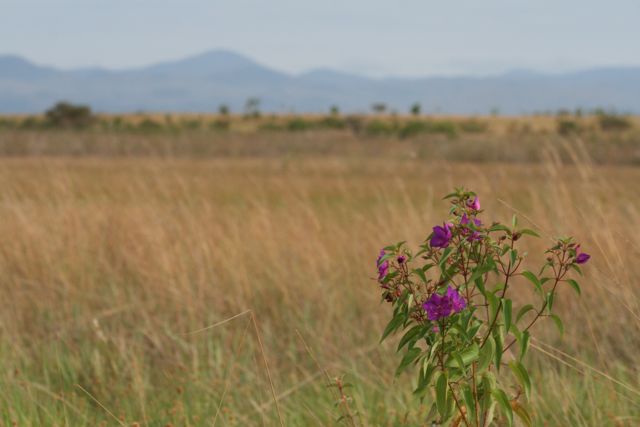
One of the things I hadn't expected to see in Guyana was grassland. I guess I thought it would all be Amazonian rainforest. I was stunned by the visual similarities between Guyana and South Africa, which I visited in 1994, when I was still shooting film. I couldn't get my head around Guyana being in South America when I saw vistas like these.
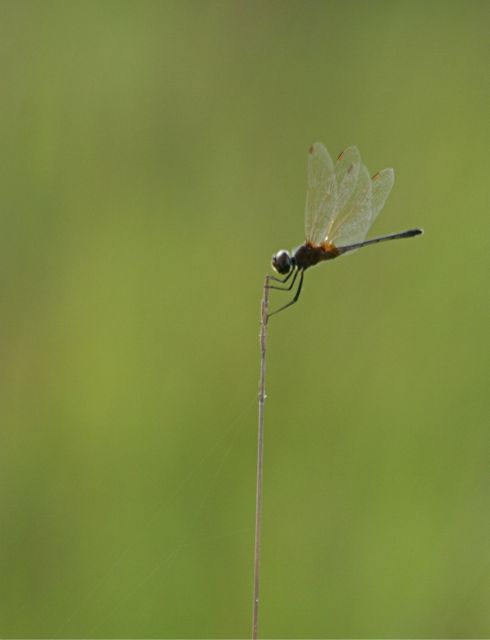
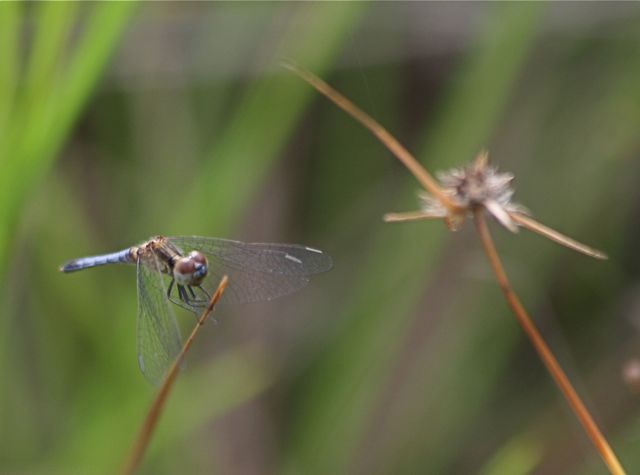
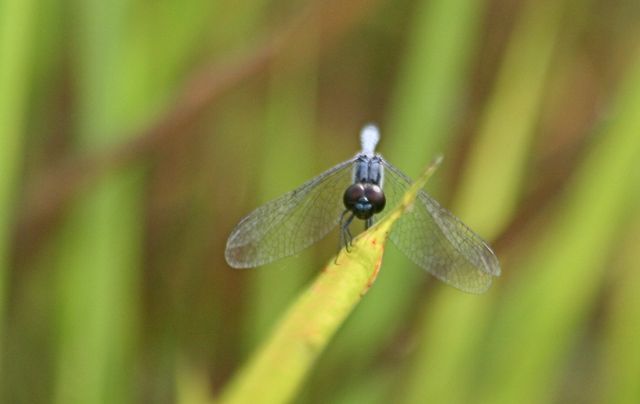
Guyana's savannas are natural, formed where the soil is too thin to support trees. Lightning helps maintain them. We had but a taste of the unique life these savannas support, so very different from the tall forest flora and fauna. There were dragonflies, for one thing, beautiful ones, and one blue one that must be among the smallest true dragonflies on the planet--less than an inch in total length.As a naturalist, it was a thrill to me to realize that I was looking at a life form that might be undescribed; endemic; that would set every nerve to tingling in my friends who study the Odonata--and to have no idea what I was looking at. I felt like a musicologist who had stumbled on a remote tribe who'd made instruments out of monkey skulls and shells, listening to music none of his colleagues had been privileged to hear.Who are you, elfin one? Does it matter to you?

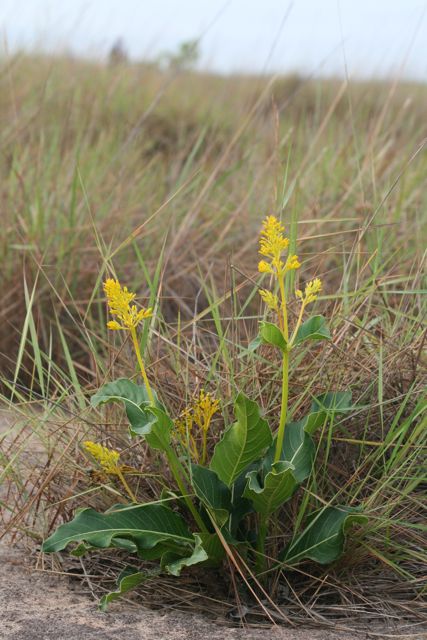
The mystery continued in the plant kingdom. No idea what this is, even what family it occupies.
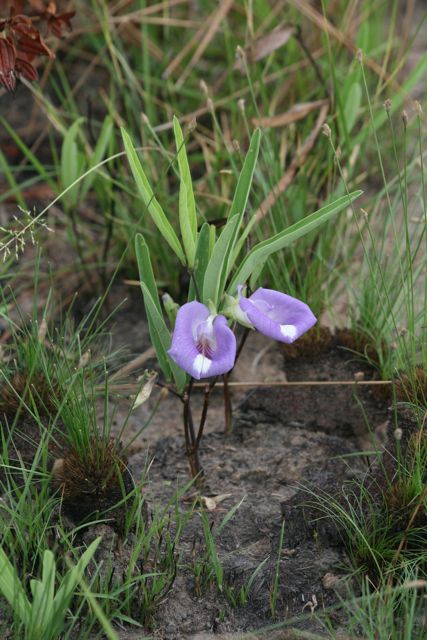
This one, I think, is in the pea family. Had to get down on my knees to see if it had a scent. Not at the moment.
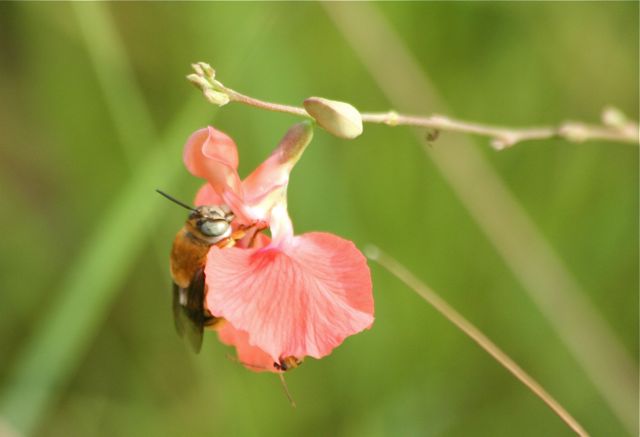
This lovely thing was reminiscent of a Gaura. It also reminded me of Salvia greggii, or Autumn Sage, one of my favorite hummingbird flowers. Even the bee looked exotic.

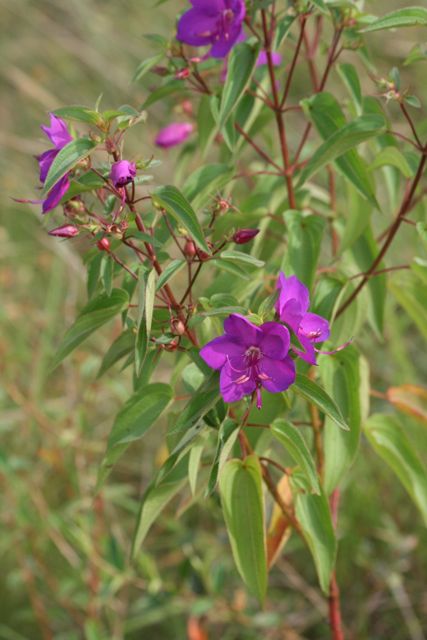
This one, I know, is a melastome, a large tropical family easily identified by the parallel veins in their leaves, and the quilted look made by the cross-veins. I've seen a similar flower grown as a tropical ornamental in San Francisco.
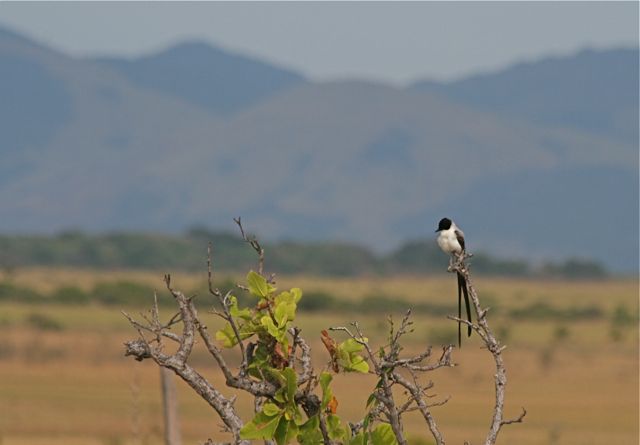
Pull back, and see the landscape--are we in Africa?
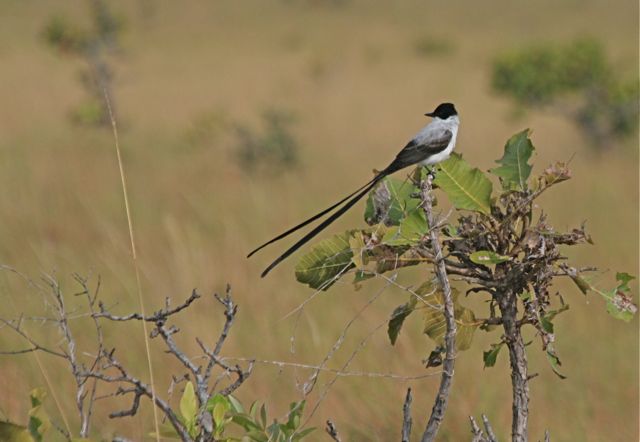
A fork-tailed flycatcher says not. East coast birders will recognize it as a strangely frequent fall vagrant, which inexplicably flies up from South America, showing up along the coast from NJ to MA, just when it might freeze to death.
It was good to see this lovely bird at home. It's reminiscent of our scissor-tailed flycatcher, with none of the paradise pink on underwing and flank. Like a kingbird in a tux.
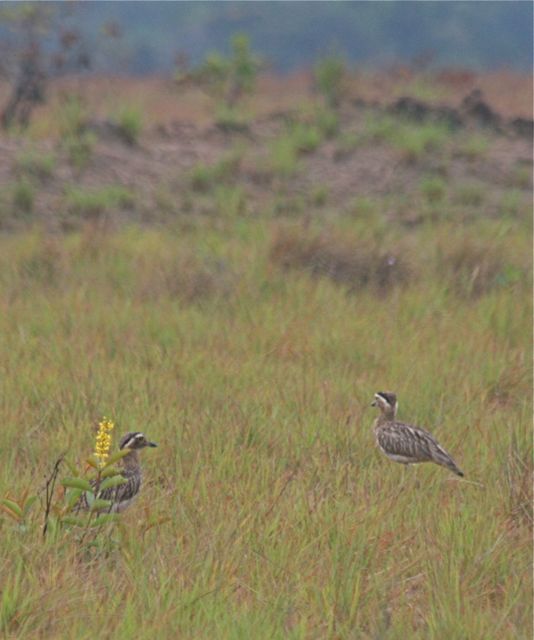
Near the airstrip where we landed, a pair of double-striped thick-knees stalked warily. Enormous relatives of plovers, they have a huge yellow eye with a heavy, weary-looking lid.
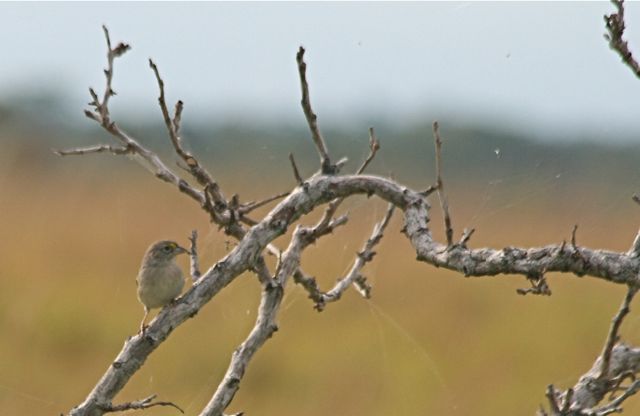
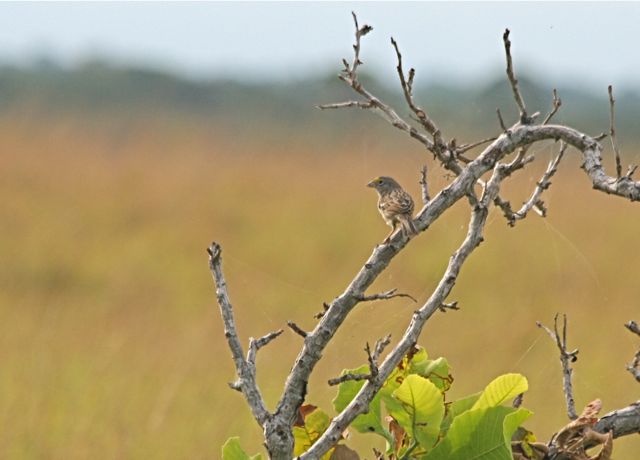
Savanna being hard to find in the Amazon basin, sparrows are hard to find. This plain little creature is the grassland sparrow.
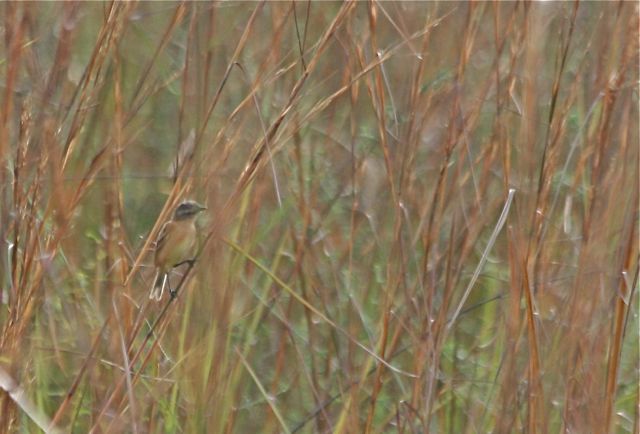
It sits in a pepper tree and voices a buzzy song that might have been a Savannah sparrow's. We found all these treasures while ostensibly hunting for an endemic, a skulky little thing of wet open marshes. It's a flycatcher ally called the bearded tachuri. Tell someone you're hunting for a bearded tachuri and see what they think it might be. I somehow snagged a photo before he dove back down into the grass. I love getting photos, any images at all, of weird endemic life birds. But the nice thing about being casual about one's life list is that it's fine with you if you don't see the bearded tachuri. For me, it's all about enjoying the ride. And having probably the only blog on the Internet with "bearded tachuri" in the tagline. Heh. Ooh, that sounds like hubris. I'm sure there are other bloggers writing about tachuris. Somewhere.
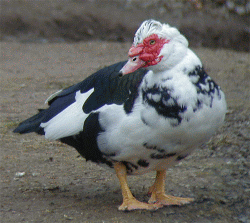
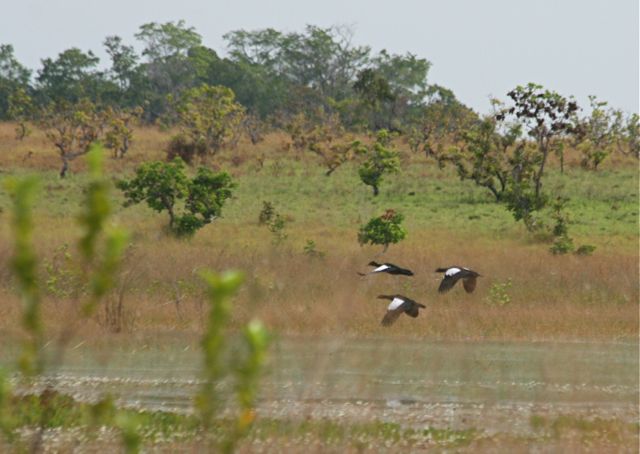
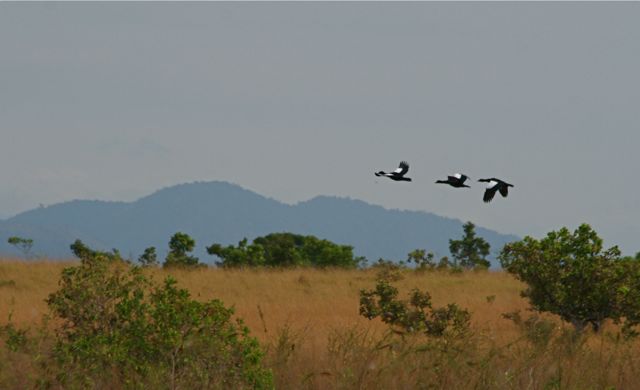
In the marsh, we scared up a trio of muscovy ducks--the slender, wild progenitors of the pot-bellied, red-faced, hissing ogres we've made of them. I will say this--even fat Muscovy ducks retain their ability to fly, which is more than I can say for Pekins. Domestic Muscovy duck--photo lifted from businessafrica.net.Wild Muscovies, in Guyana. It was so good to see them as they were meant to be.
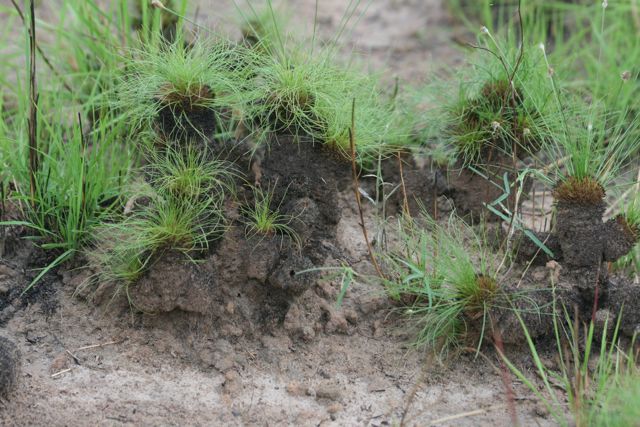
At our feet, an elfin forest of sedges and grasses. I wondered how many decades--perhaps even centuries--old these tiny "trees" might be, their trunks built up with each season's growth.
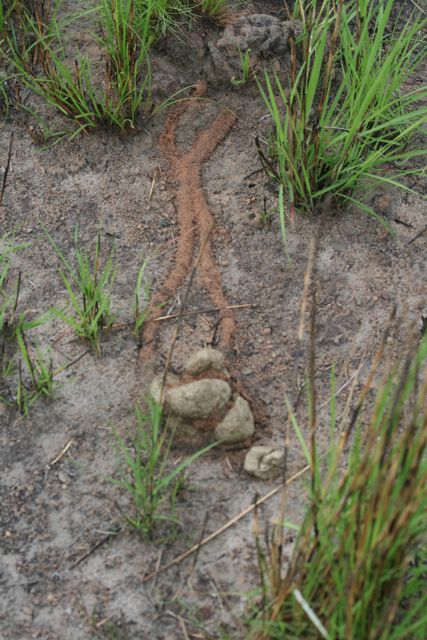
And realized that beneath my feet, termites dwelt in a teeming Gotham, making covered tunnels from one pile of horse dung to the next.
In this metropolis of insects, there is one bad actor--one enormous, all-powerful villain, perhaps the strangest animal that walks the earth, one I had never dared dream I'd see in the wild. We will meet him tomorrow. (Picture Mr. Burns, rubbing his thin white hands together).

I do enjoy cobbling a cheesy serial out of my little travelogue. Cackle!

ZICK ALERT: Wren at The Nature Blog Network just posted an interview with moi at the Nature Blog Network Blog. If only for a couple of highly cute pictures of Chet Baker, and some thoughts on why we blog and what might come of it, please go check it out!

Scorpion, Marmite, Crab-eating Raccoon

Thursday, January 1, 2009

20 comments

An abandoned dugout, washed up by high water.

Upon returning from our adventure with the Victoria regia waterlilies, we made for our huts, using the headlamps that would be indispensable throughout this trip. Simple brick abodes, the huts lacked screens or door seals, and wildlife traversed them freely via the wide gaps beneath the thatched roof or under the door. Through the night, bats chittered and fluttered in the thatch, swooping in and out of the cabin, and occasionally a huge red wasp would plop down on us--the task being to brush it away before it could unleash its painful sting. I was thankful for the mosquito netting that surrounded our beds. As I was tucking it in, I heard the plop of what had to be a very large roach...or... something...falling off my bed netting and onto the concrete slab floor. You know the sound. Plop. Silence. Scuttle. I looked down, to behold a 2 1/2" long scorpion gathering its wits and then scuttling into the darkness under the bed. Oh, great. Great. Lullabye, and good night...I tried but failed to find it, so resigned myself to dreaming about it. For all I know it climbed right back up the mosquito netting and tucked itself under my thin mattress. It simply vanished.
Terry Moore takes five with a good ceegar outside his hut. He ain't afraid of no scorpions, but he does shake out his shoes before putting them on in the morning. Scorpions hate to be stepped on.

Communal meals at Karanambu are delicious and lively. The whole place has the feel of an African camp. Diane McTurk presides and serves the food, tells stories and makes conversation with her guests. She's had amazing first hand experience with rare mammals, as you'll see...

Wait. What's that in the little brown jar? Marmite? I'd heard of Marmite, and had always wanted to try it.
I took a tablespoon and daubed out a large gob, conveying it directly into my mouth, figuring it would taste like, oh, I don't know...molasses? It looked like molasses.

What followed was apparently hilarious to everyone but me. An indescribably foul, salty sludge scraped from the cracked pipes in the putrid sewers of Hell spread across my tongue. I struggled to gag it down, just to be rid of it, and not to have to spit it out in front of fifteen people. Bad choice. I should have spat it against the opposite wall. It was like digging a spoon into the drip pan of an old tractor and eating the oily sludge. # !@##@$#% that is FOUL!!

Marmite
, purportedly made from used brewer's yeast, is an acquired taste. (Whatever Marmite.com says, I'm sticking to my Satan's sewerpipe theory). Apparently the English, with their world-reknowned culinary sensitivity, like to spread it on toast, but they use about one-tenth what I'd just ingested. Gaaagg. Glad I could give y'all a laugh this morning. Feh!I mentioned free-roaming wildlife at Karanambu. It was here that I met Bandit, the hand-raised crab-eating raccoon. You'll notice he's not Procyon lotor. He's P. cancrivorus.Much shorter of fur, beautifully rusty, and with the biggest feet I'd ever seen on any raccoon anywhere--look at those hind feet!!, this crab-eating raccoon was a whole different ball of wax than our North American beast. I was thrilled to make his acquaintance. Catlike, monkeylike, coonlike, coatilike, he was all of those, and like nothing else I'd seen. Big hands, I know you're the one.
He patrolled from hut to hut as if he owned the place, and I came to understand why he was allowed out only for short periods, under close supervision.

If I had to pick a favorite moment of the whole trip, I think it was when my roommate Erica and I were unpacking our suitcases, and there came a sudden fierce scrabbling as Bandit forced his tubby body through the narrow louvers of our window, an exhilarated grin on his simian face.
Finally popping through, he dove into my suitcase and began throwing clothes over his shoulder as he dug for the food he figured must be in there. He was just about to get to the beef jerky and power bars when I tapped him on the shoulder. HEY YOU! What do you think you're doing?

Biting you, that's what I'm doin'! Lemme be, woman! There's jerky in this suitcase, and I mean to find it!


Well, uh, help yourself, I guess...I'm not dumb enough to try to pick you up, you little hellcat. But that is my snack store you're getting into...Dang!

Erica and I laughed so long and hard that Pat, one of our hostesses, figured the little beast was up to his usual tricks, rushed over and unceremoniously grabbed him by the scruff of his neck and carried him out, twisting and snarling. Since he could force himself through the louvers, only a cage was going to stop him now.photo by Erica Gies

Such a bad, bad animal. I loved him, even as I realized that having a crab-eating raccoon break into one's hut and pillage one's suitcase isn't at the top of the most-delightful incident list for most tourists. Crab-eating raccoons are a little like Marmite. You love 'em, or you hate 'em.

The Swinging Orangutangs play tonight, and January 2, too, at the Marietta Brewing Company on Front St. in Marietta, Ohio. We been praktisin'. Happy New Year!


[Back to Top]