Background Switcher (Hidden)

Newthunt

Tuesday, April 3, 2007

1 comments

A photograph on
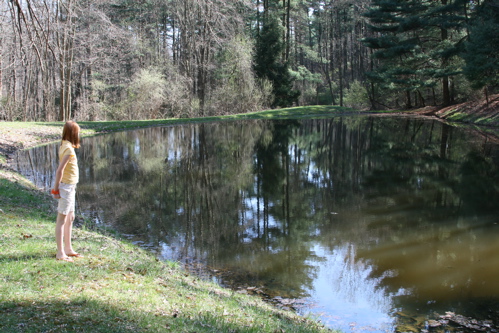
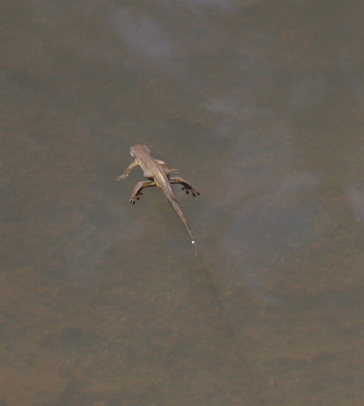
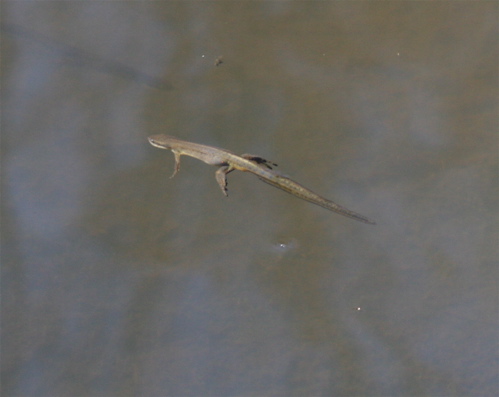
Susan Gets Native's wonderful blog stirred me out of my spring stupor and sent me and the kids looking for red-spotted newts this afternoon in our favorite newtpond. The kids, seeing my car pulled over to the side, bounced off the bus in anticipation of a promised newthunt. We weren't disappointed. Red-spotted newts make themselves known with lizardy squiggles in the shallow water of woodland ponds. They wriggle down under the leaf litter on the pond bottom as you approach. If you slow down and look ahead of you, you can see the males floating motionless, doubtless looking for females in the water beneath them.
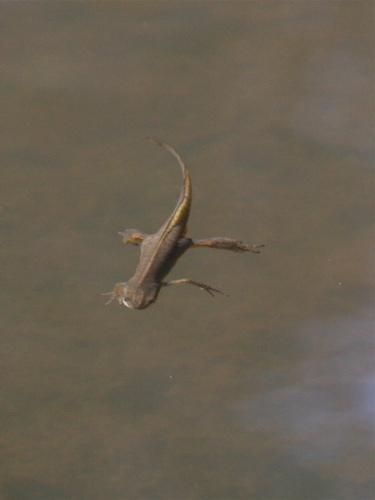
I love the poses they strike, completely relaxed and suspended. I didn't see any females engaging in this behavior. See the manly bulge at the base of his tail?
Red-spotted newts (Notopthalmus viridescens) start life as eggs, laid on underwater vegetation in early spring. Half-inch long gilled larvae metamorphose at the end of their first season into a terrestrial form called the red eft, and spend the next four years wandering on land. These flame-orange beauties, protected by poisonous skin secretions, can cover impressive distances. Think of the red eft as a mobile genetic diversity vehicle. This is not my photo. It belongs to Robert Rold.
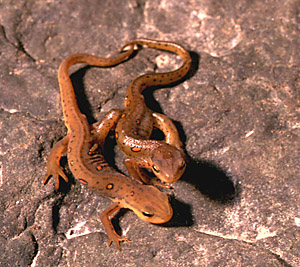
Once they metamorphose into the adult form (which still has lungs, not gills), the newts are able to mate, as the adults in the pond today were doing. Neat to think that it has been at least five years since these animals were born, probably more like six. We don't usually think of amphibians as being particularly long-lived, if we think of it at all. Nor does it occur to us that the nice big lobster we're cracking into may be more than 40 years old. Sustainability. Should we be eating 40-year-old lobsters? Are they able to make more, fast enough? Answer: No.
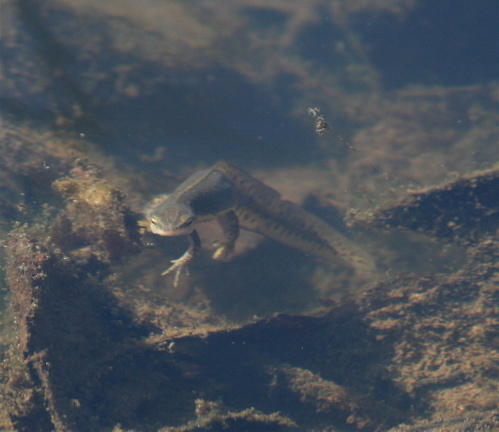
The laterally flattened tail develops after the eft takes back to the water. Lovely thing.
And how does one sex a red-spotted newt? By his newtbag, of course.
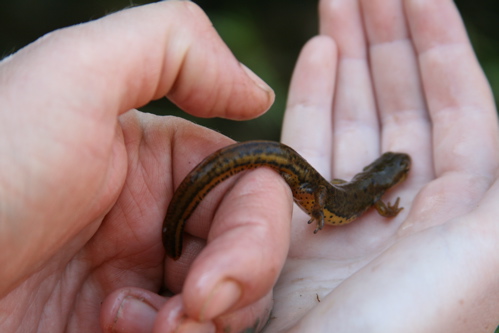
Liam was so thrilled to be able to hold a courting pair of newts. They were distracted enough not to mind being gently scooped up.

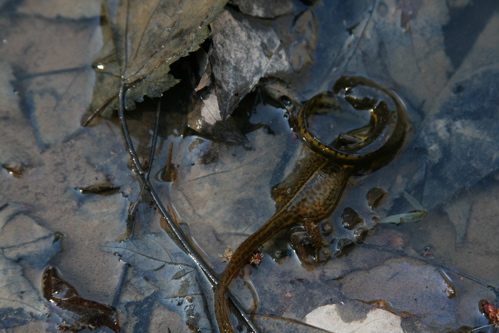
The courting pairs we saw were interesting in that the smaller, darker female was lying atop the male's back, kind of sitting on his head and wrapped around him. Dunno what that's about but it's a nice break from the animalian norm.
Miss Phoebe was a water naiad, crouching and absorbed.
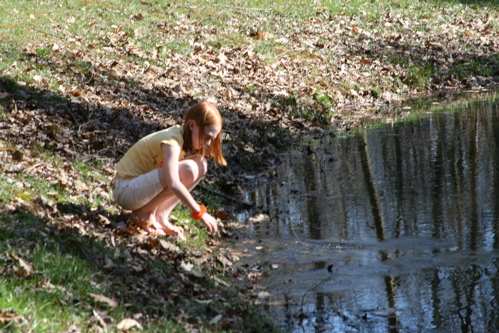
Liam was in constant motion. This is why I get more pictures of Phoebe.
I will quote my little guy here. I wrote this down when he said it. How did it feel to hold newts in your hand, Liam?

"They felt like cream swirling in my hand, only nobody was swirling it.
And with legs, and a nut sack."

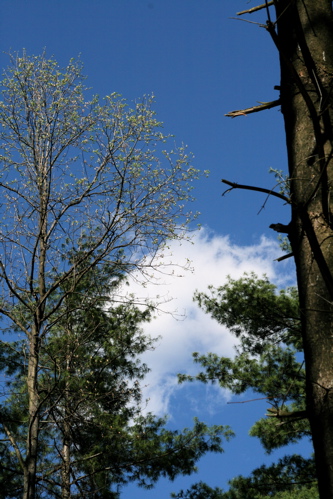
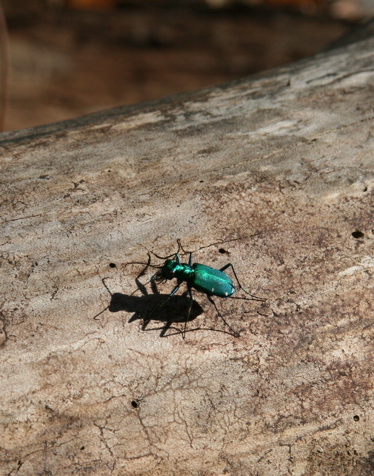
This is how the sky looked on our way back up the hill from the pond. Spring skies and observant, eloquent children make my heart swell almost out of my chest.A tiger beetle watches for prey from its perch on a sun-warmed log. Spring fills me up, like a vessel that has been empty all winter.
Box Turtle Mysteries

Monday, April 2, 2007

0 comments
Well, the wait is over. Early last June, I found a female box turtle laying eggs in our meadow. I left her alone, marked the spot with a Kleenex, and returned first thing in the morning to cage the nest, to protect it from digging mammals, egg-loving snakes, and crows. I put a fine-mesh cage over the nest proper, with 1/2" hardware cloth, and a large iron milk crate over that. I drove stakes in to firmly anchor the outer cage, knowing the strength and determination of raccoons. Last summer, I found three box turtle nests along the same path, all of which had been dug out by coons or skunks.

Knowing that box turtle nests need about three months to incubate, I began checking the nest every couple of days in September. Nothing, nothing, nothing. Nothing through October, and then it was too cold for the hatchlings to emerge. A certain percentage of hatchlings emerge in spring. I checked on it all winter, and began checking it this spring on warm days after rains. I worried all winter that my driving the stakes in the day after they were laid might somehow have addled the eggs with vibration.

Today, while working on a painting, I got an overpowering feeling that something had happened at the nest. Chet and I trotted out the meadow, and I peered into the cage. I couldn't tell, with all the overgrowth, whether I was seeing what I thought I was seeing. I yanked the stakes up to find two small exit holes, and a tiny box turtle hatchling, nose down in a shallow scrape in the clay. I was shaking with excitement.

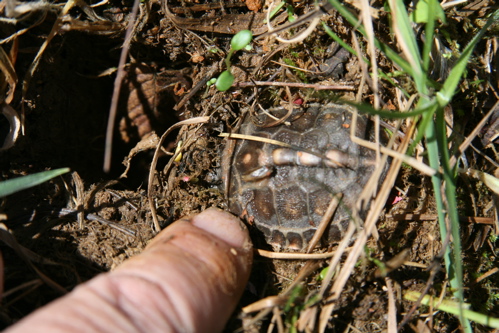
Gently, I pried the little turtle out of the clay. It was so tiny, it could fit on a quarter. Its shell was soft and it was motionless. Slowly, it dawned on me that this hatchling was dead. I was crushed. and determined to figure out why. My CSI tendencies kicked in. First, it was clear to me that it had died very recently, perhaps even this morning. There was no odor, and it was stiff with rigor mortis. There was something very wrong with its eyes and beak; they were covered with a pinkish membrane that I cannot remove. It could not have opened its eyes or breathed, except perhaps through its mouth. I thought at first this might be an egg membrane, but it seemed too tough. I still don't know whether this was a birth defect or an unusually tough membrane that adhered to the turtle's face in hatching. More of the pinkish membrane appeared along the sides and top of its shell. Again, it couldn't be peeled off. I began to think that this turtle had a birth defect. How sad.

The yolk sac had been completely absorbed, making me think that this turtle had hatched last fall and slept in the scrape over the winter. Clearly, it had enough energetic resources to dig out (no small feat, given how many roots had infiltrated the chamber). How it did that with its nostrils and eyes covered up I don't know.

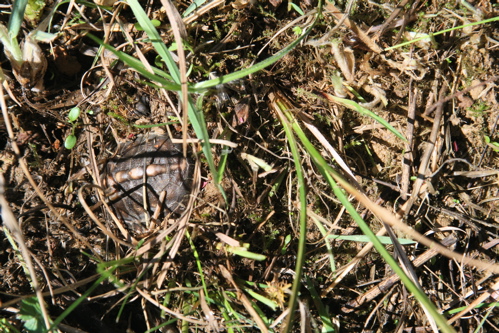
Here is a picture of the entire scene. You can see one dark exit hole to the upper left, and the second one is to the right of the turtle, just to the right of the three grass blades.

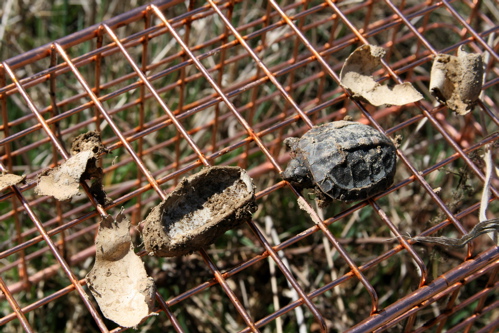
I dug more, very carefully. First, I found an addled/infertile egg that had collapsed, entire. Then, two eggshells that had been hatched out of. One must have belonged to the dead hatchling. The other must have belonged to the turtle that made the second exit hole. But where was that turtle? I searched through the grass for several feet around the nest, finding nothing.

I dug out the entire scrape. No hatchling. I can only think that the second hatchling must have dug laterally until it was out from under the small, inner cage, then exited the large milk crate and set out for parts unknown. It's also possible that it made its way out of the small cage via the larger corner holes. If there even was a second hatchling. But the eggshells and the second exit hole argue strongly that there was.

As is often the case in nature sleuthing, I'm left with more questions than answers. Did I do any good here? Did I cause the death of the unhatched egg, or somehow cause the death of the defective hatchling? Is there one tiny turtle crawling the planet who would have otherwise been lost to predators? I don't know the answers. I can only think about how to do better by them this year, if I get the chance.

To all those who've been waiting, and especially to Kai, I'm sorry I don't have a happier story for you.

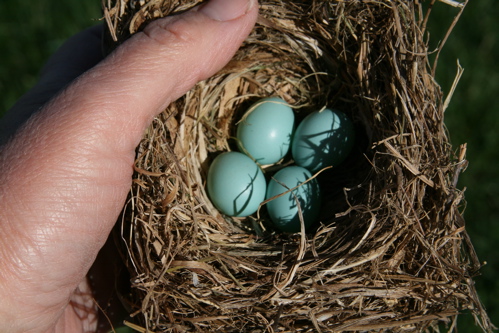
Meanwhile, in the front yard box, life is beginning. Four warm bluebird eggs on March 30, five eggs on March 31; projected hatch date April 12.

Chet Baker, Action Hero

Sunday, April 1, 2007

0 comments
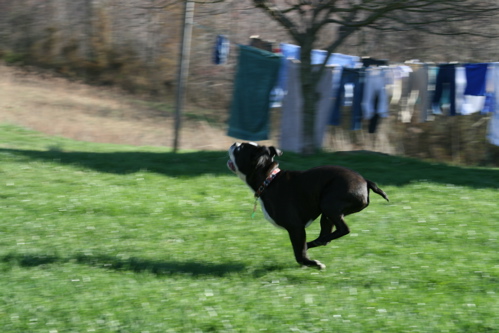
Yes, it's time to break out the acoustic clothes dryer.

I tried to work today, I really did. But the sun was hot, the air pellucid, and the garden was shouting to me. I could feel the weeds growing. I had to get out there and do it. See, it's past time to plant peas in southern Ohio; the thrasher's been in for two weeks and I haven't gotten them planted yet. So I cranked all day, forking and weeding, then burning. I'm all stove up now. Peas still aren't planted but they will be soon.
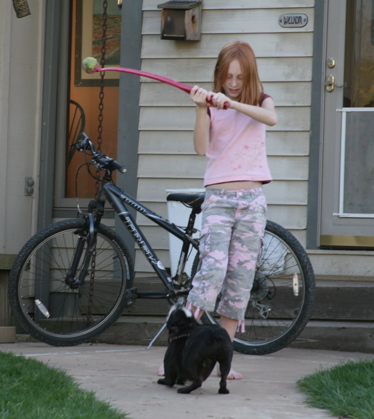
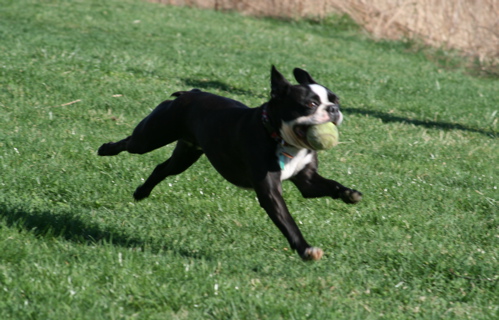
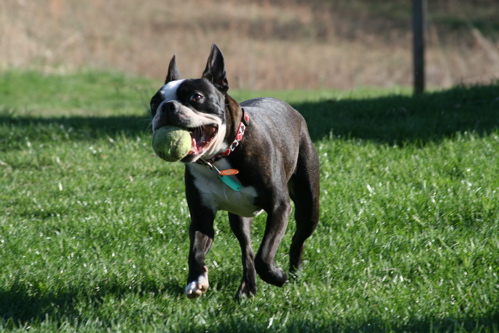
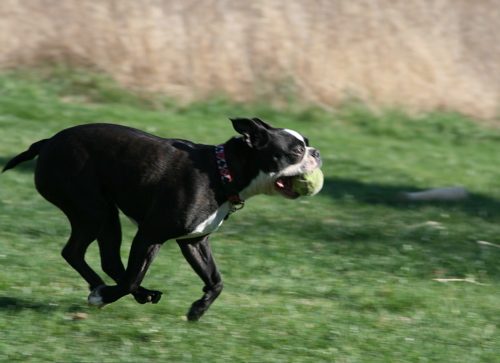
Afterward, I collapsed in a newly-hauled-out lawnchair and shot photos of Phoebe and Liam playing with Chet. Gotta love Phoebe's Daisy Mae outfit. I can't tell you how much fun I had, leading him with the camera, letting ISO 200 freeze him in his tracks. The background's a bit blurry when I'm panning, but that adds to the excitement of the shot.
Sometimes the stars align and you get everything in focus. When he's coming right at me, I can brace myself and not have to pan... I think this is my favorite of the bunch. I crowed like a rooster when I saw this one.
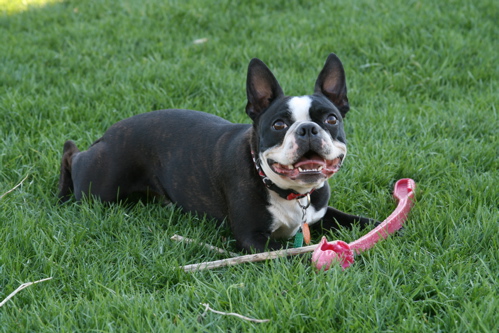
The kids were running back and forth across the lawn to see what I'd gotten, and Chet was in his element: the center of attention, leaping, running, growling, play-bowing. I never tire of watching him play with the kids. They tussle like brothers and sisters. Chet is much sassier with them than he dares to be with me; they holler and plead with him, but I have only to say his name in a warning tone and the ears flatten and the googly eyes cut over my way. It's pretty clear who the alpha beyotch is in this pack.
What a joy a well-bred, healthy young dog is. A joy to look at, to touch and to be with. Chet kept me company all day out under the sun, and was ready to rock when the kids got home.
Yesterday the Fed-ex driver, the one who always gives Chet two Milk Bones to bury, asked me how much a Boston terrier should cost. I got a big old grin. He's not the first person who's gotten to know Baker and then thought seriously about adding a Tennessee Turd-tail to his family. I laughed and told him my hidden agenda is to cover the earth in well-bred Bostons, and to let me know when he was serious about it. Mr. Milk-Bone, If you do get a puppeh, will you bring it by here, please? I would like to look it over, and perhaps sniff inside of its ears.
Just so you know: By posting about Chet Baker, I am in no way caving to pressure from Non Birding Bill, JaneyMS or any of his or her minions. It was time to post about Chet Baker. My artistic integrity emerges unpunctured.
[Back to Top]