Background Switcher (Hidden)

Showing posts with label trillium. Show all posts

Crawling Toward Mecca

Sunday, April 18, 2021

8 comments

 It's a pilgrimage that I have to make a couple of times each spring, timed around the emergence of the Virginia bluebells and everything, everything else. I am not sure why this particular stretch of mesic deciduous forest near Nelsonville, Ohio, is so darn rich, but it is, and the show these wildflowers put on is not to be missed. I've never seen wildflowers like I've seen them grow in Ohio. I try to take a friend and a kid or two with me--Liam and I made it last year, but thanks to school schedules, this was Phoebe's year.

We were delighted to be outfitted with teeny weeny Swarovski Pocket CL binoculars, 8 x 25. Just the thing for biking, hiking and running! Phoebe has my old pair, and I'm sporting a new loaner set from Swarovski Optik. Mmm mmm good!


The show of bluebells Mertensia virginica lasts only a few weeks, and then it's over. In a cold gray spring like this one, the flowers are in suspended animation, waiting for warmth and the pollinators it brings. You have a little more leeway, a grace period to get your body over there. The Hockhocking Adena bicycle trail is an old railroad bed that goes from Athens to Nelsonville, and you can ride the whole way on asphalt, with flowers as your companions for the deliriously delicious stretch between Chauncey and Nelsonville. 

I missed the bloodroot Sanguinaria canadensis--only its leaves show in the foreground--but oh, look at the Trillium grandiflorum!


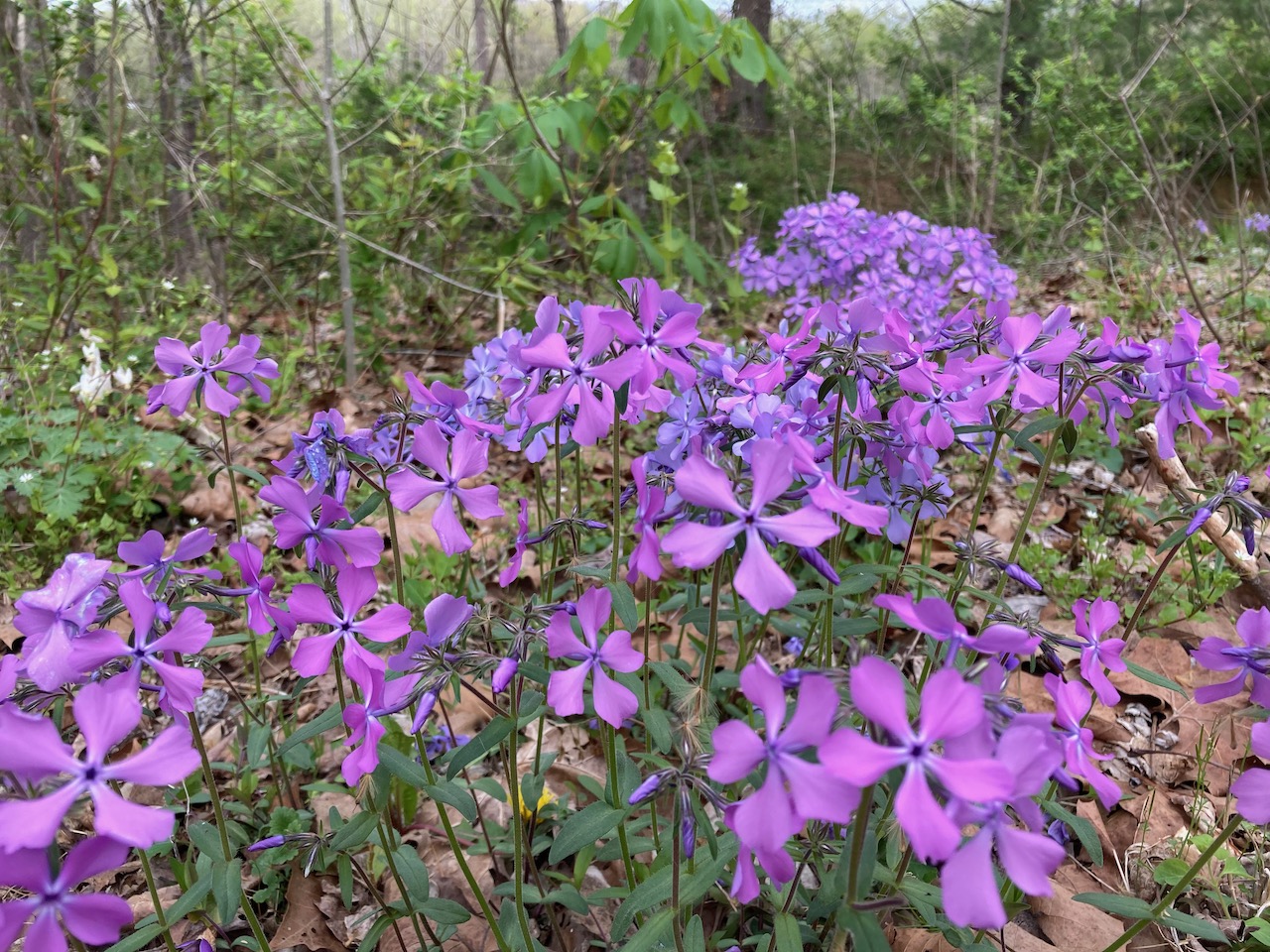
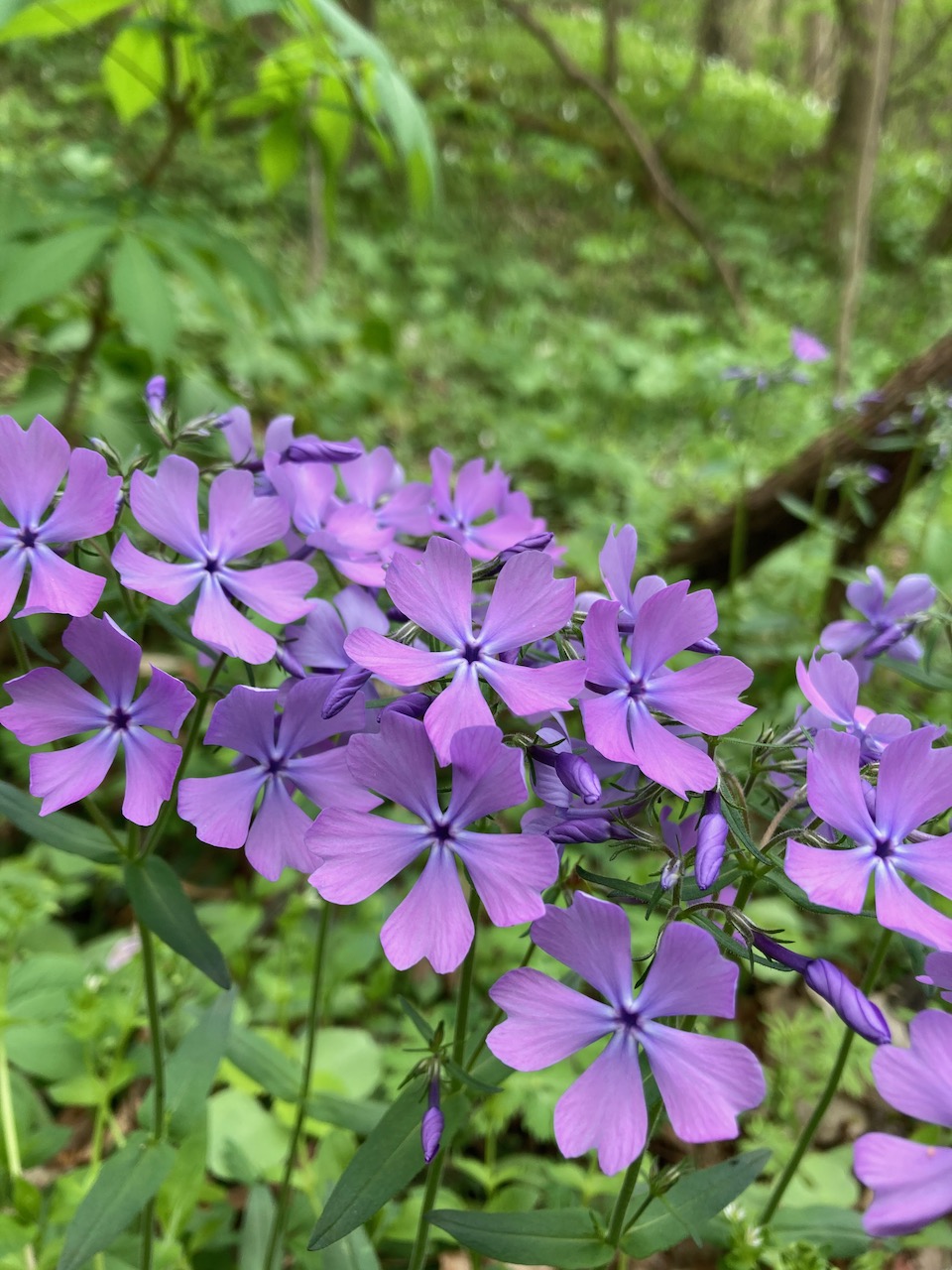
Each blue phlox plant seems to sport a different shade of rose-purple-lilac--anything but blue. Blue is a term botanists, who are so precise in everything else, seem to throw around wantonly. 


If you want blue, look to Collinsia verna--blue-eyed Mary. This free-seeding annual charms the dickens out of anyone beholding it in bloom. Now, THAT's blue. True blue. As a plant freak, I spend a lot of time and energy trying to get that blue in my garden and greenhouse. 


This magical thing happens when blue-eyed Mary is viewed en masse, at a distance. At middle distance you see this...


Step back, and it looks like mist is rolling down the hillsides.  Do click on this one, to see tiny Phoebe off to the left, and try to grasp just how many spindly little plants it takes to make smoke like this. 


It's not all blue-eyed Mary. The forest goes through phases as you ride along. At the beginning of the good stretch, Dutchman's breeches are the stars. Meet Dicentra cucullaria!


Everybody loves these cheery little pantaloons, hung up on their lines so neatly. 


And they are so very beautiful. I am fascinated by their diverse forms. Some are curved like bull's horns; some are straighter. 


And one was chubby, almost heart-shaped; even PINK.


Growing right in amongst them are their closely related congener, squirrel corn, Dicentra canadensis. I can't tell their leaves apart, but oh, the form. Look at that perfect closed heart. 


Pull back, and see how many there are. This stand seemed to be composed of about 80% Dutchman's breeches to 20% squirrel corn. (It's called that because it has a little yellow corm underground). 


It is staggering. I don't walk far up into the stands--too easy to crush the plants. But oh, I wonder what I'd find if I did. I fantasize about walking up the slope, peeking and peering. 


Every now and them, I'd find a Tennessee starwort. In my ignorance, I'd been calling this star chickweed, and it is a chickweed, but its sepals are equal in length or longer than the petals, and that means it's starwort, Stellaria coreyi. 
The Buckeye Botanist set me straight. :)
I love the firework explosion of stamens!


You can see the down on the leaves of the downy yellow violet. 


I love the name, cream violet, Viola striata. It's such a pretty little thing. 


As is the early saxifrage, Micranthes virginiensis, clinging to rock walls with little rosettes of winter-hardy leaves. 


Also on the rocks: early rue, Thalictrum dioicum. Here's rue for the Queen. 


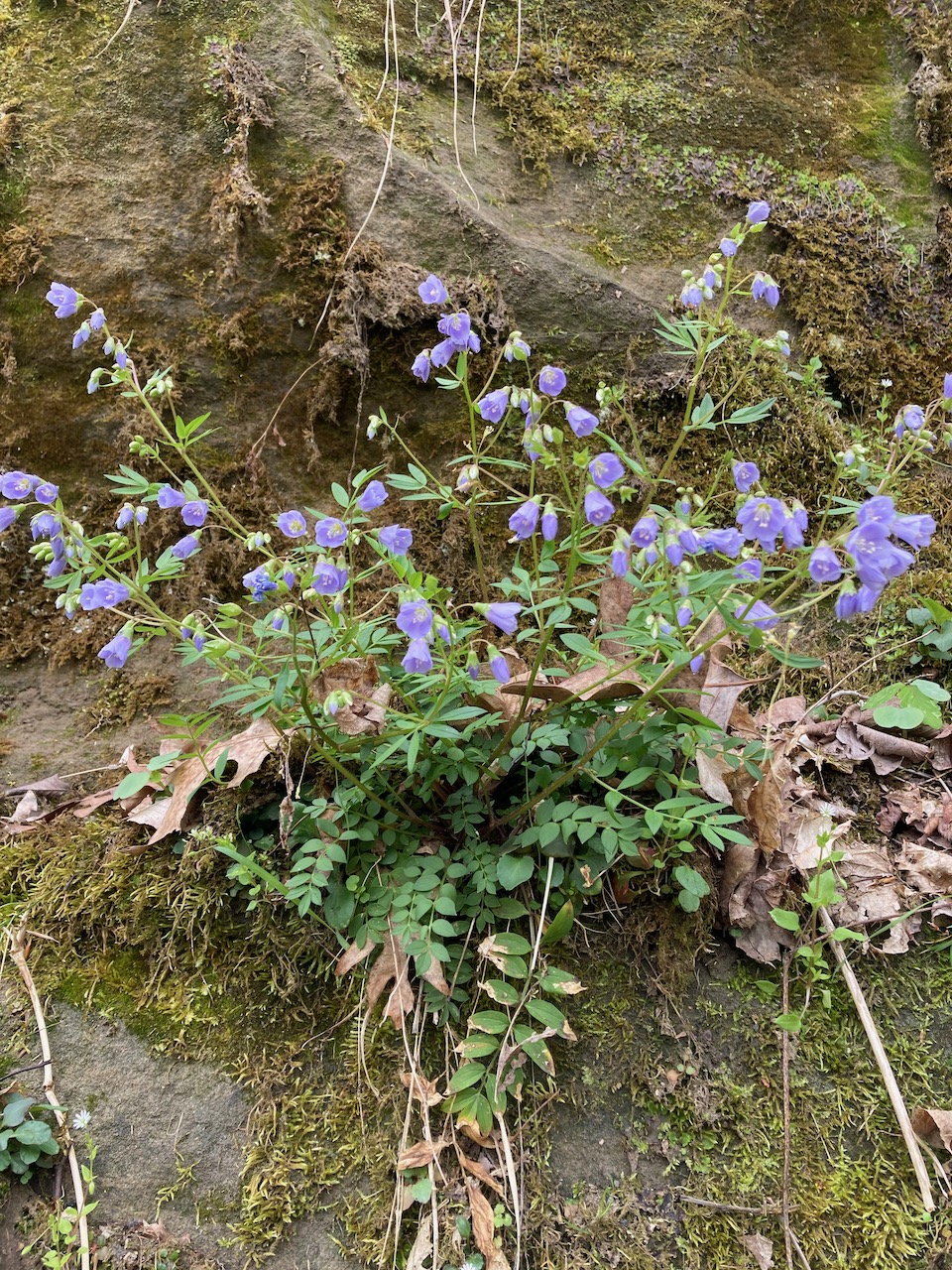
Also clinging: Greek valerian,  Polemonium reptans. This one is fairly rare on these slopes, and we were thrilled to find such a splendid specimen. 


Patches of blue phlox Phlox divaricata light the forest floor. It's so exhilarating to see it in big clumps. I learned in writing this post that it's in the Polemoniaceae, along with Greek valerian. Huh? I thought it was in the Caryophyllaceae, or pink family. Always good to find the holes in one's knowledge.


Large-flowered bellwort Uvularia grandiflora was just coming in. Such a cool plant, with great architecture. 


 The lower slopes were punctuated with toadshade, or sessile trillium Trillium sessile. The flower is stalkless, or sessile. 


Everything is in threes with trillium. I adore the variegation on their leaves. This is one of my few shots taken from directly above. I generally get down on their level to shoot their portraits. 


Much showier is the diva, Trillium grandiflorum, large-flowered trillium. 


One of my favorite shots from this spring is this trio of trillium, blue-eyed Mary, and spring beauty, with the spangled stars of a zillion more large-flowered trillium behind. I must confess I am a little sore, two days later, from climbing on and off my bicycle many dozens of times, and crouching to take each of these shots. It's of little use to take wildflower shots from a standing position. You get no feel for where they live. 


Just a tiny part of the trillium slope. It's breath-stealing to behold. 


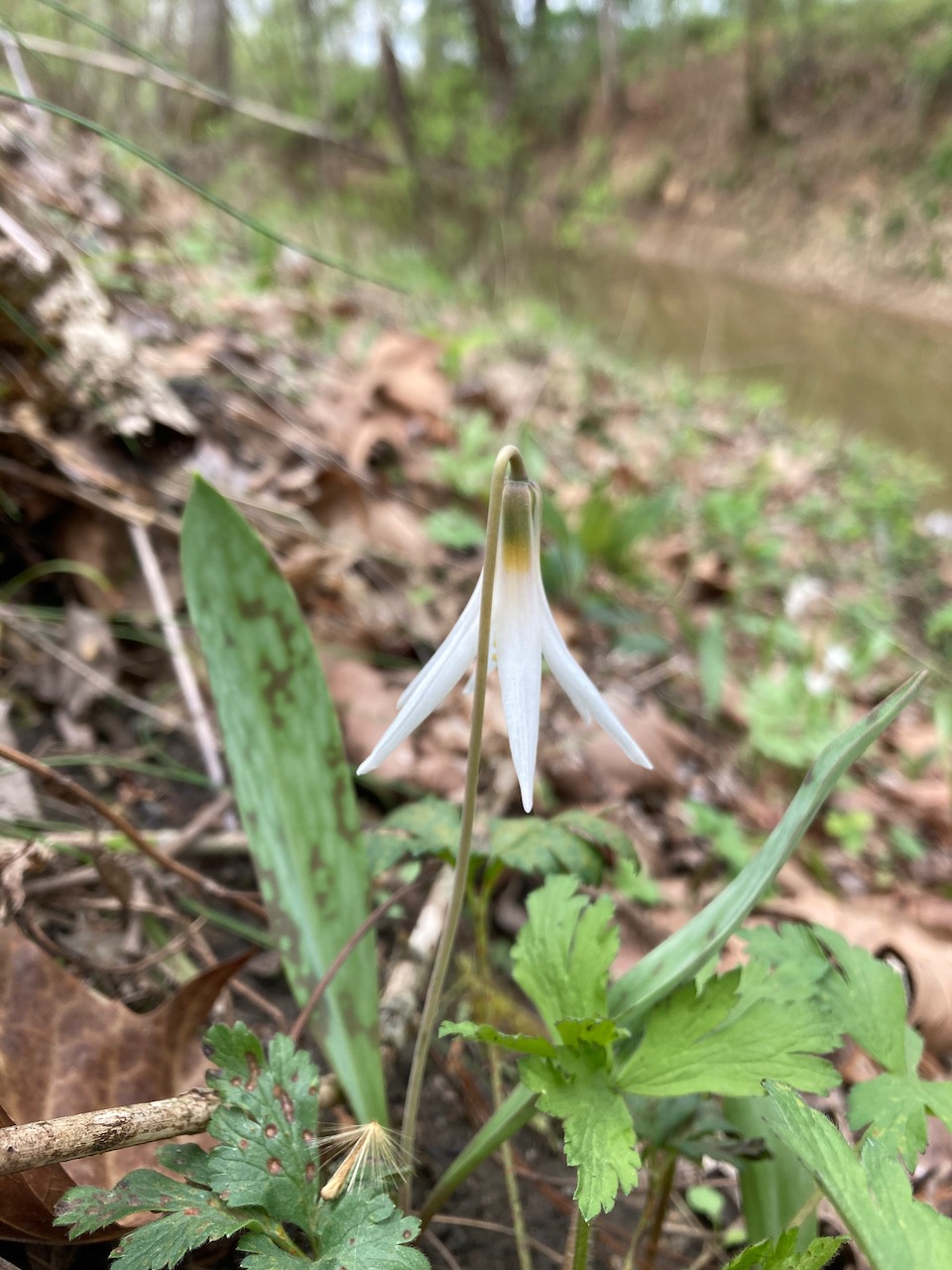
Phoebe found my very first patch of white trout lily, Erythronium albidum. 


And a flower I've yet to see in bloom--it's very early. But I recognized the paired leaflets and the distinctive seed-urn of twinleaf Jeffersonia diphylla. Get this: when the seeds are ready, the lid pops up and is hinged!


After lying prone, it's good to get up and look down again. Look at this toadshade and Virginia waterleaf Hydrophyllum virginianum!


A closer ook at the waterleaf's beautiful variegation, with spring beauties Claytonia virginica. As waterleaf ages, it loses that gorgeous pattern. It's a much later bloomer than the others, too, sending up weak stems of palest lavender bell-shaped flowers in May and June. It must be very shade-tolerant, because the canopy overhead is closed by then, and little sunlight reaches the forest floor. 


Perhaps my favorite shot from the 16th of April was this one--it speaks of the diversity, the jumble of native wildflowers, that stuns me every year.


And then there were the bluebells that didn't know whether to turn pink or blue. Sigh. I almost can't stand how beautiful it all is. I get overwhelmed.


There are a couple of places where I can get a little river plain behind the bluebells, and that is a fine thing.


To thank the woods for their incredible, abundant gifts, Phoebe and I pulled a buttload of invasive garlic mustard--diversity's worst enemy-- and laid it out to die in the middle of the path. This is ugly but necessary, as this plant will continue to grow and set seed if given even a ghost's snowball of a chance on the damp forest floor. I have faith that all Athens would turn out for a garlic mustard pull if called upon. It's that kind of town.


Thank you to the slopes, thank you to the humus, thank you to the God of diversity and all that is wild. 


Thank you to Geranium maculatum  for sending up just one flower in time for us to see it. Thank you to Phoebe and Liam and Shila, my safari companions, for loving the wildflowers as much as I do, content to crawl the slopes in search of such mid-April beauty. 


 Listen to the next video clip, and you'll hear the northern parula warbler we had just gotten in our tiny binocs! Oh! the yellow and red of his chest, his tiny white eye crescents, and the rising zzzzip! of his song!


and your blogger, speaking...with my thanks to Swarovski Optik for outfitting us with the fabulous 

Swarovski CL Pocket 8 x 25


Please note that in this video I erroneously refer to them as CL Companions, but they are Pockets. 


Video by Phoebe Thompson 

Museum of Diversity: Ohio Wildflowers

Monday, May 1, 2017

4 comments
I hadn’t seen a woodland full of bluebells since 1991. I remember the year because Bill and I were courting, and he took me to a place in northern Virginia that was knee-high in them. The sun was piercing and warm; the flowers were dazzling, and I had trouble walking in line, as I was so busy kneeling and oohing and aahing. I was taken away by the splendor of it all. I’ve always wanted to see bluebells like that again.


So when I got a line from my friend The Buckeye Botanist on a big bunch of bluebells along the Athens-Nelsonville rail-to-trail bikepath, I decided to chase it down. I shouldn’t have been surprised that Dan, the proprietor of Fullbrooks Café on the square in Nelsonville, Ohio, was the source of exact information on how to find them. I walked into the little café, hungry; Dan took note of my camera and binoculars and we struck up a conversation. I told him what I was looking for, and he told me where to go to find it. Then he made me a fantastic, fresh and delicious sandwich. I shall return!!

The bluebell preserve would be about a mile and a half’s walk from the parking area, but it was like walking through a fabulous movie about richness and diversity.


The first thing I saw was Trillium grandiflorum. This is a plant that grows bigger and more magnificent the more nutrients it gets, and these slopes are rich. Enormous white blossoms fluttered in the breeze, as far as my eye could follow up the slope and forward down the bike path. Where they are, they are, and where they aren’t, they aren’t. And they mostly aren’t any more, because people are so greedy for timber, and won’t leave the forests undisturbed. You can’t take bulldozers to a woodland, fell trees and drag logs, and expect these lovely things to survive it.


When the white trillium finally thinned out, the spotted wakerobin Trillium maculatum started. There’s something so pleasing about trilliums, how everything is in threes—leaves, petals, even stamens. Sometimes even the plants themselves. 

Some spotted wakerobin aren't spotted.


Some are, sorta. 

And some knock your socks off with pure leopard power. If you haven't picked up on it, part of the joy of spring ephemerals, at least for me, is seeking out their vast and surprising genetic variation, weaving between the differing leaf and blossom colors, leaf forms, sizes and growing conditions to recognize the common thread that identifies each one. 


It’s hard to believe, only two weeks later, that these flowers are all but done, but that is the life of a spring ephemeral wildflower. On this day, April 10, I felt I was hitting it just right, there for the show at its peak. Hepatica and trout lilies were still out even as the trillium burst into snow-white splendor.  

Hepatica acutiloba, in shimmering pink.

And the same beauty,  but here in breathtaking blue.

How to tell what they are? Just look at the old winter leaves. Sharp point on the tip? Acutiloba.


I was alone, but I felt my father there, looking at it all with me. He was in the trout lilies and the wind that moved them. And oh, there were so many trout lilies! I'd never seen so many in bloom. Rich, rich soil here.


 I have to think that this is one of the most spectacular wildflower blooms ever. The weather’s been kind; there have been no hard freezes since things got going. There’s been enough rain, and it has been warm, but not unnaturally pumped up into the 90’s like 2016’s crazy April. The nights have been cool, and everything’s perked along a bit ahead of schedule, without perturbations.

Who has seen blue rue anemone Anemone thallictroides? I have. (It's almost always white.)


Core’s chickweed put on a spectacular show with Dutchman’s breeches.


When he bade me good-bye, Dan from Fullbrooks, who has also worked as  a woodland guide, told me he’d see me along the trail. And he came biking along a few hours later! I was so happy to see my new friend here amidst the wildflowers he loves so much. Biking to work every day has its perks; Dan has his finger on the pulse of spring and floral diversity.


It was that kind of day. The world opened its arms to me, people were kind to me and I was happy for a time, knowing that my father was with me and, despite all the sadness and anger and hideous things happening in the world, that here on this striped and dappled path the flowers were safe, still opening and blooming so beautifully, keeping pace with a schedule all their own.


Wild ginger Asarum canadense


Buckeye, opening


Cardamine diphyllum, two-leaved toothwort


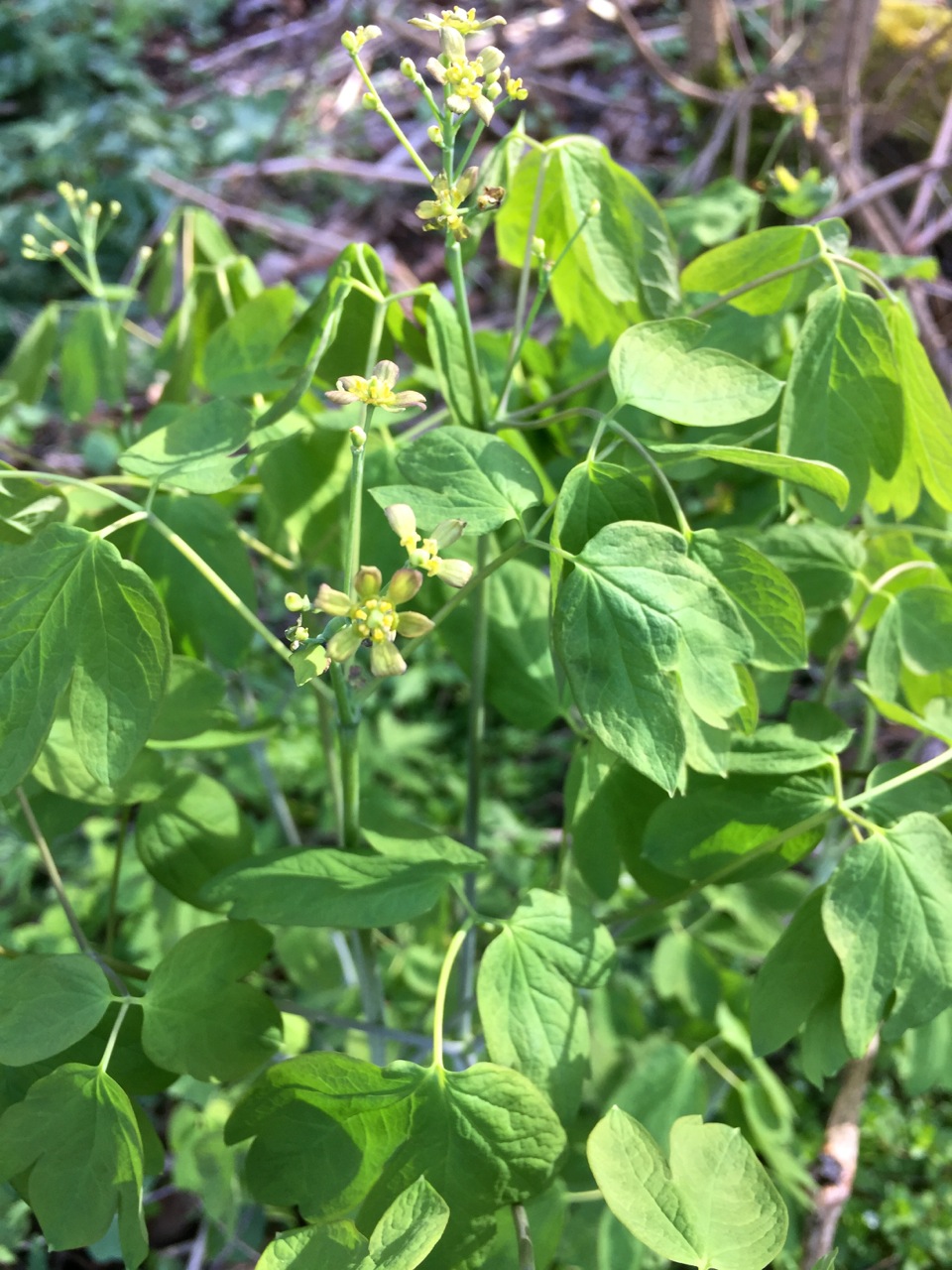
Blue cohosh, Caulophyllum thalictroides


Cut-leaved toothwort Cardamine concatenata


A trillium/shelf-fungal tableau

Wildflowers, marching down the slope, pooling at the rich bottom


More sharp-lobed hepatica


Large-flowered bellwort Uvularia grandiflora
And I hadn't even reached the bluebells yet! Enjoying the journey, as ever. 

The journey = the destination
[Back to Top]