I've said it before. The social media world is a weird, weird world. I say that as someone who's up to her neck in it and part of the problem, for sure. One reason I hang out on Facebook is to keep sending life support to my blog. I try to catch eyeballs with a photo and some kind of kicky catchphrase to cause said eyeballs' owner to click through and land here. Because this is home, where my heart lies.
I believe in blogging, but I believe in blogging on a blog. I believe in telling the story, and then the rest of the story. I see a lot of people trying to blog on Facebook, posting serial status updates with lots of photos and long paragraphs of text. I wish they'd blog instead. Facebook is a place where people go to let their ADD run wild. They're there for tiny sips, not a whole flagon or a neck-deep bath, for Pete's sake. Facebook killed a lot of blogs, but it's also keeping mine alive, thank you very much, and the dance I do to try to get people here for the whole story is a delicate one.
Probably 95% of what goes on in people's reactions to things they see on Facebook is no deeper than, "Oh that's nice. Isn't that cute. I like that." I get that and respect it. I don't expect a lot more than that, and I try to accommodate people in their search for quick hits of beauty and yes, cuteness, because we all need quick hits of nice to get us through our day. I don't discuss politics. I don't rant. I don't post anything unless I think it's worth sharing and will lift people up, help them reflect on something I find meaningful, or give them a smile. I believe in positivity, in noticing small things that others may overlook, and in sharing that. If that sounds a bit Pollyanna, that's fine with me. It's the only way I feel comfortable sharing so much of what goes on in my head.
That said, I save my best stories, photos, thoughts and essays for the blog. I put teasers up on Facebook, just fun stuff that you can take in a quick bite. I try to bring the eyeballs over here, with varying success. I'm lucky to get 20 "likes" on a blogpost link. Sad to say, 40 likes is huge. I can hope that some percentage of those 40 likers actually clicked through to the blog.
Sometimes things blow up. That's when it gets weird.
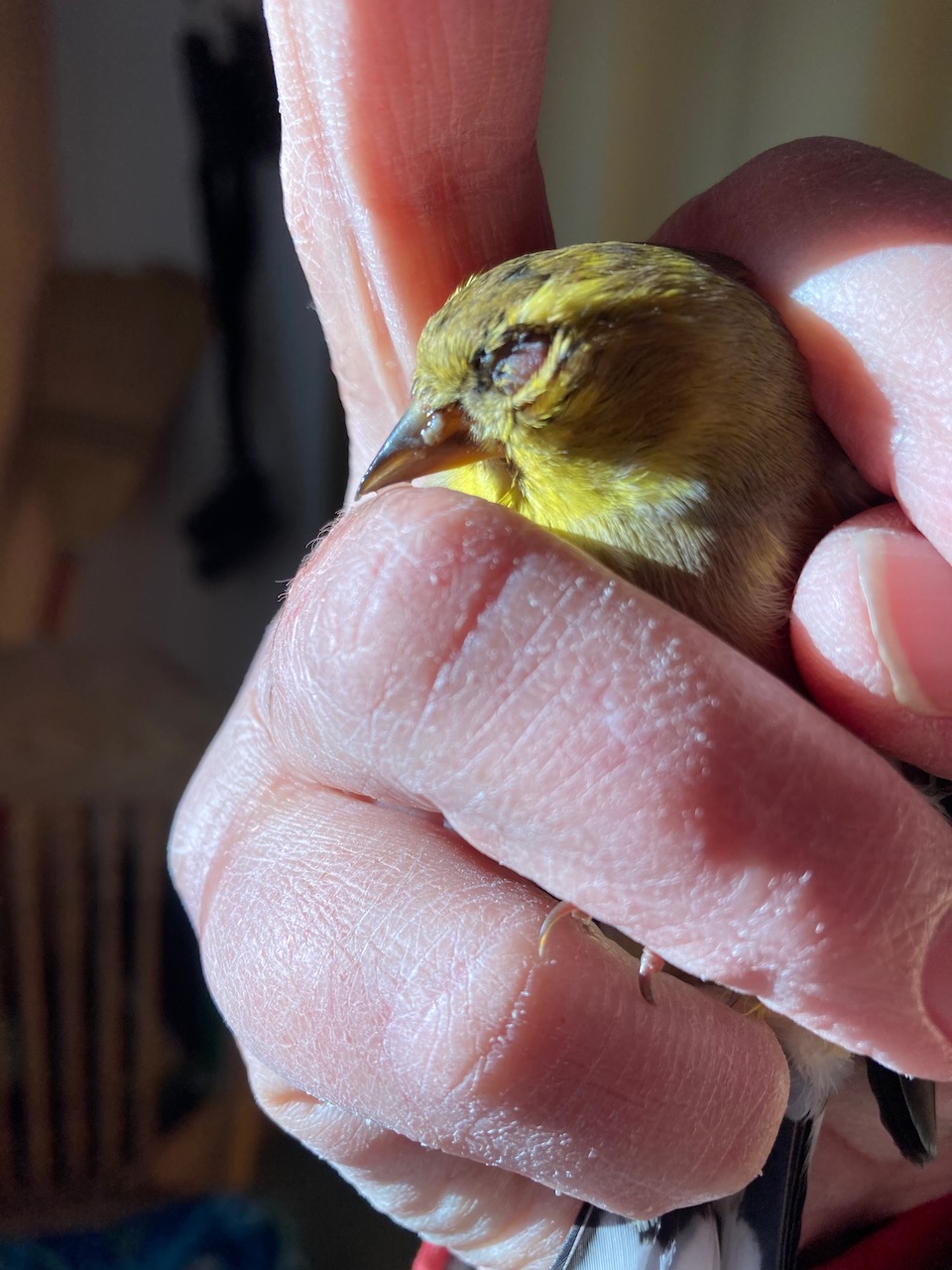
On March 25, I went out to fill my dome feeder and there was a male American goldfinch sitting in it, eyes closed, all puffed up. I looked at him there, knowing he likely had the bacterial conjunctivitis/respiratory illness called House Finch Disease and not really wanting to do what I thought I should do. Ugh. I hate having to play God with small lives. I reached a tentative finger toward him and he climbed onto it. At that point, my stupid heart kicked my smart head in. I hate it when that happens.
I closed my fingers around him so he couldn't get loose, and thought, "I should just wring his neck right now and be done with him. This is a bad, bad disease." I walked in circles, thinking about what I should do. "I need to wring this bird's neck." I started to, hesitated, remembering how he'd climbed onto my finger, this wild bird who couldn't see. Why would he do that, unless he was asking for help?
And instead of wringing his neck, headed for the medicine cabinet. I had been that close.
My primitive thought process went like this. "What have I got in here? Hmm, here's some doxycycline. That's like tetracycline. And doxycycline and tetracycline are useful for Lyme disease. Maybe it'll work on
Mycoplasma."
Completely off the cuff, uninformed, unpolluted by any real information. Just a guess. Thinking that doing something here to try to help is better than doing nothing. Or better than killing him. Maybe. I'll get back to that.
I ground up a doxycycline tablet and put a pinch of it in some just-mixed parrot handfeeding formula, took the goldfinch out of the paper bag I'd stored him in, waited until he tried to bite my finger, jammed a syringe in his bill, and force-fed the little guy some spiked food. And then, when his eyes had begun to improve that same afternoon, I was so elated that, like the attention-seeking compulsive sharer that I am, I posted about it. Note that I omitted the part about contemplating his murder.
Please note "likes" and shares. Huge doesn't begin to describe the response to this post. 162 comments and counting. 1080 likes? Whaaat?? Even my son likes it. Nothing I have ever posted (and I've been on Facebook since 2009) has even come close. A supercute bat I was caring for maybe got 400 likes. This was off the hook.
Upon capture March 25, the bad eye. I wasn't at all sure he could still see out of it.
Not sure why the post blew up. I think it spoke to that part of all of us that sees something pitiful and wants to help. Or is glad there is something someone could do to help. Maybe he's just cute enough. Or maybe the sunny prognosis I forecast sucked people in. There's something you can do for house finch disease?? God knows there's too much bad news raining down on us every day. But 1080 likes for a gloopy-eyed goldfinch?
March 27, the bad eye after three Doxycycline treatments. Hey! It's getting better!
By the afternoon of March 27, Booger, as I named him, was feeling so much better that I was having a hell of a time catching him in his finch cage. He was ricocheting off the bars. No stepping up onto my finger for him! And when I did catch him to administer his oral treatment, he ducked his head and clamped his slippery conical bill closed so tightly it was all I could do to slip my right thumbnail in the side and pry it open. Not easy to do while also holding a syringe in your right hand. You have to hold that slippery conical bill open with your left thumb and index finger while repositioning the syringe in your right hand into business mode and somehow get the medicated food down his esophagus and not his trachea. And this is not anything that a second person can help you do. Even if I had someone around to help.
It looks horrible, and is. It's actually unsustainable to manhandle a
tiny wild bird like that over and over in order to dose it. They figure out how to thwart you and thwart you they do. Or you hurt them trying to catch them. It's not good.
I could not keep this up for ten days. I couldn't keep it up for another second.
I had been reading up on Mycoplasma gallisepticum online, and found out that it's sensitive to tetracycline. OK, then. Let's figure out a way to get tetracycline into him without roping, throwing and wrassling him every day. I started searching online for a source for water-soluble tetracycline, and found that my local feed co-op carries it by the bag for use in water for sick swine, calves, and poultry. Bingo!
I bought a $5.95, 6.4 oz. bag of tetracycline, enough to make 100 gallons of solution, and used just a tiny pinch in Booger's jar lid of water, refreshing it twice daily. I tasted it first to make sure it wasn't bitter. Nope. No taste at all. I had no idea if I was even close to the proper dose. Again, seat of the pants stuff. But better than doing nothing, I hoped. Or wringing his neck.
Booger drank and bathed in the water, and continued to improve by the hour.
Thank God I didn't have to catch him and manhandle him any more! I could keep him clean, well-fed and medicated until he was all better. Or, sort of all better. That was a good thing to have learned, that I could lay my hands on an antibiotic without having to take a goldfinch to a veterinarian.
Because the veterinarians in my county quite wisely refuse to admit wild patients. They really have no choice but to say no.
If word got out that they ever did, even once, that is all they would do. And 90% of the people bringing the animals and birds in would expect free care. Because, they reason, I don't own this animal; I just found it, and I can't afford to pay for its care. Somebody has to care for it. How about you? The need here is enormous, and there is no one to answer it, because anyone who tries just gets rolled under in a never-ending wave of wild orphans and broken raptors.
Katdoc, who had been helpful in the public comment thread with suggestions on antibiotics, sent me a private message:
I'm glad Booger is responding to the treatment for his Mycoplasma conjunctivitis. It sounds like he will soon be feeling so good that he is impossible to catch and treat. That is both good and bad. I don't mean to be Debbie Downer and spread gloom, but here are the facts: Mycoplasmas are very difficult to clear. Treatment with the 'cyclines needs to be prolonged, as in weeks, not days. Stopping treatment when the eye looks better and not giving a full course often ends up with a relapse. Alternatively, you may be left with an inapparent carrier - a bird which looks healthy, but is still shedding infective organisms. I applaud your efforts and your skills, and I hope I'm wrong, but there is still the possibility things could go south.
Sorry to rain on your parade.
I hurried to reassure Katdoc that I was already waking up from my fairy tale.
Have spent a couple hours researching online. Sounds like birds remain carriers even after apparent recovery and treatment. Ugh. My first instinct was to put Booger down, and I actually was starting to, but something stopped me. Had I known about the passive carrier thing, I'd have done it. Well, now I know. And I have something like 800 people all rooting for Booger. Great. I think I'll go for the imperfect solution, and put soluble tetracycline in his water for a couple of weeks and see what happens. I'm looking at a badly infected female house finch on the feeder right now. If I could catch her I'd wring her neck. All those healthy little goldfinches right by her. Now I have a better understanding of what's actually going on, which is a pretty profound and persistent epidemic.
In my online reading, I'd found out a lot about this bacterium that I hadn't known.
Like the small fact that it's essentially incurable.
Even Baytril, the super-expensive miracle antibiotic that's one of the last resorts for pernicious infections, doesn't eliminate Mycoplasma gallisepticum (MG). I read a study where turkeys who'd had huge courses of Baytril still had MG in their tracheas, just waiting to resurge. Carriers for life. Awesome.
I contacted Dr. Starship, my go-to source on all things both astronomical and infectious, who corroborated my sinking feeling about what I'd embarked on here. He wrote:
My expertise with Mycoplasmatales and other Mollicutes is pretty much confined to trying to keep them out of cell cultures, which over time is damned near impossible, and then trying to figure out how to cure the cell culture, which you can't. Believe me, I spent a lot of time on Mycoplasma.
Which is kind of the point; nearly every critter out there comes colonized by one or more (usually more) mycoplasma species many of which are pathogenic for somebody somewhere and cannot be eradicated. Despite the fact they have no cell walls like other bacteria, they are remarkably tough and can evolve into new drug resistance right before your eyes.
Now, the saving grace for you and Booger is that M. gallisepticum is usually shed by stressed and immunosuppressed, therefore diseased, birds. What I was thinking as you described treating Booger was that, while your antibiotics wouldn't do that much for the Mycoplasma infection, they probably would help a lot with the secondary pathogens which infect a lot of diseased birds and actually cause many of the clinical signs. That, a good feeding, and some warmth would tend to turn Booger around fast if he wasn't too far gone. So, if Booger can get his immune system tuned up at your feeders he will likely stop shedding the bug, at least for the time being.
Part of the story here is that you could have flamethrowers mounted at your feeders to barbecue the Darwinian losers from their perches, but you still wouldn't eradicate the bug from the population. So, the best you can do is to try to keep them as healthy as you can through the most stressful months. The bug will still be there, though.
See why I love blogging? It has brought me wise friends like Dr. Starship, who guided me through the bat rabies debacle. The most I could hope for was to get Booger to the point where he was asymptomatic, but he'd in all likelihood still be a carrier going forward.
The problem with that being that feeding stations are the perfect place for MG to spread. It's a persistent bug. It can live on exposed metal feeder surfaces for 12-24 hours. MG. OMG.
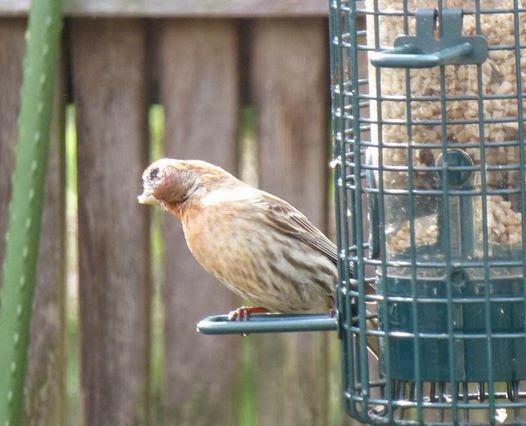
Murr Brewster contributed a photo of a house finch at her Portland, OR feeder from last summer. Like I said, this is a terrible disease. And what's even worse is that poor disfigured little bird is shedding Mycoplasma on every surface it touches. That bad eye goops on a feeder port, and the next bird's going to pick up a dose. And on it goes, a human-aided spread of a bad, bad bug.
Another interesting point from Katdoc:
It is a horrid disease. I'm sorry for what you are going through right now. I think (hope, wish) that there is some resistance in the Am. goldfinch population and that we see the Darwinian effects of weeding out the weaker members. I believe that house finches are too closely related, genetically, after generations of inbreeding the original "Hollywood Finches" to ever beat this disease.
That was an interesting take. We've had this explosive radiation of house finches in the East, all descended from a couple of crates of "Hollywood linnets" released by a pet dealer on Long Island in 1939. He probably didn't want to get fined for selling native birds, so he let them go. So this huge population blanketing the eastern half of the country is all coming from a very small founder stock, and all related at this point. Inbreeding depression weakens birds genetically. As Katdoc points out, they may never develop resistance to this illness, especially when infected birds, unable to see to forage in the wild, gravitate to feeders and spread it there. What was I doing here?
Well, I was trying to figure out what the least worst thing might be that I could do. I couldn't tell 1080 people who already "like" Booger that he was going to be fine. I couldn't very well tell them, at least on my shiny happy Facebook page, that I should have wrung his neck right at the start. People were telling me I was "amazing" and calling me "finch whisperer" and "miracle worker" and any number of other very nice names when I am none of those things. I'm blundering around here, doing too little and making way too much noise about it. So I'm telling those with enough interest to click through (that would be you!) exactly that. The "Oh how sweet!" crowd can go on their way in happy ignorance.
I decided to medicate Boog until he was asymptomatic, release him and hope he wouldn't have a relapse. And to shut my mouth next time until I knew more about what I was trying to do.
This whole time I've been working with Booger, there's been a female house finch at the feeders, almost completely blind with MG. She takes auditory cues from the other birds, and when they all fly off giving alarm calls, she flies straight up in a weird, jerky, tentative way, then descends and crash-lands high in the soft foliage of an arbor vitae, fluttering to a usually upside-down, clinging halt. It's a pretty amazing coping strategy--a blind bird still flying, and figuring out where to crash-land where she can get out of the way of danger, but won't hurt herself. High enough to be out of reach. Today I tried sneaking up on her when all the other birds had flown, and she did the same routine. She can see juuust enough to see me coming. Next time I'm going to try the koi net.
She's our Typhoid Mary, and you can bet that if I do manage to catch her, I'm not going to give her a cute name and post about her. I won't even try to treat her. Been there, done that, and I'm here now, mea culping all over the place.
When I'm done I'll bleach the feeders. No point doing that until she's out of the picture.
The scuzzy-looking goldfinch has out"liked" anything I have ever posted. Go figure. I'd say it went viral, but it's actually bacterial. Heh.
Lame jokes aside, Mycoplasma gallisepticum is a horrible disease. Western house finches, imported by us to the East, have brought it through no fault of their own.
They have spread it, at minimum, to pine siskins, common redpolls, purple and Cassin's finches, as well as American goldfinches.
Asymptomatic birds can apparently recover, but remain carriers for life.
Now you tell me.
This has been a public service announcement from Dr. Doolittle, who tries always
to tell the truth, pretty and cute or not.
UPDATE: Booger's doing GREAT. Day 11 of treatment. Zooming around the cage, eating like a pig, both eyes bright and clear, molting in a little black beret. I couldn't catch him even if I wanted to. Can't even photograph him--he's that wild. I just want to let him go. And I will, soon.












Friday, March 12, 2021
8 comments