Background Switcher (Hidden)

Showing posts with label torch ginger. Show all posts

Baby Great Potoo!

Tuesday, April 15, 2014

8 comments
As big wet flumpy snowflakes pelt down on disconsolate Ohio goldfinches, I am headed back to Costa Rica, and I'm taking you with me. 

To La Selva, where a bold young collared peccary is grinding away on some hard tropical nut. Crounch crounch crounch crounch.


Where spider monkeys swing and leap through the trees, me open-mouthed below. The first thing you know of monkeys is a great swishing and crashing of leaves, a raining of things down from their foraging. They are hard to see and harder to follow. Being a monkey researcher would be taxing, as they can travel so much better and faster by brachiation than we can by walking. 


We watched this mother spider gather herself for a great leap across open air--with her baby, eyes squinched shut, hanging on for dear life. I was happy with this shot, with her brave bony fingers leading the way, her tail a question mark. They made it, to answer the question.


We had another afternoon of messing around at Selva Verde before we headed up to the Central Highlands. I got a bad shot of violet-headed hummingbird on vervain, my only sighting of the trip. Identifiable, at least. Hummer photos get better, I promise. Much better.


A striped-breasted wren flirted with me in the dark forest. There are so many wrens in Costa Rica, many of them giving sweet echoes of our beloved Carolina. Sweet Caroline DAH DAH DAH


We watched a green heron stalking frogs and dragonflies in a small pond.


And torch ginger drew the hermit hummingbirds in a little botanical garden across the road. It was bursting with beauty and color. Just the tonic I need today.


Soon we piled in our nice bus and headed up into the highlands. 


Our fabbo guide Mario would look out the bus window and spot itty bitty torrent tyrants in places like this. It's all about knowing what to expect. Spotting tiny birds atop rocks only added to his highly mysterious wizardy aura.


The crested guans perched near a rural mailbox were a bit easier to discern, as they flew across the road in front of the bus. 


I had two turkey gobblers fly across the highway in Maryland in much the same way on my trip back from New England yesterday. Always a treat to see them fly. Cracids are not turkeys by a long shot, but they're reminiscent. And they too have fabulous wattles!


Costa Rica is just so beautiful, with those mountains giving it relief both in a topographic and climatic sense. You can go up high and get cool, or go down to the lowlands and sweat a bit. Naturally, I liked the highlands. But the lowlands birds, ohhh. Well worth the schvitzing.


Mario holds his cards close to his chest. We were looking for something in the highlands on our way to Bosque de Paz, a private sanctuary/ecolodge. I didn't know what...


But we were happy to scan and watch whatever flew by. Finally he made a couple of cellphone calls and tightened up the directions a bit, and we drove a little farther up the road and came upon a big sign that read, "POTOO."


Which, when you've been fuddling around for about twenty minutes looking for something (you know not what), was about the funniest thing we'd ever seen. Oh. This must be what we were looking for.

It didn't take Mario long to spot the bird just a settin' up in the huge tree behind the sign. The lovely family who owns the land are delighted to share their potoo with anyone who comes by. Hence the sign.


We admired it and took digiscoped shots as well as this telephoto shot. What we DID NOT know was that this potoo was at that very moment incubating an egg she had laid on the bare branch. Mario went back with another group after I was back home, and sent me this phonescoped image.


Baby Great Potoo. Everybody squee together!!
Photo by Mario Cordoba

I have to say, being able to shoot images back and forth via email to my new friend Mario is the bomb. We've been puzzling out some bug and bat ID's that way. 

He knew I'd fall apart when I saw this photo, so he sent it. And I did. And now you can fall apart, too.

Caterpillars, North and South

Wednesday, March 19, 2008

14 comments
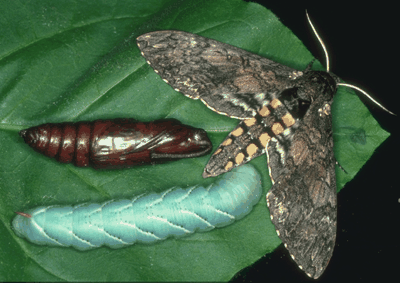
Brown pupa, caterpillar, and adult moth of the tobacco hornworm.
Photograph from Dr. Richard Vogt's page: http://zebra.biol.sc.edu/moth/manduca-l.html

Faithful readers may remember my dear friend Martha Weiss, who studies caterpillar learning at Georgetown University. Well, while I was in Nebraska on March 10, an interview with Martha aired on National Public Radio's Morning Edition. Elegant experiments in Martha's lab at Georgetown U. have shown that caterpillars of the tobacco hornworm, when exposed to a chemical odor at the same time they are given a mild electric shock, learn to avoid the odor. That's not that surprising; a measure of intelligence is needed for self-preservation whether you're a worm or a wapiti. I don't know if you've been surprised by a huge sea-green tobacco hornworm while picking tomatoes, had it rear up and click menacingly at you. Yikes. I have. Those things give me the ooks. So many of them wind up being parasitized by wasps, and dying badly with white cocoons sprouting all over their bodies, that I never remove them from my tomato plants any more. They can have the darn tomato vines. We need more hornworms around here.

OK. Back to Martha's work, educating hornworms. Here's the cool part: After metamorphosis, the adult tobacco hornworm moths that were exposed to aversive conditioning as fifth-instar caterpillars remembered the odor associated with shocks, and also avoided it. Metamorphosis, in which a caterpillar spins itself into a silken cocoon, makes a hard pupal shell within that cocoon, and essentially turns to goo inside the pupal shell before reorganizing as a moth, is a complete meltdown of the caterpillar's organs. How in the world would a memory survive the meltdown and reorganization of the caterpillar's brain? But it does, it does, and Martha and her colleagues are asking more questions about the process and doubtless designing more experiments. If you'd like to hear Martha talking about it, with her delightfully puckish sense of humor, listen here.Martha with a luna moth pancake. With that one creation, she forever changed the face and execution of pancake breakfasts on Indigo Hill.

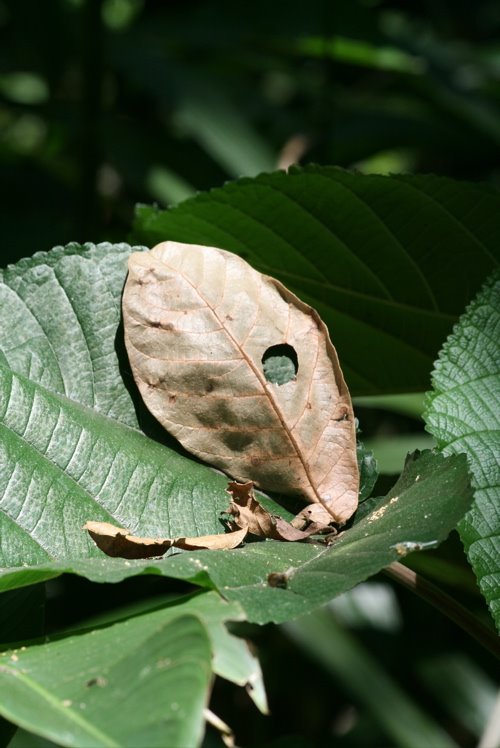
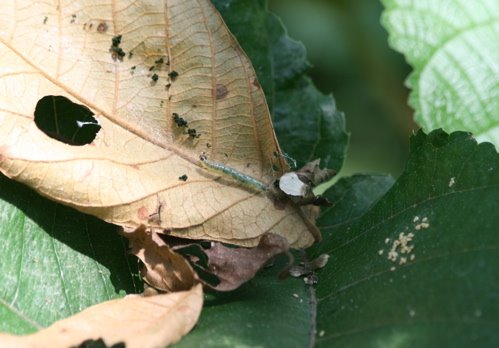
So I was thinking about Martha and her studies of caterpillar intelligence as I walked down the trails at Los Tarrales. I spied a brown leaf that didn't look quite natural, resting as it did on a green leaf, and suspected that there might be a caterpillar beneath. There was something about the way it was resting on the green leaf, and the little porthole, that made me want to lift it up. Sure enough, the leaf was pasted down with silk, and underneath was a green caterpillar, a pretty mad one, in fact. I figure he uses the porthole to enter and exit his safe little vault. Obviously he's not much for housekeeping; he was pooping inside the house. Tsk. I replaced the structure as best I could, hoping he could stick it back down before a bird caught on to the ruse.
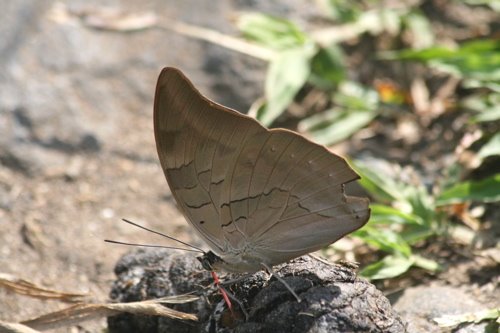
I encountered a gorgeous butterfly, black with broad electric-blue bars on fore and hind wing. I wasn't able to find a Latin name for it, but suspect it is related to the morphos. In true morpho fashion, it was imbibing phosphates and Lord knows what else from a very stinky dog dropping.
It was so absorbed in its imbibing that it allowed me to pick it up by gently pinching its forewing edge. I got a peek at the electric blue stripes on the dorsal surfaces before releasing it. Butterflies do this because they need the chemicals they get from rotting fruit, mud, droppings, urine, and even detergent (they'll imbibe from soapy clothes) to make the pheromones they need to communicate with the opposite sex.

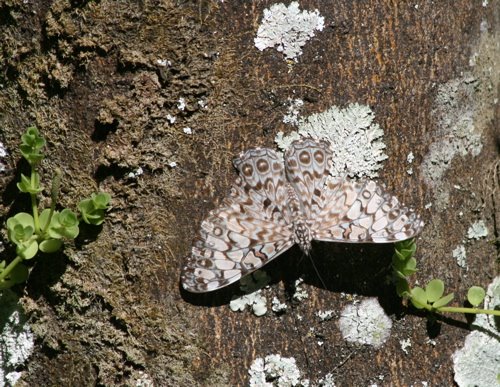
Here's another common butterfly at Los Tarrales: the cracker, so named for the snapping sound it makes when it takes off. It's got the lichen look down.
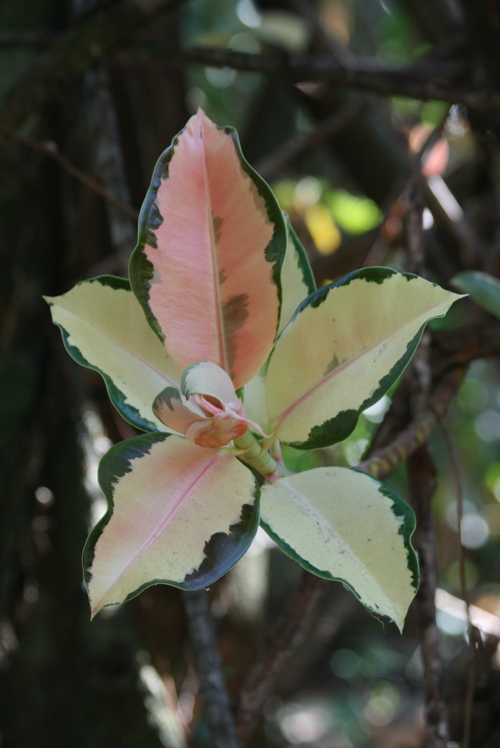
There is so much to see at Los Tarrales that it's like a wonderland for a naturalist. Added to the native fauna is the always-surprising array of ornamentals planted here and there. This is one branch of a variegated Indian rubber tree that must have been 50 feet tall.
The pink leaves glowed like an exotic flower in the dark understory.

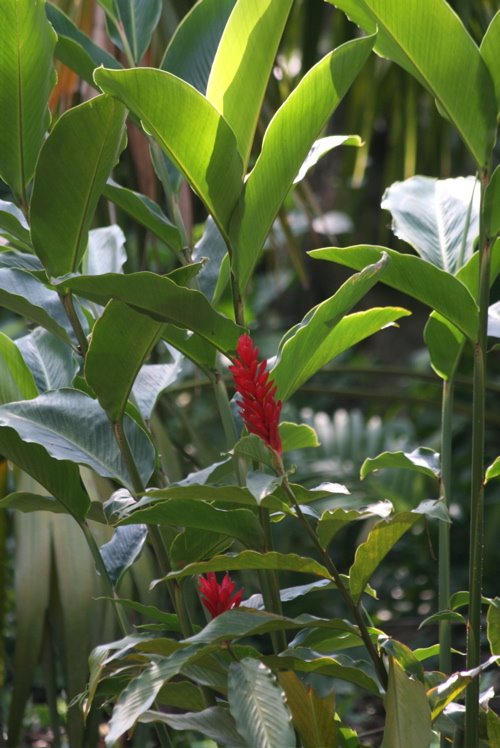
Everywhere you look, there are flowers, like these gingers. Yes, the ginger root we put in stir-fry is related to this lovely plant. Makes you want to take one out of the fridge door and plant it, doesn't it?
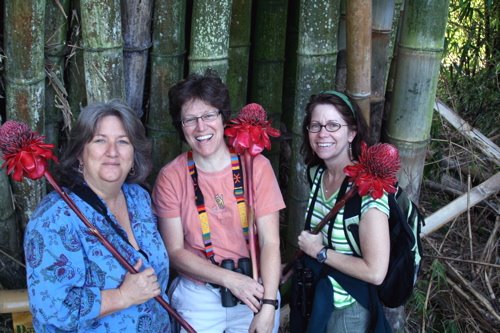
Here are the Torch Ginger Girls, Liz, Zick and Lisa, holding three of the amazing flowers that are grown here for sale within Guatemala. Bouquets are everywhere at Los Tarrales, full of the most surprising forms and colors, and it's unutterably cool to wander among the flower plantations and see them on the hoof. We're backed up against the native bamboo that gives Los Tarrales its name.

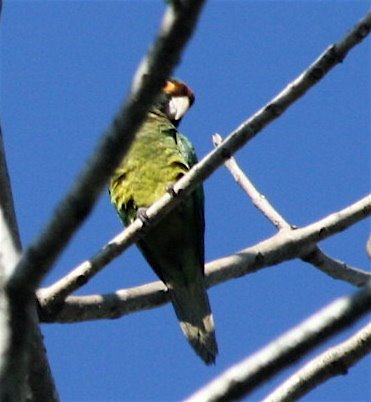
Just a birdie before I go: an orange-fronted parakeet, one of many in screaming flocks that bullet overhead constantly. It's hard hard hard to get a decent picture of a psittacine, as they're wary and flighty. But this one is diagnostic, even if its front (the area over the bill) is more rusty than orange.
Speaking of parrots, my NPR commentary stayed at #1 Most Emailed from Friday evening through midday Tuesday--a record!-- when somebody named Obama made a speech about racism that some people apparently thought was more compelling and important than the antics of an aging parrot somewhere in backwoods Ohio. No accounting for taste, I guess.

Oh, it feels good to go back to the heat and succor of Guatemala, as the rain pours from leaden skies in soggy gray old Ohio. The spring peepers sang for the first time last night. They're probably the only people happy about this deluge around here. Hoping Mary's home state is getting well soaked!
[Back to Top]