Showing posts with label grassroots conservation. Show all posts
To Save a Beaver Pond
Sunday morning, June 14, 2020, as I rested in a chaise longue with a song sparrow on my shoulder and a fine cur-dog by my side, I got a call from the county wildlife officer, with whom I've been working to try to head off any more beaver killing or dam destruction. Through conversations with my area contacts, I had sleuthed the perpetrator's address and phone number, even gotten directions to his house. Wildlife Officer Donnelly used this information, stopping by the house and finding no one home, then following up with a call that morning. He told this man that he had taken a few calls concerning the beaver dam and his destruction of it. The gaswell tender admitted to hiring a backhoe contractor to take the dam out. This man claims to have a right of way to lay a gas pipeline through private property. He said that the first couple of times he destroyed the beaver dam (and the beavers, too), he failed to "get it dry enough" to lay the pipe. So he killed the beavers and ruined the habitat for nothing, but that didn't keep him from doing it twice.
His first assault in September 2014 reduced the proud beautiful pond to a stagnant mud puddle. I would see an enormous snapping turtle rising to breathe, then settling back down to the bottom. It was such a sickening, sad remnant of the glorious pond that once was there, and it broke my heart. Through that fall and winter I was disconsolate, and I didn't go down Dean's Fork as much as usual, because her crown jewel had been drained and the beavers shot, for no good reason I could understand. For nothing.
The next fall, beavers came back in and rebuilt. Here it is, gloriously refilling, in November 2015.
Then, by my contact's reports, the well operator used dynamite to blow up their work. In the fall of 2017, back this magnificent habitat went to a sad puddle. I can't express the dismay and anguish of coming upon such destruction, where once there was such beauty.
All of this was done against the landowner's express wishes. She wanted the beavers left in peace. I was mad enough to spit bullets, on her behalf, on the behalf of all the creatures who depended on this lovely body of water in a place where water is precious.
So you see why, when I found the pond refilled in the spring of 2020, in my view it was not if the beavers would be killed again, and their dam destroyed. It was merely a question of when. I was putting my money on September of 2020 for another attack, as much as I hated the thought. I'd seen and photographed this man's patterns. I'd labeled and saved the photos, calling them up again for this post, in a bit of guerilla environmental journalism that I'm proud to be able to write. Documentation is important! Without these dates and photos, these destructive acts never happened.
Over the years, I had raged and wept over this person's rampant disregard for the law and the landowner's rights. He was taking advantage of a person who couldn't police her own land. But I'd never gotten anywhere trying to enlist the help of the county wildlife officer who preceded Ryan Donnelly. Each time I broached the subject with him, I got the stock answer: "If I don't see him do it, I can't do anything about it." This is the perennial law enforcement dodge for any crime that might happen in the future. And for doing nothing at all to prevent it. You say this to make the complainant go away, to relieve you of the burden of having to bestir yourself. You say this, knowing that you'll never catch the person at it. He's free to do whatever he wants, and nobody can walk up to you and make it your problem.
It was thoroughly frustrating. I would go away from those conversations feeling like some dumb bunny hugger who just loves beavers. I may love large wet rodents, but I am thoroughly invested not just in beavers, but in the habitat they create. Because it was never glaciated, the southeastern part of Ohio where I live has no natural bodies of water. Every lake or pond around here is man-made. Appalachian Ohio shares topography with West Virginia and Maryland, and neither of those have any natural lakes at all. In fact, in all of Ohio, there are but 100 natural lakes, and all of them are in the glaciated areas, mostly Summit, Portage and Geauga Counties. Those of you from the Dakotas and Minnesota and upstate New York just stop and think about that for a moment. No natural ponds. No lakes without a cement dam. The artificial lakes we do have are ringed with houses and used up by recreation. So we have very few places to go and see creatures like herons, ducks, dragonflies, muskrats, turtles, or any of the myriad beautiful life forms that inhabit quiet ponds and lakes. Ours is a rich but aquatically impoverished biome.
In Officer Donnelly, I had finally found an ally. Here was someone who was willing to stick his neck out to try to protect this habitat. He listened to me, and made the pre-emptive strike that the beavers so desperately needed him to execute. My pounding on the well-tender's door would get me nowhere fast. Who am I? Some beaver-lovin' crackpot. Well. This beaver-hugger finally had the ear of someone with law enforcement authority.
In their conversation, Officer Donnelly reminded the well operator of something he surely knew but had chosen to ignore: that any activity conducted on someone else's land has to have express permission from the landowner. Having a pipeline right of way does not grant him tacit permission to shoot or trap animals, much less destroy an entire wetland habitat. In a face-to-face conversation with the landowner, also facilitated by this beaver-lover, Officer Donnelly had established that the well operator never obtained permission to destroy the habitat in the two previous incidents. Now, it has become clear to the welltender that multiple people are watching and reporting his activity; law enforcement is watching; the landowner is upset, and the beavers are not to be killed nor their dam destroyed again. All that should make it a bit harder for him to just go ahead and do his thing come fall. He'll get a knock on his door if he does. He'd better hope it's not me.
Now, he told Officer Donnelly, he "doesn't have time to monkey with it" and intends to leave it be.
I cannot express how happy I was to hear this. I could hear the smile in Officer Donnelly's voice as he related their conversation. I was so happy I'd done the legwork, helped the wildlife officer do a pre-emptive strike, and finally had a county wildlife officer who cared enough to step in and do something about it. Finally, after agonizing over the fate of this habitat since 2014, I had some reassurance that, the next time I walk down Dean's Fork, there will be water, and wood ducks whistling, maybe a green heron or a kingfisher or two. And two beavers gliding back and forth across a big, deep pond of their own making. Perhaps it might have stayed that way without my asking, sleuthing, and making a pest of myself. But then again, perhaps not.
Perhaps wasn't good enough for me.
Opossum tracks in blessed water.
|
Widget for blogger by Way2Blogging | Via Spice Up Your Blog Gadgets
|
Labels:
beaver,
beaver dam,
Dean's Fork,
grassroots conservation
One Evening in June
Sunday, June 3, 2018
6 commentsWhile bending very, very low to try to catch the fragrance of my Firecrest water lily, my flubberroll pushed my trusty faithful iPhone 6 out of the stretchy little Bandi waist pouch I wear around all summer long. It usually keeps my phone and Flipnotes metal notebook safer and more accessible than they'd be in my pockets, but this time there was a wardrobe malfunction. I heard a Ploop! and swiped my hand into the water, catching the phone as it was settling gently on the bottom. Instinctively, I sucked water out of all the ports, raced inside saying, "Phone in pond. Phone in pond. Get rice!" Phoebe leapt into action and we interred the phone in rice for 36 hours. I tried to leave it alone, in state. It was hard. After 24 hours, I fired it up and it seemed OK, then went black. Back into the rice, which helps desiccate soaked electronics.
There ensued a couple of days that, if I'm honest, were entirely devoted to replacing the phone. A 40-minute drive with Bill, the account holder, to Parkersburg to the ATT store, where I decided to make an insurance claim rather than upgrade. I loved my 6. I didn't need a 7, 8, or a 10. It would be replaced with a 6, and that was fine with me. Waiting for the new phone, I realized what a part of my life it is, and mostly for the camera. I missed it terribly. When a new one arrived, I spent most of a day transferring content from the old one to the new one, and doing all the sweat-inducing password and sign-in gyrations that accompany firing up a new phone. First world problems, all of them. Nothing more than an inconvenience, and a reckoning of just how much having this magic camera/lifeline/access to a world of knowledge means to me. It was a good way to back up (literally and figuratively) and take a look at what's important to me. And what's important to me is staying in touch with my family and friends, and making images.
So when I finally got the new phone up and running, I got myself up and running for an evening light photosafari. I love running in the morning; I feel a bit logy by evening, probably because I work and garden so hard all day that exercising then seems beside the point. But the light and the allure of photography got me out.
This is the child of the great red oak who used to grace our mailbox. I love to see it thrive and grow. I love to think of a time when I'll remember when it was just a sapling. I wish I could live long enough to see it get huge, to see it throw shade on the mailbox. I want to sit under it and read the paper.
You can't really see them unless you click on this photo, but there's a bluebird on the wire, and the white breast of a redtail shining in the dead tree just beyond. And let's look at those thunderheads. Oh, Summer.
I'd been looking for the prints of the first fawn of summer, and this time I found them. So tiny it must be, the size of a cocker spaniel, tottering around after Mama on fingertip-sized hooves. Ah, June.
The field daisies are out full, finishing up, even. They always surprise me, blooming earlier every year.
Pair them with evening light and you have a poem. I don't care that they came here from Europe. So did we. They're a heavenly host and I love them without reserve.
A 15-foot tall Honeysuckle Tower of Flower Power. You simply cannot imagine the scent that comes from a cluster of Japanese honeysuckle like that. It is overpowering, and in those concentrations, it takes on a soapy powder-room overtone that actually makes me reel. This Asian import I do not love, but it has its charms. The ruby-throated hummingbirds will have nothing to do with my feeders while this riot is going on, and it's a blessing for the little hens, who have no trouble getting a headily scented meal of nectar while busy feeding their young.
The milkweed is locked, loaded and ready to fire in about a week.
I have seen some good years for Penstemon digitalis or Foxglove penstemon, a gorgeous native member of the Scrophulariaceae. But this year takes the absolute cake. Lots and lots of rain, and somewhat cooler temperatures must be just what it needs to reach its best.
My road is lined with foxglove penstemon. Another hummingbird bounty.
Evening light just makes it glow.
The light in the little churchyard was ravishing. That obelisk in the center marks the grave of Nancy Love, and the verse on it goes:
She has gone to the realms of the blest
Where sorrow can reach her never
She has passed through the gates of her rest
She is lost to our dim eyes forever.
Rain Crows fans will recognize these lines.
But the best surprise was yet to come. I've been given permission to trot around on a large piece of land where someone is building a large castle. On my first visit, I was delighted to find a grove of young persimmons, growing up around a mother-tree, topping a grassy hilltop. That was several years ago. Since then, I've been back many times. I made a point to speak with the landowner and let him know what a treasure he had in that grove. I told him the trees would make bushels of sweet fruit come fall; that they were well worth keeping around. He was all over that; he likes the idea of living off the land. And though he's done a lot of cutting and clearing there, to date he's kept his promise to save the persimmons from destruction. I feel proud of that. It's conservation on a grassroots, landowner by landowner level. Every time I visit, I look at the little grove and smile, thinking that, but for that one conversation, those trees would likely have gone unrecognized for the treasure they are. There is so much work to do.
This June evening, I walked up as usual, and everything was different. I heard the bees humming as I approached. Hundreds, thousands of bees. The trees were in bloom! PERSIMMON FLOWERS!! Where I could reach them!!
It may sound odd, but I have wanted to see persimmon flowers all my durn life. I have looked for them and have never seen them. Mostly, that's because a persimmon grows to be a very tall tree, and there's no way, even with binoculars, I'd be able to make out its tiny flowers if they were 50' over my head. But these trees were small enough to have some branches at eye level to me. Eureka!! I waded through blackberry and poison ivy to get some photos and revel in the discovery.
Tiny, four-petaled chalices of sweetness they were. You'll notice the black spots on them and all over the leaves. That turns out to be a fungus called anthracnose, and I've never seen a persimmon that didn't have it. It must not compromise them much, and for that I'm grateful.
Though small white flowers are often very fragrant, these were very lightly scented. There was a barely discernible sweet, olivey scent.
One of my favorite botany gurus, who goes by The Buckeye Botanist on Instagram, commented, "Let me just say that I've admittedly never gotten this close to fresh persimmon flowers like this before either. You got me beat!"
Life goals!!--to beat Andrew at anything plant-related!
As I thought about it, I realized this might be the first time these trees had ever bloomed. I'm sure I'd have noticed it in past springs. I felt honored, like I was present at their debut, their coming of age party. To some, it might seem like such a small thing, but it made my day.
I stepped back and looked at the grove, and realized I could capture the whole story in one photo. The bulldozer, the persimmons, and far back, the castle under construction.
There they were, with the bulldozer that might have taken them down, had I not had the nerve to say something. To try to save a little something special in this bulldozed, built-up, scraped-flat world.
I'll be back in November, looking for the sweet, squashy, sticky orange fruits. Maybe some will hang low enough for me to photograph and pick them--another first! I'm used to fighting the 'possums and coons for wind-dropped fruit, used to finding nothing but the licked-clean pedicels under the towering trees on our place. It'll be sweet, another one of those full-circle moments that happen when you're in the same place and watching and caring the whole time.
|
Widget for blogger by Way2Blogging | Via Spice Up Your Blog Gadgets
|
Red Bat!
Monday, November 17, 2008
37 comments
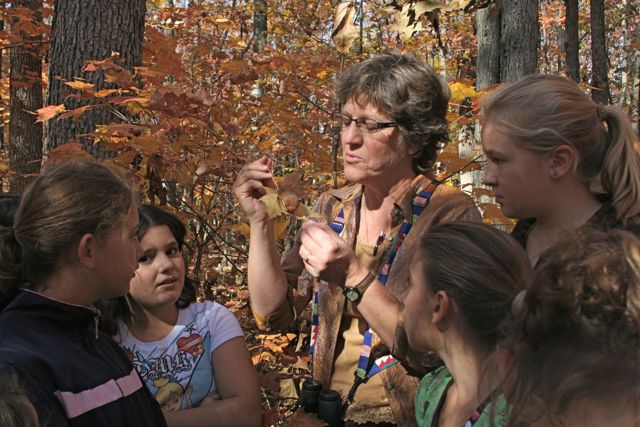
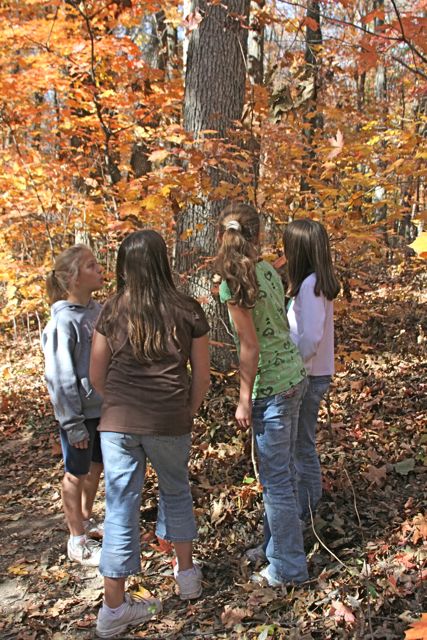
Just being in the woods with 25 people is an experience. The ways in which I normally sense things have to be recalibrated. Because 25 people make a lot of noise, listening for birdcalls or tiny scufflings in the leaves is out. But I can still look, and 25 pairs of eyes can look, too. We looked at an old hickory that had been struck by lightning, and was now healing along the blaze mark, wrapping fresh wood around a rotting inner core.
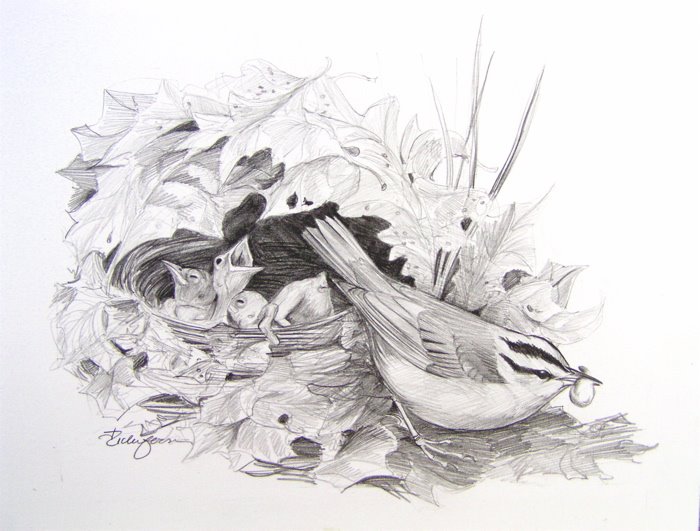
I decided to ask the students to look at the woods through the eyes of a worm-eating warbler. Worm-eating warblers (here's one of my drawings of a female tending her nest)
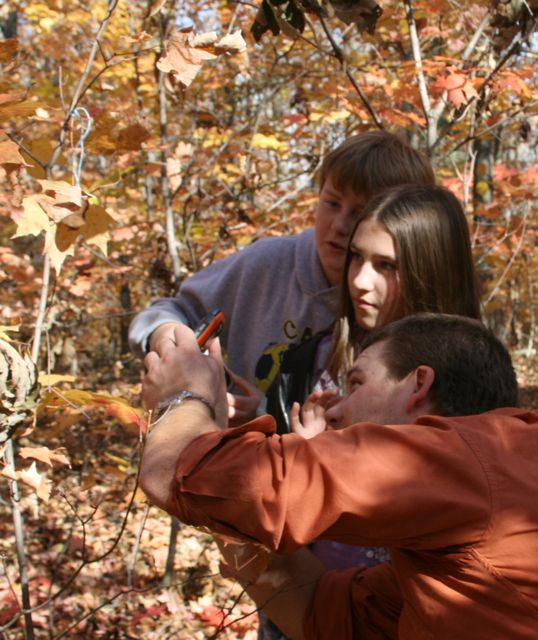
specialize in finding insects, spiders, egg sacs and larvae hiding in hanging dead leaf clusters. Until you look at the woods through a worm-eating warbler's eyes, you'd never dream how many hanging dead leaf clusters you could find to plunder for food. So I asked the kids to think like a bird, a bird which makes its living clinging upside down to dead leaf clusters, looking for whatever lives inside them. We went from cluster to cluster, prying them apart and seeing what was inside. And there was a spider or an egg sac in nearly every one. Calls of "I found one!" rang out through the golden woods. And then came the call from Caitlin Adams: "I found a BAT!"
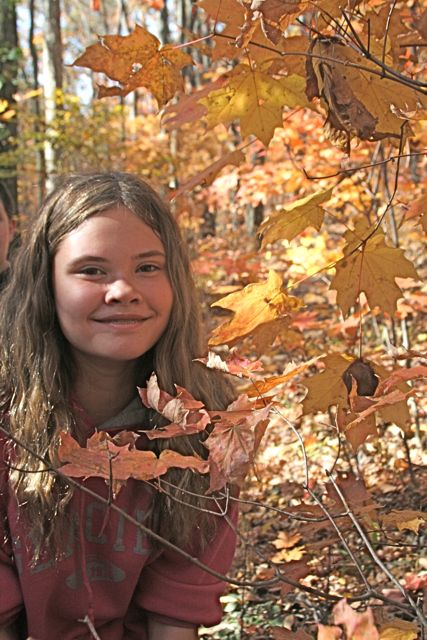
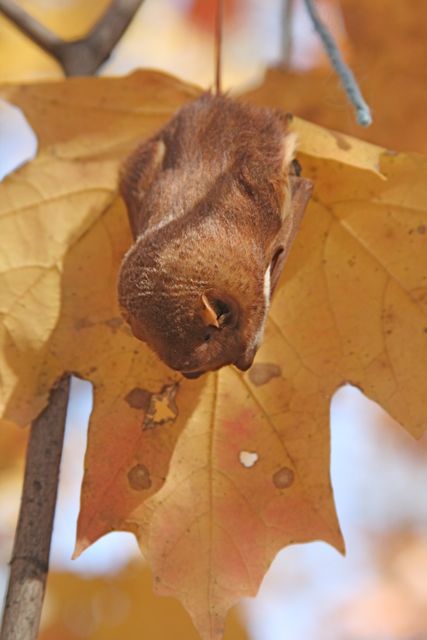
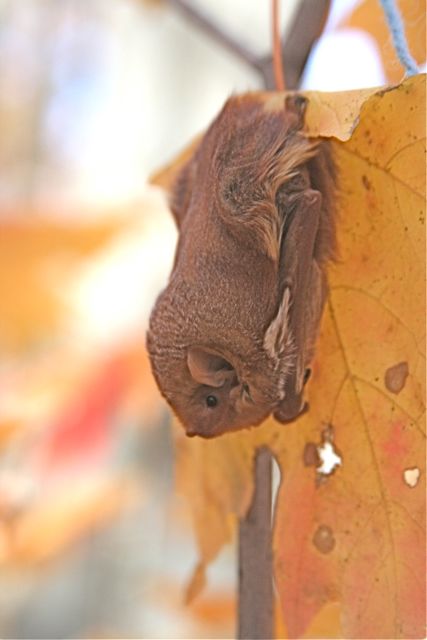
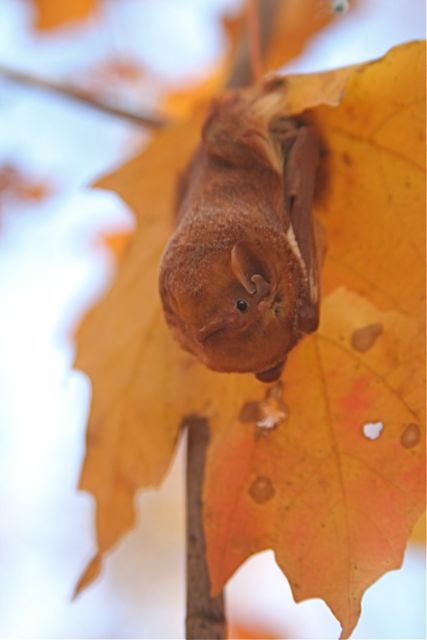
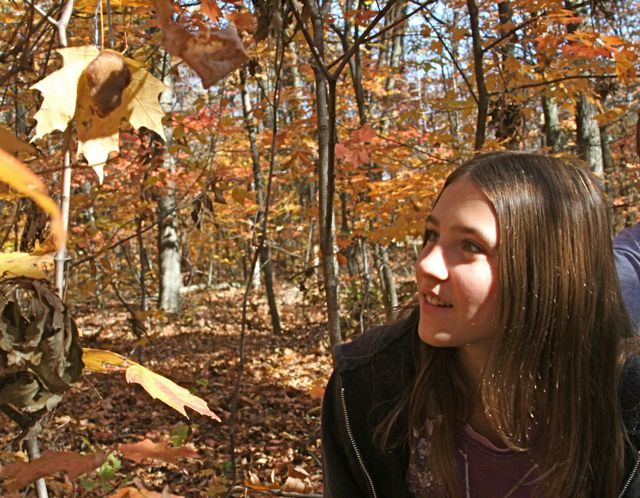
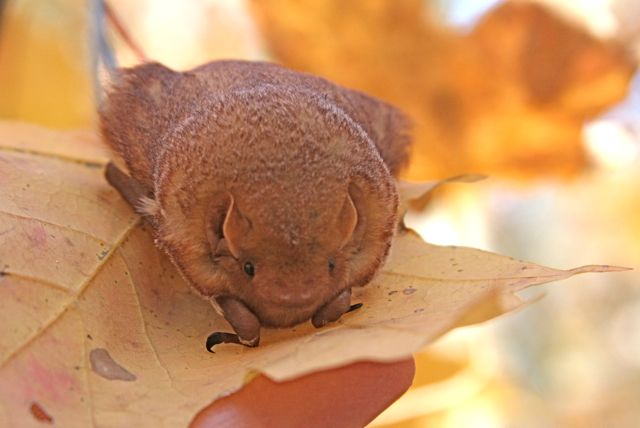
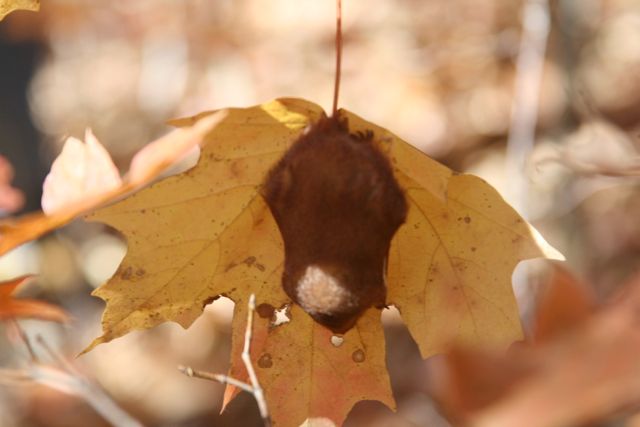
Everyone froze and hurried over to Caitlin's side. She had indeed found a bat, hanging upside down right beside a leaf cluster. Well, how about that! A bat. A BAT!! And not just any bat, but a Red Bat. My Favorite Bat of All. One I have seen countless times, but only on the wing. Oh, how I have longed for a better look at a red bat. And now, thanks to Caitlin and Mrs. Newman and Clermont Northeastern Middle School which owns these beautiful woods she helped to save from the lumber mill, here was a red bat hanging right at eye level from a sugar maple leaf for all the world to see.
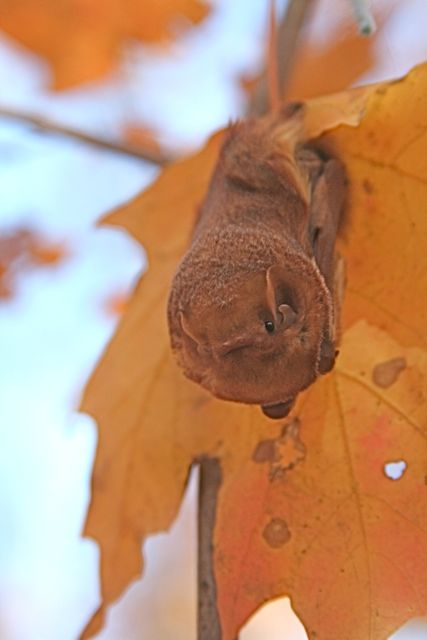
Lasiurus borealis is one of the tree bats, family Vespertilionidae. Red bats occur across the eastern two-thirds of North America, and they are more common than you'd think, but they don't live in colonies; they're solitary. They migrate south just like birds when it gets cold, though with their luxuriant cinnamon-colored fur, they have much greater cold tolerance than most other bats. In Ohio, we see them most often in late October and early November, as they make their way south. If you see a bat flying around alone on a cool autumn evening, or even during bright daylight in fall, it may be a red bat. They roost, often hanging by one foot, and look remarkably like a hanging dead leaf or pine cone. Females may have up to five young at a time, and she flies with them clinging to her belly, and when they're old enough to hang up she leaves them hanging while she forages, then flies back to nurse them. Imagine a female red bat hanging her babies up and then coming back to nurse them. It's a scene right out of Stellaluna. Red bats are actually pretty large bats, as bats go, with a body length of around four inches and wingspans of up to 13". When it's really cold they ball themselves up inside their furry tail membrane, looking like almost nothing at all.
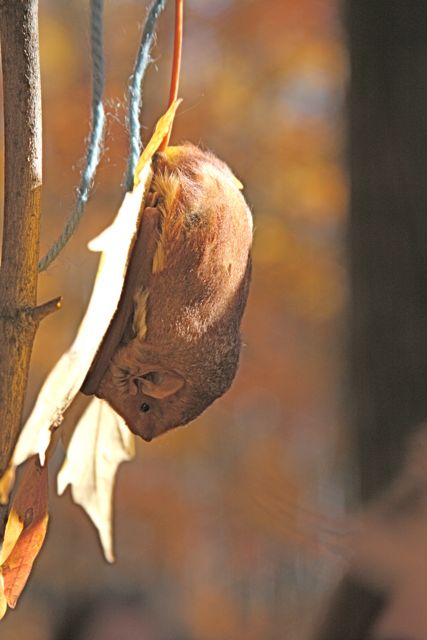
Gently, I tipped the leaf so the kids could see the bat's face, and the weakened leaf petiole, about ready to let go anyway, snapped off in my hand. After a moment of panic--I have a bat in my hand! What am I going to do with him now? Unhook his feet and hang him up somewhere else?-- it occurred to me that in the 100 or so pockets of the kids surrounding this bat there might be a bread wrapper or a piece of string. Sure enough, Tierra pulled a bit of blue yarn out of her jeans pocket. Another student held the leaf while I tied the yarn around the stem and then around a twig on the little maple tree. Voila. The bat was safely hanging once again. Phewww.
It is hard to overstate the concentrated cuteness of a red bat. Hanging head down, he didn't look like much. Maybe like a hamster, with that unusual cinnamon brown, silky fur.
But I insisted that even the kids who were a little shy about bats come forward and have a look at his face.
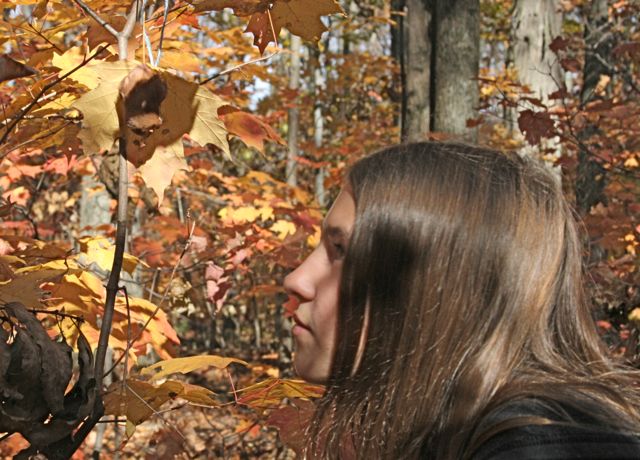
And it was there, eye to eye, that the true connection between these kids and this bat was forged. It is impossible to be afraid of an animal this adorable, no matter how bad the advance press on bats might be.
Along his side, just above the wing, was a stripe of creamy fur that seemed almost too lovely to be true. We all wanted so badly to stroke that satin fur, but we didn't want to scare him any more than we already had. For those who have internalized all the myths about bats and who recoil in horror at the thought of touching one, rest assured that no one but me got closer than a hand's length to the animal, and I stayed with it as long as the students were present.
You have been warned. The bat pictures in this post will increase in adorability until your face melts.
Every once in awhile he'd raise his head and look around in wonder at all the faces staring back into his.
Once, when we got a little too close, he gaped at us, a little warning, but even that was pretty cute.
All the while, I told the kids what I knew about red bats. The nice part for me was that we ignored, never deigned to mention, skipped completely over the old wives' tales about bats--that they get tangled in your hair, that they all carry rabies, that they are evil, bloodthirsty, black-hearted flying mice...none of which are true, and none of which obviously applied to this enchanting little creature. No, we leapt right to the infatuation phase in our relationship with this bat.
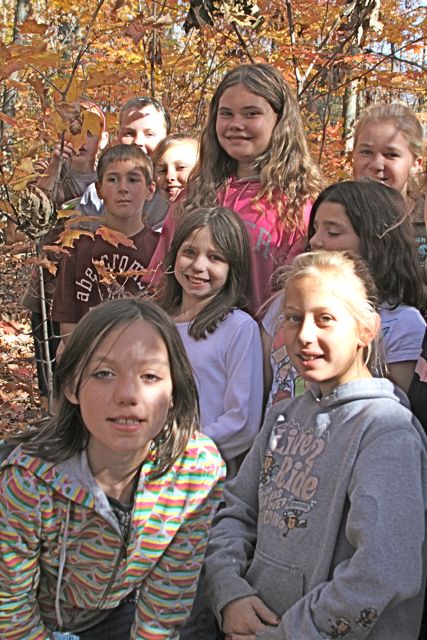
Everyone wanted their picture taken with the famous red bat (who looks like a chicken nugget in this picture, hanging right in front of one kid's face on the left side of the photo). I wish I could post all my pictures, and I apologize to anyone who was there but feels left out. There were permissions forms involved...it got complicated. Thank you, Sherri and the other teachers and students who raced to get written parental permission, for making publication of these photos possible.
Caitlin the Bat Locator is the tall girl in pink, and Tierra's right in front of her, in white. She gave me yarn, and reminds me of hauntingly of my niece, Christy. I had to stop myself from scooping her up and hugging her.
Although cellphones aren't supposed to come out during school hours, Mr. Blake
made an exception. It's not every day you get to say hello to a red bat.
A whole bunch of photos later, it was finally time to turn back toward school. We'd no sooner gotten in the doors than Mr. Blake gathered several teachers and headed back out to show them the little vespertilionid. That was one of my favorite moments of the day. I had no sooner returned from my third field trip than I turned right around and took a fourth, impromptu group out to see it. Then Sherri Newberry took two more groups. It was that special, that irresistible. The whole school caught red bat fever that golden November day.
Bridget was so completely enchanted that she couldn't leave. I knew a girl like that once.
I don't know what she'll become when she grows up, but something rare passed between Bridget
and the bat. I would imagine that teachers never get used to seeing a life change before their eyes, and that's what keeps them working and grading papers long into the night.
Thank you to Pam Murphy, Sherri Newberry, Melody Newman and Stephen Blake for making my visit so rich and for preparing the students so well, so that they could hear what I had to say. Thank you to Nick Adams for building the blind, and to his younger sister Caitlin for finding the bat. (Coincidence? I think not). Thank you to the students for loving the bat every bit as much as I did, for being willing to look into its face, to connect with its small furry soul and imagine what it must be thinking and feeling. Thank you for reading my work and looking at my paintings and photographs, and for the nice messages you've sent me. And thank you to Clermont Northeastern Middle School for protecting the pond and woodlot, for these seemingly simple landscape features provide habitat for all creatures great and small, and by their presence afford limitless opportunities for learning and spiritual renewal to your students.
I have yet to see a parking lot or a pile of lumber that can do that.
I decided to ask the students to look at the woods through the eyes of a worm-eating warbler. Worm-eating warblers (here's one of my drawings of a female tending her nest)
Everyone froze and hurried over to Caitlin's side. She had indeed found a bat, hanging upside down right beside a leaf cluster. Well, how about that! A bat. A BAT!! And not just any bat, but a Red Bat. My Favorite Bat of All. One I have seen countless times, but only on the wing. Oh, how I have longed for a better look at a red bat. And now, thanks to Caitlin and Mrs. Newman and Clermont Northeastern Middle School which owns these beautiful woods she helped to save from the lumber mill, here was a red bat hanging right at eye level from a sugar maple leaf for all the world to see.
Lasiurus borealis is one of the tree bats, family Vespertilionidae. Red bats occur across the eastern two-thirds of North America, and they are more common than you'd think, but they don't live in colonies; they're solitary. They migrate south just like birds when it gets cold, though with their luxuriant cinnamon-colored fur, they have much greater cold tolerance than most other bats. In Ohio, we see them most often in late October and early November, as they make their way south. If you see a bat flying around alone on a cool autumn evening, or even during bright daylight in fall, it may be a red bat. They roost, often hanging by one foot, and look remarkably like a hanging dead leaf or pine cone. Females may have up to five young at a time, and she flies with them clinging to her belly, and when they're old enough to hang up she leaves them hanging while she forages, then flies back to nurse them. Imagine a female red bat hanging her babies up and then coming back to nurse them. It's a scene right out of Stellaluna. Red bats are actually pretty large bats, as bats go, with a body length of around four inches and wingspans of up to 13". When it's really cold they ball themselves up inside their furry tail membrane, looking like almost nothing at all.
Gently, I tipped the leaf so the kids could see the bat's face, and the weakened leaf petiole, about ready to let go anyway, snapped off in my hand. After a moment of panic--I have a bat in my hand! What am I going to do with him now? Unhook his feet and hang him up somewhere else?-- it occurred to me that in the 100 or so pockets of the kids surrounding this bat there might be a bread wrapper or a piece of string. Sure enough, Tierra pulled a bit of blue yarn out of her jeans pocket. Another student held the leaf while I tied the yarn around the stem and then around a twig on the little maple tree. Voila. The bat was safely hanging once again. Phewww.
It is hard to overstate the concentrated cuteness of a red bat. Hanging head down, he didn't look like much. Maybe like a hamster, with that unusual cinnamon brown, silky fur.
You have been warned. The bat pictures in this post will increase in adorability until your face melts.
Every once in awhile he'd raise his head and look around in wonder at all the faces staring back into his.
Once, when we got a little too close, he gaped at us, a little warning, but even that was pretty cute.
All the while, I told the kids what I knew about red bats. The nice part for me was that we ignored, never deigned to mention, skipped completely over the old wives' tales about bats--that they get tangled in your hair, that they all carry rabies, that they are evil, bloodthirsty, black-hearted flying mice...none of which are true, and none of which obviously applied to this enchanting little creature. No, we leapt right to the infatuation phase in our relationship with this bat.
Everyone wanted their picture taken with the famous red bat (who looks like a chicken nugget in this picture, hanging right in front of one kid's face on the left side of the photo). I wish I could post all my pictures, and I apologize to anyone who was there but feels left out. There were permissions forms involved...it got complicated. Thank you, Sherri and the other teachers and students who raced to get written parental permission, for making publication of these photos possible.
Although cellphones aren't supposed to come out during school hours, Mr. Blake
made an exception. It's not every day you get to say hello to a red bat.
A whole bunch of photos later, it was finally time to turn back toward school. We'd no sooner gotten in the doors than Mr. Blake gathered several teachers and headed back out to show them the little vespertilionid. That was one of my favorite moments of the day. I had no sooner returned from my third field trip than I turned right around and took a fourth, impromptu group out to see it. Then Sherri Newberry took two more groups. It was that special, that irresistible. The whole school caught red bat fever that golden November day.
I don't know what she'll become when she grows up, but something rare passed between Bridget
and the bat. I would imagine that teachers never get used to seeing a life change before their eyes, and that's what keeps them working and grading papers long into the night.
Thank you to Pam Murphy, Sherri Newberry, Melody Newman and Stephen Blake for making my visit so rich and for preparing the students so well, so that they could hear what I had to say. Thank you to Nick Adams for building the blind, and to his younger sister Caitlin for finding the bat. (Coincidence? I think not). Thank you to the students for loving the bat every bit as much as I did, for being willing to look into its face, to connect with its small furry soul and imagine what it must be thinking and feeling. Thank you for reading my work and looking at my paintings and photographs, and for the nice messages you've sent me. And thank you to Clermont Northeastern Middle School for protecting the pond and woodlot, for these seemingly simple landscape features provide habitat for all creatures great and small, and by their presence afford limitless opportunities for learning and spiritual renewal to your students.
I have yet to see a parking lot or a pile of lumber that can do that.
|
Widget for blogger by Way2Blogging | Via Spice Up Your Blog Gadgets
|
A Singular School
Sunday, November 16, 2008
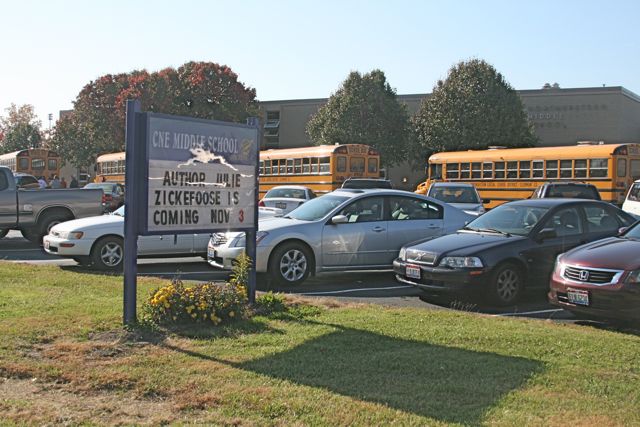
18 commentsAn Author Visit. I had never done an author visit to a school before. I could never have anticipated what that entailed, the months of preparation on the part of my school contacts at Clermont Northeastern Middle School in Batavia, Ohio. In order to accommodate an author, in this case for the entire day, they have call assemblies, figure out how many kids they can pack into each assembly, and in general discard any semblance of their normal schedule. Speaking to middle school students is different from speaking at nature festivals or bird club banquets. For one thing, festival goers and bird club members don't have to sit on the floor. There are other differences, too. Middle school students get a lot more excited than bird club people. And that, my friends, is a beautiful thing.
I visited Clermont Northeastern Middle School on November 7. And it was clear to me as the excitement for my visit built up that overhauling their schedule was the least of CNE's preparations. I had first received an inquiry from a gracious and lovely person named Pam Murphy, who was familiar with my work, but who retired from her position as school librarian in the year that ensued. She must have made a good case for hosting me. Library aide Sherri Newberry and science teacher Melody Newman took up Pam's torch and made sure the students were familiar with Letters from Eden. Mrs. Newberry got all fired up, made Letters a centerpiece of her library classes, and read several chapters to her students. In a unique electronic outreach, they and several other teachers took pains to familiarize their students with my blog.
Ooh. Wait a minute.
When the 5th through 8th grade students began digging into the archives of the last three years, I was extremely happy that I've taken care from the very start to keep it reasonably clean, rant-free and kid-friendly. Once a post goes up, it's up, and there it stands for anyone to read at any time. So do the comments.
Pause for other bloggers to think about whether they want 5th through 8th graders reading their blog archives...waiting for their next post...
OK, go get yourselves a glass of wine and come back. Pour me one, too. The genie is out of the bottle. I am not going back to edit old posts. I yam what I yam, as Popeye says.
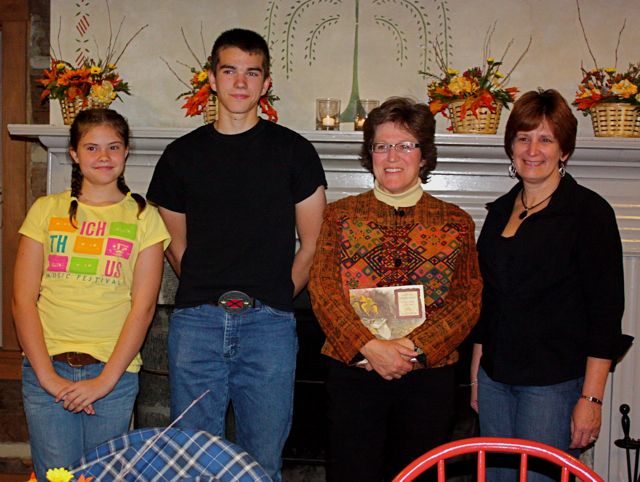
Not only had the kids read much of my book and begun following my blog, but Melody Newman had spearheaded an effort to have a feeding station put up and a bird blind built overlooking the feeding station...all in time for my visit. This fact really didn't sink in on me until I walked into the blind, redolent of new plywood, and sat down to look at birds visiting the spanking-new feeders. This is not just any bird blind. It is a masterpiece, built as an Eagle Scout project by CNE alum Nick Adams. Here is Nick, with his sister Caitlin, me and Melody Newman. You'll see more of Caitlin later. This is the night before the school visit, and she doesn't know what she is about to discover. Neither do I, but we look like we're expecting something good, don't we?
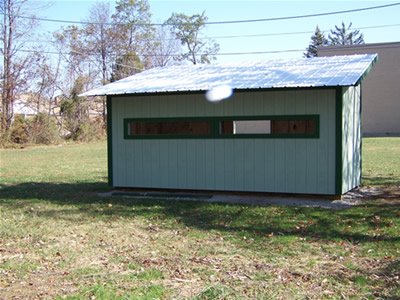
And here is the blind that Nick built, on weekends and evenings for "I don't know, exactly. A really long time."
I could live in this bird blind.
Clermont Northeastern Middle School was much, much better. It was great. Though the feeders had been up for only a week, cardinals, white-breasted nuthatches, blue jays, white-throated sparrows, white-crowned sparrows, and even a red-bellied woodpecker visited the feeding station while the students and I looked on. I was impressed at the birds' adaptability; they were probably already well-acclimated to the sight and sound of active kids, and our wiggling around in the blind didn't faze them. It was the perfect way for kids without binoculars to get close looks at wild birds on school grounds. Imagine.
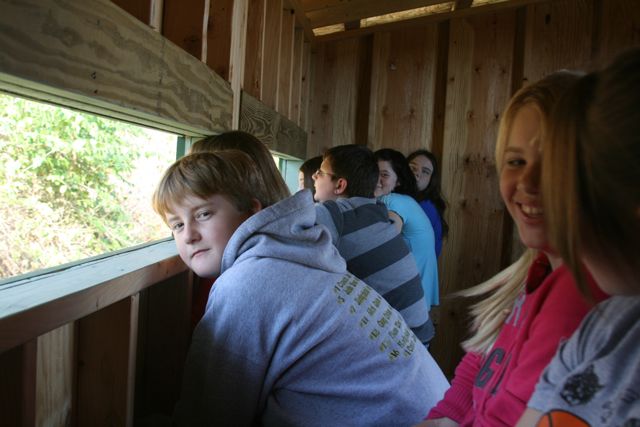
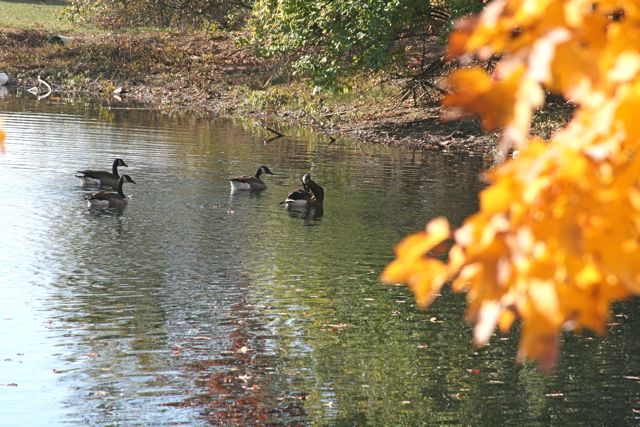
It became clear to me that Mrs. Newman is the kind of person who can't help leaving a legacy behind. She cares deeply that her students truly connect with nature, and she puts that caring into action. Thanks to her, plantings around the school building were bird-friendly, fruit-bearing shrubs and trees. A beautiful pond graces school grounds, afloat with Canada geese, home to snapping turtles and minnows, because Mrs. Newman refused to allow it to be filled in for a parking lot. She and her students can be found out there with dip nets and buckets, figuring out what all lives beneath its quiet surface. A school with a pond.
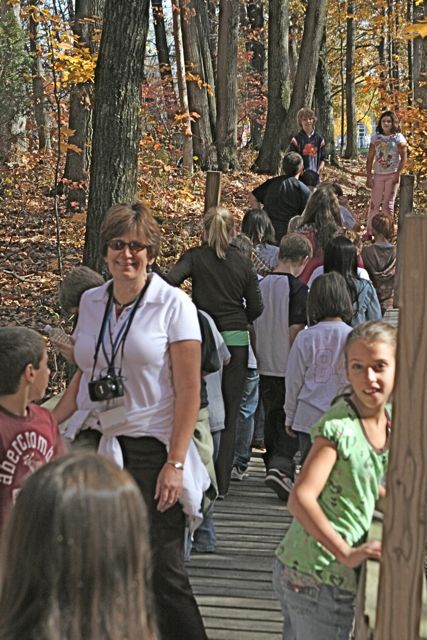
But there is an even greater legacy now. Behind CNE, on its land, is a very fine stand of old timber, many trees in excess of 100 years old. Dominated by fine, straight oak and hickory trees, it is precisely the kind of stand that, in southern Ohio, might long ago have been cut and sold for lumber. How it escaped timbering this long is a wonder and a mystery. Finally, though, tough financial times and its undeniable monetary value combined to bring it onto the block. The old trees were spray-painted and marked for cutting. Melody Newman said no. And then she yelled NO!!!! long and loud, and a lot of other people yelled with her. She and her students had made a nature trail through that forest, and they meant to keep it. Were these trees, this mature forest ecosystem, worth more than their value as timber? Mrs. Newman thought so, and she'd have lain down in front of the bulldozers if she had to. She may yet have to. There is as yet no formal protection of this woodlot, no covenant to ensure that it will remain forever wooded. But for now, it is safe. Here's Mrs. Newman in her element.
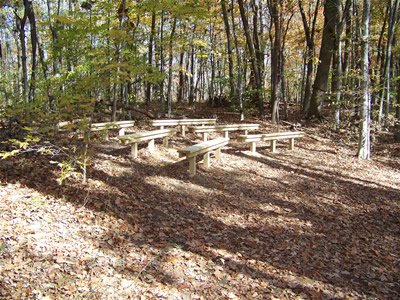
Here is the outdoor classroom that Ivan Glasgow built for the school's science classes. Mrs. Newman's vision at work, again. It's in a beautiful natural amphitheatre and it has all the comfort and wonder of the woods in it.
And it was through that beautiful forest we walked on November 3, and it was there that we found the most magical thing imaginable.
I love to torture you kids.
|
Widget for blogger by Way2Blogging | Via Spice Up Your Blog Gadgets
|


Sunday, June 21, 2020
33 comments