Background Switcher (Hidden)

Showing posts with label alligators. Show all posts

Butterfly Lightning

Sunday, February 8, 2015

5 comments
The best thing about being a generalist is that you can amuse yourself anywhere. If there isn't a bird to watch nearby, there are bound to be plants and insects. 

And January butterflies are fabulous. January butterflies!! I'll take 'em!!

Here's an eastern pgymy-blue  Brephidium isophthalma. This bug is the size of my ring fingernail. Pygmy is the word. But it's not blue, not even close. Brown and orangeish above. But oh what a train of tiny jewels on the hind underwing. I'm sure they'd be stunning if I could only see them closer.


If you want to know how I figured out that the white flower I was seeing everywhere on damp roadsides near salt/brackish marsh is Bidens pilosa, Spanish needles, I Googled "white composite flower Florida" and went through a kazillion photos until I found it. Yay Google. Yay me. Yay Spanish needles! The butterflies were all over it, all the time.


I wish I knew what makes the hieroglyphs on a pygmy-blue's wing. Or whom. 


A boffo big gator on Biolab Road. I love the name of the road. It reminds me of happy college days. Biolab Road runs behind the dune, through the marsh that backs the barrier beach of Canaveral National Seashore. It is chock fulla wading birds and gators.


There is one bend in the road that had a dozen gators this warm sunny day. We knew to look for them there, because the same was true even on a cold sunny day four years ago, the last time Liam and I beheld gators. Liam spotted every single gator we saw on this trip. 


 Great southern white, Ascia monuste. Best said with a slow Virginia drawl. Say it: "Gret Suthrun whaat." (thanks, John Acorn.)  Enjoying Spanish needles again, they are.  My Kaufman butterfly guide says antennal clubs usually pale blue-green...yep! Who knew? Until now?


 Gulf Fritillary Agraulis vanillae. These vivid beauties take fritillary orange and add a dash of chile.  Za-zing! And they're everywhere, mingling with the gret suthrun whaats. To me, they look like a frit crossed with a heliconian (see below).

This one puzzled me. There are lots of yellows in the Deep South that we don't have up to home.
I had to look it up. Turns out to be a  Barred Yellow, (winter form), Eurema daira.


This little beauty was flitting through longleaf pine forest at Tosohatchee NWR, a huge complex of wooded pine swamp and riverine forest and prairie that is crawling with great wildlife and birds.
 I was lucky enough to lead a morning's trip there for the Space Coast Birding and Wildlife Festival.
You can see a peek of the clear sulfur-yellow of this barred yellow's forewing in this shot.


White peacock Anartia jatrophae. Hard to photograph and catch the subtle iridescent baby blue that suffuses its wings.

Still wondering about this skipper. Waiting to hear from Swarovski rep, photographer, birder and digiscoper extraordinaire Clay Taylor, who helped me with a lot of my ID's. Clay was one of the people who turned me on to butterflies back in the early 1980's, in Connecticut. 


Salt marsh skipper, Panoquina panoquin (below).  Distinguished by its elongated narrow wings, which make it a panoquin amongst the skippers. I need to find out the derivation of that word. I like it. Hang tight...dang it! Can't find the derivation. Kinda sounds Greek. Help, somebody?

And Wheatley kicks in with: "Panoquin was the name of a Narragansett who aided in the
attack on Lancaster in February, 1675, purchasing Mrs. Rowlandson of the Narragansett who captured her at that time. 

Whaa? Don't know what all the people purchasing is about, but Wheats points out that several skippers are named for Native Americans: Sachem, Ocala, Hobomok, Delaware...except for those named for Greeks: Horace's, Juvenal's, genus Erynnis...Awesome. Thanks my friend.


More Panoquinas, all salt marsh skippers:


That long white window on the hindwing is a great field mark.


Zebra longwing Heliconius charithonia. I will never forget seeing my first zebra longwing on a visit back to where I grew up in Richmond, Virginia, in the mid 1980's. It must've been a late fall stray northward, but I didn't know that. All I knew was that I saw a vision of tropical loveliness floating on shallow wingbeats through a powerline cut in a pine forest along the James River. I had no idea what it was or even how to find out, but it burned itself into my brain--how could it not?  Now I know. I smile every time I see a heliconian, first because they're beautiful and second because when I see heliconians I am usually in the tropics, and I'm smiling nonstop anyway. But I also think back to that day, when a bolt of lepidopteran lightning struck me in the Virginia pinewoods.

I am so grateful for the Google. Now I can almost always find out what it is I've seen. I can put names to things. And that is the greatest luxury and most nourishing food for a curious Science Chimp. Even if it takes years to do it, the most delicious thing for me is to learn.

Lesser scaup, or bluebill. Liam asked me what the ducks with the blue bills were and I replied, "Bluebills."
Hunter names are often better than birder names.

I know it's a lesser scaup because of the purple sheen on its peaked head, the small size and the heavy vermiculation barring its grayish back and sides. Greater scaup have green-glossed rounded heads, a broader bill with larger black "nail" on the end, and almost pure white backs and sides. And they don't tend to hang out in these marshes back of dunes. I see a LOT more lesser scaup in my peregrinations than greaters.


 Common Buckeye Junonia coenia. I was looking for mangrove buckeyes but failed to find any. This butterfly makes this Buckeye feel at home. We have oodles of 'em in autumn. Florida's winter ones are much less colorful than ours.


Do you have oodles of us?


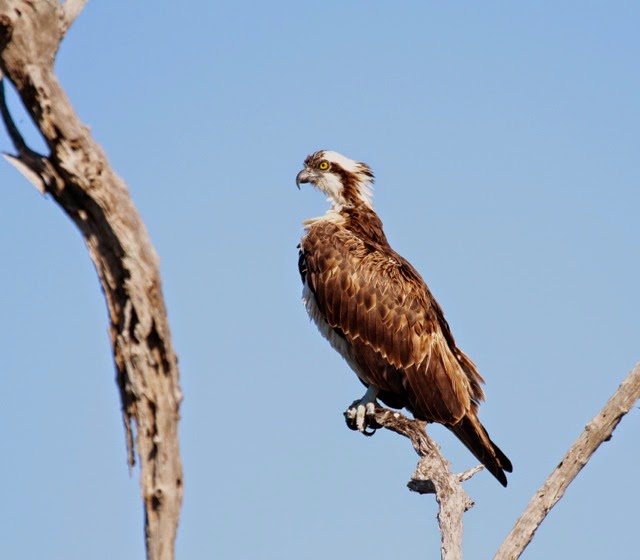
No, sir, we don't, and I'm very glad to see one of you on almost every lamppost on every bridge. Blown away, in fact, and reeling. It is a fine world we live in, where ospreys are as common as gulls. That speaks well for the fish, and for the bay, and for the people of Florida.


Escape to Blue Spring

Tuesday, February 3, 2015

10 comments
I'm writing this on a dreary Ohio evening. I've just returned from a four-mile run and a singing session in the Waxler Church at twilight. It's the most I can do to fight the gloom. The boys are at a StupidBowl party, something that is frankly so far down on my scale of Appealing Things that it's flatlining. I'm wondering if I can conjure a little of the magic of the day Liam and I threw our suitcases and backpacks in the car, wound down through the hamlet of Bonn, Ohio, where we spotted a cat verrrry high up in a tree. I think this is one of those situations where it's a lot easier to run up than to ooch your way down...yiiiikes! I do not envy that kitty. But trust it got back down...they usually do.


 We fought our way through a sudden snowstorm to Canton/Akron airport 


sat on a Southwest jet for 2.5 hours, rented a car in Orlando, and headed to Blue Springs State Park for the final 45 minutes of the day before night fell.

I'm glad I didn't look at the map before embarking on our journey, because in no way is Blue Springs on the way to Titusville, as I had imagined. All I knew is I wanted to show my boy some manatees.

In that, we were not disappointed.


Consider the contrast between the monochrome, frigid world we inhabit, and the limpid, 72-degree turquoise green waters of Blue Spring. We certainly did. 

Liam shrugged into shorts and I rolled up my pants and peeled off layers of shirtage
and we walked with bare arms! in the evening warmth.

Gazing into the water, we watched the manatees gently lolling, rising every so often to exhale, phaaaaaa! and inhale.... thwipp!


and it all had such a surreal quality that we couldn't stop sighing along with the enormous placid sirenians.

I set about trying to get photos of their nostrils and eyes because let's face it, the rest of the manatee is but a vast and beautiful expanse of gentle blubber, ending in paddles


I squealed when I got this shot because it shows the nostrils slamming shut.


Let's have a closer look.


and that my dears is about all the spout you're going to get out of a manatee. I wish I could have gotten a better photo of the eye, because the eyelids close more like a sphincter than lids. Hard to describe, but the eye looks like it's at the center of a many-petaled flower or a star. It's beautiful.


before she sounds in the four-foot depths of this warm spring. The manatees are here for the geothermal upwelling which warms the water to a constant 72 degrees year round.

The fish like it, too.

Most prominent: the invasive exotic blue tilapia, Oreochromis aureus, native to Israel and escaped from fish farms and distributed throughout the Deep South and Central America now. I hadn't known the tilapia was a member of the cichlid family (the darlings of aquariists). I have eaten my share of them, especially in Central America. Pretty good eating, but a bit mucky-tasting to my palate. 


A common snook, Centropomis undecimalis. A native predatory fish, prized as a gamefish. It did look a bit lurky there. 


Longnose gar, Lepisosteus osseus. Gar are super cool looking fish, also predaceous and well-armed with snaggly teeth.


I stared at this one for a long time, and couldn't make it out to be anything but a pacu, which I recognized from my hours of staring into aquariums. Pacus are large tetras (charachins) native to South America. (Piranhas are also charachins.) I understand that in Papua New Guinea, these hefty fish have been known to rise up and neatly remove the testicles of skinny-dippers. One would presume that, in these fruit and nut-eating fish, this is a case of mistaken identity. Or a semantic error.

That has got to be terrible. Fatal, even. Eeesh! Wear your swim trunks!


Speaking of dangerous, we found this gentleman moored to the shore, trying to look like a sodden log.


Our first gator of the trip, a nice big'un. We would see many more, since the weather would be near perfect the whole week. Ahhhh thank you Florida. I understand it was craptastic the two weeks before our visit. Sometimes you just get lucky.

Like when you catch a manatee yawning, or something. No. It couldn't be yawning underwater. 


Maybe it's laughing. Yeah, that's it. Making pacu jokes. Get a load of those papillae. I have been honored to be mawed by young captive manatees in Brasil, and I can tell you that the suction power of that velvety mouth is awesome.  I tried to stay in front of the molars...which reminds me...is manatee on my Bite List? 


I felt very lucky not only to see manatee lips, but to finally be SLEEVELESS, and best of all to have a traveling companion for the week like Liam. Someone who can dig the scene with me, who makes me laugh. I'm grateful that his school doesn't object when we occasionally yank him out for travel and enrichment. Better than throwing a pinata to the elephants. They know he's going to learn a ton of things Ohio can't teach him. Like about pacus. He just ran out of the studio, doubled over. Keep 'em thinking, my dad always said.

Far too soon, the sun sank on Blue Spring, and we turned toward dinner and Titusville.


We heard cricket music, the sweet exhalations of manatees in the gathering dark. And we were so glad to be in Florida. On the way into Titusville, we stopped to find Comet Lovejoy in the inky sky. I found it in a matter of seconds, having learned where it was back home, shivering in the cold. We got back in the car and hadn't gone 100 yards down the road when a huuuge orange fireball exploded into the sky. I'd never seen anything like it. I thought I'd seen my first UFO.  We finally realized that they must've launched a rocket from Canaveral. Atlas 5, with a Navy communications satellite on baord. And we were in the perfect place to observe the launch. Our trip was starting most auspiciously.


Blue Springs Manatees

Tuesday, March 15, 2011

11 comments


High on our agenda for our Florida trip was a visit to Blue Springs, a bit west of Orlando.  This is a classic limestone (karst) spring, carved out by upwellings of sweet water.  We devoted our last morning to it, as a sweet cherry atop the luscious sundae Sunday of our trip. It was cold and foggy when we arrived, making us envy the manatees stacked like cordwood in the pellucid 72 degree water of the river.  My first wild manatees, anywhere. Yes, I'd seen the Amazonian freshwater manatee in Brazil and Guyana, but only in captive situations. Heck, I'd gotten right down and hugged them!

I was overwhelmed by seeing free-living wild manatees--so very many--I counted 80 in one turn of my head! Yeah, yeah, I was bawling. I'd waited a long time to see my first wild sirenians, and I'd strained my eyes peering into the muddy waters of many a tropical river trying. This was too easy. It was like they were waiting for a bus, and the bus was us!


While we waited for the fog to clear, we looked beneath the observation dock. Some native Florida gar joined a snook, hanging as if on strings in the water. My GarGuru, FloridaCracker, advises that there may be two species of gar here, so he advised me to go against my Science Chimp instincts and not get too specific. 


The spring was almost choked with tilapia, an African escapee from fish farms. They're cichlids, related to those darlings of freshwater aquaria. Pretty good eating, but it doesn't look like we're going to catch up with their reproductive rate any time soon. Sigh. Fortunately (or unfortunately for Blue Springs), tilapia are confined to waters that stay above 60 degrees year-round, meaning that (so far) only Florida has to deal with them, and, outside of extreme southern Florida, generally around power plant outflows.

Farm-raised tilapia fed on corn may be fattier than bacon or hamburger. (Remember when everyone found out that the fish sandwich at Mickey D's is the worst thing you can order? That was because of the way they fry it, though.) And,
 interestingly enough, commercially farmed tilapia are subjected to testosterone baths as young fry, turning them all into males. In this way, pisciculturists can ensure they raise an even-age batch of harvest-sized fish, rather than having to sort the offspring of their inevitable pairings. These look pretty even-aged to me--where are the juveniles? Dunno.

FloridaCracker says tilapia make huge, meter-wide bowl-shaped nests, crowding out native sunfishes. Bah. Why do so many escaped exotics have to live so darn large?

Tilapia have made it to the International Union for the Conservation of Nature's 100 World's Worst Alien Invasive Species, having been introduced into tropical waters all over the planet.  They're the big boxy gray fish in this photo.


The blackish banjo-shaped catfish are vermiculated sailfin catfish, native to Amazonia and known in the aquarium trade as Plecostomus catfish, or "plecos." One guess where those came from. I'll give you a hint. When I was a kid, I had one in my tiny 5 gallon aquarium along with the mollies and platies, and it got about 8" long so we gave it to the neighbors, who flushed it down their toilet when it got too big for their 20-gallon tank. Never give anything to your neighbors if you care about it.

In an Amazonian fish market in Manaus, Brazil, I saw Plecostomus catfish for sale, stacked like firewood, upside down, their sucker mouths gasping for air. They were about a yard long. I felt bad about that for years until I saw these.

Why do we import things like this, to put in little tanks and then, when they no longer fit in the tanks, to put in our crystal springs, where they dig the sides out and erode them, making their nests? Why do people keep Burmese pythons and then, when they're too big for the  apartment,  turn them loose in the Everglades, to proliferate to terrifying levels? That's just what we do. Dumb stuff like that. Genies get out of bottles and there is no stuffing them back. Especially when the genies like Florida's subtropical climate.

There were other creatures in with the manatees, which caused the big sirenians no concern whatsoever.


This was the youngest gator we saw, still carrying its banded tail.
It was about two feet long.


Even the big gator seemed not to carry a threat to the gentle mammals, who cruised right under it.


Blue Springs State Park is a magical place. Just the original homestead with the new sun beaming through its Tillandsia-draped tree...oh my goodness. We didn't have time for the house tour. Well, anyway, the Science Chimp can rarely be found on historic house tours--she's usually digging around in the leaf litter instead.


We had only one morning, this misty morning burning off to bright sun, before we had to go back to freezing, iron-gray Ohio.


We soaked it up as best we could.  More manatees anon!

Liam's First Alligator

Sunday, March 6, 2011

18 comments


I will not lie. Liam's first and main reason for wanting to go to Florida was not together time with his mom and sister, although he loves that. No, he wanted to see a ten-foot-long lizard. He really, really wanted to see an alligator. So from the moment we came in over the runway at Orlando airport, we were straining our orbs for eyebumps in every ditch and puddle. But it would be a couple of days before we got lucky.

Driving along Black Point Wildlife Drive at Merritt Island NWR, I finally spotted the prehistoric pile of scalage that said "gator" to my unaccustomed eye. It would have been hard to miss this one, hauled out as he was on a warm winter's day. Holy smokes!

It was all I could do to get Liam to take his eyes off it long enough to snap the photo of a boy with longing, for now, fulfilled.


We got out the spotting scope to get a better look at this dozing beauty.


I don't know why, but every time I see a dozing 'gator, my first thought is that it has hauled out of the water to die. They just look dead. When they close their eyes, the eye seems to sink back into the head, and they really, really look dead. You can't discern any respiration. A sleeping gator defines "inert."


Until the Science Chimp bleats like a little lost fawn separated from its mama and maybe about to try to cross the creek...oh, hello there. Sorry to bother you, but we didn't want our first gator viewing to turn into a wake.


Thus satisfied that the 'gator was quite alive and thinking about venison, we moved the scope so the kids and I could appreciate that armored tail. Dinosaurs live!


It was to be a wonderful evening for 'gators. We proceeded from Black Point to the alluringly named Biolab Road, where a molten sunset pointed up the scalation on three more beautiful gators.


It was really too beautiful and primeval to be believed. And these weren't babies, either. Liam's first  gator was the biggest--gettin' on 12 feet, we guessed. 


This one, maybe 9 feet...about the length of my canoe...eek! I wondered what it would be like to canoe around a beast like that. Maybe FloridaCracker can tell us. Does your heart race when one swirls under you? Heck, a big carp can scare the granola out of me, rocking my boat...what about a gator longer than your own conveyance??

I couldn't resist a shot of Firehair admiring this gorgeous animal.


Another...maybe 7 feet.

Another conservation success story. It's hard to believe we almost hunted the American alligator into extinction, just for the bumpy "leather" it lent to fancy purses and cowboy boots. It seems so archaic, so ridiculous to exterminate such a magnificent beast for things like that. It seems so...human of us. I grew up thinking I'd never see an alligator, or a bald eagle, or a wood stork...they were all but gone in the mid-1960's.

Endangered species legislation works. Alligators, bald eagles, and wood storks are back. Brown pelicans, too--they were once on the brink of extinction, as amazing as that seems. It's just too bad that so many truly endangered species are languishing in the Endangered Species Waiting Lounge, left unprotected because it's economically inconvenient to list them.

 How could we keep taking the tops off Appalachian mountains if the cerulean warbler that lives on them were finally listed as an endangered species, and we were legally bound to protect its habitat? Better not list that one. See, that's how it works. Once we saw what a powerful conservation tool the ESA could be, it was imperative to remove its teeth.

What if we had to legally acknowledge that polar bears and Pacific walruses are endangered because their pack ice habitat is melting out from under them? Legally they're listed as threatened, so we're not bound to do anything to reverse this deeply alarming phenomenon. They're in the waiting room, too. And what about the seals, mainstay of polar bears, that need the pack ice for pupping? Do we expect them and the walruses to simply switch overnight to hauling out on land? Who needs a bunch of pack ice? We don't. So what if they do? 

Having gotten a bit off track, I am thankful for alligators and the legislation that allowed their populations to recover. Well over a million alligators now populate the ditches and swamps of the Southeast.  And I'm deeply thankful that there are still places where you can take your kids to see the oversized scaly wonders of the natural world. 

See it while it's here, folks. 

[Back to Top]