Background Switcher (Hidden)

Showing posts with label Kaufmann Field Guide to Insects. Show all posts

Jumpin' Bristletails! Slitherin' Stimulopalpus!

Tuesday, December 20, 2011

10 comments


Every now and then, I have fresh cause to celebrate the Kaufman Field Guide to Insects of North America, surely one of the most dog-eared of a collection of dog-eared field guides.

Moving the garden cart in the garage, I noticed something scurrying, which reminded me of a silverfish, but wasn't quite right. It was a Jumping Bristletail, which has been moved from the silverfish (order Thysanura) to the order Microcoryphia. They're forest-floor denizens, and they have a beautiful coppery sheen and three cool-looking tails. To me, they look like something that might have crawled the Permian sea floor. In fact, they appeared in the Devonian period along with the arachnids, and are among the least-changed of all insects. With simple chewing mouthparts, they feed on algae, mosses and lichens.

I particularly like this passage from Wikipedia:

During courtship, the males spin a thread from their abdomen, attach one end to the substrate, and string packages of sperm (spermatophores) along it. After a series of courtship dances, the female picks up the spermatophores and places them on her ovipositor. The female then lays a batch of around 30 eggs in a suitable crevice. The young resemble the adults, and take up to two years to reach sexual maturity. Unlike most insects, the adults continue to moult after reaching adulthood, and typically mate once at each instar. Archaeognaths may have a total lifespan of up to four years, longer than many larger insects.[2]


What is it about me and odd, long-lived insects? I'm attracted to the primitive, the odd, the venerable. I like knowing that this tiny creature can live up to four years, while much larger and more spectacular insects like the luna moth may croak a week after metamorphosis. (Ah, but the Science Chimp urges that we remember that the luna has had a nice long summer of caterpillar and a winter of pupa under its belt before it takes wing to mate and die).


And now the Science Chimp is warmed up and rubbing her hairy hands in glee. Because late this summer, she finally solved a mystery which has been buggin' her for years. 

See, there are these tiny, tiny insects that flow in packs over the sandstone walls around our patio, over the paving blocks that form our raised garden beds; even over the cemetery headstones at my favorite churchyard.

And nobody I asked knew what they were.

There were difficulties. For one thing, they're very quick, and very difficult to photograph as they race over the stone. Yes, this is a lousy photo, but it's better than the previous 50.


I kept at it, though, and finally got a couple of decent shots of live rockrunners, as I named them (needing to name them something!)
I was elated to discover thin threadlike antennae in this photo, which might help in tracking down an identity. To judge how very tiny this thing is, those are sand grains in the sandstone...


I tried to catch some, hoping to put them in the fridge for awhile and cool them down enough to get some good macro shots. Well, I accidentally killed one in gently clapping my hand over it.

Tiny. Why do I care? Because I have to know what it is, and I don't mind waiting years to find out.


At last, I could see something of its structure.


And though I'd never seen one fly, it had wings! Nice big wings!


 I thumbed through my insect guide. The closest I could get was Springtails, order Collembola. But this thing seemed more insect-like than a springtail. So I hit bugguide.net. I can't remember the series of things I typed into the search box before arriving at Stimulopalpus japonicus. But whoop, there it was.

It's in the Order Psocodea (Barklice, Booklice and Parasitic Lice). It's in the suborder Troctomorpha, and the family  Amphientomidae (Tropical Barklice.) And get this: It was accidentally introduced to the Washington, D.C. area from Japan in the late 1950's and has spread as far west as southern IL to northern AL.

"The introduced population is apparently all-female."

Which means that they're all clones, reproducing through parthenogenesis.


What they're doing in those massive packs, so many that they flow like water over the rock; how they've managed to flourish to such an extent that they're now found on rocks in the middle of tumbling streams and gravestones and my garden walls in Ohio, must remain a mystery. 

At least they have a name for me now. Not that they know or care, these parthenogenic female packs of rockrunners.

Bugs. I can only wonder, and wonder some more, the permanent question mark hovering over my head.

Bugs

Thursday, October 20, 2011

19 comments
Since posting about the bolas spider, I got an email from the co-author of a cool book called Spider Silk: Evolution and 400 Million Years of Spinning, Waiting, Snagging, and Mating
Her name is Leslie Brunetta, and her co-author is arachnologist Catherine Craig. Leslie gave me a great big present in this David Attenborough video of a bolas spider doing her thing. Get a load of this:


To think of my little beauty getting busy with her sticky bolas, slinging it around as hopeful male cutworm moths circle...well, I had to share that one with Science Club, every fourth, fifth and sixth grade member of which now knows about bolas spiders. In the process, I learned how to convert YouTube files to .mov files that I can keep on my computer, because Liam's school blocks YouTube. There's a free service at zamzar.com that will convert the files into a format of your choice and email them to you! Who knew? So you can have awesome film clips without accessing the Net.
 Not long ago I got a comment on my blog informing me that my use of the word "bug" to describe all insects and (shudder) arachnids is incorrect. "Bug," correctly used, refers only to hemipterans, the "true bugs," which have a long sucking tube for a mouth. Stinkbugs, wheel bugs, milkweed bugs, bugs like that. 

I started to write a reply, got all het up and launched as I am wont to do into an essay, then thought better of it and saved it for the blog.  On this blog and in real life, I use "bug" knowingly, tongue firmly in cheek. For a number of reasons, I feel it best to establish myself here as an entomological piker from the get-go. Bugs are scary enough to many readers without getting all pointy-headed about what you call them. You'll find me describing butterflies as bugs, too. I take my lead from my friend and entomological hero, John Acorn, author of the delightful book Bugs of Ontario. He says in his introduction:

"This book is for bugsters. If you haven't heard that term before, don't feel left out--I think I invented it with the help of my friends. We needed a word for people who are fascinated by insects and enjoy them for no other reason than their intrinsic niftiness. 'Amateur entomologist' seemed too stuff, as did 'insect enthusiast' and 'entomophile.' 'Bugger' is out of the question...I did find the term 'entomaniac' popular among some of the people I know, but it probably isn't the best one to use as a recruiting tool. Maniacs are crazy, but we bugsters are merely enthusiastic.

  "Even the word 'bug' is fraught with problems.In the strict language of entomology, a bug is a member of the Order Hemiptera, often pedantically called 'true bugs'...Let's just cut through all of this confusion and call the critters 'bugs,' and the people who love them 'bugsters.'"

All hail John Acorn, who makes nature accessible and fun. I'm aping him as best I can. Bug, bug, insect, beetle, arthropod and arachnid...I love 'em all, except for ticks, mites and house and wood cockroaches, all of which I hate, except for the brown-hooded cockroach, which I adore, capricious bugster that I am.

I will now reprise a post, because I love it too much to trust you to click upon a link to it, that sums up how I feel about bugs. Even odd cockroaches in the bedroom.

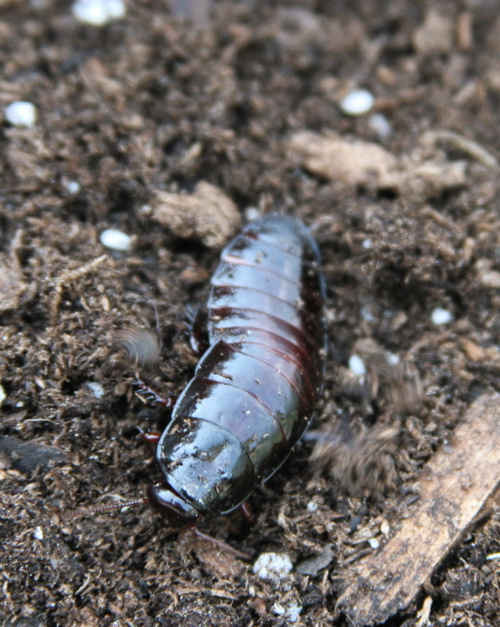
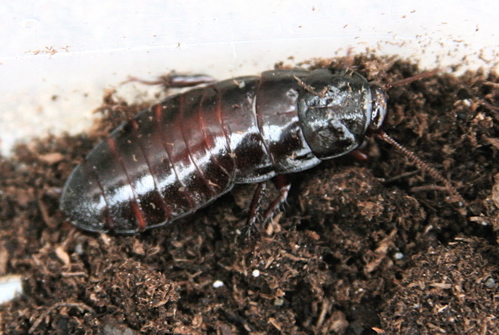
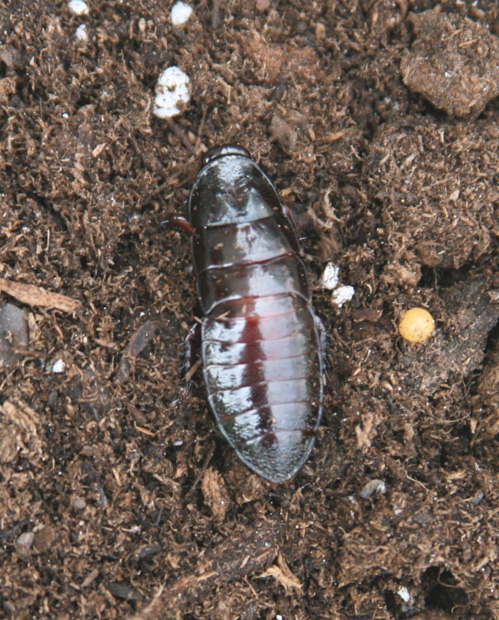
It was a magic moment, the kind Science Chimps live for. I was bathing Liam (this tells you how old this post is--2007!)  and from the bedroom Bill said, "Zick! Look at this!" with that note in his voice that could only mean a kind of gross but interesting bug. He came into the bathroom with a wad of Kleenex in his hand, and this huge shiny cockroach, almost 2" long, squirmed free of it and plopped down onto the bathmat. It crawled methodically, squirming side to side like a little Sherman tank, most unroach-like.

I noticed first that its cerci, the two antenna-like projections at the tip of the abdomen that are one of the roach family's distinguishing characteristics, were very small, but still present. Its legs were heavily barbed, strong and stout. It looked like a miniature version of the Madagascar hissing cockroaches I used to visit in their plastic shoeboxes in the Harvard Biolabs. I knew that I had seen this bug before, but only in a photograph. A photograph in my brand-spankin' new Kaufman Field Guide to Insects of North America.

Oh! Oh! Oh! Mad scramble for the book. And there it was, the brown-hooded cockroach, right there on the roach page where I remembered it being. But there, too, in one tantalizing paragraph, was its story. The hair stood up on my legs (which took some doing, since I'd just shaved 'em) when I read this:

The Brown-hooded Cockroach (Cryptocercus punctulatus), often placed in its own family (Cryptocercidae), is a unique social insect of northwestern mountains and the Appalachians. It lives in family groups in rotting wood, females giving live birth to three or four offspring. These nymphs feed on adult feces, consuming protozoans that help digest cellulose. They take six years to mature.

So we've got a native insect, an endemic, almost, with a disjunct range. Which gives live birth, instead of laying a gross little egg capsule like most roaches that infest houses. Whose offspring live on the feces of their parents. Which is social. A social roach. Which takes Six Years to Mature. It was almost too much to take in at one time.

I did a little digging around on the Net. From researchers at Sweetbriar College, via discoverlife.org came the following synopsis, which differs in some details from the Eaton/Kaufman story:

Wood roaches are monogamous and exhibit considerable parental care: a mated pair stay together for several years and raise a single set of offspring. After a sexually mature wood roach finds a mate (how? I don't know), the pair establishes a nesting site in a dead log on the forest floor. They will probably stay in one log for the rest of their lives. Wood roaches have ecological and physiological similarities to their close relatives, the termites. Like termites, they feed on dead wood and live in galleries they construct within fallen logs. Since insects lack the enzyme cellulase, they rely on microbes to digest wood. Termites and wood roaches house these microbes, primarily flagellated protozoa, in their gut. The mated female lays a clutch of 50-100 eggs. A newly hatched roach nymph's gut is empty - it does not have any symbiotic microbes. To get these from its mother or father it uses proctodeal trophallaxis (feeding on fluids from the adult's anus). The necessity of obtaining gut microbes is a constraint on the life history of the wood roach: these insects cannot grow to maturity as loners. Initially the nymphs feed exclusively by trophallaxis and are completely dependent on their parents for their nutrients. As they mature, they acquire their own gut flora and begin feeding on dead wood directly. Development to sexual maturity takes more than two years.

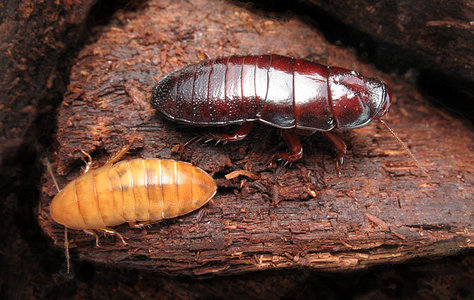
Here's a roach and its nymph, a picture taken off the Net. Vastly superior to mine. I found this insect a bit tough to photograph, since being out in the light upset it and it made endless circles around the perimeter of its enclosure. This is a jolly good shot, even though it's lifted. (I wish I could find it again to credit the photographer.)

So. Do they lay eggs or give birth to live young? Dunno. Does it take two or six years to reach sexual maturity? Dunno that, either. See how much we don't know for sure about insects? When it comes right down to it, they are unknown, weird piled on weird.

Cryptocercus
. Hidden cerci. Yeah. Punctulatus would mean spotted. In the words of Tom Morrison, the foreman of the construction crew that built our birding tower, I was "all ate up." I jumped up and down, pumping my fists like Tiger Woods after a birdie. High-fiving Bill. New Bug! Weird Social Long-Lived Bug! In our House! Still am all ate up, to have this venerable Appalachian social cockroach circling around in a plastic pitcher on my kitchen counter. But none of that could have happened unless Kenn Kaufman and Eric Eaton and my beloved publisher, Houghton Mifflin (Harcourt), had gotten it together to make this brand-new field guide to insects, this gift to the planet, to Science Chimps everywhere. Get yourself one at your local bookstore, or order it online. Give yourself the gift of knowing your roaches, your stink bugs, your odd long-horned beetles, your Midas flies and scorpion flies. Let your curiosity rule the day. Tune in to the previously inaccessible world of insects.


I let it go the next day in rotting wood, of course. Hoping there would be a new social group of brown-hooded cockroaches for it to join. What it was doing in the bedroom I can't imagine. As Bill said, "I'm just glad I didn't flush it."

The Horned Passalus and Its Passengers

Sunday, September 11, 2011

19 comments

                               I think of this as my Summer of Bugs. I've always liked bugs.


But this year, I have tools to learn more about them, and I am using those tools. My favorite is Eric Eaton's and Kenn Kaufman's Field Guide to Insects of North America. There, I learned that what I've always called a Betsy Bug is a Horned Passalus (oh wonderful name!) Odontotaenius disjunctus.  It's a pretty wonderful bug, I must say.  There are only two species of passalid in North America; it's a mostly tropical family, with over 500 species worldwide. Shiny (Patent Leather Beetle is another colloquial name), strong (just try holding one back!) and robust, it's very beautiful and strange to watch as it feels its way around with jointed antennae. Like roaches, the passalus is sensitive to air currents, and rather shy. It's usually found in rotted wood, which it eats. But unlike termites, for instance, it lacks beneficial bacteria in its gut to digest the wood. So it eats the wood, poops, and then eats the fungus that grows on its own poop. Now what is not to love about that?

But it gets better. The Horned Passalus is a social insect, and Eaton says that it is able to "talk" to its family (yes, it has a family; we'll get to that) by rubbing bits of itself together, something called stridulating. And curious entomologists have identified fourteen different sounds, or calls, that this insect can make.

See the cool little horn on its head?


I was bitten pretty good by a Betsy Bug while playing in a Virginia sandbox at the tender age of six or so. To be fair to it, I was squishing it in my hand. I didn't mean to; I thought it was a sand clump. They don't usually bite, though. They're too busy being cool. Get this:  They chew through rotted wood, making galleries where they haul around their eggs and larvae, a bit like giant ants. They live in colonies with their offspring. They pair up. And the pairs of beetles care for their larvae, feeding them chewed wood mixed with their own feces (there they go again!) They can live up to 16 months, and most of that is spent in caring for their young while the eggs hatch, larvae grow and metamorphose into pupae and then adult beetles.

I like the golden leg fringe bling. Not sure what its function may be; maybe it acts as a comb to keep wood debris off its limbs? Maybe it combs those sensitive antennae with its leg fringe? I would need to watch one for a few hours to see what it does.

My partner in discovery is my Canon G-11. (Who knows how many of these cameras I've sold? B & H Photo's link that was supposed to kick back $$ never worked for me, so heck with it. Go buy one. Tell 'em I sent you). 


This little camera shows me things I can hardly see with my own orbs. See anything interesting on the beetle's head? Yeah, me too. Mites. Little copper-colored round mites.

I noticed that this beetle (I have two individuals in these shots) was carrying mites, and it seemed to have little scooped-out areas on its head that cradled the mites just so, which got me thinking that the mites might be doing something nice for the beetle; maybe cleaning its jaws and keeping it all shiny-polished; maybe getting rid of excess food or feces; maybe singing tiny little mite songs to it as it chews away on the rotten wood. Hi ho, Hi ho, it's off to work you go! Tra la la la! Hey, if a beetle can have at least 14 different calls, mites should be able to sing.


Some of the mites found on bess bugs are found nowhere else.

So something's going on here; the mites get something from the association with the passalus that they can't get anywhere else. Who knows what the passalus gets from it? That's bugs for you. Looking closely can lead to looking more closely, and then a question mark forms over your head that is pretty much permanent, like a halo.

I would much rather have a question mark over my head than a halo. Much more fun.


Shiver Me Timbers. A New Cockroach!

Thursday, August 2, 2007

1 comments
It was a magic moment, the kind Science Chimps live for. I was bathing Liam, and from the bedroom Bill said, "Zick! Look at this!" with that note in his voice that could only mean a kind of gross but interesting bug. He came into the bathroom with a wad of Kleenex in his hand, and this huge shiny cockroach, almost 2" long, squirmed free of it and plopped down onto the bathmat. It crawled methodically, squirming side to side like a little Sherman tank, most unroach-like.I noticed first that its cerci, the two antenna-like projections at the tip of the abdomen that are one of the roach family's distinguishing characteristics, were very small, but still present. Its legs were heavily barbed, strong and stout. It looked like a miniature version of the Madagascar hissing cockroaches I used to visit in their plastic shoeboxes in the Harvard Biolabs. I knew that I had seen this bug before, but only in a photograph. A photograph in my brand-spankin' new Kaufman Field Guide to Insects of North America.

Oh! Oh! Oh! Mad scramble for the book. And there it was, the brown-hooded cockroach, right there on the roach page where I remembered it being. But there, too, in one tantalizing paragraph, was its story. The hair stood up on my legs (which took some doing, since I'd just shaved 'em) when I read this:

The Brown-hooded Cockroach (Cryptocercus punctulatus), often placed in its own family (Cryptocercidae), is a unique social insect of northwestern mountains and the Appalachians. It lives in family groups in rotting wood, females giving live birth to three or four offspring. These nymphs feed on adult feces, consuming protozoans that help digest cellulose. They take six years to mature.

So we've got a native insect, an endemic, almost, with a disjunct range. Which gives live birth, instead of laying a gross little egg capsule like most roaches that infest houses. Whose offspring live on the feces of their parents. Which is social. A social roach. Which takes Six Years to Mature. It was almost too much to take in at one time.

I did a little digging around on the Net. From discoverlife.org came the following synopsis, which differs in some details from the Eaton/Kaufman story:

Wood roaches are monogamous and exhibit considerable parental care: a mated pair stay together for several years and raise a single set of offspring. After a sexually mature wood roach finds a mate (how? I don't know), the pair establishes a nesting site in a dead log on the forest floor. They will probably stay in one log for the rest of their lives. Wood roaches have ecological and physiological similarities to their close relatives, the termites. Like termites, they feed on dead wood and live in galleries they construct within fallen logs. Since insects lack the enzyme cellulase, they rely on microbes to digest wood. Termites and wood roaches house these microbes, primarily flagellated protozoa, in their gut. The mated female lays a clutch of 50-100 eggs. A newly hatched roach nymph's gut is empty - it does not have any symbiotic microbes. To get these from its mother or father it uses proctodeal trophallaxis (feeding on fluids from the adult's anus). The necessity of obtaining gut microbes is a constraint on the life history of the wood roach: these insects cannot grow to maturity as loners. Initially the nymphs feed exclusively by trophallaxis and are completely dependent on their parents for their nutrients. As they mature, they acquire their own gut flora and begin feeding on dead wood directly. Development to sexual maturity takes more than two years.

Here's a roach and its nymph, a picture taken off the Net. Vastly superior to mine. I found this insect a bit tough to photograph, since being out in the light upset it and it made endless circles around the perimeter of its enclosure. This is a jolly good shot, even though it's lifted.

So. Do they lay eggs or give birth to live young? Dunno. Does it take two or six years to reach sexual maturity? Dunno that, either. See how much we don't know for sure about insects? When it comes right down to it, they are unknown, weird piled on weird.

Cryptocercus
. Hidden cerci. Yeah. Punctulatus would mean spotted. In the words of Tom Morrison, the foreman of the construction crew that built our birding tower, I was "all ate up." I jumped up and down, pumping my fists like Tiger Woods after a birdie. High-fiving Bill. New Bug! Weird Social Long-Lived Bug! In our House! Still am all ate up, to have this venerable Appalachian social cockroach circling around in a plastic pitcher on my kitchen counter. But none of that could have happened unless Kenn Kaufman and Eric Eaton and my beloved publisher, Houghton Mifflin (Harcourt), had gotten it together to make this brand-new field guide to insects, this gift to the planet, to Science Chimps everywhere. Get yourself one at your local bookstore, or order it online. Give yourself the gift of knowing your roaches, your stink bugs, your odd long-horned beetles, your Midas flies and scorpion flies. Let your curiosity rule the day. Tune in to the previously inaccessible world of insects.

I let it go the next day in rotting wood, of course. Hoping there would be a new social group of brown-hooded cockroaches for it to join. What it was doing in the bedroom I can't imagine. As Bill said, "I'm just glad I didn't flush it."
[Back to Top]