Background Switcher (Hidden)

Showing posts with label Checking nestboxes. Show all posts

Burning Mustard, Burning Time

Sunday, May 15, 2016

12 comments
The last blogpost was supposed to be about pulling garlic mustard, and the one before it was supposed to be about spring in West Virginia. Not sure what’s coming out now, but I think I’m done writing about my teeth. “Nothing ever goes away until it has taught us what it set out to teach.” Not sure who said it --was it the Dalai Lama or Rumi, Ralph Waldo Emerson or Paula Deen?—but it’s a good ‘un. Clop, clop, clop. I’m learning, slowly.


 Duck Creek Road. One of my happy places. I love the way it curves on into infinity. It draws me onward.

So I’m coming back on a two hour drive from a dental procedure that shall remain unnamed and I turn up Duck Creek Road just to quickly stop in and check a couple of bluebird boxes I put up on Washington Co. Fish and Game Club’s property. I put them up last year, two brand new boxes with pole-mounted predator baffles, because I could no longer stand to watch the club’s old boxes rot and fall off the trees they were nailed to, bluebirds and tree swallows struggling, making nests in wet, rotten, roofless houses, soaked by rain. How could you stand by and watch that? And in the first of my new ones were four baby bluebirds—good!!in the most enormous nest I've ever recorded.


Four-day-old eastern bluebirds

 and in the second were five baby house sparrows—bad!! but what could I do? Nothing. Not throwing these gold-lipped jewels into the weeds; it’s too late to fix this now. 


I remember painting my house sparrows for Baby Birds. I’d kept dragging their nests out of the clothesline pole box until I got lazy and a clutch hatched before I could get to it. Phoebe asked, “Why don’t you paint the babies?” It was a lightbulb moment, the child leading the parent in insight and wisdom, and it wasn’t the first time, nor will it be the last that my kids have shown me the way. 


While I take no pride in having allowed, by my travel-induced inattention, this nefarious pest to nest in a second one of my boxes, the artist in me is delighted to see young house sparrows again, such strange, flat-eyed, vividly colored three-day-old babes, lying in their many-textured fluffy grass nest. It’s lined with rock pigeon and Canada goose feathers. When they’re done with it, I’ll take it home and identify all the feathers inside; it’ll be like Christmas for a Science Chimp. And I’ll figure out how to trap the adults should they start a second brood. Such is the irony and pang of managing bluebird boxes.
 

While I was at the Fish and Game Club I checked the clubhouse and stage structures for any phoebe nests, and found a couple of robin nests, one of which looked long and strange. To my friend and club caretaker Sid’s quiet amusement, I climbed up on the banister, clinging to the rafters, and documented my first American robin duplex! Must not have liked the first one, because she stopped before she mudded it and built an addition. I wonder if the babes will spread out into the anteroom when they get big, feathered, 13 days old? Bet they will! Eggs in the main house were warm from Mama’s brood patch. Nothing like that blue, that blue.


Though I was in a hurry, I could not fail to notice the most incredible swathes of appendaged waterleaf (Hydrophyllum appendiculatum) I had ever, ever seen. Waterleaf must love rain, because this was just off the hook fabulous. It went on and on, deep into the woods, and in a panorama of shivery lilac, all along the road, completely covering the hepatica and Dutchman’s britches, squirrel corn and trillium that had held sway only a couple of weeks earlier, which is done and gone anyway.


Ephemerals. No better name for these native spring wildflowers. I got out of the car and shot some waterleaf photos to share, because unless you happen upon this fabulous borage in bloom, you don’t know what it can do.

And while admiring the nativity, the real nativeness going on, I happened upon a medium-sized patch of garlic mustard, possibly the plant I loathe and fear the most of all invasive exotics. I saw red. I started to grind my teeth, and stopped. I looked at my just-washed Keens, shrugged, leapt the muddy ditch and lunged up the steep slope. Braced myself and started pulling, mindful of the poison ivy that always grows amidst garlic mustard on the shaded roadsides where it first takes hold. Got a big patch on my elbow despite being careful. I threw the plants down in the road, finished the job, then leapt back down. Looking at the siliques laddering up the stems, I could see they were nearly mature, and about to spread thousands of seeds into this heretofore pristine wildflower Valhalla. I couldn’t leave them in the road, where car tires would spread them even farther. I looked at my never-mudded new Subaru, sighed, and loaded the muddy plants into the back.
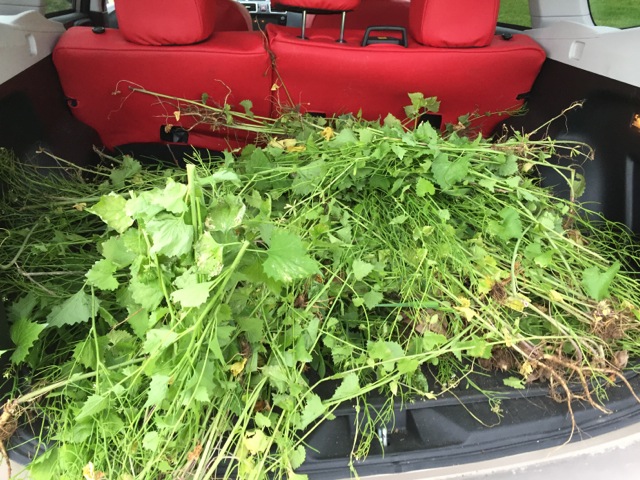

Now what? Head for home. Try to find time to burn the damn things. I drove, scanning the roadside. Another patch, this one three times the size! I growled and repeated the routine, adding to the batch in the back. The car stank of garlic. Now what? I had too much to burn. Take it home and bag it up? Lay it out in the sun to dry and burn it when I got home from Utah? I’d doubtless wind up introducing it to our forest in the process. What a mess.

I kept driving. And started praying that Randy would be out and about in his yard. He’d helped me last year when he saw me pulling and throwing. Though he’d never heard of garlic mustard, he understood what was needed immediately, and offered to load the plants in his truck, take them home and burn them for me. I rounded the curve and there he was, like a burly angel from heaven, only smoking a large blunt cigar. YAAAAY!!

“Remember last year when you burned some garlic mustard plants for me? Well, I’m baaack.” He smiled and pointed to his fire circle. “Load ‘em in there and I’ll burn ‘em for you.” I was only too happy to get the reeking pile out of my car. Randy looked at it and started for the shed. “Why don’t we  just build a fire and burn that right now?” He fetched a bag of refuse and lit it. It was going slowly.  I thanked him for taking the time to help. “I was going to burn anyway. I’m always burning.”
How kind of him.

“Right about now, my dad would go for the propellent,” I mused. “I was just thinking the same thing,” he said, and headed back to the shed, coming back with a jug of kerosene.


 I observed that it was a rare man who’d throw kero on a fire while smoking a large cigar. “Kerosene isn’t as much of a hazard as gasoline. It needs contact with an open flame.” Exactly what my dad would have said, I thought, a filmstrip playing in my head of the time my father, having lost some of his once excellent judgement to a brain aneurysm in 1989, spilled gasoline down his pants, then threw more on an open fire in our backyard. The flames leapt up his pant legs, and were just as quickly extinguished without doing much harm. But that image stays with me, the burning man who had once been a guy who wouldn’t have done that in a million years.


A man and his fire. If you live in the country, you need a place where you can burn stuff. I envied his setup—the sturdy stone wall especially. We have a rickety ring of stacked bricks that the deer keep knocking down in their quest for whatever it is they get out of ashes. It took awhile to get the plants all burned down, but I didn’t want to let a seedhead get by. I looked at my watch. Oh man. The time had flown. I’d been at this quest for two hours, and I had to leave for Utah the next day. I thanked Randy again, got in the car, and got about 200 yards down the road before I saw another patch of garlic mustard, bigger than the last two. The air went blue. I sighed, leapt the ditch, pulled it all—it was perilously close to going to riotous seed—and loaded it into the Subaru. Zick 3, garlic mustard, 0. I hoped. While I was pulling, a curious neighbor stopped to ask what I was doing. Never one to let a teaching moment go by, I showed her the plant, told her how to recognize its paltry white blossoms, and encouraged her to look for it and pull it wherever she saw it. It’s hard to convey to someone who may take them for granted how rare and precious such diverse wooded slopes are, and what a deadly threat garlic mustard poses, but I tried.


Randy watched me back up to the fire circle for the last time. “Didja miss me?” We repeated the dry wood and kerosene routine until the last plant went up in black smoke. It was starting to get dark. What a day it had been.

Best part? His last name is BURNWORTH.


There are those who say that, with massive introductions of exotic invasives worldwide, we have a global flora and fauna now; that it’s pointless to fight the Burmese pythons and the walking catfish, the Japanese honeysuckle or the water hyacinth. That we should just sit back and appreciate it all. It’s all natural, it’s all good. Well. I choose not to trade Duck Creek Road’s trillium, Dutchman’s britches, squirrel corn, hepatica, Jack in the pulpit, purple cress, dwarf larkspur, blue phlox and spring beauties for a solid stand of tall, gangly garlic mustard. I consider that a natural diversity holocaust, and I’m not scared to put in the work to prevent it. I’ll go farther, and say that you should care, too; that if you’re able, you should be pulling that crap wherever you find it, and disposing of it in a way that won’t spread it further. (Easier said than done). For me, choosing not to do anything is tantamount to watching a mugging in progress, shrugging and saying, “I guess he needs some money for drugs. Too bad for that person he’s robbing.” I can’t drive by the stuff, because I know what it’s up to. And neither should you.

Baby Bluebirds, Chickadee Eggs, Trashy Tree Swallows

Tuesday, May 19, 2015

4 comments

Still checking bluebird boxes on May 6. It was a big day, enough to make three posts out of it! And I love bringing you along. This stuff is just so cool, I have to share.

The Three Graces leaf out. I have been photographing them every time I pass. It's awesome to see the changes. 


Hendershot has four nice four-day-old bluebirds. I fool them into gaping by giving a little whistle. Easier to count them when they pop their heads up, as you shall see...


Driveway Mid has four two-day-old bluebirds. The hen seems to have removed a fifth, infertile egg. 
I have her down as having laid five, but poking down into the pile o' meat reveals nothing. Yes, they're hard to count. You kind of have to figure out what you're seeing each time you look into a box. You can't count heads, because you can't always see them. In this case, the chick at 6 o'clock in the lineup has its head under the chick at 9 o'clock, and the 12 o'clock chick has its wing over on the 1 o'clock chick and its head way over to 4 o'clock, and the 1 o'clock chick has its head tucked down. This makes me chuckle. But trust me, there are four chicks here in this sweet Celtic knot.


Here are some six-day-old bluebirds from my Old Studio box in our yard. They're smaller than the Warren #4 babies, though they're the same age. It's all about food. They're fine--the Warren babes are just abnormally fat and well-fed, being only three in number. You should see babies in a box where only one or two of the clutch hatches. Monsters!


There are some fun surprises in today's box check. Meadow Slot on our farm has E-Nor-Mous ten-day old bluebirds, five of them! Man, she got started early! Counting back, these hatched April 26, so she started incubating her clutch on April 12, meaning she started laying April 9. Whoo-ee. And I'm not feeding bluebirds this spring, either, so that tells me that Bill's mowing the meadow three times last season has improved the feeding grounds for our bluebirds. Or maybe she's just hot to trot. She'll have these fledged and be thinking about starting another nest while most are still feeding young in the box. The minimum turn around time for bluebirds from fledging a batch to starting the next clutch of eggs is about two weeks.


That's not very long. This amazing ebb and flow, and all the change and surprise in my bird boxes is is why I get so frustrated when I'm traveling and don't get around to check them at least once a week. All this wonderful stuff happens and I'm missing it. After running boxes since 1982, I still hate to miss a single little thing.

Surprises abound today. I had something start a moss and bark fiber nest in the meadow PVC box, and I thought it juuust might be a white-breasted nuthatch, since we keep seeing nuthatches perched out in the open on the snags we put up in the meadow. I was literally holding my breath. And then one day I came and found the nest all torn up, and tree swallows holding the territory. I was really disappointed, because nuthatch is my Holy Grail of baby birds I want to paint. I haven't had a nuthatch in a bluebird box since about 1984, in Connecticut, and it was on an old box that my landlord had nailed to a tree (bad, bad thing). And the babies were taken by a coon just before they fledged. Part of me has never gotten over that. And this is why you never, ever nail a nest box to a tree. 

So I was waiting with bated breath to see what would happen to this torn-up mossy nest--to see who built it. And it looked like the swallows had queered everything. 
Not so. 

For today, May 6, a Carolina chickadee bursts out of the box as I come up to it, and I find six precious little Carolina chickadee eggs in there! I can only guess that she had them hidden under the moss and they escaped the tree swallow's depredation. And she has prevailed! The tree swallows have moved to a wooden box nearby. Hooray!


It's a great year for chickadees on our place. Here's another nest in the garden box--an uncharacteristically late laying. This moss nest appeared overnight, and I think she's still laying as of May 6. We now have four active CACH nests with eggs, and another in the Oilwell box built, with no eggs. Not sure what's going on there. This is what makes checking such fun! This is the latest CACH egg laying I've ever had. Something must have happened to their first attempt. I find that chickadees are one-brood wonders, and they seem not to attempt nesting if it gets too late. It's one brood or nothing for them, at least in southern Ohio.


I am absolutely knocked over by the perfume coming in the windows from my heirloom lilacs. This is Aunt Lolly the Younger, who is heir apparent to the throne, as Aunt Lolly the Elder is slowly croaking in her shaded north exposure. I have to lop off one enormous trunk after another.  Hooray for The Younger! But I'm not counting The Elder out, no way. These are tough, tough plants. They really should be called tree lilacs--the biggest darn lilac I've ever seen.


 Up close. Swoon!


Bill for scale. Look at the size of those clusters! I planted this one about six years ago. It's headed for the top of the deck. I deliberately planted it where I could stand on the raised deck and someday swoosh my face in the blossoms. It will get that tall. I think I've found The Perfect Spot for it, don't you?

 Speaking of tall, I had to move Hibiscus "The Path" to the front porch. She was bumping her head on the ceiling of the greenhouse, and it's too hot in there now for anything but peppers and tomatoes. They love heat. My fuchsias, hibiscus and jasmines, not so much. Out they go!


One last surprise in the Meadow Wood box. Here's what tree swallows do when they can't find any nice white feathers for their nests. When they can't find any feathers at all. They use beech leaves, tinfoil, and cellophane. Awww. Poor little things. On a whim, I tore some feather-like strips from my bluebird notebook and let them fly on the breeze. The tree swallow who built this nest watched intently, its flat little head pivoting, as they fluttered by him. I'm betting they end up in his nest. Don't worry. I'm going out to buy them some goose feathers this afternoon.


Thus ends the box check. But it's never over, not until August. So there will be more babies to come!

Peeking Into Nests

Thursday, May 14, 2015

4 comments
Having left Duck Creek, we're going down Stanleyville Road.  It's still May 6, a whopper of a day checking all my bluebird boxes. Warren #1 has five brand-new hatchlings. It's hot, and they're panting as the sun pours in the front of their little slot box. They'll be fine. A bluebird baby has a resting body temperature of 104.


Warren #2 has five two-day-old baby bluebirds (below), also dumping heat through their mouths. It's such fun to find all my bluebird boxes "full of meat," as my Dad used to say. When I got into bluebirds upon moving to Connecticut right after college, I came home and put boxes up for him on the old farm where he kept his huuuge collection of antique cast iron hit-and-miss gasoline engines in a chicken house out west of town that he rented for a pittance. He loved having that place to go to, where Mom couldn't holler at him for bringing grease upstairs from the basement. So I put up four bluebird boxes there, and he called me a few weeks later and said, "When I checked my boxes every one of 'em was full of meat!" Ha ha ha ha ha. He had a way with words. I laugh just remembering that.


I'm sure without even checking that the farm and DOD's ramshackle chicken house have long been sold and rolled under by housing developments. I'm not going back to Richmond to look. If ever there were a place you can't go back to again, the horse and orchard country west of Richmond, Virginia, would be it. I'm glad it was largely intact when I was growing up, but seeing it fall to development changed me. Watching them smash the fragant pineywoods for Circuit City stores and bulldoze the horse pastures and orchards for giant megachurches when I was a teenager made me who I am today: a rural hermit with a ferocious love for the land and country living. Protective of the things I hold dear. Old barns, woodland, meadows, bluebirds, to name just a few.

Hm. I was checking bluebird boxes. Right. Back to it. Warren #3 still has eggs, which by my calculations should hatch May 7. I hold them to the sun--my way of candling them--and see dark embryo and large gas space in all five...looks good. They should all hatch. I'd like to show you that, but I can't hold the camera and an egg at the same time without fumbling and maybe breaking an egg. Bluebirds come first.

Warren # 4 got started early. These chicks are six days old already! Hmm. She laid five eggs--let's see what's under these rather high-sitting babes. I tease down into the pile and unearth two unhatched eggs.


 Two of the eggs haven't hatched, and they won't now. They're infertile. I remove them, carry them off to the asphalt road and break them to see if the embryo ever started. Nope. Just yellow slush in there. I see that a lot, but it's usually only one egg that fails to hatch. I always break them to check, because I'm curious, and there's no chance they'll hatch after the other chicks are a couple of days old, because they won't get the direct heat from the female's brood patch, and besides if they were viable they would already have hatched. So I get them out of there lest they break when the babies get old and start jumping around, and make a sticky mess in the nest.


Note how big and fat these three Day 6 chicks are. That's because Mom and Dad have fewer mouths to feed. 

That finishes Stanleyville's four boxes. Now I've got 13 more to check on our road and farm.

On my way there, I see a frog leaping, those huge, high, desperate leaps frogs do when they are in trouble. It's 11 AM on a hot, dry, sunny day, and this frog has come up from Fergus' pond, climbed a very steep hayfield hill, and is crossing the road into another enormous dry hayfield. There's no water where he's headed. I cannot imagine why he's doing this.


The creased lines running from eye to tail mean he's a green frog--a good guy. Not a bird-eater like bullfrogs. I cannot leave him on this dry ridge in this withering sun. I'm amazed how wet he still is, but it seems to be just his own slime keeping him moist. Has he leapt all the way up the hill?

I can't leave him here. He's headed to nowhere, frogwise. So I impulsively drop him in a Solo cup I keep in the car for just such things, and pour some cool water over him. And I head home. Once there, I dump him out on the rock by my water garden. I lost Raoul, my 20-something green frog, in the horrible winter of 2013, and I miss him badly. I hope this is my next Raoul. I have a giant bullfrog in the pond I need to rehome. I'm pretty sure this sizeable green frog is too big for the bull to eat, but you can never be sure with bullfrogs. Ugh. Bullfrogs. Click the link if you want to know why I say Ugh. Bullfrogs. 


The frog seems stunned and amazed to have been teleported. He's got his back hunchd defensively, and he's frozen. Gently, I nudge him with my finger to face him toward the pond, and in a single leap he knifes into the cool dark water. See you later?


More babies and surprises anon!


Checking the Bluebird Boxes

Wednesday, July 29, 2009

12 comments
Two weeks is a long time to leave one’s boxes in bluebird nesting season. Lots of things can happen while you’re gone. One of the last things I did before leaving for Trinidad was check the boxes, and checking them will be one of the first things I’ll do on getting home. Right now, I'm putting away food from our apres-vacation trip to Columbus' twin emporiums of foodie pleasure: Trader Joe's and Whole Foods. I'm also spraying scale-infested orchids, burning trash, taking stock of the (well-watered) gardens, emptying the dishwasher, sorting mail, hugging Chet Baker and kissing Charlie, smooching the kids, reading 305 emails, cleaning Charlie's room, trying to figure out what's for dinner, tracking the rotten smells in the fridge...you know the drill.

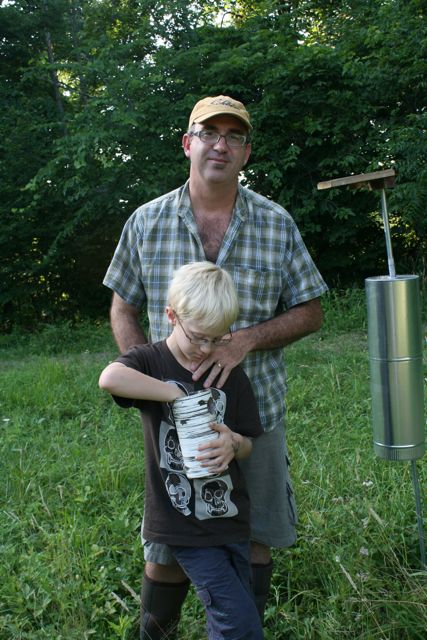
The kids usually come along when we check boxes. Here, Liam gently touches some nestling bluebirds before Daddy hangs the Gilbertson PVC box back up on its post.


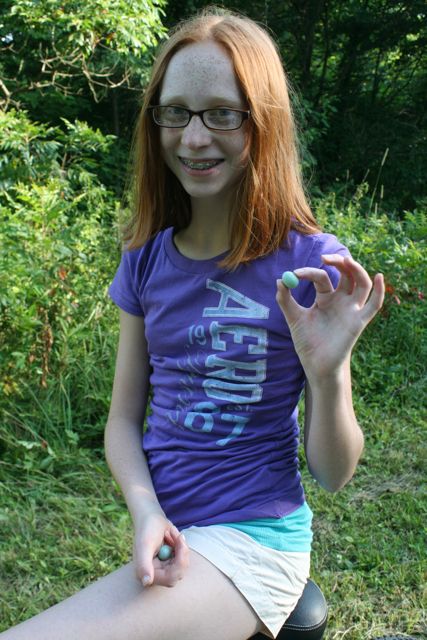
Sometimes one or more eggs don’t hatch, and when I’m sure there’s no hope that they will (after the other nestlings are three days old) I open them up to see what’s what. Almost always, they turn out to be infertile, and the embryo has never developed. Phoebe holds a couple of infertile eggs about to have theirselfs analyzed. She's working on her naturalist Vanna White chops.


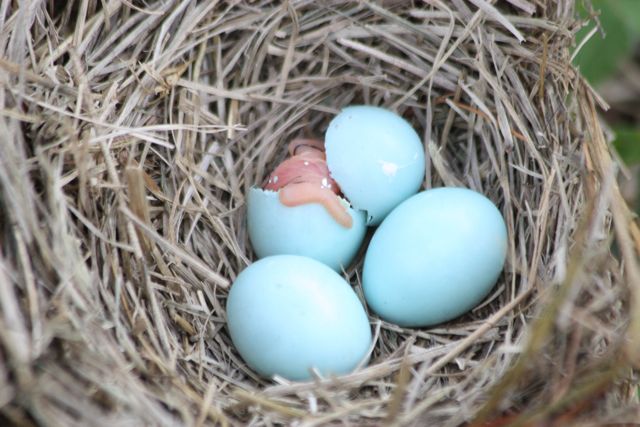
And then there are the eggs that do hatch. I love opening the box at just the moment of hatching.

A bluebird hatchling, having pipped and cut all around the big end of his egg prison, wears his shelltop like a helmet. Enh! Enh! I closed up the box and tiptoed away.


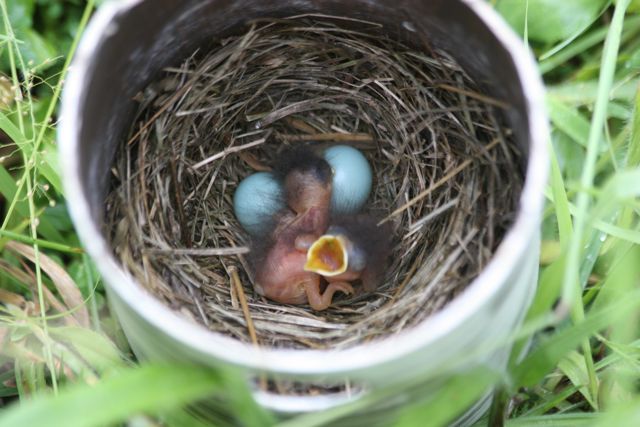
When they’re very young, nestlings think I’m Mom, and they beg for food at the slightest stimulus.


It’s good to be back, and see things like this again.


[Back to Top]