Background Switcher (Hidden)

Showing posts with label Campephilus woodpeckers. Show all posts

I Love a Spectacled Owl in the Morning!

Sunday, March 8, 2015

5 comments
Just across the road from Selva Verde Lodge is their botanical garden. Many, many treasures abound, botanical and bird. 

Cane orchid, world's tallest. Looks like a Dendrobium, but it grows right in the soil. Way over my head!

Lobster claw heliconia. The diversity of forms and colors in this family is delightful. The true flower is that yellow bit peeking out of the third claw down from the left. A succession of these flowers pokes out of the colorful, long-lasting bract, attracting hermit hummingbirds, with their decurved bills. 
Here's a green hermit, so you can see how its bill would fit right in that flower. Hermits are big and very cool, fast and flitty and severe-looking, with unearthly viridian green plumage.


Parrots are morning people. They fly over shrieking their species-specific shrieks just after sunrise. It behooves a birder to learn these shrieks, and once you get a handle on it, you can use the shriek and the size, shape and flight style to reliably identify speeding bird bombs high overhead. Getting a good photo of parrots is another story. I take probably 50 parrot photos for each one that's worth a darn. This one's worth a darn. Allopreening white crowned parrots (Pionis senilis) --get it? White hair? Old man?


A pair of pale-billed woodpeckers was double-rapping on a large hollow tree. What a thrill to hear the trademark knock of Campephilus woodpeckers. We all stood in awe, wishing imagining ourselves in a bayou somewhere in the States.


Pale-billeds are very short-tailed, and not nearly as massive as the ivory-bill, but still. 


Nearby, a pair of masked tityras croaked in a bare treetop. These cotingas sound like frogs and travel in pairs.


I walk with my head down, listening, looking at the ground. It's good to pair me with a guide who walks looking up, as Mario Cordoba does. We make quite a team. I miss flyovers. He picks them up. He misses mystery stomachs. I...well, I don't pick them up, but I see them.


A bunny met an untimely end. I saw its stomach (bottom center) and when I showed it to Mario, he showed me the rest of it (top right). I remarked that owls do that: surgically remove the stomach, which they won't eat, and then start eating from the head back. 

As we were looking at the crime scene, rufous motmots were growling and a variety of birds was scolding in the forested hillside just above us. Mario (who was looking up) spotted a large owl flying through the trees. Lightning fast, he set up the scope, and said, "Julie, you're gonna like this."


I did. I really, really liked it. A spectacled owl!!


Which was quite perturbed about being mobbed by motmots.


And which looked, as one of my Facebook friends said, like a stuffed version of itself. Some kind of avian Muppet. An amazement. And a gift on this misty clear morning as we were leaving Selva Verde.


We would go on to see many other things, but that owl stuck with me. In Brasil, they called it Carpintiero for its rapid, hollow, knocking hoot. They said it was building coffins. Love it.


This woman was cooking palm fruit (pejibaye) which is hanging in clusters over her head.


At our next stop this beautiful Brahma let me fondle her spotty brisket. I needed an animal fix of some kind, and she was kind enough to oblige. A good day in the making.


Ivory-billed Birds

Sunday, March 23, 2008

9 comments
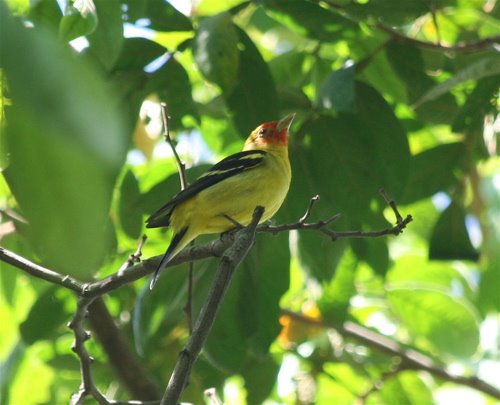
Thanks to the lush plantings, small clearings, hummingbird and fruit feeders that are carefully maintained, birds are EVERYWHERE at Los Tarrales. You can idle away hours in the garden, watching tanagers, orioles, thrushes, honeycreepers and even great fruit bats feeding at the bananas and grapefruit that are put out each morning for their enjoyment. It makes you want to run home and put oranges, grapefruit and bananas out for orioles. Except that they're still in Guatemala. But it is cool to think that our Baltimore orioles will recognize tropical fruits, because they might have encountered them on the wintering grounds. Western tanagers are everywhere. Here's a nice male, coming into spring plumage; i.e. getting an orange head:
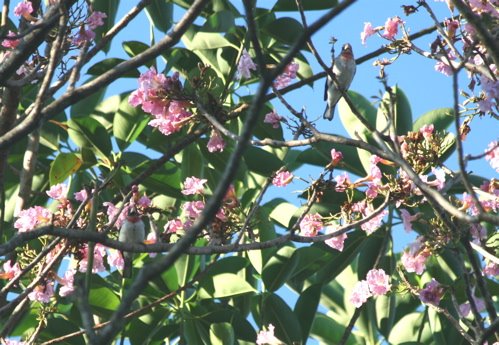
Los Tarrales has some special birds, endemics that are found only in a limited area. The blue-tailed hummingbird is one. This is a lousy picture, but you can tell what it is, and get a hint of its beauty in better light. One of my favorite shots from Los Tarrales is this pair of male rose-breasted grosbeaks in a flowering tree. It's hard to find them, but they look so fine in that setting! (You have to know how frustrating it is for a Science Chimp to have to describe any plant as "a flowering tree.") Agghhh. Eee. Eee. They'll be at our feeders before you know it. I noticed that most of the male rose-breasts in Guatemala had very pale pink cravats. Perhaps some white feather edges have to wear off before they will be in full spring finery.

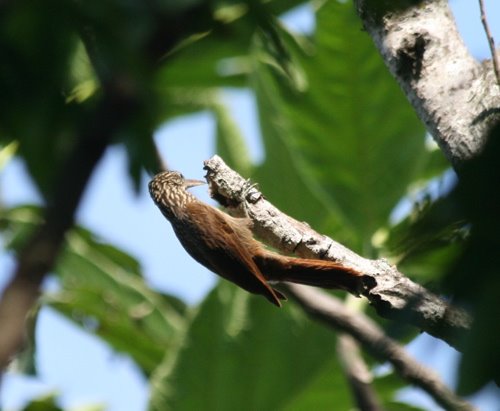
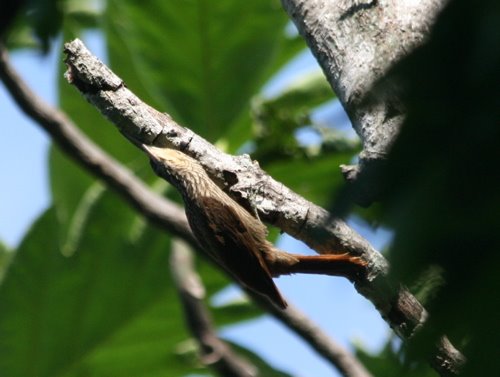
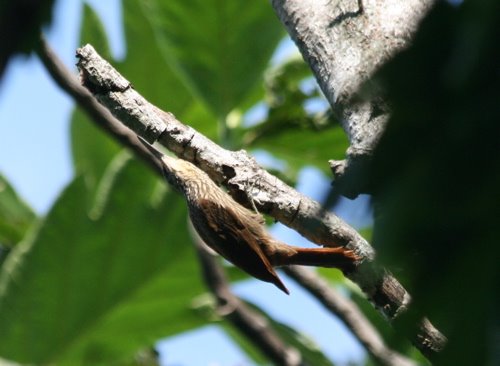
Woodcreepers are part of a large Neotropical family called the Dendrocolaptidae.  Most are variations on a theme of burnt sienna. Many have spine-tipped tails, like woodpeckers, but they're not generally as robustly built as woodpeckers, since they tend to probe and glean rather than hammer for their food. They're tame and easy to spot as they work the bark, mosses and epiphytes on forest tree trunks. One of the commonest is the ivory-billed woodcreeper, a nice hearty bird with a spine-tingling name. Long, flexible necks and a slightly decurved bill allow this IBWC to probe into forgotten crevices, looking for insect and invertebrate prey. It's always surprising to see the positions a bird can get into when it's foraging. If you're used to our robust woodpeckers, woodcreepers look kind of willowy and gracile in comparison, with fine legs, toes and bills, and soft fluffy plumage.
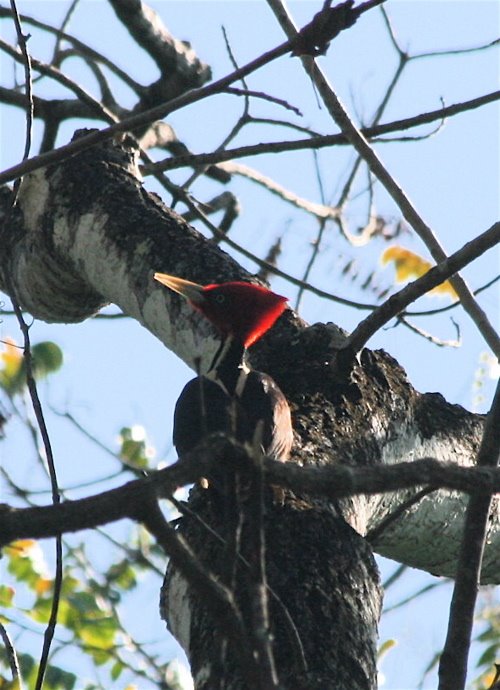
And speaking of ivory-bills, here is the tropical Campephilus that always raises the hair on the back of my neck with its double-raps and yapping calls--the pale-billed woodpecker. Ba-DOCK! Yip yip yip yip! I guess "Ivory-billed woodpecker" was already taken. I shot photo after photo as it hitched up the tree, its massive bill and flaming crest backlit by morning sun. Would that our Campephilus were so cooperative, but who can blame it for shunning the company of man?

I got an e-mailed response from Dr. Stephanie Doucet, Asst. Professor of Biology at the University of Windsor, Ontario, who answered from her field station in Costa Rica. I asked her about tail molt in long-tailed manakins. I was kind of embarrassed to have to ask her, because the manakin painting I showed you was on the cover of the issue of The Auk (the journal of the American Ornithologists' Union) that featured her awesome article about...molt in long-tailed manakins. As the cover artist, I was provided a copy, and I can't find it; it's probably swallowed in the bowels of my big wooden flatfile. Duh. She sent me a copy of her article, which is absolutely fascinating; she mist-netted and color-banded  1,315 long-tailed manakins to figure out what was going on with their plumage development. It takes young males FIVE YEARS to come into definitive adult plumage! And she figured out how to tell exactly how old a manakin was, up to age five, by its plumage. Obviously, manakins can tell, too, and the social implications of wearing your age like a badge are multitude. It all plays into that odd lek-based mating system, where social rank and age determine whether a bird can pass on its genes. Anyway, Stephanie was kind enough to write to say:

In answer to your question, they re-grow their central rectrices (tail feathers) each year,
and as they go from juvenal plumage to definitive adult plumage, their tails get longer every year.

So Katdoc, you were right--the older males just shed their feathers, then grow a new longer tail every year, like an older buck growing a new set of big antlers each summer. Think about that--I'm thrilled to see five or six manakins, and Dr. Doucet has banded over a thousand of them, keeping records on each one. There's interesting, and then there's amazing.

Hope you had a wonderful Easter. We did. Church, communion for 400? zzzzzz, two egg hunts, lamb gravy.

Liam: I LOVE that lamb gravy! Can I put it on my asparagus?
Me: Sure. Knock yourself out.
Liam: Suddenly, it doesn't look so appetizing.

Last night he said his bed didn't look so sleepitizing to him. That's my boy.

[Back to Top]